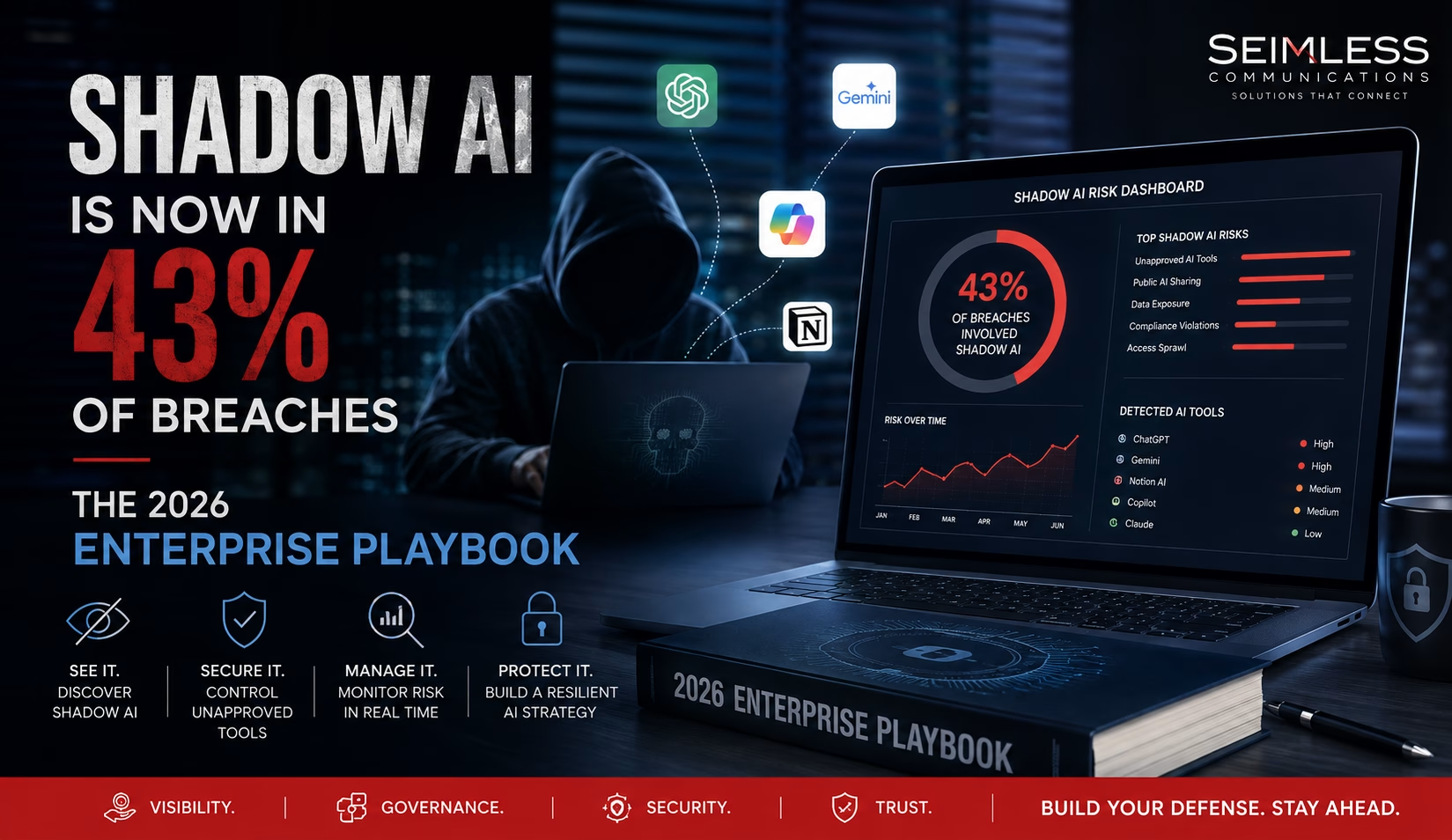
Shadow AI has become the fastest-growing security gap in the enterprise, and the 2026 numbers finally make the scale of it undeniable. IBM’s latest breach research puts unsanctioned AI tools inside 43% of security incidents. That figure more than doubled in a single year. Meanwhile, most organizations still have no process for approving, tracking, or revoking the AI tools their own employees use every day.
This is not a story about reckless staff. It is a story about a control gap. People adopt AI because it makes their work faster, and they reach for whatever tool is nearest when the sanctioned option does not exist. At ibm/SEIMless, we have watched the same pattern play out with cloud storage, then with messaging apps, and now with AI. The lesson repeats: you cannot secure what you have not inventoried.
This guide covers what shadow AI is, what the current data actually says, how it leaks information, what regulators now expect, and a practical program you can start this quarter.
What Shadow AI Actually Is, and What It Is Not
Shadow AI describes any artificial intelligence tool, model, agent, or AI-enabled feature that touches company data without security review, procurement approval, or governance oversight.
The definition sounds narrow. In practice it is very wide, because AI now arrives through four separate doors, and only one of them looks like a purchase.
The Four Faces of Shadow AI
Consumer chatbots on personal accounts. An analyst pastes a customer list into a free chatbot to reformat it. No contract governs that data. No log records the transfer.
AI features quietly added to approved software. Your sanctioned CRM ships an AI summarizer in a routine update. Nobody reviewed it, yet it now reads every record. This is the category most teams miss entirely.
Employee-built automations and agents. A finance lead wires an AI agent to a spreadsheet and an email inbox. The agent holds credentials, and no one has scoped them.
Browser extensions and plugins. Free extensions read page content by design. On an internal application, that means they read your data.
Notice what unites all four. None involves malice, and none triggers a purchase order. Consequently, none reaches the security team through the usual channels. Our post on how LLMs will improve network security explains the upside of AI in the enterprise; shadow AI is simply that same technology arriving without the guardrails.
The 2026 Numbers: Shadow AI Moved From Edge Case to Norm
The evidence base changed sharply this year. Three major studies now measure shadow AI directly rather than treating it as an anecdote.
IBM’s Cost of a Data Breach Report 2026, published on 29 July 2026, studied 602 breached organizations across 17 industries and 16 countries. It found shadow AI involved in 43% of incidents, up from roughly one in five the previous year. Furthermore, more than two-thirds of those organizations had no governance process to limit unauthorized AI deployment.
The same report puts the global average breach cost at $4.99 million, a 12% jump and an all-time high. AI-driven attacks rose 56%, led by deepfake impersonation and AI-enabled malware.
Netskope’s AI Report 2026 adds the usage picture. Only 56% of workplace AI users stay entirely inside organization-managed applications. Another 14% mix managed and personal tools, while 30% use personal accounts exclusively. In other words, nearly half of AI activity sits partly or wholly outside company control.
Verizon’s 2026 Data Breach Investigations Report rounds out the threat side. It reports that 15% of attack techniques are now bolstered by generative AI, and that 31% of breaches begin with software vulnerabilities, which have overtaken stolen credentials as the leading entry point.
What Shadow AI Costs When It Goes Wrong
Cost data from IBM’s earlier baseline research is the clearest picture available of shadow AI’s financial tail.
Breaches linked to shadow AI added as much as $670,000 to the average incident cost. Nearly two-thirds of those breaches exposed customer personally identifiable information. Intellectual property proved the most expensive category, at $178 per record.
One statistic stands out above the rest. Among organizations that suffered an AI-related breach, 97% lacked proper AI access controls. That is not a technology failure. That is an identity and permissions failure, and it is fixable.
Why the Governance Gap Persists
Ask any CISO why the gap exists and you get the same three answers.
First, procurement never sees the tool, because free tiers require no purchase. Second, network monitoring often misses it, since traffic to a major AI provider looks identical to ordinary web browsing. Third, and most importantly, the sanctioned alternative is either slower, worse, or missing altogether.
That third reason matters most. Employees do not route around controls for fun. They route around controls that cost them time.
Shadow AI Is Not Just Shadow IT With a New Name
Security teams reach for the shadow IT playbook first, and that instinct is only half right. The discovery methods transfer well. The remediation methods do not.
Shadow IT moved data to an unapproved location. You could usually find the file, delete it, and close the ticket. Shadow AI behaves differently in three ways that matter.
The data may not come back. A prompt sent to a consumer service can be retained, reviewed by humans, or used to improve a model. Deleting your local copy changes nothing about the copy that already left.
The exposure compounds over time. Model memorization means a snippet submitted today can surface in an output months later. Traditional shadow IT exposure was static, whereas this exposure has a long tail.
The tool acts on your behalf. An unapproved file-sharing service stored things. An unapproved AI agent authenticates, queries, writes, and sends. Therefore the blast radius is defined by permissions rather than by storage.
There is a fourth difference that is easy to miss. Shadow IT was mostly invisible to the vendor whose product it displaced, while shadow AI often arrives *from* the vendors you already trust. When a licensed application adds an AI assistant in a routine release, the shadow appears inside your approved estate. Our post on the five major impacts of machine learning models on data security covers that dynamic in more depth.
How Shadow AI Actually Leaks Enterprise Data
Understanding the mechanics helps you choose the right control. Shadow AI leaks data through five distinct channels, and each one needs a different answer.
Prompt-Side Leakage
This is the obvious one. A user pastes source code, a contract, a patient record, or a credential into a prompt. The data leaves your perimeter instantly.
Volume tells the story here. Netskope’s Cloud and Threat Report 2026 found that data sent to SaaS generative AI apps grew sixfold in a year, from roughly 3,000 to 18,000 prompts per month in the median organization. Around 3% of AI users generate an average of 223 data policy violations each month.
The Personal Account Problem
Enterprise AI agreements typically promise that your prompts will not train the vendor’s models. Consumer accounts frequently promise the opposite, or say nothing at all.
Encouragingly, the trend is improving. Infosecurity Magazine reported that personal-account usage among workplace AI users fell from 78% to 47% across a single year. Nevertheless, 47% is still nearly half your workforce operating outside contractual protection.
Agentic AI and MCP Widen the Channel
Chatbots read what you paste. Agents read what they can reach, which is a much larger set.
Netskope recorded downstream data policy violations doubling from 12 to 31 per week in the median organization, with top-quartile organizations climbing from 72 to 206. The report attributes that growth to agentic AI and to a fourfold increase in Model Context Protocol traffic. We covered the security implications of autonomous agents in our analysis of the agentic AI vulnerability exposed in ServiceNow and the malicious npm package that stole files from an AI user directory.
Model Inversion and Memorization
The subtlest channel runs in reverse. Attackers query a model to reconstruct the data it was trained or fine-tuned on.
NIST’s Generative AI Profile, AI 600-1, names data memorization explicitly, warning that models can leak, generate, or infer sensitive information about individuals. IBM prices the average model inversion breach at $6 million — higher than a conventional breach, because the exposed asset is usually the training corpus itself.
Third-Party and Supply Chain Exposure
The fifth channel is not yours at all. Your vendors, contractors, and managed providers use AI too, and their shadow AI becomes your exposure the moment they touch your data.
Consider a design partner summarizing your specifications in a consumer chatbot, or an outsourced support team pasting customer tickets into a free translator. No control you deploy internally will catch either one. Only contract language and vendor assessment will.
Third-party risk already dominates breach reporting, and AI widens it. Our coverage of the Ericsson service provider breach and the GlassWorm supply chain takedown shows how quickly a partner’s weakness becomes your incident. Add AI clauses to your standard agreements now, before renewal cycles make it awkward.
The Compliance Clock Is Already Running
Regulation caught up with shadow AI faster than most enterprises expected, and one date in particular lands this month.
Under the EU AI Act implementation timeline, most remaining provisions of the Act began applying on 2 August 2026. Member states must now maintain at least one national AI regulatory sandbox. A further milestone follows on 2 August 2027, when Article 6(1) obligations and legacy general-purpose model compliance take effect. If you process EU data or serve EU customers, ungoverned AI is no longer only a security problem.
Three frameworks now define what “reasonable care” looks like, and auditors increasingly expect at least one.
- NIST AI Risk Management Framework, built on four functions: Govern, Map, Measure and Manage.
- ISO/IEC 42001, the certifiable AI management system standard, published in December 2023.
- NIST Cybersecurity Framework 2.0, which added a Govern function that maps neatly onto AI oversight.
For the threat side, OWASP’s GenAI LLM Top 10 for 2026, released on 3 August 2026, and the companion Top 10 for Agentic Applications give engineering teams a concrete checklist. MITRE ATLAS supplies the adversary tactics catalogue, while CISA’s artificial intelligence resources and the UK NCSC machine learning principles translate all of it into operational guidance.
Why Blocking Shadow AI Never Works
Every organization tries the block first. Almost every organization abandons it within two quarters.
The reason is simple. Blocking a domain does not remove the need that drove the employee there. It relocates the activity to a phone, a home laptop, or a personal browser profile, where you have no visibility at all. Consequently, you trade a monitored risk for an invisible one.
The World Economic Forum’s Global Cybersecurity Outlook 2026 frames the same tension at a macro level, describing accelerating AI adoption alongside widening capability gaps. Stanford HAI’s AI Index puts it more bluntly still, documenting a widening gap between what AI can do and how prepared organizations are to manage it.
So the goal is not zero AI. The goal is zero ungoverned AI. Those are very different targets, and only one of them is achievable.
A Seven-Step Shadow AI Governance Program
Here is the sequence we use with clients. It works because it starts with visibility and ends with an alternative, rather than starting with a ban.
- Discover before you decide. Inventory AI usage from egress logs, SaaS management tooling, browser extension reports, and expense data. Include AI features inside tools you already own, since that category hides the most exposure.
- Classify by data sensitivity, not by tool popularity. A niche tool touching patient records outranks a popular one touching marketing copy. Rank by what the tool can reach.
- Fix access controls first. Recall that 97% of AI-related breaches involved missing access controls. Scope every AI integration to least privilege, use short-lived credentials, and log every call. Our zero trust content security approach applies directly.
- Publish a short, readable AI policy. Two pages beats twenty. State clearly what data may go into which tier of tool, name the approved options, and explain the approval route. A policy nobody reads governs nothing.
Steps Five to Seven: Replace, Monitor, Repeat
- Provide a genuinely good sanctioned option. This is the step that actually reduces shadow AI. If the approved tool is slower or weaker than the free one, employees will keep choosing the free one. Our Microsoft SaaS and DaaS and security as a service practices exist to close that quality gap.
- Monitor prompts and outputs, not just domains. Domain blocking sees destinations. Content inspection sees data. Pair data loss prevention with Exodus ARIA ADR, endpoint detection and response and Exodus Transparent Encryption.
- Re-run discovery every quarter. Shadow AI is not a project with an end date. New tools appear weekly, and vendors add AI features to existing products constantly.
For the infrastructure underneath this program, see our guides to enterprise IT infrastructure services and next-gen network security solutions.
What Good Looks Like in the First 90 Days
Programs stall when the first milestone is too far away, so keep the opening quarter deliberately small.
In weeks one to three, run discovery and produce a single list of every AI tool touching company data. Do not judge anything yet. Completeness matters far more than accuracy at this stage.
In weeks four to six, fix access controls on the ten highest-risk integrations. Scope permissions down, rotate long-lived credentials, and turn on logging. This is the step that moves the risk number most.
In weeks seven to nine, publish the two-page policy and name the approved tools. Announce it in plain language, and explain the approval path in a single sentence.
In weeks ten to twelve, stand up monitoring and book the next discovery run. Then report to leadership using one number: the share of AI usage now inside governed channels.
That final metric is the one worth tracking every quarter. It rises as your program works, and unlike breach counts, it does not require something to go wrong before it tells you anything.
Five Questions to Put to Every AI Vendor
Procurement language is your cheapest control, and these five questions surface most of what matters.
- Do you train on our data by default, and can we contractually opt out? Get the answer in the contract, not in a marketing page.
- What is your data retention period, and can we set it to zero? Retention you cannot configure is retention you cannot govern.
- Which sub-processors see our data, and where do they operate? This drives your residency and EU AI Act position.
- How do you scope and log agent permissions? If the answer is vague, assume the permissions are broad.
- Will you support post-quantum key exchange, and on what timeline? Data captured today stays readable later, a point we cover in Harvest Now, Decrypt Later.
Ask these of your existing vendors too, not only new ones. Most AI functionality in your estate arrived through renewals rather than through fresh procurement.
Shadow AI Risk by Sector
Exposure varies with the data you hold and the rules you answer to.
Healthcare. Protected health information pasted into a consumer chatbot is a reportable disclosure in most jurisdictions. Clinical staff face heavy documentation loads, so the pull toward AI summarization is strong. Sanctioned tooling matters more here than anywhere else.
Financial services. Model risk management already governs algorithms in this sector, and shadow AI sits squarely outside it. Add customer PII exposure and the audit questions get pointed quickly. Our look at why big cybersecurity budgets still fail covers the spending-versus-control mismatch.
Manufacturing and engineering. Intellectual property carries the highest per-record cost in shadow AI breaches. A single design document in a prompt can outweigh a year of security spending. Third-party exposure compounds it, as the Ericsson service provider breach showed.
Legal and professional services. Privilege does not survive a prompt sent to an unvetted third party. Client confidentiality obligations make this the sharpest risk of all.
Public sector and defense suppliers. Procurement rules increasingly require documented AI governance. Our reporting on the Pentagon’s supply-chain risk designation for an AI vendor shows how fast that scrutiny is tightening.
How ibm/SEIMless Helps Enterprises Govern Shadow AI
We are vendor-agnostic by design, and since 2001 we have selected technology on fit rather than on partnership incentives. With every vendor now claiming AI governance capability, that independence matters more than it used to.
Shadow AI is fundamentally a visibility and identity problem, so we treat it as a network problem. Discovery runs across your wide area network, SD-WAN and business class internet egress points. Enforcement runs through Exodus NxtGen Firewall, zero trust content security and EDR.
Data protection layers underneath. Exodus Transparent Encryption and our Exodus Quantum-Resistant Networking portfolio protect data at rest and data in motion, while Exodus Key Management tracks the credentials your AI integrations depend on.
Finally, the sanctioned alternative has to be good. Our cloud services, Microsoft Azure, telecom services and document management practices give employees capable approved tooling, which is the only durable way to shrink the shadow.
Frequently Asked Questions
What is shadow AI in simple terms?
Shadow AI is any AI tool, model, agent, or AI feature that handles company data without security review or approval. It includes consumer chatbots, employee-built agents, browser extensions, and AI features switched on inside software you already license.
How common is shadow AI in 2026?
IBM found shadow AI involved in 43% of studied security incidents in its 2026 report, more than double the prior year. Separately, Netskope found that 44% of workplace AI users touch personal, unmanaged AI applications.
Is shadow AI worse than shadow IT was?
In one respect, yes. Shadow IT typically moved data to an unapproved location, whereas shadow AI can move data into a system that may retain it, learn from it, or expose it through later queries. The data does not simply sit somewhere new.
Can we just block AI tools at the firewall?
Blocking alone rarely works. Employees move the activity to personal devices where you have no visibility, so you exchange a monitored risk for an invisible one. Discovery plus a good sanctioned alternative outperforms blocking every time.
What does the EU AI Act require from us?
Most remaining provisions of the Act began applying on 2 August 2026, with further obligations arriving on 2 August 2027. If you handle EU data, you need documented AI inventories, risk classification, and oversight.
Where should we start if we have done nothing yet?
Run discovery, fix AI access controls, and publish a two-page policy. Those three steps take weeks rather than quarters and remove most of the immediate exposure.
The Bottom Line
Shadow AI is not a passing phase, and it will not resolve itself. Adoption is running ahead of governance in almost every organization, and the 2026 data now prices that gap precisely: 43% of incidents, a record $4.99 million average breach cost, and 97% of AI-related breaches traced to missing access controls.
The organizations that handle this well are not the ones with the strictest policies. They are the ones that see what is running, control what it can reach, and give people an approved tool worth using. Visibility first, identity second, alternatives third.
Ready to find out what is actually running on your network? Get started with ibm/SEIMless or contact our team for a shadow AI discovery and governance assessment. You can also review our reports, browse our partners, read the FAQs, or explore distributor opportunities.
Further Reading: 20 Authoritative Sources
- Cost of a Data Breach Report 2026 — IBM
- Cost of a Data Breach: Shadow AI and Governance Findings — IBM Think
- Data Breach Investigations Report 2026 — Verizon Business
- As Data Breaches Grow Costlier, Ungoverned AI Creates New Risks — Cybersecurity Dive
- Netskope AI Report 2026 — Netskope Threat Labs
- Gen AI Data Violations More Than Double — Help Net Security
- Personal LLM Accounts Drive Shadow AI Data Leak Risks — Infosecurity Magazine
- AI Risk Management Framework — NIST
- AI RMF Generative AI Profile, NIST AI 600-1 — NIST
- Cybersecurity Framework 2.0 — NIST
- ISO/IEC 42001 Artificial Intelligence Management System — ISO
- EU AI Act Implementation Timeline — EU AI Act
- OWASP GenAI LLM Top 10 2026 — OWASP GenAI Security Project
- OWASP Top 10 for Agentic Applications 2026 — OWASP GenAI Security Project
- MITRE ATLAS — MITRE
- Artificial Intelligence Resources — CISA
- Machine Learning Principles — UK National Cyber Security Centre
- AI Safety Working Group — Cloud Security Alliance
- Global Cybersecurity Outlook 2026 — World Economic Forum
- AI Index Report — Stanford HAI
Complete ibm/SEIMless Resource Index
Quantum-Resistant Networking
- Exodus Quantum-Resistant Networking
- Quantum Computing and Encryption
- Exodus Key Management
- Data at Rest
- Data in Motion
- QR-Edge
- Exodus PIET
NxT-Gen Network Security Solutions
- NxT-Gen Network Security Solutions
- Exodus ARIA ADR
- Exodus Transparent Encryption
- Exodus NxtGen Firewall
- Zero Trust Content Security
- EDR — Endpoint Detection and Response
- Managed WAN Optimization
- Business Class Internet Access
- Ethernet Services
- Amazon Web Services
Wide Area Networking and Connectivity
- SD-WAN
- MPLS Replacement Solutions
- MPLS Service
- Ethernet Service
- Private Line
- Wavelength Services
- Dark Fiber Services
- SONET
- Wireless Network
- Global Access Options
- Cabling and Infrastructure
Cloud Services
- Cloud Services
- Microsoft Azure
- Amazon Web Services
- Google Cloud
- Private and Hybrid Cloud
- Cloud Telephony
- Back-Up and Recovery
- IBM i Series, PureFlex and AS/400 Migrations
- IBM i Series High Availability
Microsoft SaaS and DaaS
- Microsoft SaaS / DaaS
- Office 365 and Teams
- Microsoft SharePoint
- Microsoft Dynamics
- SaaS — Security as a Service
- DaaS — Desktop as a Service
- IaaS — Infrastructure as a Service
Telecom and PBX Services
- Telecom Services
- UCaaS — Unified Communications as a Service
- CCaaS — Call Center as a Service
- Hosted Telecom
- Cloud-Based Telephony
- Premise-Based Telephony
- POTS, PRI, ARD and SIP
- PBX Services
- PBX Installations
- PBX Repair
Document Management
Company Pages
- Home
- About Us
- Services
- Our Partners
- Distributors
- FAQs
- Reports
- Blog
- Contact Us
- Get Started
- Challenge: A Single Accurate View of Telecom Assets and Expenses
- Privacy Policy
Blog Categories
- Blog
- Cybersecurity
- Document Management
- Enterprise Technology
- Next-Gen Security Solutions
- PBX
- Public and Private Cloud
- QRN
- SEIMless
- Telecom
- WAN
- Wide Area Networking
All Blog Posts: Quantum and Post-Quantum
- Harvest Now, Decrypt Later: Why 2026 Is the Year Every Enterprise Must Move to Quantum-Resistant Networking
- Post-Quantum Cryptography Migration: The 2026 Enterprise Playbook for Quantum-Safe Networks
- How Quantum Computing Is Reshaping Enterprise Cybersecurity Strategies
- The Future of Enterprise Security: Why Quantum-Resistant Networking Is Becoming a Business Necessity
- How Quantum Computers Break Encryption: Shor’s Algorithm Explained
- S. Lawmakers Urge Action on Cybersecurity in Face of Quantum Threat
- The Quantum Encryption Apocalypse Is Closer Than You Think, Scientists Say
- EXODUS QRN – Data at Rest: Securing Mission-Critical Information in the Quantum Era
- Exodus QRN: Quantum-Resistant Network Infrastructure for the Post-Quantum Era
- Future-Proof Communications with ibm/SEIMless: Secure, Scalable and Quantum-Resistant Solutions
- The Impact of Quantum Computing on Modern Security Protocols Like IPsec: 5 Areas of Concern
- IBM Shares Climb After Unveiling Quantum Networking Partnership with Cisco
- Microsoft Enters Quantum Space
- The Road to Quantum Supremacy
- The Merger of Quantum Computing and AI
- Exploring the Impact of Quantum Networking on Cybersecurity
- Can IT Services Support Quantum-Resistant Networks?
- Unlocking the Potential of Quantum Networks for Secure Communication
- Why Microsoft 365 Is Essential in the Quantum Networking Era
- Why PIET Over MPLS and MACsec
All Blog Posts: Cybersecurity and Threat Intelligence
- GlassWorm Malware Takedown Disrupts Developer Supply Chain Attack Infrastructure
- Malicious npm Package Stole Files From Claude AI User Directory via GitHub
- Making Vulnerable Drivers Exploitable Without Hardware — The BYOVD Perspective
- Microsoft Patches 138 Vulnerabilities, Including DNS and Netlogon RCE Flaws
- Ericsson US Discloses Data Breach After Service Provider Hack
- CISA Adds Actively Exploited ConnectWise and Windows Flaws to KEV
- New Python Backdoor Uses Tunneling Service to Steal Browser and Cloud Credentials
- Interlock Ransomware Exploits Cisco FMC Zero-Day CVE-2026-20131 for Root Access
- Ubuntu CVE-2026-3888: Critical systemd Vulnerability Enables Root Access Exploit
- Hackers Use Fake Resumes to Steal Enterprise Credentials and Deploy Crypto Miner
- Agentic AI Security Vulnerability in ServiceNow Exposed
- Dozens of Major Data Breaches Linked to Single Threat Actor
- Critical 9.8 Fortinet Flaw from 2020 Actively Exploited
- Massive Data Breach Sees Credit Card Details of Over 5.6 Million Victims Leaked
- Cyberattack Cripples Japan’s Beverage Giant Asahi
- Why Big Cybersecurity Budgets Still Fail: Lessons from the UNFI Breach
- United Healthcare’s Change Healthcare Hack
- Cybersecurity Challenges This Week
- All Android Owners Warned Not to Ignore Latest Free Software Update
- Consumers Lost $12.5 Billion to Fraud Last Year, and AI-Powered Scams Are Set to Explode in 2026
- AT&T Customers Can Receive Up to $7,500 in $17M Data Breach Settlement
- Choosing the Best Endpoint Detection System for Your Organization in 2025
- The 5 Major Impacts of Machine Learning Models on Data Security
- AI Leading Next Generation of Defense
- CIOs Rethinking Their Cloud Strategies After CrowdStrike Failure
- The Dangers of System Collapse: An In-Depth Analysis
- What Is Zero Trust?
- The Future of Network Security
- Is Your MPLS Traffic Safe?
- 7 Key Benefits of Transitioning to Secure Networks
- 8 Essential Tips for Secure Inventory Management in the Digital Age
All Blog Posts: Networking, Infrastructure and Managed Services
- Enterprise IT Infrastructure Services: Building Secure, Cloud-Ready, Quantum-Resistant Networks
- Today’s Software-Defined Networks Are Not Future-Ready: Why Enterprises Must Modernize Now
- Next-Gen Network Security Solutions: Future-Proof Your Enterprise Against Modern Cyber Threats
- Cloud Infrastructure Services: Building a Secure, Scalable and Future-Ready Business
- Managed IT Services: The Foundation of Modern Business Success
- Managed Telecom Services New York: Simplify Communications with ibm/SEIMless
- Microsoft Azure: Enterprise Cloud Built for Security, Scale and Innovation
- Exodus-Wide Area Networking: Redefining Connectivity Across the USA
- SD-WAN Not Ready for Next Generation Attacks
- Why the Approach to AIOps Must Change as It Looks Towards SD-WAN
- MPLS: Secure, Unsecure — You Decide?
- Modernizing Cabling and Infrastructure
- Choosing the Right Hosting and Co-Location Solution for Your Business
- Choosing the Right Unified Communications Solution for Your Organization
- What Makes a Call Center Solution Effective?
- The Impact of Microsoft Teams Voice on the UCaaS Market and the Future of Collaboration
- Need Help Building a Custom Network Strategy or Evaluating ISPs for an RFP?
- Ready to Evaluate ERP Systems or Compare Platforms in a Live Business Case?
- The Transformative Impact of Fax to Mail, Electronic Signatures and Workflow Automation in 2025
- Telecoms in the United States: Statistics and Facts
- Verizon Outage Is ‘Resolved’: What Happened and What Comes Next
- AT&T 911 Outage Disrupts Emergency Services Across Three States
- Amazon Finds Fix for Huge Internet Blackout, but Reddit Is Now Down
- Wide Area Networking in 2026
- AWS Outage Reveals Critical Lack of Redundancy and Proper ACLs
- The Future of Telecom Services in 2025
- The Future of PBX Services in 2025: Transforming Business Communication
- The Future of Cloud Computing in 2025
- The Future of Cloud Services in 2025
- Public vs Private Cloud Storage Services in 2025
- Microsoft SaaS and DaaS in 2025
- Microsoft 365 Integration Tips
- Enterprise Technology Management Services in 2025
- 10 Reasons Why IT Services Are Crucial for Modern Enterprises
All Blog Posts: Barcode, Inventory and Data Operations
- A Beginner’s Guide to Integrating Barcode Tracking with Advanced Networks
- Exploring Barcode Solutions in Financial and Healthcare Sectors
- Exploring the Benefits of Barcode Solutions for Multi-Nationals
- What Are Common Challenges in Inventory Management?
All Blog Posts: AI, Cloud and Industry Analysis
- AI-Native Networks: The Future of Telecommunications
- How LLMs Will Improve Network Security in SMB, Mid-Market and Enterprise Networks
- Pentagon Formally Designates Anthropic a Supply-Chain Risk
- Anthropic Teams Up with Major Wall Street Players
- Anthropic Won’t Let You Run Mythos. But Claude Is Already in Your Salesforce
- When the AI Pushes Back: What Anthropic’s Alleged Incident Reveals About AI Governance
- FTC Investigates AI Companions: A Turning Point for Emotional AI Regulation
- Meta Is Planning a Cloud Business to Sell AI Computing Power
- Meta to Cut Up to 30% of Metaverse Budget
- OpenAI Hits $500 Billion Valuation: A New Benchmark in AI Innovation
- OpenAI’s Secret AI Device: A Bold Vision Facing Real-World Challenges
- OpenAI to Remain Nonprofit as Company Seeks to Manage External Pressures
- OpenAI and Elon Musk: The Saga Continues
- xAI Sues Apple and OpenAI: Elon Musk Alleges Anticompetitive Conspiracy Over Grok Chatbot
- Elon Musk Claims Money Will Soon Be Obsolete While Launching a New Payment System
- Is SaaS Dead? Satya Nadella’s Bold Prediction and the Rise of AI Agents
- Salesforce Buys Informatica: The Challenges Ahead
- Salesforce CEO Claimed Microsoft Is in Panic Mode: Copilot Is a Flop
- Microsoft Is Shutting Down Skype to Focus on Its Teams Application
- How Apple Is Addressing Its AI Deficit: A Strategic Shift
- Google AI Chatbot Changed to Gemini
- Google’s Ambitious Leap: AI-Driven Computers on the Horizon
- Unpacking Google’s Monopoly Ruling: Key Insights from the Recent Case
- How Deep Seek’s Announcement Impacts OpenAI and Others
- Exploring Deep Seek’s Latest Developments and the Implications of Threaded POSEs
- Sam Altman Believes AGI Is Achievable with Current Hardware
- The Death of the Smartphone: How AI Technology Will Replace Millions of Devices
- Nvidia Leads Semiconductor Stocks Higher as AI Chip Demand Surges
- Alphabet’s Record-High Stock Rally Continues Amid AI Enthusiasm
- Intel Gives First Look at NextGen Chips, Says Arizona Fab Is Fully Operational
- Intel Sells Its Stake in Altera: What It Means for the Future of Technology
- Intel’s Chipmaking Business Lost Billions Last Year
- Amazon’s Satellite Initiative: A New Frontier in Competition with Starlink
- The EU Strikes Back: How Europe Is Redefining the Rules for Big Tech
- Kevin Warsh Nominated to Be Next Fed Chair
- Understanding the Reasons Behind the Termination of Kohl’s CEO for Cause
- TikTok Shutting Down in the U.S.