by hannahadmin | Sep 25, 2026 | cybersecurity, Seimless, telecom
POTS line replacement is no longer a someday project. In 2026 the Federal Communications Commission made it faster and simpler for carriers to stop selling, and then stop providing, copper-based phone service. AT&T and Verizon are already filing to shut down copper in specific wire centers, and many businesses will get the notice before they have a plan.
The desk phone is the easy part. The hard part is the analog lines nobody remembers: the fire alarm dialer, the elevator emergency phone, the garage call box, the burglar panel, the fax line, and the PRI feeding an aging PBX. Those lines protect people. This guide explains what changed and how to plan a POTS line replacement that keeps every life-safety connection working.
| What is POTS line replacement? POTS line replacement is the process of moving analog “plain old telephone service” copper lines to digital alternatives, such as managed POTS-in-a-box devices, dual-path cellular communicators, SIP trunks, or cloud telephony, while keeping fire alarms, elevator phones, fax, and 911 calling working and code compliant. |
| KEY TAKEAWAYS
■ The FCC’s March 2026 order lets carriers grandfather copper voice without a filing and speeds discontinuance approvals.
■ AT&T plans to exit most of its copper footprint outside California by the end of 2029, and Verizon has filed to retire copper in parts of New York.
■ Fire alarm, elevator, and emergency call box lines need a code-reviewed POTS replacement, not a generic VoIP adapter.
■ Kari’s Law and RAY BAUM’S Act 911 rules apply to any new phone system you install.
■ Start with an inventory; audits often find unused copper lines you still pay for. |
Why the Copper Retirement Accelerated in 2026
In July 2025 the FCC’s July 2025 fact sheet on reducing barriers to network improvements proposed eliminating network change filings and consolidating the “adequate replacement” tests for discontinuing legacy voice.
On March 26, 2026, the Commission adopted them. The FCC fact sheet for the Network and Services Modernization Order and the final rule published in the Federal Register (FCC 26-19, WC Docket Nos. 25-208 and 25-209) describe the changes, effective May 20, 2026, with certain sections delayed.
What the new FCC order changes
- Blanket grandfathering. Carriers received blanket Section 214 authority to grandfather legacy voice, data below 25/3 Mbps, and VoIP provisioned over copper. You may be unable to add copper lines long before existing ones shut off.
- Faster discontinuance. Technology-transition discontinuance applications now qualify for a 31-day automatic grant for all carriers, not just smaller ones.
- Five “adequate replacement” categories. Facilities-based VoIP, mobile wireless of at least 5/1 Mbps, voice funded by modernized high-cost programs, the carrier’s own alternative voice service, or a widely available third-party voice service, each with 911 access.
- 911 coordination. Carriers discontinuing services that support 911 traffic must give 911 authorities 90 days’ notice and coordinate before filing.
- No new alarm-compatibility mandate. The order declined to add new codec requirements for legacy alarm devices, noting that compatibility obligations from the 2016 technology transitions rules had already sunset.
See the FCC’s Report and Order, FCC 26-19 and the procedures in 47 CFR 63.71.
That last bullet matters most: keeping your alarm panel talking to its monitoring center is now your responsibility, not the phone company’s.
AT&T and Verizon Landline Sunset Timelines
According to Broadband Breakfast’s report on AT&T’s January 2026 FCC approval, the FCC approved AT&T’s request to discontinue copper services in another 25% of its wire centers, bringing approvals to more than 30% of its copper footprint outside California across 18 states, with discontinuation starting November 15, 2026. AT&T spends roughly $6 billion a year maintaining about 4,600 copper wire centers and targets retiring most copper outside California by the end of 2029.
WWNY-TV reported in September 2026 that Verizon has asked the FCC for approval to phase out copper landlines in parts of northern New York, with a decision expected by the end of November 2026. Verizon told the station it will not discontinue a customer’s copper voice service where a suitable replacement is not yet available.
Why remaining POTS lines keep getting more expensive
In 2019 the FCC’s unbundling and resale forbearance order (FCC 19-72) relieved price-cap incumbents of obligations to unbundle analog voice-grade copper loops and offer avoided-cost resale. That removed a wholesale pricing floor competitive providers relied on, and per-line POTS pricing has tended to climb as the copper base shrinks. For organizations with many analog lines, waiting often costs more than a planned POTS line replacement.
Which Business Lines Are at Risk?
Map every line to the device and the people it protects before choosing technology.
| Line type |
Why it matters |
Special considerations |
| Fire alarm communicator (DACT) |
Sends alarms to a supervising station |
NFPA 72 and local fire marshal approval |
| Elevator emergency phone |
Trapped passengers call for help |
ASME A17.1 and ADA two-way communication rules |
| Emergency call box / area of refuge |
Direct help line for people in danger |
Must reach a staffed location, often 24/7 |
| Burglar/intrusion alarm |
Signals the monitoring center |
Panel protocol compatibility with IP or cellular |
| Fax |
Regulated document exchange |
Analog fax can fail over compressed VoIP |
| PRI / T1 trunks |
Main voice capacity |
Migration to SIP trunks or cloud voice |
If you are unsure what a line does, trace and test it before disconnecting.
POTS Line Replacement for Life-Safety Systems
A poorly planned POTS line replacement can put people in danger here. Treat each line as its own project, with the authority having jurisdiction (AHJ) involved early.
Fire alarm panels and NFPA 72
The 2025 edition of NFPA 72, the National Fire Alarm and Signaling Code, governs how alarm signals reach a supervising station, though your fire marshal may enforce an earlier edition.
The Minnesota State Fire Marshal’s guidance on fire alarm transmission signals explains that traditional DACT systems relied on two POTS lines, that newer NFPA 72 editions are more performance-based, and that a DACT can pair one phone line with a secondary path that is not a second phone line, such as cellular, radio, or IP. It also cautions that VoIP is not recommended for transmitting fire alarm signals because compression can corrupt the data.
Practical steps:
- Confirm the NFPA 72 edition and local amendments your AHJ enforces.
- Ask your fire alarm contractor whether the panel supports an IP or cellular communicator directly.
- Consider a listed dual-path communicator (for example, cellular plus IP) rather than a generic analog adapter.
- Document supervision, battery standby, and signal testing, and get written AHJ sign-off before cutting copper.
Elevator emergency phones
The U.S. Access Board’s guide to ADA elevator requirements notes that ASME A17.1 requires a two-way means of emergency communication in elevator cars, activated by a push button, with a visual signal acknowledging the call. Replacements must work during power loss and reach a staffed location, so involve your elevator contractor and inspector.
Emergency call boxes and burglar alarms
Confirm your monitoring center supports the replacement path, then test end to end, including a simulated power outage. The FCC’s guidance on modernizing networks is a good checklist for questioning carriers.
Backup power
Copper lines are powered from the central office; digital services are not. The FCC’s technology transitions overview explains that providers of non-copper voice must offer customers backup power options, a requirement rooted in the FCC’s rules on ensuring continuity of 911 communications. For life-safety lines, size batteries to each system’s code-required standby time.
911 Compliance: Kari’s Law and RAY BAUM’S Act
Replacing trunks or a PBX triggers federal 911 obligations, summarized on the FCC’s page on multi-line telephone system 911 requirements with rule text in 47 CFR 9.16.
- Direct dialing. Users must be able to dial 911 without a prefix such as “9.”
- On-site notification. Where technically feasible, the system must alert a central location, such as a front desk or security, when someone calls 911.
- Dispatchable location. Calls must convey a street address plus details such as floor or room. Fixed devices were required to comply by January 6, 2021, and non-fixed and off-premises devices by January 6, 2022.
See the FCC’s dispatchable location page and 911.gov’s Kari’s Law and RAY BAUM’S Act overview. As 911 centers move to IP-based Next Generation 911, accurate location data matters even more.
Comparing POTS Line Replacement Options
Most enterprises mix POTS line replacement options by line purpose.
| Option |
Best for |
Strengths |
Watch-outs |
| Managed POTS-in-a-box |
Fire alarms, elevators, call boxes, legacy analog devices |
Keeps analog interface; cellular with optional wired failover; remote monitoring; battery backup |
Confirm listings and AHJ acceptance; monthly service fee |
| Dual-path alarm communicator |
Fire and intrusion panels |
Designed for alarm signaling; supervised paths |
Panel-specific; requires alarm contractor |
| SIP trunking |
Replacing PRI/T1 to an existing IP-capable PBX |
Lower cost per call path; scales easily; supports DID |
Needs quality broadband, SBC, and 911 location configuration |
| Cloud telephony (UCaaS) |
Desk phones, softphones, remote workers |
No on-site PBX; built-in mobility and collaboration |
Plan for power and internet outages; configure dispatchable location |
| Premises-based IP PBX |
Sites needing local control or survivability |
Local call processing; integration flexibility |
Hardware lifecycle and maintenance |
| Cloud fax (fax-to-email) |
Regulated document exchange |
Eliminates fax lines and machines |
Review retention and security requirements |
For voice, ibm/SEIMless supports every model: POTS, PRI, TDM, and SIP services, cloud-based telephony, and premises-based telephony. If you are weighing platforms, our guide to choosing the right unified communications solution and our overview of Microsoft 365 and Teams voice can help.
Resilience: Don’t Trade One Single Point of Failure for Another
Copper often kept working in power outages. Digital replacements depend on power, broadband, and cellular networks, which fail too. The FCC’s report on the February 22, 2024 AT&T wireless outage found that the event blocked more than 92 million calls, including about 25,000 calls to 911. We covered a related incident in our post on the AT&T 911 outage that disrupted emergency services across three states.
Build resilience into your POTS line replacement:
Your POTS Line Replacement Roadmap
A practical POTS line replacement sequence for CIOs and facilities leaders:
Step 1: Inventory and audit
Match every circuit ID on carrier invoices to a location and device. Our single, accurate view of telecom assets and expenses approach helps you find them.
Step 2: Classify by risk
Group lines as life-safety, regulated, business-critical, or disposable.
Step 3: Watch carrier notices
Assign someone to read every carrier notice, and see the Massachusetts consumer guide to the copper-to-fiber transition for what those notices should include.
Step 4: Select and pilot
Match each class to an option above and pilot at one site, including power-failure tests.
Step 5: Migrate voice and fax
Move PRIs to SIP or cloud voice, update or retire PBX installations, and shift fax to Fax2Mail cloud faxing. Verify 911 settings on every endpoint.
Step 6: Document and decommission
Record AHJ approvals, test results, and new circuit IDs, then cancel old copper so billing stops.
Multi-site organizations can lean on our managed telecom services in New York to run this program end to end.
Frequently Asked Questions
Are POTS lines being discontinued in 2026?
Not everywhere at once, but the pace is accelerating. The FCC’s March 2026 order lets carriers grandfather copper voice without a filing and streamlines discontinuance approvals. AT&T received approval covering more than 30% of its copper footprint outside California, with discontinuations beginning November 15, 2026, and Verizon has filed to retire copper in parts of New York. Expect notices by location rather than a single national shutdown date.
What is the best POTS line replacement for a fire alarm panel?
Usually a listed dual-path communicator or a managed POTS replacement device designed for alarm signaling, using cellular plus a second path such as IP. The right choice depends on the NFPA 72 edition your jurisdiction enforces, your panel model, and your monitoring center. Always involve your fire alarm contractor and get written approval from the local fire marshal before disconnecting the copper line.
Can I just plug my alarm or elevator phone into a VoIP line?
It is risky. Standard VoIP compresses audio, which can corrupt alarm tones and modem signals, and the Minnesota State Fire Marshal specifically advises against VoIP for fire alarm transmission. Elevator phones also need to work during power loss and reach a staffed location. Use equipment built and supported for these life-safety uses, and test it end to end.
What happens if I ignore my carrier’s copper retirement notice?
Once the discontinuance takes effect, the line can stop working. For a fire alarm, that could mean the monitoring center never receives an alarm and your building falls out of compliance. For an elevator, a trapped passenger may not reach help. Ignoring a notice also leaves you with less time to buy equipment, schedule contractors, and secure AHJ approvals.
Do Kari’s Law and RAY BAUM’S Act apply to my new phone system?
Yes, if it is a multi-line telephone system or VoIP service installed or configured under current rules. Users must dial 911 directly without a prefix, a central on-site contact should be notified when 911 is called where feasible, and the call must send a dispatchable location such as street address, floor, and room. Build these settings into every SIP, cloud, or PBX migration.
How much does POTS line replacement cost?
Costs depend on the number of lines, device types, and required approvals. Managed POTS replacement typically carries a monthly per-line fee plus hardware and installation, while SIP trunking and cloud voice are priced per call path or user. Many organizations offset costs by auditing invoices and cancelling unused copper lines, which can fund part of the migration.
Talk to ibm/SEIMless About Your POTS Line Replacement
For more than 20 years, ibm/SEIMless has helped financial, healthcare, and insurance organizations manage communications services without vendor bias. We will inventory your copper, coordinate with your alarm and elevator contractors, and move you to the right mix of managed POTS, SIP, cloud telephony, and resilient wireless.
Your people depend on those lines. Let’s make sure they keep working.
by hannahadmin | Sep 17, 2026 | blog, Quantum Security, Seimless, telecom, Zero Trust
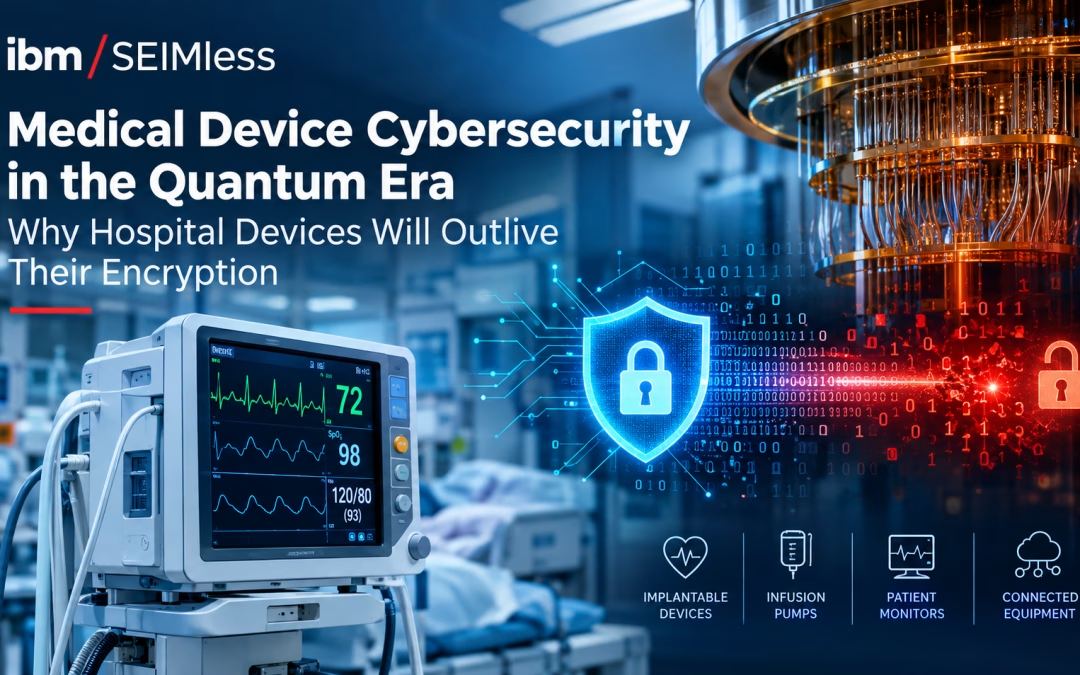
Medical device cybersecurity has always been a race between patching and exposure. Now it has a second clock. The infusion pump, patient monitor, or imaging system a hospital buys this year may still be in clinical use in the late 2030s. By then, the RSA and elliptic-curve cryptography protecting it is scheduled to be retired. Healthcare leaders who plan only for today’s threats are buying devices that will fall short of tomorrow’s standards before they are fully paid off.
This guide explains the gap, what regulators already require, and how hospitals and manufacturers can close it. It starts from a simple belief we hold at ibm/SEIMless: protecting patient data is protecting people.
What is medical device cybersecurity? Medical device cybersecurity is the practice of protecting connected clinical devices, and the patient data and care they support, from unauthorized access, tampering, and disruption across the device’s full lifecycle, from design through retirement.
What is the cryptographic lifespan gap? The cryptographic lifespan gap is the number of years a device stays in clinical service after the encryption it relies on has been deprecated. For most connected devices bought in 2026, that gap is already more than zero.
Why Medical Device Cybersecurity Now Has a Quantum Deadline
In August 2024, NIST published its first three post-quantum standards: FIPS 203 (ML-KEM), FIPS 204 (ML-DSA), and FIPS 205 (SLH-DSA). In March 2025 it selected HQC as a backup encryption algorithm. Its draft transition plan, NIST IR 8547, proposes deprecating quantum-vulnerable algorithms after 2030 and disallowing them after 2035.
Federal policy has since set dates. Executive Order 14412, signed June 22, 2026, gives federal systems until December 31, 2030 to adopt post-quantum key establishment. We covered those milestones in our Executive Order 14412 deadline guide. The NSA’s CNSA 2.0 FAQ goes further on firmware. It urges signing systems to move first, because the code that checks a signature is often hard to update once a product ships.
That last point is the heart of the medical device cybersecurity problem. Enterprise laptops are replaced every few years. Clinical equipment is not.
The Cryptographic Lifespan Gap, Explained
Here is the arithmetic. A connected device bought in 2026 and kept for 10 to 15 years stays in service until 2036–2041. If the 2030 and 2035 dates in NIST’s draft hold, that device will spend years running cryptography that federal standards no longer accept.
| Device purchased |
Likely retirement |
Years past 2030 deprecation |
Years past 2035 disallowance |
| 2020 |
2030–2035 |
0–5 |
0 |
| 2026 |
2036–2041 |
6–11 |
1–6 |
| 2029 |
2039–2044 |
9–14 |
4–9 |
These ranges are illustrative, not a prediction for any single product. The pattern is the point: the later a hospital waits to demand post-quantum readiness, the wider the gap it signs up for.
An FDA-commissioned white paper from MITRE, Managing Legacy Medical Device Cybersecurity Risks, makes the same point. It warns that devices being purchased today can already meet the definition of a legacy device. It also notes a mismatch between how long hospitals keep equipment and how long manufacturers support it.
Why patient data makes “harvest now, decrypt later” worse
Attackers do not need a quantum computer today to benefit from one later. They can record encrypted traffic now and decrypt it once the math breaks. We explain the tactic in Harvest Now, Decrypt Later, and the underlying math in Shor’s algorithm explained.
Health data is an ideal target. A credit card can be canceled. A diagnosis, a genetic result, or a psychiatric history cannot. Data that stays sensitive for a patient’s lifetime needs protection that lasts just as long.
What the FDA Already Requires for Medical Device Cybersecurity
The FDA has steadily raised the bar. Since March 29, 2023, section 524B of the FD&C Act has required makers of “cyber devices” to include cybersecurity information in premarket submissions. The FDA’s cybersecurity FAQ defines a cyber device as one that includes sponsor-validated software, can connect to the internet, and could be vulnerable to cyber threats.
Manufacturers must now:
- Submit a plan to monitor, identify, and address postmarket vulnerabilities.
- Provide a software bill of materials (SBOM) covering commercial, open-source, and off-the-shelf components.
- Make updates and patches available to the device and related systems.
The FDA’s premarket guidance, Cybersecurity in Medical Devices: Quality Management System Considerations and Content of Premarket Submissions, was updated on February 3, 2026 to align with the new Quality Management System Regulation. It lists cryptography among its recommended security controls. It also names secure and timely updatability and patchability as a core security objective. The agency’s postmarket guidance adds that networked devices need continual maintenance for their entire life.
Where the rules stop
None of these documents sets a date for post-quantum algorithms in medical devices. And as the GAO noted in GAO-24-106683, the 524B requirements do not reach back to devices already on the market before March 2023 unless a maker files a new submission. That leaves the installed base, which is most of what hospitals actually run, outside the new rules.
The Legacy Fleet Hospitals Already Own
Healthcare delivery organizations inherit the gap whether they planned for it or not. The FBI warned in a 2022 private industry notification that unpatched and outdated medical devices give attackers openings into hospital networks. The Health Sector Coordinating Council’s Managing Legacy Technology Security (HIC-MaLTS) guide describes the same shared burden between makers and providers.
The risk is not theoretical. In January 2025, the FDA issued a safety communication on certain Contec and Epsimed patient monitors. It pointed to CISA advisory ICSMA-25-030-01, which described hidden functionality and patient data being sent outside the care environment. The FDA’s advice was to cut the monitors off from the internet.
When the fix for a device is “disconnect it,” the network becomes the only control left. That is exactly where post-quantum protection can be added without waiting for firmware.
The stakes are high. An analysis of 2025 OCR data counted 710 large healthcare breaches exposing more than 61.5 million people’s records. Every one is listed on the HHS OCR breach portal. We saw the downstream damage in the Change Healthcare hack.
Why Post-Quantum Cryptography Is Hard on Medical Devices
If swapping algorithms were easy, the gap would close on its own. Four constraints make it hard.
1. Bigger keys and signatures
Post-quantum keys and signatures are much larger than the ones they replace. Per the FIPS 203 and 204 parameter sets:
| Function |
Classical (today) |
Post-quantum (NIST) |
| Key exchange public key |
X25519: 32 bytes |
ML-KEM-768: 1,184 bytes |
| Digital signature |
ECDSA P-256: about 64 bytes |
ML-DSA-65: 3,309 bytes |
On a battery-powered wearable or a low-memory controller, those extra bytes cost power, bandwidth, and storage.
2. Firmware roots of trust
Many devices verify updates with a key burned into hardware. If that check only understands RSA or ECDSA, no software update can teach it a new algorithm. This is why CNSA 2.0 favors the stateful hash-based signatures in NIST SP 800-208 (LMS and XMSS) for firmware signing now.
3. Validation and re-submission
Changing cryptography can mean new testing under the Cryptographic Module Validation Program and, for some changes, a new FDA submission. Our look at certificate lifecycle management and the FIPS 140-2 sunset covers why validation queues matter.
4. Protocols built for another era
Clinical networks still carry older protocols, flat VLANs, and vendor remote-access tunnels. We examined similar weak points in quantum computing’s impact on IPsec and why SD-WAN is not ready for next-generation attacks.
Regulatory Pressure Beyond the FDA
Medical device cybersecurity sits inside a wider compliance picture for providers:
A Medical Device Cybersecurity Roadmap for Hospitals
Hospitals cannot rewrite vendor firmware. They can control what surrounds it. A practical sequence:
- Inventory every connected device and its cryptography. Record the protocol, algorithm, certificate, and end-of-support date. A cryptographic bill of materials (CBOM) turns this into a living record.
- Score each device by its lifespan gap. Rank devices by planned retirement date, data sensitivity, and whether their cryptography can be updated.
- Segment clinical networks. Put devices in tightly scoped zones with zero trust policies, so a compromised monitor cannot reach the EHR.
- Wrap device traffic in quantum-resistant tunnels. Protect the paths between clinical zones, data centers, clouds, and remote sites so recorded traffic stays safe.
- Centralize key management. Rotate and govern keys in one place, rather than on thousands of endpoints.
- Watch device behavior. Flag devices that suddenly talk to unknown destinations, as in the Contec case.
- Protect the data at rest. Encrypt and back up the imaging archives and clinical data that devices feed.
- Write post-quantum language into contracts. Make readiness a buying requirement, not a wish.
Six questions to ask every device manufacturer
- Which algorithms does the device use for key exchange, signing, and storage today?
- Can those algorithms be changed by a field update, or are they fixed in hardware?
- What is your published roadmap for ML-KEM, ML-DSA, or LMS/XMSS support?
- Will you provide a CBOM alongside the SBOM?
- What is the end-of-support date, and what happens to security updates after it?
- Does the device support hybrid classical plus post-quantum modes during the transition?
What Manufacturers Should Build Into the Next Submission
For device makers, medical device cybersecurity is now a design decision with a long tail. The strongest submissions will show:
- Crypto-agility by design. Algorithms isolated behind interfaces so they can be swapped without a hardware change.
- Quantum-safe roots of trust. LMS or XMSS firmware signing, with ML-DSA as validated modules fit the device.
- Hybrid key exchange. Classical plus ML-KEM during the transition, so security never drops below today’s level.
- Honest lifecycle dates. End-of-support timelines that match how long hospitals actually keep equipment.
- A CBOM next to the SBOM. Buyers increasingly need to see cryptography, not just components.
How ibm/SEIMless Helps Close the Medical Device Cybersecurity Gap
Our view is simple: the fastest way to protect devices you cannot change is to protect the network around them. That is the thinking behind our Exodus QRN quantum-resistant networking suite.
Because this protection runs at the network layer, it does not depend on a device maker shipping new firmware. Hospitals can start with their highest-risk paths this quarter, then extend coverage as budgets allow. For the full migration picture, see our post-quantum cryptography migration playbook and network edge security in 2026. For AI-driven clinical workflows, our analysis of blind agent transfer applies to healthcare just as much as finance.
Medical Device Cybersecurity FAQ
What is medical device cybersecurity?
Medical device cybersecurity is the protection of connected clinical devices, and the patient data and care they support, from unauthorized access, tampering, and disruption across the device’s full lifecycle, from design through retirement.
Does the FDA require post-quantum cryptography in medical devices?
Not by a specific date. Section 524B requires cybersecurity information, an SBOM, and a vulnerability plan for cyber devices, and FDA guidance recommends strong, updatable cryptography. It does not yet set a deadline for post-quantum algorithms.
What is the cryptographic lifespan gap?
It is the number of years a device stays in clinical use after the encryption it relies on has been deprecated. A device bought in 2026 and kept 10 to 15 years may run six or more years past NIST’s proposed 2030 deprecation date.
Can hospitals protect legacy medical devices that cannot be updated?
Yes, with compensating controls. Segmentation, zero trust policies, behavior monitoring, and quantum-resistant encryption of network paths protect device traffic without changing device firmware.
Why is health data a target for harvest-now, decrypt-later attacks?
Health information stays sensitive for a patient’s lifetime. Attackers can record encrypted traffic today and decrypt it once quantum computers can break RSA and elliptic-curve cryptography.
What should hospitals ask device manufacturers about quantum readiness?
Ask which algorithms the device uses, whether they can be updated in the field, the vendor’s roadmap for ML-KEM, ML-DSA, or LMS/XMSS, whether a CBOM is available, and the end-of-support date.
Protect Patients Before Q-Day Arrives
Every connected device in your hospital carries a patient’s trust. ibm/SEIMless and Exodus QRN help healthcare, financial, and insurance organizations close the medical device cybersecurity gap at the network layer, without waiting on firmware. Let’s map your highest-risk device paths together.
Contact Us | Our Blog | Our Services | See Previous Post
by hannahadmin | Aug 21, 2026 | blog, cybersecurity, QRN, Seimless, telecom, wide area networking
Agentic AI security has moved from a research topic to a boardroom line item in under twelve months. At the same time, the countdown to Q-Day keeps ticking. Most enterprises still treat these as two separate projects, run by two separate teams, on two separate budgets. That separation is the mistake. Autonomous attackers and quantum-vulnerable encryption are not parallel risks. They are the same risk, arriving from two directions, and they will meet inside your network.
At ibm/SEIMless, we have spent more than two decades helping firms build networks that survive the next threat rather than the last one. This guide explains what changed, why it matters now, and what a defensible roadmap looks like for 2026 and beyond.
What Agentic AI Security Actually Means in 2026
Traditional AI security focused on the model. Teams worried about prompt injection, hallucination, and data leakage inside a chat window. Agentic AI security is a different discipline entirely, because agents do not just answer. They act.
An agentic system plans, calls tools, writes and runs code, authenticates to APIs, and chains dozens of steps together without a human in the loop. So every credential the agent holds becomes an attack path. Every tool it can reach becomes a lateral movement option.
The OWASP GenAI Security Project published its Top 10 for Agentic Applications on 9 December 2025. The list reads less like an AI document and far more like a network security document. Agent identity spoofing, tool misuse, privilege compromise, and cascading multi-agent failures all appear. In other words, agentic AI security is network security wearing a new label.
That framing matters for one practical reason. If the risk lives in identity, credentials, and traffic, then the controls belong in your network architecture — not only in your AI governance policy. Our NxT-Gen Network Security Solutions practice was built on exactly that principle.
The First Documented AI-Orchestrated Campaign Changed the Conversation
For years, autonomous attack scenarios lived in threat modeling slide decks. Then they left the slide deck.
On 13 November 2025, Anthropic published its account of disrupting the first reported AI-orchestrated cyber espionage campaign. The operators, tracked as GTG-1002, manipulated an AI coding agent into running reconnaissance, vulnerability discovery, exploitation, and data exfiltration across roughly thirty target companies. Technology companies, financial institutions, chemical manufacturers, and government agencies all appeared on the target list.
The headline figure is the one that should reset your planning assumptions. The AI performed an estimated 80 to 90 percent of the campaign. Human operators intervened at only four to six critical decision points.
Congress noticed. The Congressional Research Service now maintains a standing brief titled “Agentic Artificial Intelligence and Cyberattacks,” most recently updated on 6 July 2026. Regulators, insurers, and auditors now read the same material your board reads.
Meanwhile, the pattern keeps repeating at smaller scale. Our coverage of the agentic AI security vulnerability exposed in ServiceNow, the malicious npm package that stole files from a Claude AI user directory, and the GlassWorm malware takedown all describe the same underlying shift. Attackers now automate the boring parts of intrusion, and the boring parts were the parts that used to give defenders time.
Why Speed Is the Real Weapon in Agentic AI Security
Autonomous tooling does not invent new exploits. Instead, it removes the human bottleneck. A campaign that once took a skilled team three weeks now takes an agent three hours.
Detection windows shrink accordingly. If your mean time to detect is measured in days, an agentic adversary has already finished. As a result, controls that depend on human triage speed are quietly obsolete, which is why we pair Exodus ARIA ADR with endpoint detection and response rather than relying on either alone.
Q-Day, Harvest Now Decrypt Later, and the Cryptographic Clock
Now consider the second front.
Q-Day describes the moment a cryptographically relevant quantum computer can break the RSA and elliptic-curve cryptography that protects almost every enterprise session today. The Cloud Security Alliance’s Q-Day Clock research places that moment as plausibly feasible around 2030.
However, the deadline that matters is not 2030. It is today. Adversaries already capture encrypted traffic and store it, waiting for the decryption capability to arrive. Security teams call this Harvest Now, Decrypt Later, and we covered the business impact in depth in Harvest Now, Decrypt Later.
Ask a simple question about your own data. How long does it need to stay secret? Patient records, financial contracts, engineering drawings, legal discovery, and government correspondence all carry secrecy lifetimes measured in decades. Therefore, anything you transmit today with classical encryption is already exposed to a decryption event ten years out.
The standards exist. NIST finalized FIPS 203, FIPS 204, and FIPS 205 on 13 August 2024, then selected HQC as a backup key encapsulation mechanism on 11 March 2025. You can read the current status directly on the NIST Post-Quantum Cryptography project page. For a plain-English explanation of the underlying mathematics, see our post on how quantum computers break encryption.
Adoption, by contrast, lags badly. The same Cloud Security Alliance research found that only about 5 percent of firms had deployed quantum-safe encryption as of May 2025.
Where Agentic AI Security and Quantum Risk Converge
Here is the thesis. These two threats do not simply coexist. They multiply.
Harvesting Becomes Cheap and Continuous
Harvest Now, Decrypt Later used to demand patient, well-resourced adversaries. Someone had to find valuable flows, set up collection, and hold access for years. Agentic tooling collapses that cost. An AI agent can map a network, spot long-lived sensitive flows, and stage theft around the clock.
In short, the pool of actors able to run a decade-long harvest just grew sharply. Our guidance on protecting data in motion and data at rest addresses both halves of that exposure.
Machine Identity Explodes the Key Estate
Every agent needs credentials. Those credentials depend on keys. Each key then becomes another item in a cryptographic inventory that most organizations cannot even enumerate today.
Most teams already struggle to track human identities. Now add thousands of non-human identities that spin up, authenticate, and disappear within minutes. So agentic AI security and post-quantum migration share one need: knowing where your keys are. That is precisely the problem Exodus Key Management exists to solve.
Crypto-Agility Stops Being Optional
Crypto-agility means you can swap algorithms without rebuilding applications. In the past, teams put it off, because algorithm changes came once a decade.
That assumption no longer holds. Between the NIST standards, NSA CNSA 2.0 requirements, and vendor timelines, most firms will change cryptographic primitives more than once before 2032. Moreover, AI-assisted code breaking may shorten those cycles further. A design that hard-codes one cipher has a shelf life.
Your Overlay Is Only as Strong as Its Handshake
Software-defined networking encrypts site-to-site traffic, and most teams consider that box ticked. Look closer, though. Many overlays still negotiate keys with classical Diffie-Hellman.
An attacker capturing that traffic today can decrypt it after Q-Day, no matter how modern the overlay looks. We examined this gap in Today’s Software-Defined Networks Are Not Future-Ready and in SD-WAN Not Ready for Next Generation Attacks. If you run SD-WAN or are evaluating MPLS replacement solutions, the handshake deserves an audit before the roadmap does.
Agentic AI Security Cuts Both Ways for Defenders
The picture is not one-sided. Autonomy cuts both ways, and defenders can automate correlation, triage, and containment just as effectively.
Modern networks already use machine learning to spot anomalies that no analyst would catch at three in the morning. We explored that shift in AI-Native Networks: The Future of Telecommunications and in How LLMs Will Improve Network Security. Furthermore, our piece on AI leading the next generation of defense covers the operational side of that argument.
The difference comes down to preparation. Attackers use autonomy when it suits them. Defenders must use it on purpose, with governance, logging, and clear escalation paths. Organizations that build that discipline into agentic AI security now will absorb the next wave far better than those retrofitting later.
What Executive Order 14412 Changes for Private Enterprises
On 22 June 2026, the White House signed Executive Order 14412, “Securing the Nation Against Advanced Cryptographic Attacks”. The order appeared in the Federal Register on 25 June 2026. A companion order, “Ushering in the Next Frontier of Quantum Innovation,” targets deployable quantum capability by 2028.
The federal timeline is now concrete:
- 30 days: every agency names a post-quantum cryptography migration lead.
- 90 days: OMB issues guidance covering High Value Asset inventories and transition plans.
- 180 days: NIST launches a migration pilot, and CISA publishes guidance on minimum cryptographic bill of materials elements.
- 270 days: the FAR Council proposes amended contractor disclosure rules.
- 31 December 2030: High Value Assets use post-quantum cryptography for key establishment.
- 31 December 2031: the same systems use post-quantum cryptography for digital signatures.
Three Ways the Order Reaches Private Networks
Private enterprises are not directly bound. Nevertheless, three mechanisms will pull you in anyway.
First, procurement. Federal contract language flows down to subcontractors and suppliers, and the FAR rulemaking makes that explicit. Second, the cryptographic bill of materials concept will become a standard due-diligence question, much as software bills of materials did. Third, insurers and auditors follow federal benchmarks when they define reasonable care.
CISA’s Post-Quantum Cryptography Initiative and the NSA’s CNSA 2.0 FAQ remain the clearest public statements of expectation. Notably, CNSA 2.0 pushes new national security system acquisitions toward quantum-resistant algorithms from January 2027. Our earlier reporting on U.S. lawmakers urging action on the quantum threat traced how this policy momentum built.
Industry is moving on its own schedule too. Cloudflare reports that more than two-thirds of browser traffic to its network already uses post-quantum encryption. The Quantum Insider’s August 2026 timeline survey shows Google and Cloudflare targeting 2029, Microsoft targeting 2033, and SWIFT planning a post-quantum SwiftNet release for 2027.
What the Convergence Means Sector by Sector
Risk is never evenly distributed. Your exposure depends on how long your data stays valuable and how quickly your operations must respond.
Healthcare. Patient records carry a legal and practical secrecy lifetime of decades. So healthcare providers sit at the very top of the Harvest Now, Decrypt Later risk list. Meanwhile, connected clinical devices give autonomous attackers an unusually soft internal surface.
Financial services. Transaction records, credit files, and contract archives all outlive current encryption. SWIFT plans a post-quantum SwiftNet release for 2027, so the migration pressure is already contractual rather than theoretical. Our analysis of why big cybersecurity budgets still fail explains why spending alone will not close this gap.
Manufacturing and supply chain. Engineering drawings and process data retain competitive value for twenty years or more. In addition, third-party exposure keeps growing, as the Ericsson service provider breach showed.
Government and public sector. Executive Order 14412 applies directly, and the flow-down reaches every supplier. Our reporting on the Pentagon’s supply-chain risk designation for an AI vendor shows how quickly AI procurement scrutiny is tightening.
Critical communications. Outages and intrusions compound each other. Recent incidents such as the AT&T 911 outage show how thin the safety margin has become for vital services.
A Seven-Step Roadmap for Agentic AI Security and Quantum Readiness
You do not need two programs. You need one program with two outputs. Here is the sequence we use with clients.
- Build a combined inventory. Catalog cryptographic assets and non-human identities in the same exercise. Both questions share one answer set. Where are the keys, who holds them, and what do they protect?
- Classify by secrecy lifetime. Rank data by how long it must stay confidential. Anything above ten years moves to the front of the queue immediately.
- Audit your handshakes. Check what your VPNs, overlays, and management planes actually negotiate. Marketing material and packet captures often disagree.
- Govern agents like privileged users. Give every agent a scoped identity, a short-lived key, and a full audit trail. Above all, remove standing access. Our work on zero trust content security applies directly here.
- Protect the two data states separately. Data in motion and data at rest fail differently, so plan them as distinct workstreams. Exodus Transparent Encryption and our EXODUS QRN data-at-rest guidance cover the second.
- Shorten detection to machine speed. Automated attacks require automated response. Human triage remains essential for judgement, yet it cannot be the first line.
- Rewrite procurement language now. Ask every vendor for post-quantum support, key inventories, and agent governance. This costs nothing today and saves enormous rework later.
For a deeper build sequence, see our companion pieces on post-quantum cryptography migration and enterprise IT infrastructure services.
How ibm/SEIMless Approaches Agentic AI Security and Quantum-Resistant Networking
We are vendor-agnostic by design. Since 2001, we have selected technology on fit rather than on partnership incentives, which matters more than ever now that every vendor claims quantum readiness.
Our Exodus Quantum-Resistant Networking portfolio addresses the cryptographic layer through key management, data in motion, data at rest, and edge enforcement through QR-Edge and Exodus PIET. On the detection side, Exodus NxtGen Firewall, Exodus ARIA ADR, and EDR close the response-time gap that agentic attackers exploit.
Underneath sits the transport itself. Whether you run Ethernet, MPLS, wavelength services, dark fiber, private line, or wireless, the encryption question follows the circuit. Our cloud services, Microsoft SaaS and DaaS, telecom services, and document management practices extend the same standard across the rest of the estate.
Frequently Asked Questions
Is agentic AI security different from traditional AI security?
Yes. Traditional AI security protects a model and its outputs. Agentic AI security protects an autonomous system that holds credentials, calls tools, and takes actions across your network, so the controls resemble identity and network security far more than content moderation.
Do we need to fix quantum risk before agentic AI risk?
Neither one waits for the other. Start both with the same inventory exercise, because the underlying question — where your keys and identities live — is identical for both programs.
Does Executive Order 14412 apply to private companies?
Not directly. However, its requirements reach private firms through federal procurement flow-downs, contractual due diligence, and the benchmarks that auditors and insurers adopt.
What is a realistic first ninety days?
Complete a cryptographic and non-human identity inventory, classify data by secrecy lifetime, audit your overlay handshakes, and update procurement language. Those four steps cost little and unlock everything that follows.
How does quantum-resistant networking differ from post-quantum cryptography?
Post-quantum cryptography describes the algorithms. Quantum-resistant networking describes the architecture that deploys, rotates, and governs those algorithms across live enterprise traffic.
The Bottom Line
Two clocks are running. One counts down to autonomous attackers operating faster than your response process. The other counts down to the day today’s captured traffic becomes readable. They are converging, and the organizations that treat them as one program will finish years ahead of those that do not.
Agentic AI security and quantum-resistant networking share the same foundation: know your keys, govern your identities, and build architecture you can change. Everything else is implementation detail.
Ready to start? Get started with ibm/SEIMless or contact our team for a cryptographic and agent-governance readiness assessment. You can also review our reports, browse our partners, read the FAQs, or explore distributor opportunities.
Complete ibm/SEIMless Resource Index
Quantum-Resistant Networking
NxT-Gen Network Security Solutions
Wide Area Networking and Connectivity
Cloud Services
Contact Us | Our Blog | Our Services | See Previous Post
by hannahadmin | Aug 11, 2026 | cybersecurity, QRN, Seimless, telecom
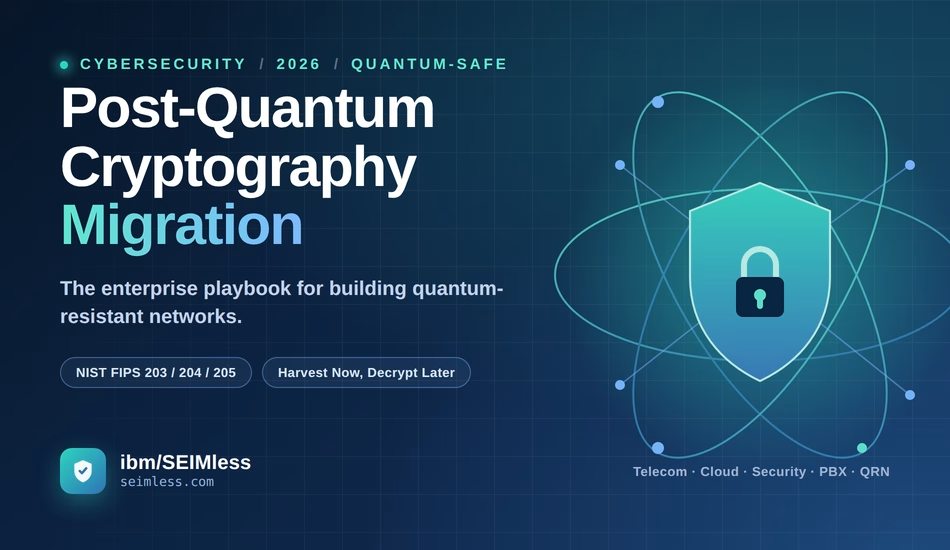
Every encrypted message your enterprise sends today could already be sitting in an adversary’s archive, waiting for the day a quantum computer can crack it open. That is the uncomfortable reality behind “harvest now, decrypt later,” and it is why post-quantum cryptography migration has moved from a research-lab curiosity to an urgent boardroom priority in 2026. For organizations that depend on telecom, cloud, PBX, and networked infrastructure, the question is no longer if you will migrate to quantum-resistant encryption — it is how fast and how safely you can do it.
At ibm/SEIMless, we help enterprises answer that question with confidence. This guide breaks down what post-quantum cryptography migration actually involves, why the deadlines are closer than most leaders realize, and the practical steps you can take now to protect your data, your customers, and your reputation.
What Is Post-Quantum Cryptography Migration?
Post-quantum cryptography (PQC) refers to a new generation of encryption algorithms designed to withstand attacks from both classical and quantum computers. Post-quantum cryptography migration is the structured process of replacing today’s vulnerable public-key algorithms — RSA, ECC, and Diffie-Hellman — with these quantum-resistant standards across every system that stores or transmits sensitive data.
The urgency comes from a simple mathematical truth. A sufficiently powerful quantum computer running Shor’s algorithm could break the public-key cryptography that secures virtually all modern digital communication — from VPN tunnels and TLS sessions to PBX signaling and cloud storage. In August 2024, the U.S. National Institute of Standards and Technology (NIST) released the first three finalized post-quantum encryption standards, formally opening the migration era for every enterprise on the planet.
The New Standards Driving Migration
The finalized standards give security teams a concrete target. Rather than waiting for perfect certainty, organizations now have federally vetted algorithms to build around:
- FIPS 203 (ML-KEM) — derived from CRYSTALS-Kyber, the primary standard for general encryption and key establishment. You can review the full FIPS 203 specification on the NIST CSRC portal.
- FIPS 204 (ML-DSA) — derived from CRYSTALS-Dilithium, the primary standard for digital signatures.
- FIPS 205 (SLH-DSA) — derived from SPHINCS+, a backup signature standard built on a different mathematical foundation for added resilience.
NIST’s ongoing work, documented on its Post-Quantum Cryptography Standardization project page, continues to evaluate additional algorithms to ensure cryptographic diversity. The message from NIST leadership has been unambiguous: begin integrating these standards immediately, because full integration takes years, not months.
Why “Harvest Now, Decrypt Later” Changes the Timeline
The single most misunderstood aspect of the quantum threat is timing. Many executives assume they can wait until a cryptographically relevant quantum computer exists before acting. That assumption is dangerous.
Adversaries are already capturing and storing encrypted traffic today — financial records, health data, intellectual property, government communications — with the intent of decrypting it once quantum capability matures. This is the “harvest now, decrypt later” (HNDL) attack model. Any data with a shelf life longer than the expected arrival of quantum computers is effectively at risk right now. For a hospital, a bank, or a defense contractor, that shelf life can stretch across decades.
This is precisely why federal guidance has accelerated. The Cybersecurity and Infrastructure Security Agency (CISA), together with the NSA and NIST, published a joint Quantum-Readiness: Migration to Post-Quantum Cryptography resource urging organizations to start now. Their companion factsheet on quantum readiness lays out the first concrete steps for critical-infrastructure operators.
The Regulatory Clock Is Already Ticking
Post-quantum cryptography migration is not just best practice — it is increasingly a compliance mandate.
The National Security Agency’s Commercial National Security Algorithm Suite 2.0 (CNSA 2.0) sets firm transition timelines for national security systems, with full adoption of quantum-resistant algorithms expected by 2035 and earlier milestones for software and firmware signing. In the legislative arena, the Quantum Computing Cybersecurity Preparedness Act — signed into law in December 2022 — requires federal agencies to inventory their cryptographic systems and prioritize migration, a standard that inevitably flows down to contractors and private-sector partners.
For hands-on implementation, the NIST National Cybersecurity Center of Excellence (NCCoE) maintains a dedicated Migration to Post-Quantum Cryptography project that offers reference architectures and playbooks. Broader national strategy and research coordination are tracked through the U.S. National Quantum Initiative at quantum.gov. Even industry bodies have weighed in: the Cloud Security Alliance’s analysis of the finalized FIPS 203, 204, and 205 standards frames the finalization as a defining moment for the quantum-safe future.
A Practical Post-Quantum Cryptography Migration Roadmap
Migration can feel overwhelming, but it becomes manageable when broken into disciplined phases. Here is the roadmap ibm/SEIMless uses to guide enterprises toward crypto-agility.
1. Build a Cryptographic Inventory
You cannot protect what you cannot see. Start by discovering every place cryptography lives in your environment — TLS certificates, VPNs, PBX signaling, database encryption, cloud APIs, IoT devices, and third-party integrations. This inventory becomes the master map for your entire migration.
2. Prioritize by Data Sensitivity and Longevity
Rank systems by the value and shelf life of the data they protect. Long-lived secrets — trade secrets, personal health information, legal records — move to the front of the line because they are the prime targets of harvest-now-decrypt-later campaigns.
3. Achieve Crypto-Agility
Crypto-agility is the ability to swap cryptographic algorithms without re-architecting your systems. Building this flexibility now means you can adopt new standards as they evolve, rather than facing a painful forklift upgrade with each change. Our quantum computing and encryption resources explain how crypto-agility fits into a modern security stack.
4. Protect Data in Motion and Data at Rest
A complete migration secures information wherever it lives. That means quantum-resistant protection for data in motion as it travels across your network, and for data at rest in storage and backups. Strong key management ties the two together and remains the backbone of any resilient encryption program.
5. Layer Quantum-Safe Networking with Zero Trust
Post-quantum algorithms are strongest when combined with a defense-in-depth architecture. Pairing PQC with a zero trust security model and a next-generation firewall ensures that even if one layer is challenged, your data stays protected. For distributed enterprises, quantum-safe SD-WAN extends this protection across every branch, remote worker, and cloud connection.
How ibm/SEIMless Makes Quantum-Safe Migration Seamless
Migrating an entire enterprise to post-quantum cryptography is a journey, and you should not walk it alone. ibm/SEIMless delivers end-to-end Quantum Resistant Networking built on the same NIST-aligned standards driving federal migration — combined with the telecom, cloud, and PBX expertise your operations already rely on.
Because we integrate quantum-safe encryption directly into your networking, cloud infrastructure, and voice communications, you gain protection without the complexity of stitching together a dozen vendors. Our approach is grounded in a simple conviction: the technology that protects an organization’s data is ultimately protecting the people who trust that organization. Security done right is a form of care.
Explore our full range of managed security and networking services, or learn more about who we are and why enterprises across the country choose us as their quantum-safe partner.
The Cost of Waiting Far Outweighs the Cost of Acting
Post-quantum cryptography migration is the defining cybersecurity project of this decade. The standards are final, the federal timelines are set, and the harvest-now-decrypt-later threat is active today. Organizations that begin their migration now will move deliberately, protect their most valuable data, and meet compliance deadlines with room to spare. Those that wait risk a chaotic, expensive scramble — or worse, a breach of data they thought was safe years ago.
The future of secure networking is quantum-resistant, and it is being built right now.
Ready to Future-Proof Your Encryption?
Do not let your enterprise become a target of harvest-now-decrypt-later. The ibm/SEIMless team will help you inventory your cryptography, build a phased migration roadmap, and deploy quantum-resistant protection across your entire network. Get started with a quantum-readiness consultation today, or contact our specialists to secure your digital future — before someone else decides your timeline for you.
Contact Us | Our Blog | Our Services | See Previous Post…
by hannahadmin | Jul 22, 2026 | blog, telecom
How Artificial Intelligence Is Revolutionizing Global Communication Infrastructure
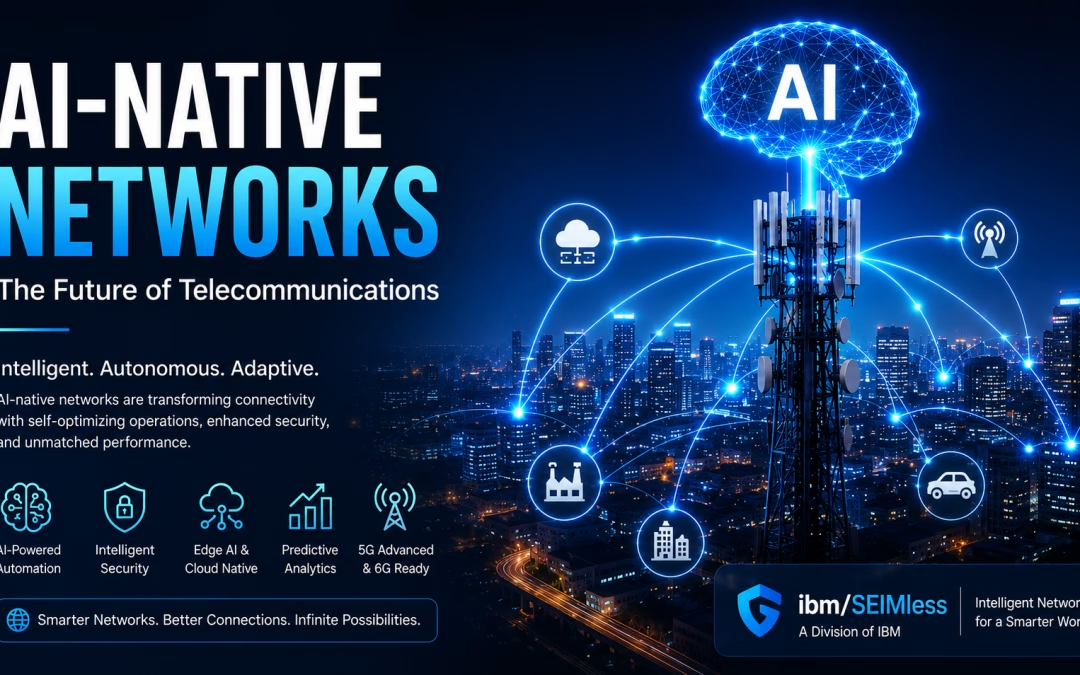
The telecommunications industry is entering a transformative era driven by Artificial Intelligence (AI). Traditional networks, designed primarily for connectivity, are evolving into intelligent ecosystems capable of learning, adapting, and optimizing themselves in real time. This new paradigm, known as AI-Native Networking, integrates AI into every layer of the network—from planning and deployment to operations, security, and customer experience.
As global data traffic continues to grow exponentially, fueled by cloud computing, IoT, autonomous vehicles, smart cities, immersive digital experiences, and billions of connected devices, conventional network architectures struggle to meet increasing demands. AI-native networks address these challenges by enabling predictive analytics, automated resource allocation, self-healing capabilities, intelligent security, and autonomous operations.
For enterprises, governments, telecom operators, and critical infrastructure providers, AI-native networking is not merely an upgrade—it is a strategic necessity. Organizations that adopt intelligent network architectures today will be better positioned to support 5G Advanced, emerging 6G technologies, quantum-safe communications, and next-generation digital services.
At ibm/SEIMless, we believe the future of telecommunications lies in secure, intelligent, autonomous, and resilient networking solutions. By combining advanced AI, cybersecurity, cloud-native infrastructure, and quantum-resistant technologies, businesses can create communication networks that are faster, more secure, and prepared for the digital challenges of tomorrow.
The Evolution of Telecommunications
Telecommunications has undergone remarkable transformation over the past four decades.
First Generation (1G)
The first generation of mobile communications introduced analog voice services. Although revolutionary at the time, 1G offered limited capacity, poor security, and low-quality voice transmission.
Second Generation (2G)
Digital communications arrived with 2G, enabling SMS messaging, improved voice quality, and stronger encryption. Mobile communication became more accessible and reliable for consumers worldwide.
Third Generation (3G)
The rise of smartphones brought the demand for mobile internet. 3G enabled web browsing, email, multimedia messaging, and early mobile applications, fundamentally changing how people interacted with digital services.
Fourth Generation (4G LTE)
4G transformed telecommunications by delivering high-speed broadband connectivity. Streaming media, cloud applications, remote collaboration, and mobile commerce flourished due to significantly improved network performance.
Fifth Generation (5G)
5G introduced ultra-low latency, massive device connectivity, network slicing, and enhanced mobile broadband. It created new opportunities for smart manufacturing, healthcare, autonomous transportation, industrial automation, and immersive technologies.
However, while 5G dramatically improved connectivity, managing increasingly complex network environments has become a major challenge. Millions of devices, distributed cloud environments, edge computing platforms, and growing cybersecurity threats require far more intelligent network management than traditional automation can provide.
What Are AI-Native Networks?
AI-native networks represent the next evolution of telecommunications. Unlike conventional networks where AI functions as an external management tool, AI-native networks embed artificial intelligence into the core architecture itself.
Every network component continuously learns from operational data, predicts future behavior, identifies anomalies, optimizes resources, and automatically responds to changing conditions without human intervention.
Rather than reacting to problems after they occur, AI-native networks anticipate issues before they impact users.
These intelligent systems leverage:
- Machine Learning
- Deep Learning
- Reinforcement Learning
- Large Language Models (LLMs)
- Predictive Analytics
- Digital Twins
- Edge AI
- Autonomous Decision Engines
- Intent-Based Networking
- Generative AI for Operations
Together, these technologies create networks capable of self-monitoring, self-optimizing, self-healing, and self-protecting.
Why Traditional Networks Are No Longer Enough
Modern telecommunications environments generate enormous volumes of operational data every second. Network engineers must manage:
- Billions of IoT devices
- Cloud-native applications
- Distributed edge infrastructure
- Hybrid multi-cloud environments
- Software-defined networking
- Virtualized network functions
- Massive cybersecurity threats
- Increasing customer expectations
Traditional monitoring systems rely heavily on manual intervention and predefined rules. This approach is no longer scalable.
Common challenges include:
- Unexpected service outages
- Network congestion
- Slow fault resolution
- Rising operational costs
- Complex security management
- Delayed capacity planning
- Inefficient resource utilization
AI-native networks address these limitations by enabling continuous learning and autonomous optimization, reducing downtime and improving overall service quality.
Core Characteristics of AI-Native Networks
1. Autonomous Operations
AI-native networks automate routine operational tasks such as configuration management, traffic engineering, software updates, and fault remediation. This minimizes human error and accelerates network responsiveness.
2. Predictive Intelligence
Instead of waiting for failures, AI models analyze historical and real-time telemetry to forecast equipment degradation, traffic surges, and potential outages. Operators can resolve issues proactively.
3. Self-Healing Infrastructure
When disruptions occur, AI-native systems automatically reroute traffic, isolate affected components, and restore services with minimal downtime, improving network resilience and customer satisfaction.
4. Intelligent Resource Allocation
AI dynamically allocates bandwidth, compute, and storage resources based on demand, ensuring efficient utilization and consistent application performance.
5. Built-In Security
Cybersecurity is integrated into the network fabric. AI continuously detects anomalies, identifies emerging threats, and initiates automated responses to mitigate risks before they escalate.
The Business Value of AI-Native Networks
Adopting AI-native networking delivers measurable benefits across industries:
- Reduced operational expenses through automation
- Improved network reliability and uptime
- Faster incident detection and resolution
- Enhanced customer experiences
- Greater scalability for future technologies
- Stronger cybersecurity posture
- Efficient energy consumption
- Accelerated service deployment
- Simplified network management
- Increased return on infrastructure investments
For telecom operators, enterprises, and public sector organizations, these advantages translate into improved competitiveness and long-term resilience.
Contact Us | Our Services | Our Blog | See Previous Post
by hannahadmin | Jul 10, 2026 | blog, telecom
Software-Defined Networking (SDN) has transformed enterprise networking by simplifying network management, improving scalability, and enabling greater automation. For years, organizations relied on SDN to reduce hardware complexity and accelerate digital transformation.
However, the technology landscape has evolved dramatically.
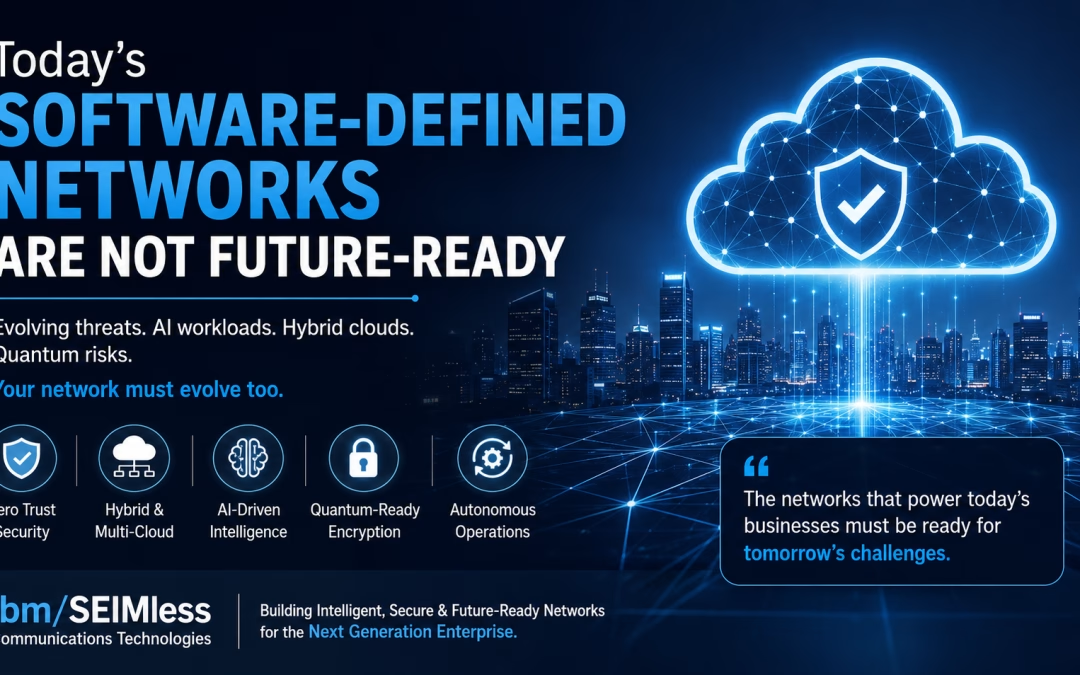
Artificial Intelligence (AI), hybrid cloud environments, edge computing, Zero Trust security models, Internet of Things (IoT), and the emerging threat of quantum computing have exposed limitations in many traditional SDN deployments. While SDN remains a foundational networking technology, many implementations were designed for yesterday’s challenges—not tomorrow’s.
Today’s businesses require intelligent, autonomous, and resilient networks capable of adapting to rapidly changing workloads and increasingly sophisticated cyber threats.
Why Traditional Software-Defined Networks Are No Longer Enough
Traditional SDN solutions were designed to improve network efficiency by separating the control plane from the data plane, allowing centralized management and automation.
Although these advantages remain valuable, modern enterprise infrastructures now demand much more.
Today’s organizations operate across:
- Multi-cloud environments
- Hybrid cloud infrastructure
- Remote workforces
- AI-powered applications
- Edge computing platforms
- Billions of connected IoT devices
- Mission-critical digital services
Legacy SDN architectures often struggle to deliver the flexibility, intelligence, and security required to support these environments effectively.
The Biggest Challenges Facing Today’s SDN Deployments
1. Cybersecurity Threats Continue to Evolve
Cyberattacks have become increasingly automated and AI-driven.
Modern attackers target centralized management systems because compromising an SDN controller can provide visibility into large portions of an organization’s network.
Future-ready networking requires:
- Zero Trust Architecture
- Continuous authentication
- AI-powered threat detection
- Automated incident response
- Behavioral analytics
- Micro-segmentation
Security must become an integrated component of the network rather than an additional layer.
2. Hybrid and Multi-Cloud Complexity
Most enterprises now operate workloads across multiple environments including private cloud, public cloud, on-premises data centers, and edge locations.
Managing consistent security policies, network visibility, and application performance across these environments remains challenging for many traditional SDN solutions.
Future-ready networking requires centralized visibility combined with distributed intelligence.
3. Artificial Intelligence Changes Network Requirements
AI applications generate entirely new traffic patterns.
Large Language Models (LLMs), machine learning workloads, and GPU-intensive applications require:
- Ultra-low latency
- High bandwidth
- Dynamic traffic optimization
- Predictive congestion management
- Intelligent workload balancing
Static routing policies cannot efficiently support modern AI environments.
AI increasingly requires AI-powered networking.
4. Preparing for the Quantum Computing Era
Although quantum computing is still evolving, organizations must begin preparing today.
Current encryption standards protecting enterprise communications could eventually become vulnerable to quantum-enabled attacks.
Organizations responsible for protecting sensitive information should evaluate quantum-resistant networking strategies before these risks become immediate.
Early planning reduces future migration complexity while strengthening long-term cybersecurity resilience.
5. Network Operations Are Becoming Too Complex
Enterprise IT teams manage thousands of devices across geographically distributed environments.
Manual configuration and reactive troubleshooting are no longer sustainable.
Modern networking platforms should provide:
- Self-monitoring
- Self-healing capabilities
- Predictive maintenance
- Automated optimization
- AI-assisted operations
- Intelligent analytics
Automation should extend beyond deployment into continuous operational improvement.
What Makes a Network Future-Ready?
A future-ready network combines traditional SDN capabilities with advanced technologies that improve security, intelligence, and adaptability.
Key characteristics include:
AI-Driven Network Intelligence
Artificial Intelligence enables networks to predict failures, optimize routing, detect anomalies, and improve application performance without constant manual intervention.
Zero Trust Security
Every user, device, workload, and application should be continuously verified before receiving network access.
Trust should never be assumed.
Quantum-Ready Encryption
Organizations should prepare for Post-Quantum Cryptography (PQC) to ensure long-term protection of sensitive communications.
Cloud-Native Architecture
Future-ready infrastructure should seamlessly integrate:
Autonomous Network Operations
The next generation of enterprise networking will increasingly automate:
- Network optimization
- Security policy enforcement
- Fault detection
- Capacity planning
- Incident response
The Business Risks of Delaying Network Modernization
Organizations that postpone infrastructure modernization may experience:
- Increased cybersecurity exposure
- Higher operational costs
- Reduced network performance
- Slower digital transformation
- Compliance challenges
- Greater business disruption
- Poor support for AI initiatives
- Limited scalability
Modernizing proactively is typically more cost-effective than responding to failures after they occur.
How ibm/SEIMless Builds Future-Ready Enterprise Networks
At ibm/SEIMless Communications Technologies, we help organizations move beyond conventional Software-Defined Networking by designing intelligent, secure, and scalable enterprise infrastructure.
Our networking approach focuses on:
- Intelligent network architecture
- AI-enhanced infrastructure
- Hybrid and multi-cloud connectivity
- Zero Trust implementation
- Advanced cybersecurity integration
- Enterprise network optimization
- Infrastructure modernization
- Quantum-resistant networking initiatives through Exodus QRN
Rather than simply deploying networking technology, ibm/SEIMless helps organizations build resilient digital infrastructure capable of supporting future innovation while reducing operational complexity and cybersecurity risks.
Preparing for the Next Generation of Enterprise Networking
Networking is no longer just about connectivity.
It has become the foundation for Artificial Intelligence, cloud computing, cybersecurity, digital transformation, and future business innovation.
Organizations that continue relying solely on legacy SDN implementations risk falling behind as technology evolves.
By investing in intelligent automation, Zero Trust security, cloud-native architecture, AI-driven operations, and quantum-safe networking strategies, enterprises position themselves for sustainable growth and long-term resilience.
Future-ready networking begins with preparing today—not reacting tomorrow.
Conclusion
Software-Defined Networking transformed enterprise IT, but today’s rapidly evolving technology landscape demands more than traditional SDN architectures can provide.
Artificial Intelligence, hybrid cloud, Zero Trust security, automation, and quantum computing are reshaping how organizations build and secure their networks.
Businesses that modernize today will gain stronger cybersecurity, improved operational efficiency, greater scalability, and a competitive advantage in the digital economy.
At ibm/SEIMless, we help organizations design enterprise networks that are secure, intelligent, scalable, and ready for the challenges of tomorrow.
Frequently Asked Questions
Why are today’s software-defined networks not future-ready?
Many SDN deployments were built before AI, edge computing, hybrid cloud, and quantum-security considerations became mainstream. Modern enterprise environments require more intelligent and adaptive networking capabilities.
What is a future-ready network?
A future-ready network integrates AI, automation, Zero Trust security, cloud-native architecture, predictive analytics, and quantum-resistant encryption to support evolving business requirements.
How does AI improve enterprise networking?
AI helps optimize traffic, predict failures, automate security responses, detect anomalies, improve performance, and reduce manual network administration.
Should businesses prepare for quantum-safe networking now?
Yes. Organizations that manage sensitive data should begin planning for post-quantum cryptography today to reduce future security risks and ensure long-term data protection.
Contact Us | Our Blogs | See Previous Post