The advent of quantum networking marks a significant shift in the landscape of cybersecurity. As threats evolve and become more sophisticated, traditional methods of securing data and communications are increasingly vulnerable. This blog explores the transformative potential of quantum networking in safeguarding digital assets and ensuring secure communications, shedding light on both its challenges and opportunities.
Understanding Quantum Networking
Quantum networking utilizes the principles of quantum mechanics to create secure communication channels. This section delves into the fundamental concepts of quantum entanglement and superposition that enable quantum networks to function, highlighting how these principles differ from classical networking methods.
At its core, quantum networking hinges on the phenomenon of quantum entanglement, where pairs of particles become interconnected in ways that classical particles cannot. This interconnection allows information to be transferred with a level of security that traditional methods simply cannot provide. Moreover, superposition enables qubits to represent multiple states simultaneously, enhancing the capability for complex data transmission.
Understanding these intricate concepts is essential, as they lay the foundation for innovations in cybersecurity. By utilizing quantum properties, networks can detect unauthorized access through changes in the entangled states of particles, thus providing an additional layer of security. As we further explore quantum networking, it becomes increasingly apparent that its implications extend far beyond mere speed enhancements; they redefine the very principles of secure communication.
Current Cybersecurity Challenges
The cybersecurity landscape faces numerous challenges, including increasingly sophisticated cyber-attacks and data breaches. This section examines the limitations of traditional cybersecurity measures and the urgent need for more robust solutions to protect sensitive information.
As digital transformation continues to reshape various sectors, threat actors are also evolving their tactics, deploying advanced techniques like machine learning to bypass conventional security measures. Data breaches have skyrocketed in recent years, exposing sensitive personal and organizational information, which highlights the vulnerabilities of existing frameworks.
In particular, the reliance on symmetric and asymmetric cryptography raises flags. While these methods have served us well to date, they may not withstand the quantum onslaught that is approaching. The urgency to rethink our approach to cybersecurity stems from the realization that, without an adaptation to these emerging technologies, we risk falling prey to new types of cyber threats.
This pressing need for revolutionary solutions compels us to explore the realities of integrating quantum networking as it promises to tackle challenges that current systems have been unable to resolve. Understanding how quantum principles can mitigate these risks is essential for developing a secure digital future.
How Quantum Networking Enhances Cybersecurity
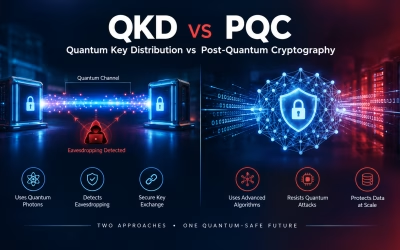
This section explores the various ways quantum networking can enhance cybersecurity, such as through quantum key distribution (QKD), which allows for the detection of eavesdropping and ensures secure key sharing between parties. Real-world applications and potential use cases are discussed.
One of the most significant breakthroughs in enhancing cybersecurity through quantum networking is the implementation of quantum key distribution (QKD). Employing the principles of quantum mechanics, QKD enables parties to share cryptographic keys in a manner that is inherently secure. By measuring quantum states, any interception of the key can be detected, alerting users to potential threats in real-time.
Consider financial institutions utilizing QKD systems in their transactions. The nature of QKD ensures that funds are transferred securely, with a built-in mechanism to verify the integrity of the communication channel. This systems approach not only improves security for individual users but also enhances the overall trust in digital financial ecosystems.
Furthermore, quantum networking can also facilitate the development of secure communication protocols that leverage the unique properties of entangled particles. For instance, entangled photons can be transmitted across long distances without fear of eavesdropping, creating possibilities for secure governmental and military communications. The implications of these advancements could greatly alter the landscape of cybersecurity across various sectors, setting the stage for a more secure digital world.
Challenges and Limitations of Quantum Networking
While quantum networking shows tremendous promise, it also faces several challenges, including technological limitations and the need for significant infrastructure investments. This section analyzes these hurdles and discusses the current state of research and development in the field.
Despite the excitement surrounding quantum networking, the technology is still in its infancy and struggles with various barriers to widespread adoption. Foremost among these is the requirement for delicate equipment and conditions necessary for quantum transmission; even minor disturbances can lead to the loss of entanglement and data integrity.
Additionally, the financial implications cannot be overlooked. The installation of quantum networks demands substantial investment in infrastructure and technology upgrades, raising questions about the feasibility for organizations working within limited budgets. Policymakers and tech leaders must collaborate to address these financial challenges while promoting the benefits of integrating quantum solutions.
Another concern is the potential for quantum technology to inadvertently create new vulnerabilities. As quantum systems evolve, so too will the tactics of cybercriminals. Therefore, ongoing research needs to focus not only on enhancing current capabilities but also on understanding the potential risks involved in quantum implementation. Thus, while the future looks bright, a cautious approach is essential.
Looking Ahead: The Future of Quantum Networking in Cybersecurity
This section speculates on the future integration of quantum networking into cybersecurity frameworks. It highlights emerging trends, potential technologies on the horizon, and the importance of collaboration between governments, academia, and the private sector to advance this field.
As quantum networking matures, its potential to revolutionize the cybersecurity space becomes increasingly tangible. Future technologies may allow for unprecedented levels of security, making sensitive transactions virtually immune to eavesdropping. The combination of quantum computing and networking could yield breakthrough capabilities that traditional systems cannot match.
Moreover, fostering collaboration between governmental bodies, research institutions, and the private sector will be fundamental in navigating the complex terrain of quantum networking. Initiatives that support knowledge-sharing and funding for quantum projects can accelerate development and ensure that this technology is effectively coupled with regulatory frameworks.
The prospect of a quantum internet may not be far-fetched; it could unify disparate systems, making secure communications ubiquitous across industries. This holistic approach towards cybersecurity could eventually lead to a world where digital interactions are safeguarded by the principles of quantum mechanics, fundamentally reshaping our understanding of privacy and security in the digital age.
The Future of Cybersecurity with Quantum Networking
In conclusion, quantum networking presents a revolutionary approach to enhancing cybersecurity protocols. Its ability to leverage the principles of quantum mechanics ensures a higher level of data integrity and security against emerging cyber threats. As technology continues to advance, embracing quantum networking may be crucial for organizations aiming to fortify their defenses in an increasingly perilous digital environment.