In today’s cybersecurity landscape, the rise of quantum computing is no longer theoretical—it is a strategic reality. Organizations that rely on classical encryption must now prepare for a paradigm shift where quantum algorithms can dismantle widely used cryptographic systems. This article explains how quantum computers threaten encryption, focusing on Shor’s Algorithm, and what forward-looking companies like ibm/SEIMless Communications Technologies, Inc. are doing to build quantum-resistant solutions.
What Makes Quantum Computers Different?
Traditional computers process data in binary bits (0s and 1s). Quantum computers, however, use qubits, leveraging principles such as:
- Superposition – a qubit can exist in multiple states simultaneously
- Entanglement – qubits can be correlated across distances
- Quantum parallelism – multiple computations occur at once
These capabilities allow quantum systems to solve certain mathematical problems exponentially faster than classical machines.
The Foundation of Modern Encryption
Most current encryption systems, including RSA encryption, rely on the difficulty of factoring large numbers into primes. For classical computers, this task is computationally infeasible at scale, which is why encryption has remained secure for decades.
👉 Learn more about modern cryptography standards from National Institute of Standards and Technology:
How Shor’s Algorithm Breaks Encryption
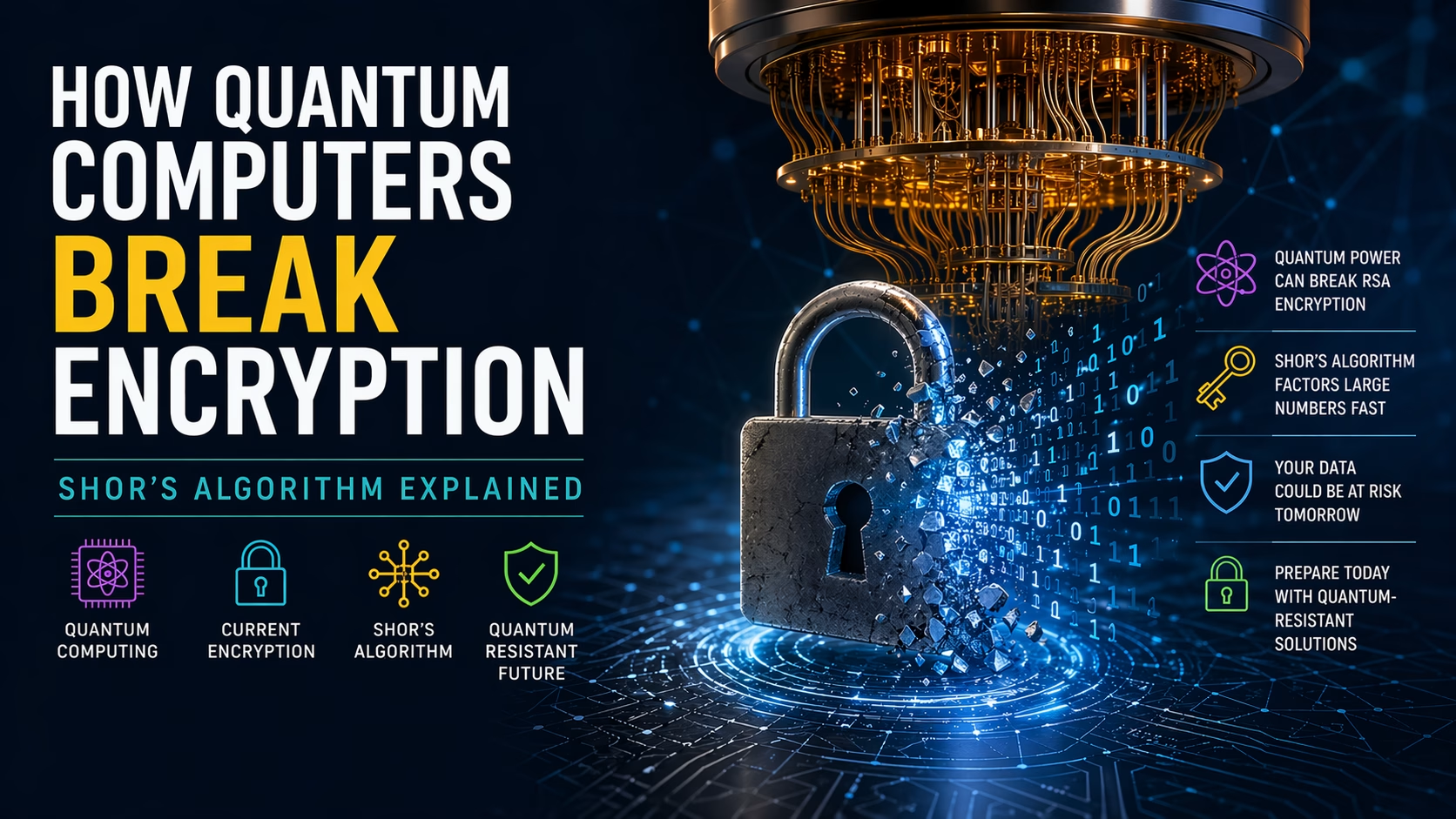
Shor’s Algorithm, developed by Peter Shor in 1994, fundamentally changes the game.
Core Principle:
Shor’s Algorithm can factor large integers exponentially faster than the best-known classical algorithms.
Why This Matters:
- RSA and similar cryptosystems depend on factoring difficulty
- Quantum computers running Shor’s Algorithm can derive private keys from public keys
- This effectively breaks encryption protocols used globally
👉 Technical breakdown of Shor’s Algorithm
Step-by-Step: Simplified Explanation
- Choose a large number used in encryption
- Convert factoring into a periodicity problem
- Use quantum Fourier transform to find the period
- Derive the factors efficiently
This process reduces what would take classical computers millions of years into hours or minutes on a sufficiently powerful quantum machine.
Real-World Implications
1. Financial Systems at Risk
Banking encryption protocols could be decrypted, exposing sensitive transactions.
2. Government & Military Data
Classified communications protected by RSA could become vulnerable.
3. Data Harvesting Threat
Attackers may store encrypted data today and decrypt it once quantum systems mature (“harvest now, decrypt later”).
👉 Cybersecurity insights from Cybersecurity and Infrastructure Security Agency
The Solution: Quantum-Resistant Cryptography
To counter this threat, the industry is transitioning toward post-quantum cryptography (PQC)—algorithms designed to withstand quantum attacks.
Key Approaches:
- Lattice-based cryptography
- Hash-based signatures
- Code-based encryption
How ibm/SEIMless is Leading the Transition
At ibm/SEIMless Communications Technologies, Inc advancing Quantum Resistant Networking (QRN)—a next-generation infrastructure designed to secure communications against quantum threats.
Our Focus:
- Quantum-safe encryption frameworks
- Secure communication protocols for telecom & enterprise
- Scalable quantum-resistant network architectures
Why Businesses Must Act Now
Waiting for quantum computers to fully mature is a strategic mistake. The transition to quantum-safe systems requires:
- Infrastructure upgrades
- Cryptographic agility
- Long-term planning
Organizations that act early will maintain data integrity, compliance, and competitive advantage.
Conclusion
Quantum computing is poised to disrupt the very foundation of digital security. With Shor’s Algorithm, encryption methods like RSA encryption are no longer future-proof.
The path forward lies in adopting quantum-resistant technologies, and companies like ibm/SEIMless are already building that future.