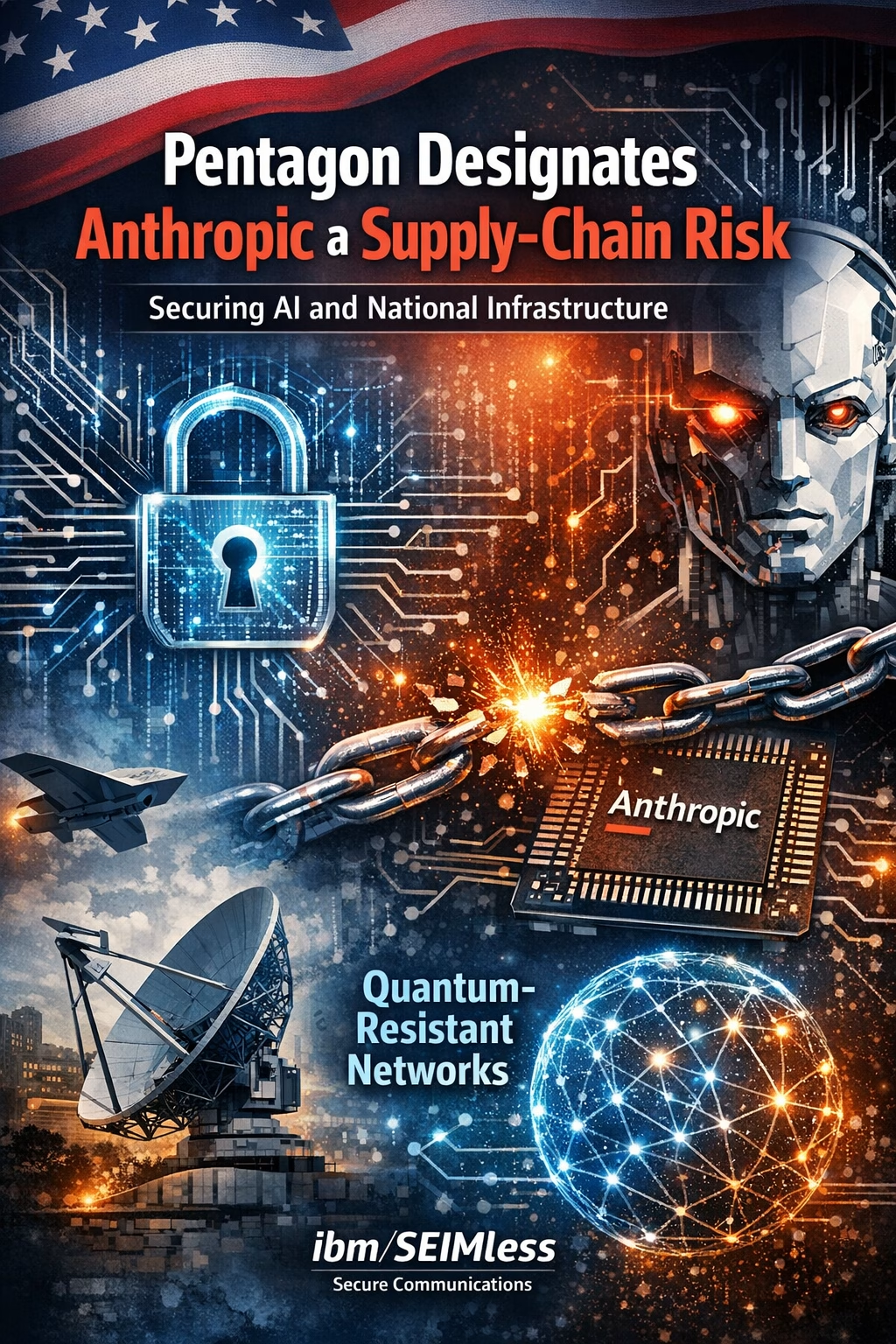
In a significant development within the cybersecurity and artificial intelligence landscape, the United States Department of Defense—commonly known as the Pentagon—has formally designated Anthropic as a potential supply-chain risk.
This decision signals a broader shift in how governments evaluate AI vendors involved in sensitive digital ecosystems, national defense technologies, and critical infrastructure networks.
For organizations responsible for mission-critical communications, including government contractors and advanced technology firms, this designation underscores the urgent need for secure, transparent, and quantum-resilient infrastructure.
Companies like SEIMless Communications Technologies, Inc. (ibm/SEIMless), headquartered in New York, are responding to this new security paradigm by developing Quantum Resistant Networks (QRN) designed to protect sensitive data from both classical and emerging quantum threats.
Understanding the Pentagon’s Supply-Chain Risk Designation
Supply-chain risk designations typically occur when a vendor’s technologies, data handling practices, or operational dependencies raise concerns regarding:
- Data sovereignty
- Foreign technology dependencies
- Algorithmic transparency
- Cybersecurity vulnerabilities
- Insider threat exposure
With AI systems increasingly integrated into defense logistics, surveillance analytics, communications platforms, and autonomous systems, even small vulnerabilities can create large-scale national security risks.
When the Pentagon identifies a potential risk within the AI supply chain, it often triggers:
- Procurement restrictions
- Additional security reviews
- Vendor compliance audits
- Contract re-evaluations
Such actions ripple across the broader technology ecosystem, forcing organizations to reassess their AI infrastructure and digital trust frameworks.
Why AI Supply Chains Are Becoming a National Security Priority
Artificial intelligence platforms increasingly operate as foundational infrastructure within both public and private sectors. Unlike traditional software vendors, AI providers manage complex models, training data pipelines, and continuous learning mechanisms.
This introduces several security concerns:
1. Data Integrity Risks
AI systems trained on compromised or manipulated datasets can produce unreliable or biased outputs.
2. Model Manipulation
Adversarial attacks may exploit model weaknesses to manipulate decision-making processes.
3. Cloud Dependency Vulnerabilities
Centralized AI services may expose sensitive operational data to external infrastructure risks.
4. Quantum-Era Encryption Threats
Emerging quantum computing capabilities could eventually break traditional cryptographic protections.
These risks explain why governments are shifting toward secure AI supply chains combined with next-generation encryption technologies.
The Role of Quantum-Resistant Networks
At ibm/SEIMless, security architecture focuses on post-quantum communications infrastructure designed to withstand both present-day cyber threats and future quantum decryption capabilities.
Through its advanced Exodus QRN framework, the company is developing network ecosystems that deliver:
- Quantum-resistant encryption
- Secure decentralized key management
- Defense-grade communications protocols
- AI-compatible cybersecurity frameworks
More details on this architecture can be explored at
👉 https://www.seimless.com
These technologies aim to ensure that sensitive government and enterprise data remains secure even as computing power dramatically evolves.
What This Means for Government Contractors and Enterprises
The Pentagon’s action is likely to influence procurement decisions across the broader federal ecosystem. Organizations operating within defense or critical infrastructure sectors should consider several strategic steps:
Conduct AI Vendor Risk Assessments
Evaluate whether AI service providers comply with strict cybersecurity and transparency standards.
Implement Post-Quantum Security Strategies
Prepare for the future of cryptography by adopting quantum-resistant encryption frameworks.
Secure Communications Infrastructure
Transition from legacy systems toward secure digital communications networks designed for high-risk environments.
Strengthen Data Governance Policies
Ensure AI training datasets and operational pipelines maintain full traceability and integrity.
The Future of Secure AI Ecosystems
The Pentagon’s designation is not simply about one vendor—it reflects a broader transformation in how AI technology, cybersecurity, and national security intersect.
In the coming years we will likely see:
- Increased federal regulation of AI supply chains
- Mandatory AI risk certification frameworks
- Expansion of post-quantum cybersecurity standards
- Greater demand for trusted communications infrastructure
Technology leaders like ibm/SEIMless are actively working to support this transition through secure communications platforms and quantum-resistant networks capable of protecting critical systems worldwide.
Conclusion
The designation of Anthropic as a supply-chain risk represents a pivotal moment in the governance of artificial intelligence technologies within national security environments.
As AI systems continue to power defense operations, enterprise decision platforms, and critical infrastructure networks, security, transparency, and quantum-resilience will become essential requirements.
Organizations seeking to future-proof their communications and cybersecurity infrastructure can explore advanced secure networking solutions at:
With emerging threats evolving rapidly, investing in quantum-resistant communications and trusted AI infrastructure is no longer optional—it is a strategic necessity.