by hannahadmin | Sep 28, 2026 | blog, WAN
The dark fiber vs wavelength decision has moved from a niche carrier conversation to a board-level infrastructure question. AI training, inference, cloud on-ramps and hybrid cloud replication push enormous data volumes between a few locations and punish congestion and outages.
For CIOs, CISOs and network leaders, getting dark fiber vs wavelength right shapes cost, agility and risk for years. This guide defines each option, compares them side by side, and closes with a practical RFP checklist.
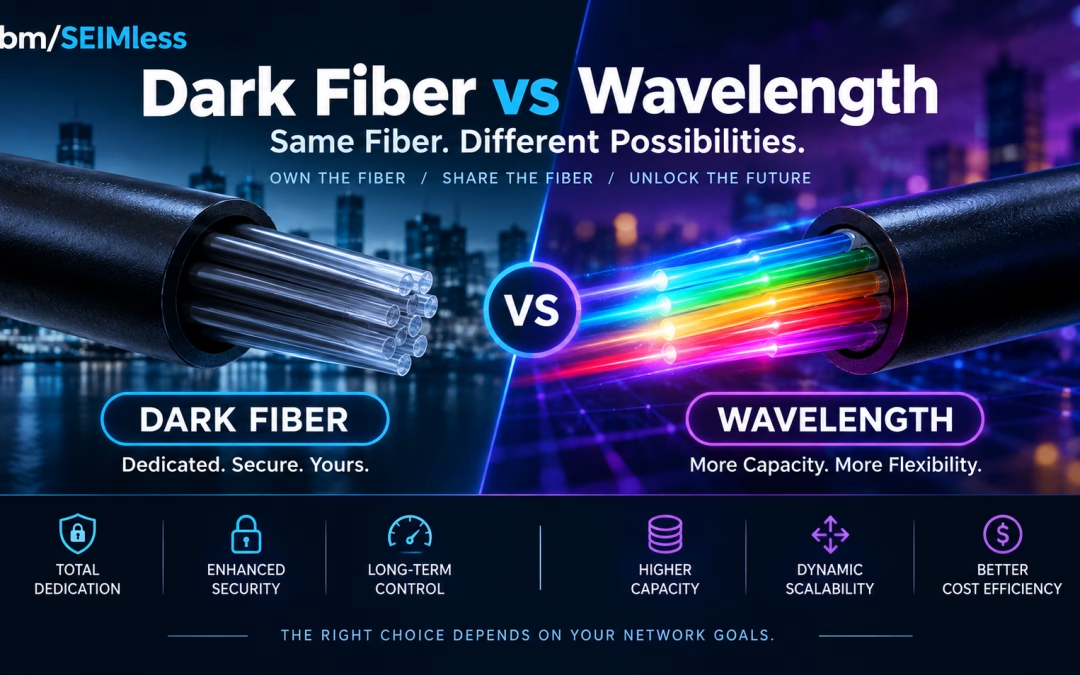
| What is dark fiber vs wavelength? Dark fiber vs wavelength is the choice between leasing unlit optical strands that you light and operate with your own equipment, and buying a lit wavelength service where a carrier provides a dedicated optical channel (such as 100G or 400G) over its DWDM system. Dark fiber maximizes control; wavelengths minimize operational burden. |
| KEY TAKEAWAYS
■ AI and data center growth are driving demand for dedicated 100G, 400G and 800G optical capacity between data centers, clouds and offices.
■ Dark fiber offers near-unlimited capacity and full control but requires optical equipment, skills and CapEx; wavelengths deliver carrier-managed capacity with SLAs on an OpEx model.
■ Physical layer links are not automatically private. Encrypt data in motion and plan now for quantum-safe cryptography.
■ Diverse routing, not just bandwidth, determines whether your private optical network survives a fiber cut.
■ A disciplined RFP that asks about routes, latency, SLAs and encryption prevents expensive surprises. |
Why AI Workloads Are Reshaping the Dark Fiber vs Wavelength Debate
AI is a transport story as much as a compute story. Training datasets, checkpoints and replicated storage move constantly between GPU clusters, colocation halls and public clouds.
The energy data shows how quickly the underlying footprint is growing. According to the U.S. Department of Energy’s release on the Berkeley Lab data center report, data centers consumed about 4.4% of total U.S. electricity in 2023 and could reach roughly 6.7% to 12% by 2028. The full 2024 United States Data Center Energy Usage Report from Lawrence Berkeley National Laboratory traces consumption from 58 TWh in 2014 to 176 TWh in 2023.
The U.S. Energy Information Administration’s Annual Energy Outlook 2026 announcement states that data center load is emerging as the dominant driver of long-term U.S. electricity growth. A May 2026 EIA Today in Energy analysis of data center server energy use estimates that servers accounted for about 7% of commercial-sector electricity in 2025.
Every new megawatt of compute needs a path in and out, so hyperscaler moves such as Alphabet’s $2B data center investment and Meta’s plan to sell AI computing power ripple into enterprise demand for data center interconnect.
The optical speed ladder: 100G, 400G and 800G
The IEEE Standards Association approved IEEE 802.3df-2024, which defines 400 Gb/s and 800 Gb/s Ethernet operation, in February 2024. Cloud providers have followed: AWS Direct Connect documentation lists MACsec support on 10, 100 and 400 Gbps dedicated connections at selected locations.
For most enterprises, 10G and 100G waves remain the workhorses, but GPU clusters and multi-cloud AI pipelines increasingly justify 400G wavelength services. Faster rates also change the dark fiber vs wavelength math, because each new generation of optics lights more capacity on the same strands.
Public investment in middle-mile fiber
Federal programs are also expanding the fiber footprint. NTIA’s Enabling Middle Mile Broadband Infrastructure Program awarded $980 million in 2023. NTIA’s program highlights report more than 12,500 miles of new middle-mile fiber across 40 states and territories. For availability research at specific addresses, the FCC National Broadband Map and the underlying FCC Broadband Data Collection are useful starting points for mass-market service, though not for enterprise optical routes.
Definitions: Dark Fiber, Wavelengths, Ethernet, Private Line and SONET
These terms are often blurred in vendor proposals, so define them before you compare dark fiber vs wavelength pricing.
Dark fiber
Dark fiber is unlit optical fiber leased (often through a long-term indefeasible right of use, or IRU) with no carrier electronics attached. You install your own optics or DWDM platform at each end and decide how many channels to run and at what speeds. ibm/SEIMless dark fiber services range from individual strands to high-count cable designs across more than 20,000 route miles in the Northeast, mid-Atlantic and Chicago regions.
Wavelength (lit) services
A wavelength service is a dedicated optical channel, a specific “color” of light, on a carrier’s DWDM network. You receive a clean handoff such as 10G, 100G or 400G, and the carrier manages the optical layer. ibm/SEIMless wavelength services provide low-latency, point-to-point private connections between data centers and other facilities with dedicated capacity.
Carrier Ethernet
Carrier Ethernet delivers Layer 2 connectivity (E-Line, EVPL, E-LAN) that can be shared or dedicated. ibm/SEIMless Ethernet services offer committed information rates from 10 Mbps to 100 Gbps, making them a flexible middle ground for branch and metro connectivity.
Private line and SONET
Traditional TDM circuits still serve voice and legacy workloads. A private line delivers DS-1, DS-3 and OC-N capacity with optional route diversity. SONET services use ring-based protection for high availability and remain common for disaster recovery and PBX backhaul.
Dark Fiber vs Wavelength: Side-by-Side Comparison
Actual terms vary by route, market and carrier, so treat this table as a framework rather than a quote.
| Factor |
Dark Fiber |
Wavelength Service |
Carrier Ethernet |
Private Line / SONET |
| Control |
Full control of optics, channels and upgrades |
Carrier controls optical layer; you control traffic |
Carrier-managed Layer 2 |
Carrier-managed TDM |
| Cost model |
CapEx heavy (IRU plus equipment), low marginal cost per added channel |
OpEx monthly recurring charge per wave |
OpEx, priced by committed rate |
OpEx, priced by circuit |
| Scalability |
Add wavelengths by upgrading your own gear |
Order additional waves or higher-rate waves |
Increase committed rate up to port speed |
Limited; step changes by circuit type |
| Lead times |
Often longest if construction or splicing is needed |
Shorter where the carrier is already lit on-net |
Short to moderate on-net |
Depends on legacy availability |
| SLAs |
Typically fiber availability only; you own performance |
Availability, latency and repair SLAs from carrier |
Availability, latency, jitter, loss SLAs |
Availability and protection switching |
| Management burden |
High; you need optical engineering and 24/7 operations |
Low to moderate |
Low |
Low |
| Security posture |
Physically dedicated; you choose and manage encryption |
Dedicated channel on shared fiber; encryption strongly advised |
Logical separation; encryption advised |
Dedicated timeslots; encryption advised |
The core trade-off in any dark fiber vs wavelength evaluation is control versus operational simplicity. Dark fiber rewards organizations with scale and optical expertise; wavelengths reward organizations that want predictable, carrier-supported capacity.
When Each Option Fits
Financial trading and low-latency markets
Trading firms care about microseconds. Dark fiber lets them choose the straightest route and lowest-latency optics, while wavelengths compete when the carrier guarantees route-specific latency.
The SEC’s proposed expansion of Regulation SCI emphasizes capacity, resiliency and business continuity testing for critical market participants. ibm/SEIMless dark fiber links major Chicago metro areas and financial exchanges, which is relevant for these designs.
Healthcare imaging and clinical data
Hospitals move large imaging studies and EHR replicas between campuses and data centers. The HHS HIPAA Security Rule requires technical measures to guard against unauthorized access to ePHI transmitted over electronic networks. An encrypted 10G or 100G wavelength usually balances capacity, compliance and staffing best.
Multi-site enterprises and hybrid cloud
Multi-site organizations often blend services: wavelengths or dark fiber between primary data centers, Carrier Ethernet to large offices, and SD-WAN for smaller branches. Private optical links into AWS, Google Cloud and Microsoft Azure on-ramps also reduce reliance on the public internet for private and hybrid cloud workloads.
Retiring legacy circuits? Weigh our MPLS service against our MPLS replacement solutions. Our guide to choosing hosting and co-location explains how facility choice drives interconnect options.
Security of Optical Links: Why Layer 1 Is Not Automatically Private
Whichever side of the dark fiber vs wavelength choice you land on, a dedicated path is not automatically private. Fiber can be tapped by bending or splicing, and huts, splice points and carrier facilities add exposure.
In December 2024, CISA, NSA, FBI and international partners published enhanced visibility and hardening guidance for communications infrastructure after PRC-affiliated actors compromised major telecommunications providers. The guidance recommends strong encryption wherever possible. CISA’s Communications Sector overview notes that every critical sector depends on communications.
Encryption options for data in motion
Quantum-safe encryption and harvest now, decrypt later
High-capacity optical links carry the long-lived data adversaries want to capture now and decrypt later, as explained in our post on why 2026 is the year to move to quantum-resistant networking.
NIST published FIPS 203 (ML-KEM) in August 2024 and later selected HQC as a backup post-quantum algorithm. The draft NIST IR 8547 transition report lays out the migration away from quantum-vulnerable algorithms. NSA’s CNSA 2.0 announcement sets quantum-resistant requirements for national security systems. The joint CISA, NSA and NIST quantum-readiness factsheet urges organizations to inventory cryptography and engage vendors now, and CISA’s Post-Quantum Cryptography Initiative supports critical infrastructure in that transition.
Exodus QRN data-in-motion protection uses quantum-resistant encryption designed to minimize latency while preserving data integrity in transit. Pair it with Exodus key management and review our overview of quantum computing and encryption to build a roadmap.
Diverse Routing and Resilience
Bandwidth without diversity is a single point of failure. A backhoe can take down a 400G wave as easily as a 1G circuit, so resilience belongs in every dark fiber vs wavelength design.
Design for it explicitly:
- Physically diverse paths: Separate conduits, rights-of-way and building entrances, verified with route maps rather than verbal promises.
- Diverse river and corridor crossings: In the New York metro area, ibm/SEIMless dark fiber offers 16 diverse river crossings plus a diverse Transcom route that bypasses the I-95 corridor.
- Protection schemes: Choose between protected wavelengths, SONET ring protection, or two unprotected waves on diverse routes.
- Tested recovery: Include failover drills in your backup and recovery
Financial institutions should align designs with the FFIEC Business Continuity Management booklet, which examiners use to assess enterprise resilience. Oversight bodies have also scrutinized sector coordination, as the GAO noted in its report on CISA’s support for the communications sector.
Dark Fiber vs Wavelength Buying Checklist: RFP Questions to Ask
A structured RFP turns a dark fiber vs wavelength evaluation into an apples-to-apples comparison. Use these questions with every provider:
- Route and diversity: Can you provide KMZ route maps, building entrance details and shared-conduit disclosures for every path?
- Latency: What is the guaranteed round-trip latency per route, and how is it measured and reported?
- Capacity roadmap: Can the route support 100G, 400G and 800G today? What is the upgrade path and cost?
- SLAs: What are the availability, mean-time-to-repair and latency SLAs, and what credits apply?
- Lead times: Is the route on-net and lit, or does it require construction, permits or splicing?
- Encryption: Do you offer Layer 1, OTN or MACsec encryption? Are modules FIPS 140-3 validated? What is your post-quantum roadmap?
- Commercials: For dark fiber, what are IRU length, maintenance fees and relocation terms? For wavelengths, what are term discounts and upgrade rights?
- Cloud and colocation reach: Which data centers, carrier hotels and cloud on-ramps are on-net?
- Exit and portability: What happens at term end, and can you migrate without downtime?
For a deeper framework, see our guide on building a custom network strategy or evaluating ISPs for an RFP.
How ibm/SEIMless Helps You Decide
ibm/SEIMless has been a vendor-agnostic carrier, cloud and communications partner for more than 20 years. That independence matters, because the right dark fiber vs wavelength answer is often a blend.
Our dark fiber footprint includes access to more than 175 data centers and more than 250 carrier hotels and central offices, plus about 1,000 route miles in Virginia connected to the Ashburn data hub. Where lit services fit better, we design around your latency, resilience and budget targets.
We then add transport-layer security with Exodus QRN. Our post on Exodus wide area networking across the USA explains how that fits into a national WAN, and our look at AI-native networks shows where telecom architecture is heading.
Frequently Asked Questions
Is dark fiber cheaper than a wavelength service?
It depends on scale and time horizon. Dark fiber usually requires higher upfront spending on the IRU and optical equipment, but adding more wavelengths later costs relatively little. A wavelength service has predictable monthly charges and no equipment to buy. Organizations needing many high-capacity channels on one route for many years often find dark fiber more economical over the full term.
What speeds do wavelength services support in 2026?
Most enterprise wavelength services are delivered at 10G and 100G, with 400G increasingly common between data centers and cloud on-ramps. IEEE 802.3df-2024 defines 400 Gb/s and 800 Gb/s Ethernet, and 800G is emerging in the largest AI deployments. Availability depends on the carrier’s DWDM platform and the specific route.
Is a dedicated fiber or wavelength secure without encryption?
No. A dedicated optical path is separated from the public internet, but fiber can be tapped and carrier facilities can be compromised. Federal guidance from CISA, NSA and FBI recommends strong encryption wherever possible. Use Layer 1, OTN or MACsec encryption with validated modules, and plan a transition to quantum-resistant cryptography for long-lived sensitive data.
When should an enterprise choose dark fiber over wavelengths?
Choose dark fiber when you need very high or rapidly growing capacity on a fixed route, want full control over optics and latency, and have or can hire optical engineering and 24/7 operations. Financial trading firms, hyperscale-adjacent AI operators and large health systems with several campuses are typical candidates. Otherwise, wavelengths usually deliver faster time to value.
How does harvest now, decrypt later affect optical networks?
Adversaries can record encrypted traffic today and store it until quantum computers can break classical public-key algorithms. High-capacity data center interconnect links carry exactly the long-lived financial, health and intellectual property data they target. Adopting NIST’s post-quantum standards, such as FIPS 203 ML-KEM, and quantum-resistant encryption for data in motion reduces that future exposure.
What should an RFP for dark fiber or wavelengths include?
A strong RFP asks for route maps and shared-conduit disclosures, guaranteed latency per route, availability and repair SLAs with credits, lead times, and upgrade paths to 400G or 800G. It should also request encryption options, FIPS 140-3 validation status, a post-quantum roadmap, on-net data center and cloud locations, and clear terms for renewal, relocation and exit.
Talk to ibm/SEIMless About Your Dark Fiber vs Wavelength Strategy
Your AI and hybrid cloud plans deserve an optical foundation that is fast, resilient and secure. ibm/SEIMless will map your routes, compare every option side by side, and design quantum-resistant protection for data in motion.
Get started with a network assessment or contact our team today.
- Phone: 646-546-5245
- Email: in**@**********ss.com
- Address: One Liberty Plaza, New York, NY 10006
by hannahadmin | Sep 4, 2026 | cybersecurity, Next-gen Security solutions, Seimless, WAN
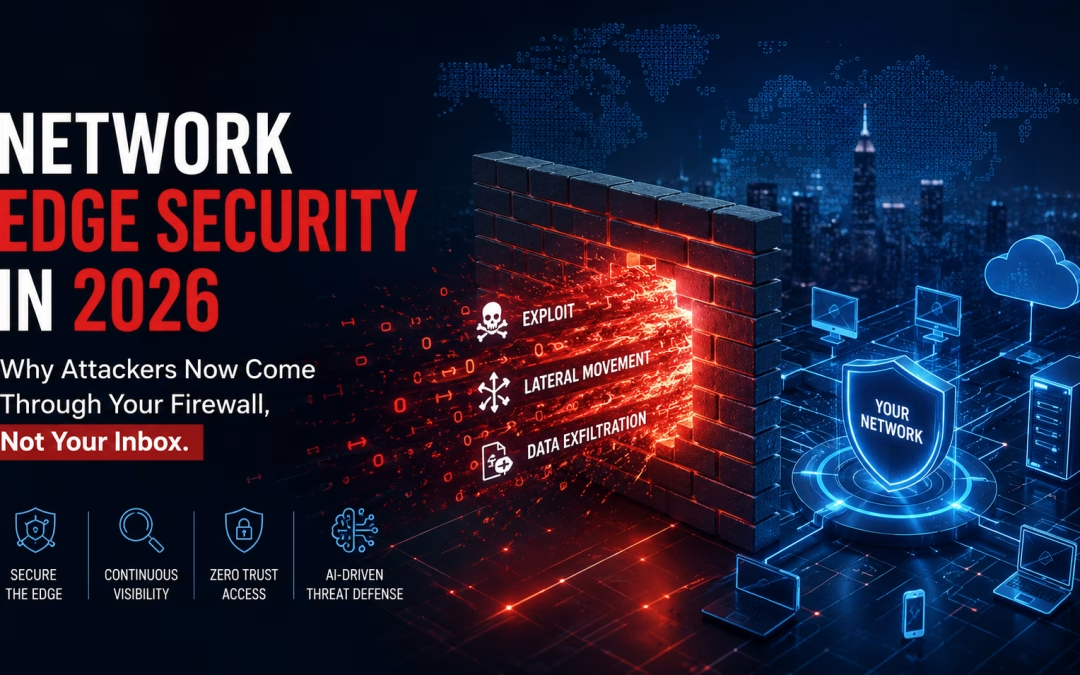
Network edge security has quietly become the single highest-leverage control in the enterprise, and the 2026 incident data explains why. Exploits are now the leading way attackers get in, for the sixth year running. Email phishing has fallen to a fraction of what it was. The front door moved, and most security budgets have not followed it.
That shift is uncomfortable, because network edge security is exactly where traditional tooling goes blind. Your endpoint agent does not run on a VPN concentrator. Your SIEM may not receive its logs. Meanwhile the device sits on the public internet, holds credentials for the network behind it, and often runs firmware nobody has touched in three years.
At ibm/SEIMless, we have spent more than two decades designing and operating enterprise networks. This guide sets out what changed in 2026, what the numbers actually show, how a modern edge compromise unfolds, and a practical program to close the gap.
What Network Edge Security Means in 2026
The edge is no longer a single boundary device. It is every internet-facing appliance that terminates a session, holds a credential, or routes traffic between trust zones.
That list is longer than most inventories admit. It includes firewalls, VPN gateways, SD-WAN appliances, load balancers, secure web gateways, remote access servers, routers, branch switches, out-of-band management interfaces, and file transfer appliances. Furthermore, it includes every one of those devices at every branch, not only at headquarters.
The Edge Grew While Nobody Redrew the Map
Three changes expanded the edge without anyone deciding to expand it, and each one widened the network edge security problem.
Remote work multiplied VPN and gateway capacity, and much of that emergency capacity is still running. Branch networks moved from private circuits to internet underlays, which put appliances at every site on the public internet. Cloud adoption added a second edge in front of workloads that used to sit safely inside a data center.
Consequently, the attack surface grew faster than the asset inventory. Ask most teams for a complete list of internet-facing appliances by firmware version and you will get a spreadsheet that is at least a quarter out of date. That inventory gap is the real vulnerability, and everything else follows from it. Our guidance on enterprise IT infrastructure services starts from exactly this point.
The 2026 Data: Exploits Beat Phishing, and the Edge Is Where They Land
Three major datasets published this year point the same direction on network edge security, which is unusual and worth taking seriously.
Exploits Are Now the Number One Way In
Mandiant’s M-Trends 2026, released on 23 March 2026, found exploits responsible for 32% of initial infections, the most common vector for the sixth consecutive year. Voice phishing came second at 11%, and prior compromise third at 10%.
Email phishing, by contrast, accounted for just 6% of cases, down from 22% in 2022. Automated email controls worked. Therefore attackers moved to the surface those controls do not cover.
Verizon’s 2026 Data Breach Investigations Report reaches a similar conclusion from a different dataset, reporting that 31% of breaches now start with software vulnerabilities, overtaking stolen passwords as the leading entry point.
Twenty-Two Seconds From Access to Handoff
The most alarming number in M-Trends is not about entry at all. It is about speed.
In 2022, the median gap between an initial access event and handoff to a secondary threat group ran to more than eight hours. In 2025, that window collapsed to 22 seconds. Access brokers now pre-stage the second actor’s tooling during the initial intrusion, so the handoff is instantaneous.
Consider what that does to your response plan. If your playbook assumes hours between compromise and escalation, it is planning around a window that no longer exists. Help Net Security’s coverage notes the median dwell time actually rose to 14 days in 2025, so defenders are getting less time to act and more time to bleed.
Where the Exploited Devices Actually Live
VulnCheck’s 2026 State of Exploitation report, also published on 23 March 2026, adds the device-level picture, and it is bleak.
42.5% of vulnerabilities exploited in 2025 affected end-of-life or likely end-of-life devices. Consumer routers and widely distributed networking products accounted for 56% of exploited edge device vulnerabilities. Among botnet-exploited vulnerabilities, 65% hit end-of-life products.
Read that again, because it reframes the problem. This is not primarily a zero-day story. It is an asset lifecycle story. Devices that should have been retired are still terminating production traffic, and attackers know it. Our post on modernizing cabling and infrastructure covers the physical half of the same neglect.
Why the Numbers Converge
Independent datasets rarely agree this closely, which is what makes the 2026 picture persuasive.
Mandiant works from incident response engagements. Verizon works from breach reports across thousands of organizations. VulnCheck works from honeypots and exploitation telemetry. Tenable and SentinelOne work from customer environments and actor attribution. Four different vantage points, four different collection methods, and one shared conclusion about where intrusions begin.
Furthermore, the Tenable and SentinelOne comparison found 79% convergence on the same vendor attack surfaces despite minimal overlap at the individual CVE level. Different sensors, different flaws, same handful of products. When that many independent measurements agree, treating network edge security as a secondary priority becomes very hard to defend in a board paper.
The Patch Gap That Undermines Network Edge Security
In network edge security, knowing which device is vulnerable turns out to be easier than getting it fixed. Joint research from Tenable and SentinelOne, published on 26 August 2026, quantifies the delay across 93 CVE-to-actor attribution pairs.
The Priority Paradox
High-priority CVEs carry a median remediation time of 146 days, against 122 days for everything else. In other words, the vulnerabilities you flagged as urgent get patched *24 days slower* than the ones you did not.
The reason is operational rather than negligent. Critical edge appliances carry the highest change-control friction, because rebooting a VPN concentrator disconnects the workforce. So the most dangerous devices are the hardest ones to touch, and the queue grows.
Exposure varies sharply by vendor. The same research found actively exploited CVEs present in 53.8% of monitored environments running F5, 24.9% for Fortinet, 24.1% for Ivanti and 18.6% for Check Point. Citrix customers showed the slowest remediation of all, at a median of 461 days.
KEV Is Necessary but Not Sufficient
Most vulnerability programs anchor on CISA’s Known Exploited Vulnerabilities catalog, and they should. It remains the authoritative record of what is being exploited in the wild.
However, VulnCheck found that only 23.7% of the vulnerabilities it observed under active exploitation appear in KEV. Treating KEV as the complete picture leaves roughly three quarters of observed exploitation unaddressed. Pair it with probabilistic scoring such as FIRST’s EPSS and with internet-scanning telemetry from organizations like the Shadowserver Foundation, which sends free daily exposure reports to network operators.
How a Modern Edge Compromise Actually Unfolds
The clearest public description of edge tradecraft is the multinational advisory on Chinese state-sponsored compromise of networks worldwide, co-authored by the NSA, CISA, FBI and DC3 alongside agencies from twelve other countries. It maps a pattern that criminal groups now imitate.
Step one: exploit a known CVE. The advisory names CVE-2023-20198, CVE-2024-3400 and CVE-2024-21887. None was a zero-day at the time of widespread use. Each had a patch available.
Step two: persist below the agent. Attackers modify access control lists, enable unauthorized SSH, and abuse virtualized containers such as Guest Shell. No endpoint agent runs there, so nothing alerts.
Step three: collect credentials at the choke point. Using the device’s own packet capture capability, they harvest authentication traffic including TACACS+. The edge device is the ideal listening post precisely because everything passes through it.
Step four: move and tunnel out. SNMP enumeration maps the internal network, then GRE and IPsec tunnels carry data out through traffic that looks entirely routine.
Notice that only step one involves a vulnerability. Everything after that uses features the device shipped with. We covered a comparable pattern in Interlock ransomware exploiting a Cisco FMC zero-day and in the actively exploited Fortinet flaw from 2020.
Why EDR Alone Cannot Deliver Network Edge Security
Most enterprises answer the network edge security detection question with the name of their EDR product. On the edge, that answer does not hold.
Edge appliances run vendor-locked operating systems that do not accept third-party agents. So the detection you rely on everywhere else is structurally absent at the one place attackers now prefer. Endpoint detection and response remains essential, yet it needs a network-side partner rather than being asked to cover ground it cannot reach.
Three controls fill that gap. First, configuration integrity monitoring that alerts on ACL, SSH and container changes. Second, centralized encrypted logging shipped off the device, so an attacker who clears local logs does not erase the evidence. Third, network detection that watches for unexpected tunnels and management-plane traffic, which is where Exodus ARIA ADR and Exodus NxtGen Firewall do their work.
Four Network Edge Security Myths That Cost Money
Every edge program runs into the same four objections. Each sounds reasonable, and each is wrong in a way the 2026 data now settles.
“We are behind a next-generation firewall, so we are covered.” The firewall is the target. Exposure research found actively exploited CVEs sitting inside a quarter to a half of monitored environments depending on vendor. A control that is itself unpatched protects nothing.
“Our devices are not interesting enough to attract state actors.” The multi-nexus finding kills this one. Twelve CVEs in the combined Tenable and SentinelOne dataset showed state-sponsored *and* criminal groups exploiting the same flaw independently. Ransomware crews reuse espionage tradecraft within weeks, so nobody stays uninteresting for long.
“We patch quarterly, which is fine for infrastructure.” A quarterly cycle against a 22-second handoff window is not a mismatch, it is a formality. Edge devices need an exception path, and that path must exist before you need it.
“Multi-factor authentication on the VPN solves this.” Strong authentication protects the login. It does nothing about a pre-authentication remote code execution flaw in the appliance that presents the login page. Both matter, but they defend different things.
Underneath all four sits the same assumption, namely that the edge is infrastructure rather than a security control. Once you treat every internet-facing appliance as a security product with a support contract and a firmware baseline, network edge security stops being an annual scramble. Our post on today’s software-defined networks not being future-ready makes the same argument from the architecture side.
A Nine-Point Network Edge Security Program
This is the network edge security sequence we run with clients. It is deliberately ordered so the cheapest, highest-impact steps come first.
- Build a complete edge inventory. Every internet-facing appliance, with model, firmware version, support status and end-of-life date. Nothing else works without this.
- Retire end-of-life devices first. Given that 42.5% of exploited vulnerabilities hit end-of-life gear, replacement often beats patching as a risk reduction per dollar.
- Get management planes off the internet. No administrative interface should be publicly reachable. Use dedicated management VRFs and jump hosts, as the joint advisory recommends.
- Disable what you do not use. Guest Shell, Smart Install, HTTP interfaces, unused SNMP communities. Every disabled feature is one fewer persistence option.
- Ship logs off the box, encrypted. Centralized logging is the only reliable way to detect edge tampering, since local logs are the first thing an attacker edits.
Steps Six to Nine: Prioritize, Verify, Segment and Rehearse
- Prioritize with three signals, not one. Combine KEV, EPSS probability, and your own exposure data. Any single source leaves gaps, as the 23.7% coverage figure shows.
- Pre-approve emergency change windows for edge patching. The 24-day priority paradox is a process problem. Fix it by agreeing the maintenance window before the emergency, not during it.
- Segment behind the edge. Assume the appliance falls. NIST SP 800-207 Zero Trust Architecture and our zero trust content security approach both start from that assumption, so a compromised gateway yields a segment rather than the network.
- Rehearse a 22-second scenario. Run a tabletop where escalation is immediate. Most response plans quietly assume hours of grace, and that assumption no longer survives contact.
Map the whole program to NIST Cybersecurity Framework 2.0 so it reports cleanly to your board, and cross-check device hardening against the UK NCSC device security guidance.
Network Edge Security in the First Thirty Days
Keep the opening month small and concrete, because ambitious programs stall.
In week one, produce the inventory. Accept that it will be imperfect, and publish it anyway.
In week two, flag every end-of-life and out-of-support device, then price replacement. That list becomes your budget conversation.
In week three, close public management interfaces and disable unused services. This costs nothing and removes the most common persistence paths.
In week four, turn on centralized logging and agree the emergency patch window. Then report one number to leadership: the percentage of edge devices under active support with current firmware.
Five Questions to Ask Before Your Next Edge Refresh
Procurement is where most network edge security debt gets created, so these five questions belong in every evaluation.
- What is the published end-of-support date for this exact model? Not the product line, the model. End-of-life gear carried 42.5% of exploited vulnerabilities, so this date is a security control.
- How quickly have you shipped fixes for actively exploited flaws in the past two years? Ask for dates. Vendor responsiveness varies enormously, and the record is public.
- Can the management interface be fully isolated from the data plane? If the answer requires creative network design, the product is fighting you.
- What does the device log, and can it stream encrypted to our collector in real time? Logging that only lives on the appliance disappears with the first attacker who reaches root.
- Will you support post-quantum key exchange, and when? Long-lived tunnels captured today stay readable later, a point we cover in Harvest Now, Decrypt Later.
Ask the same five of the appliances already in production. Most edge debt arrives through renewals and quiet refreshes rather than through deliberate new purchases, so the installed base usually answers worse than the shortlist.
Network Edge Security Risk by Sector
Network edge security exposure is not evenly distributed, because operational tolerance for downtime varies enormously.
Manufacturing and industrial. Dragos recorded 1,140 industrial ransomware incidents in Q2 2026, a 12% rise on the prior quarter, with manufacturing absorbing 747 of them. Plant networks tolerate downtime poorly, so edge patching slips further here than anywhere else.
Healthcare. Clinical continuity makes maintenance windows scarce, and remote access gateways for clinicians are a standing target. Segmentation matters more than patch speed when patch speed is genuinely constrained.
Financial services. Regulatory scrutiny of third-party and infrastructure risk keeps rising, and edge appliances sit squarely inside it. Our analysis of why big cybersecurity budgets still fail speaks directly to the spend-versus-control mismatch.
Telecom and service providers. The joint advisory named telecommunications infrastructure specifically. Router compromise here is not only a company problem, since it exposes the customers riding those circuits.
Public sector and suppliers. Procurement increasingly asks for firmware currency and support status by name. Our reporting on CISA adding actively exploited flaws to KEV tracks how quickly those expectations harden.
Across all of them, the financial stakes moved too. IBM’s Cost of a Data Breach Report 2026 puts the global average at $4.99 million, a 12% increase and a record high, while the World Economic Forum’s Global Cybersecurity Outlook 2026 documents widening capability gaps between organizations.
How ibm/SEIMless Approaches Network Edge Security
We are vendor-agnostic by design, and since 2001 we have chosen technology on fit rather than on partnership incentives. When exposure rates differ by a factor of three between edge vendors, that independence stops being a philosophical position and becomes a practical one.
Our network edge security work starts with the transport, because the edge is where the network meets everything else. Whether you run SD-WAN, MPLS, Ethernet, private line, wavelength services, dark fiber or wireless, each termination point is an edge device that needs an owner, a firmware baseline and a support contract. Teams evaluating MPLS replacement solutions should count the new appliances that decision introduces.
Enforcement runs through NxT-Gen Network Security Solutions, including Exodus NxtGen Firewall, zero trust content security and managed WAN optimization. Data protection sits underneath through Exodus Transparent Encryption and our Exodus Quantum-Resistant Networking portfolio, which protects data in motion across exactly the links an edge compromise would target.
Two related pieces round out the picture. Our post on agentic AI security meeting Q-Day explains why autonomous tooling shortens every timeline above, and the 2026 shadow AI playbook covers the governance gap that sits alongside this one.
Frequently Asked Questions
What counts as a network edge device?
Any internet-facing appliance that terminates sessions, holds credentials, or routes between trust zones. That includes firewalls, VPN gateways, SD-WAN appliances, load balancers, routers, remote access servers and file transfer appliances, at every site rather than only at headquarters.
Why is network edge security suddenly a priority in 2026?
Exploits became the leading initial infection vector at 32%, while email phishing fell to 6%. Attackers followed the weakest surface, and edge appliances offer internet exposure, credential access and no endpoint agent coverage.
Is this mainly a zero-day problem?
No. VulnCheck found that 42.5% of vulnerabilities exploited in 2025 affected end-of-life or likely end-of-life devices, and the major state-sponsored campaigns used CVEs that already had patches available.
Does our EDR cover edge appliances?
Generally not. Edge devices run vendor-locked operating systems that do not accept third-party agents, so coverage has to come from configuration integrity monitoring, centralized logging and network detection instead.
Is the CISA KEV catalog enough for prioritization?
It is essential but incomplete. Only 23.7% of vulnerabilities VulnCheck observed under active exploitation appeared in KEV, so combine it with EPSS scoring and your own exposure telemetry.
What single step reduces edge risk fastest?
Get management interfaces off the public internet. It costs nothing, takes days rather than quarters, and removes the access path most edge intrusions depend on.
Conclusion
The perimeter did not disappear. It changed shape, moved to every branch office, and stopped being covered by the tooling most enterprises trust. That is the whole network edge security problem in one sentence.
The 2026 evidence is consistent across independent datasets. Exploits lead at 32%, edge devices are where those exploits land, end-of-life hardware carries 42.5% of the exploited vulnerabilities, and the window between compromise and escalation is now 22 seconds. None of that requires a new product category to address. It requires an accurate inventory, a retirement budget, closed management planes and a maintenance window agreed in advance.
Network edge security rewards discipline over spending. The organizations that get this right are rarely the ones with the largest budgets. They are the ones that know exactly what is plugged into the internet, and who owns it.
Ready to find out what your edge actually looks like? Get started with ibm/SEIMless or contact our team for an edge inventory and exposure assessment. You can also review our reports, browse our partners, read the FAQs, or explore distributor opportunities.
Contact Us | Our Blog | Our Services | See Previous Post….
by hannahadmin | Jul 29, 2026 | blog, Document management, Enterprise technology, Next-gen Security solutions, PBX, Public and Private cloud, QRN, Seimless, WAN
Quantum computing is changing cybersecurity strategy long before most organizations deploy a cryptographically relevant quantum computer. The reason is simple: the encryption protecting enterprise data, identities, VPNs, code-signing workflows, and digital trust systems is built on mathematical assumptions that quantum machines are expected to weaken or break at scale. NIST says its Post-Quantum Cryptography project exists to protect electronic information against that future threat, because quantum computers could eventually break many widely used cryptographic systems.
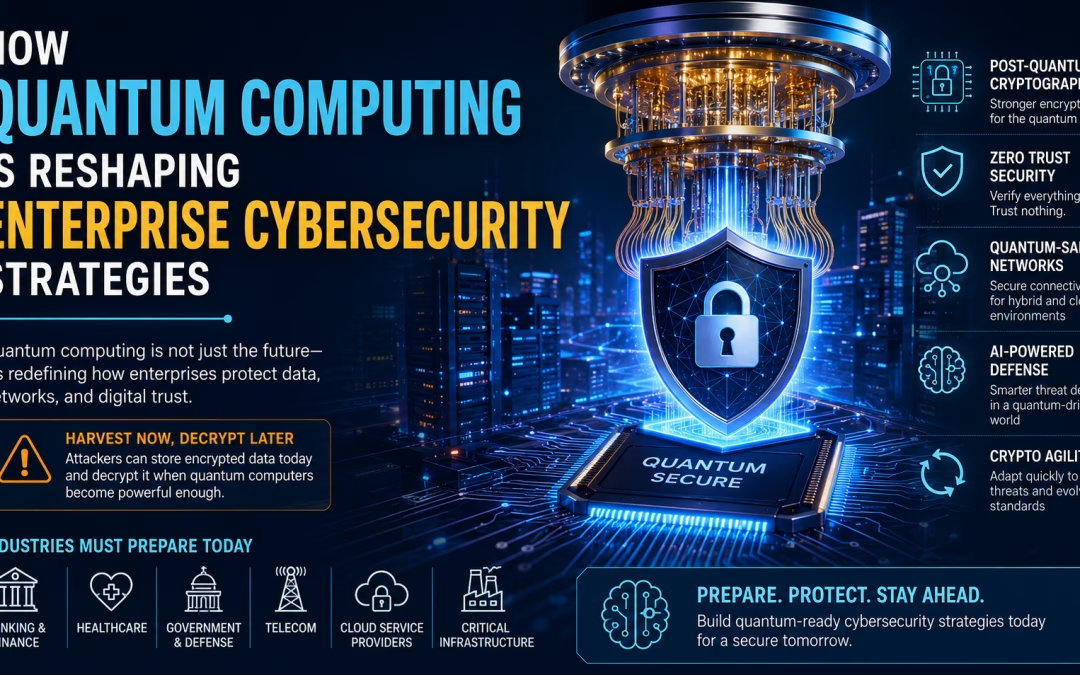
For enterprises, that means quantum risk is not only a future problem. It is also a present-day migration problem. Sensitive data captured today may remain valuable for years, which is why NIST explicitly highlights “harvest now, decrypt later” as a real concern and urges organizations to begin transitioning now.
Why enterprise security teams are rethinking the stack
Most enterprise security programs still depend on public-key cryptography for key exchange, authentication, and trust chaining. As quantum capabilities progress, the strategic response is shifting toward post-quantum cryptography, or PQC. NIST finalized its first three PQC standards in August 2024: FIPS 203, FIPS 204, and FIPS 205. Those standards introduced ML-KEM for key establishment, ML-DSA for digital signatures, and SLH-DSA as a hash-based signature option.
That standardization matters because it gives enterprises a concrete migration target instead of a vague research horizon. Security teams can now map systems to approved post-quantum algorithms, prioritize the most exposed assets, and plan upgrades in phases rather than waiting for a crisis. NIST’s NCCoE migration guidance says organizations need to identify quantum-vulnerable public-key algorithms across hardware, software, and services, then build roadmaps that prioritize the new NIST algorithms.
The biggest strategic shift: from static cryptography to crypto agility
Quantum readiness is not just about swapping RSA or ECC for a new algorithm. It is about building crypto agility into the enterprise so cryptographic methods can be updated without reengineering the entire environment. That includes applications, APIs, cloud connections, certificate management, identity systems, embedded devices, and vendor dependencies. ibm’s quantum-safe guidance frames the transition as a structured program, not a single replacement project, and emphasizes that organizations should prepare now for harvest-now-decrypt-later risks.
This is where many enterprises underestimate the work. Encryption is often buried deep in legacy systems, third-party integrations, and operational technology. CISA’s post-quantum initiative exists specifically to bring government and industry together around those risks, and CISA’s recent product-category guidance was created to help accelerate PQC adoption across hardware and software categories.
What changes in the enterprise security roadmap
The first practical step is a cryptographic inventory. Security teams need to know where key exchange, signatures, certificates, and encrypted channels are used. That includes TLS, VPNs, email security, code signing, remote access, backup systems, and long-lived archives. Once those dependencies are visible, the team can decide which systems need immediate remediation and which can be moved on the next lifecycle cycle. NIST’s migration materials specifically recommend understanding where quantum-vulnerable algorithms are used and developing a prioritized roadmap.
The second shift is to make identity and authentication quantum-ready. Enterprises often focus on data-at-rest encryption first, but authenticated communications and digital signatures are equally important. That is why NIST’s finalized PQC standards include signature algorithms, and why NSA’s CNSA 2.0 guidance states that its quantum-resistant algorithms are intended to be secure against both classical and quantum computers and will eventually be required for National Security Systems.
The third shift is network and transport modernization. TLS, IPsec, and secure messaging are central to enterprise trust. Cloudflare’s post-quantum work shows how vendors are already rolling out hybrid and post-quantum protections across large-scale internet infrastructure, and Cloudflare says it is targeting 2029 for full post-quantum security across its platform. That is a strong signal that enterprise networking roadmaps are already being rewritten around PQC readiness.
Where the business risk is highest
Quantum threats are especially important for industries that handle long-lived sensitive data: financial services, healthcare, government, telecom, defense, cloud providers, and critical infrastructure. In these sectors, data often has a secrecy lifetime measured in decades, not months. That is exactly why “harvest now, decrypt later” is so dangerous: encrypted records captured today may still be valuable when quantum decryption becomes practical.
This also changes procurement. Enterprises can no longer treat post-quantum support as a nice-to-have feature. It becomes a vendor-selection criterion. Security, architecture, and procurement teams should ask whether products support PQC roadmaps, whether certificate systems are crypto-agile, and whether signing, key exchange, and secure channel negotiation can be upgraded without major service disruption. That is the operational meaning of quantum readiness.
A practical enterprise response plan
A strong quantum security strategy usually starts with five moves:
First, inventory every cryptographic dependency across the estate.
Second, classify data by secrecy lifetime so the longest-lived assets receive priority.
Third, introduce crypto agility into applications, infrastructure, and vendor contracts.
Fourth, pilot the NIST-approved PQC standards in low-risk environments before broad rollout.
Fifth, align security, compliance, procurement, and engineering around one migration roadmap.
The organizations that move early gain more than technical protection. They gain time. PQC migration is a multi-year program, and the enterprises that start now are far less likely to face rushed, expensive, and error-prone replacements later. That is why NIST, CISA, and NSA have all pushed public guidance, standardization, and transition planning rather than waiting for the technology to mature further.
(FAQs)
1. What is quantum computing, and why is it a cybersecurity concern?
Quantum computing is an advanced computing technology that uses quantum bits (qubits) to perform complex calculations much faster than traditional computers. While it has the potential to solve scientific and business challenges, it also threatens current encryption methods such as RSA and ECC, which protect sensitive enterprise data. This is why organizations are preparing for quantum-resistant cybersecurity solutions.
2. What is Post-Quantum Cryptography (PQC)?
Post-Quantum Cryptography (PQC) refers to cryptographic algorithms designed to remain secure against attacks from both classical and quantum computers. The U.S. National Institute of Standards and Technology (NIST) has standardized several PQC algorithms that organizations can begin implementing to safeguard long-term sensitive information and prepare for the quantum era.
3. What is the “Harvest Now, Decrypt Later” (HNDL) threat?
“Harvest Now, Decrypt Later” is a cybersecurity strategy where attackers steal encrypted data today and store it until powerful quantum computers become capable of decrypting it in the future. This makes long-term confidential information—such as financial records, healthcare data, intellectual property, and government communications—particularly vulnerable if organizations delay adopting quantum-safe encryption.
4. How can enterprises prepare for quantum-safe cybersecurity?
Organizations should begin by identifying where cryptography is used across their IT infrastructure, including VPNs, cloud applications, databases, digital certificates, APIs, and communication systems. They should then develop a migration roadmap to NIST-approved Post-Quantum Cryptography, implement crypto-agile architectures, strengthen Zero Trust security models, and work with technology vendors that support quantum-resistant solutions.
5. Which industries are most affected by quantum computing security risks?
Industries that manage highly sensitive or long-lived data face the greatest quantum security risks. These include banking and financial services, healthcare, telecommunications, government agencies, defense organizations, cloud service providers, critical infrastructure, energy companies, and insurance firms. These sectors should prioritize quantum readiness to protect data against future decryption attacks and maintain regulatory compliance.
Conclusion
Quantum computing is reshaping enterprise cybersecurity strategies by forcing a transition from today’s static trust model to a future of quantum-safe, crypto-agile, and inventory-driven security operations. The shift is already underway. NIST has finalized its first PQC standards, CISA is coordinating industry readiness, NSA has published quantum-resistant requirements, and major infrastructure providers are moving ahead with post-quantum deployments.
For enterprises, the right response is not panic. It is preparation: discover what is vulnerable, protect what matters most, and build a cryptographic foundation that can survive the next generation of computing.
Contact Us | Our Blog | Our Services | Previous Post…
#ibmseimless #ibmSEIMless #QRN