by hannahadmin | Aug 11, 2026 | cybersecurity, QRN, Seimless, telecom
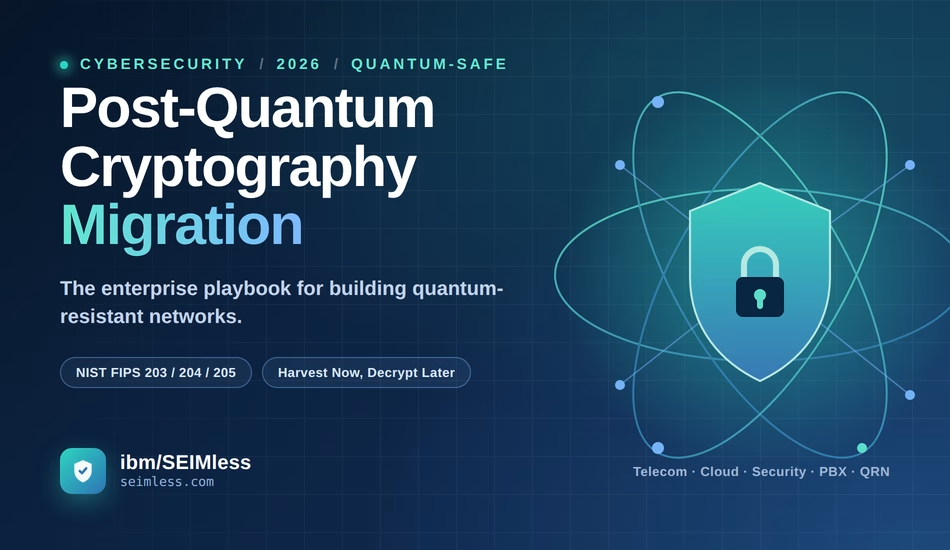
Every encrypted message your enterprise sends today could already be sitting in an adversary’s archive, waiting for the day a quantum computer can crack it open. That is the uncomfortable reality behind “harvest now, decrypt later,” and it is why post-quantum cryptography migration has moved from a research-lab curiosity to an urgent boardroom priority in 2026. For organizations that depend on telecom, cloud, PBX, and networked infrastructure, the question is no longer if you will migrate to quantum-resistant encryption — it is how fast and how safely you can do it.
At ibm/SEIMless, we help enterprises answer that question with confidence. This guide breaks down what post-quantum cryptography migration actually involves, why the deadlines are closer than most leaders realize, and the practical steps you can take now to protect your data, your customers, and your reputation.
What Is Post-Quantum Cryptography Migration?
Post-quantum cryptography (PQC) refers to a new generation of encryption algorithms designed to withstand attacks from both classical and quantum computers. Post-quantum cryptography migration is the structured process of replacing today’s vulnerable public-key algorithms — RSA, ECC, and Diffie-Hellman — with these quantum-resistant standards across every system that stores or transmits sensitive data.
The urgency comes from a simple mathematical truth. A sufficiently powerful quantum computer running Shor’s algorithm could break the public-key cryptography that secures virtually all modern digital communication — from VPN tunnels and TLS sessions to PBX signaling and cloud storage. In August 2024, the U.S. National Institute of Standards and Technology (NIST) released the first three finalized post-quantum encryption standards, formally opening the migration era for every enterprise on the planet.
The New Standards Driving Migration
The finalized standards give security teams a concrete target. Rather than waiting for perfect certainty, organizations now have federally vetted algorithms to build around:
- FIPS 203 (ML-KEM) — derived from CRYSTALS-Kyber, the primary standard for general encryption and key establishment. You can review the full FIPS 203 specification on the NIST CSRC portal.
- FIPS 204 (ML-DSA) — derived from CRYSTALS-Dilithium, the primary standard for digital signatures.
- FIPS 205 (SLH-DSA) — derived from SPHINCS+, a backup signature standard built on a different mathematical foundation for added resilience.
NIST’s ongoing work, documented on its Post-Quantum Cryptography Standardization project page, continues to evaluate additional algorithms to ensure cryptographic diversity. The message from NIST leadership has been unambiguous: begin integrating these standards immediately, because full integration takes years, not months.
Why “Harvest Now, Decrypt Later” Changes the Timeline
The single most misunderstood aspect of the quantum threat is timing. Many executives assume they can wait until a cryptographically relevant quantum computer exists before acting. That assumption is dangerous.
Adversaries are already capturing and storing encrypted traffic today — financial records, health data, intellectual property, government communications — with the intent of decrypting it once quantum capability matures. This is the “harvest now, decrypt later” (HNDL) attack model. Any data with a shelf life longer than the expected arrival of quantum computers is effectively at risk right now. For a hospital, a bank, or a defense contractor, that shelf life can stretch across decades.
This is precisely why federal guidance has accelerated. The Cybersecurity and Infrastructure Security Agency (CISA), together with the NSA and NIST, published a joint Quantum-Readiness: Migration to Post-Quantum Cryptography resource urging organizations to start now. Their companion factsheet on quantum readiness lays out the first concrete steps for critical-infrastructure operators.
The Regulatory Clock Is Already Ticking
Post-quantum cryptography migration is not just best practice — it is increasingly a compliance mandate.
The National Security Agency’s Commercial National Security Algorithm Suite 2.0 (CNSA 2.0) sets firm transition timelines for national security systems, with full adoption of quantum-resistant algorithms expected by 2035 and earlier milestones for software and firmware signing. In the legislative arena, the Quantum Computing Cybersecurity Preparedness Act — signed into law in December 2022 — requires federal agencies to inventory their cryptographic systems and prioritize migration, a standard that inevitably flows down to contractors and private-sector partners.
For hands-on implementation, the NIST National Cybersecurity Center of Excellence (NCCoE) maintains a dedicated Migration to Post-Quantum Cryptography project that offers reference architectures and playbooks. Broader national strategy and research coordination are tracked through the U.S. National Quantum Initiative at quantum.gov. Even industry bodies have weighed in: the Cloud Security Alliance’s analysis of the finalized FIPS 203, 204, and 205 standards frames the finalization as a defining moment for the quantum-safe future.
A Practical Post-Quantum Cryptography Migration Roadmap
Migration can feel overwhelming, but it becomes manageable when broken into disciplined phases. Here is the roadmap ibm/SEIMless uses to guide enterprises toward crypto-agility.
1. Build a Cryptographic Inventory
You cannot protect what you cannot see. Start by discovering every place cryptography lives in your environment — TLS certificates, VPNs, PBX signaling, database encryption, cloud APIs, IoT devices, and third-party integrations. This inventory becomes the master map for your entire migration.
2. Prioritize by Data Sensitivity and Longevity
Rank systems by the value and shelf life of the data they protect. Long-lived secrets — trade secrets, personal health information, legal records — move to the front of the line because they are the prime targets of harvest-now-decrypt-later campaigns.
3. Achieve Crypto-Agility
Crypto-agility is the ability to swap cryptographic algorithms without re-architecting your systems. Building this flexibility now means you can adopt new standards as they evolve, rather than facing a painful forklift upgrade with each change. Our quantum computing and encryption resources explain how crypto-agility fits into a modern security stack.
4. Protect Data in Motion and Data at Rest
A complete migration secures information wherever it lives. That means quantum-resistant protection for data in motion as it travels across your network, and for data at rest in storage and backups. Strong key management ties the two together and remains the backbone of any resilient encryption program.
5. Layer Quantum-Safe Networking with Zero Trust
Post-quantum algorithms are strongest when combined with a defense-in-depth architecture. Pairing PQC with a zero trust security model and a next-generation firewall ensures that even if one layer is challenged, your data stays protected. For distributed enterprises, quantum-safe SD-WAN extends this protection across every branch, remote worker, and cloud connection.
How ibm/SEIMless Makes Quantum-Safe Migration Seamless
Migrating an entire enterprise to post-quantum cryptography is a journey, and you should not walk it alone. ibm/SEIMless delivers end-to-end Quantum Resistant Networking built on the same NIST-aligned standards driving federal migration — combined with the telecom, cloud, and PBX expertise your operations already rely on.
Because we integrate quantum-safe encryption directly into your networking, cloud infrastructure, and voice communications, you gain protection without the complexity of stitching together a dozen vendors. Our approach is grounded in a simple conviction: the technology that protects an organization’s data is ultimately protecting the people who trust that organization. Security done right is a form of care.
Explore our full range of managed security and networking services, or learn more about who we are and why enterprises across the country choose us as their quantum-safe partner.
The Cost of Waiting Far Outweighs the Cost of Acting
Post-quantum cryptography migration is the defining cybersecurity project of this decade. The standards are final, the federal timelines are set, and the harvest-now-decrypt-later threat is active today. Organizations that begin their migration now will move deliberately, protect their most valuable data, and meet compliance deadlines with room to spare. Those that wait risk a chaotic, expensive scramble — or worse, a breach of data they thought was safe years ago.
The future of secure networking is quantum-resistant, and it is being built right now.
Ready to Future-Proof Your Encryption?
Do not let your enterprise become a target of harvest-now-decrypt-later. The ibm/SEIMless team will help you inventory your cryptography, build a phased migration roadmap, and deploy quantum-resistant protection across your entire network. Get started with a quantum-readiness consultation today, or contact our specialists to secure your digital future — before someone else decides your timeline for you.
Contact Us | Our Blog | Our Services | See Previous Post…

by hannahadmin | Jul 30, 2026 | blog, cybersecurity, QRN
During recent discussions surrounding the future of digital finance and artificial intelligence, Musk suggested that traditional money may eventually become obsolete as AI-driven economies, autonomous agents, and instant digital transactions redefine how value is exchanged.
At nearly the same time, X (formerly Twitter) continues expanding its financial ecosystem through X Money, a digital payment platform designed to transform the social media platform into an “everything app.”
Although these developments are separate, together they reveal a much bigger trend:
The future isn’t simply about replacing cash—it is about rebuilding the entire financial infrastructure.
For enterprises, governments, financial institutions, and technology providers, this raises one important question:
Is today’s payment infrastructure prepared for tomorrow’s digital economy?
The Evolution of Money
Money has continuously evolved throughout human history.
- Barter systems
- Precious metals
- Paper currency
- Credit cards
- Online banking
- Mobile wallets
- Cryptocurrency
- Central Bank Digital Currencies (CBDCs)
Every major innovation has reduced friction between buyers and sellers.
Artificial intelligence is now pushing this evolution even further.
Future transactions may occur without human involvement.
Imagine:
- AI assistants purchasing groceries
- Autonomous vehicles paying tolls automatically
- Industrial robots ordering replacement parts
- Smart factories negotiating supplier contracts
- Digital identities performing cross-border payments
In this world, payment becomes an invisible background process.
What Elon Musk Is Actually Building
Rather than introducing another cryptocurrency, Musk’s current strategy centers around integrating financial services directly into X.
The platform is gradually evolving into a digital ecosystem capable of supporting:
- Peer-to-peer transfers
- Creator payments
- Digital wallets
- Merchant services
- Subscription management
- Financial identity
- Banking partnerships
The objective resembles the highly successful “super apps” already common across Asia.
Instead of switching between multiple applications, users interact within a single ecosystem.
Communication.
Commerce.
Entertainment.
Payments.
All connected together.
Why This Matters Beyond Social Media
Most headlines focus on Musk.
The larger story is infrastructure.
Digital payments are becoming deeply integrated into everyday software.
Examples include:
- SaaS platforms
- ERP systems
- Healthcare portals
- Retail applications
- Logistics software
- Manufacturing systems
- Smart cities
- Government digital services
Payments are no longer standalone banking functions.
They are becoming embedded services.
The AI Economy Is Different
Traditional commerce involves people making purchasing decisions.
AI-driven commerce introduces machine-to-machine transactions.
Examples include:
- Cloud servers purchasing additional computing resources automatically
- AI agents scheduling software subscriptions
- Smart energy grids buying electricity in real time
- Autonomous delivery fleets paying charging stations
- IoT devices ordering maintenance
This creates billions of automated transactions every day.
Existing financial systems were never designed for this scale.
The Cybersecurity Challenge
Every payment system becomes a target.
As digital finance expands, cyber threats grow alongside it.
Organizations now face:
- Identity theft
- API attacks
- Supply-chain compromises
- Account takeover
- AI-generated fraud
- Deepfake authentication
- Credential stuffing
- Ransomware targeting financial systems
Attackers increasingly automate their operations using AI.
Defenders must do the same.
Quantum Computing Changes Everything
Today’s online payments rely heavily on public-key cryptography.
Protocols such as RSA and ECC secure:
- Banking applications
- Payment gateways
- Digital wallets
- E-commerce platforms
- Financial APIs
However, sufficiently powerful quantum computers could eventually break many of today’s widely used encryption methods.
Even before that day arrives, adversaries can adopt a “Harvest Now, Decrypt Later” strategy—stealing encrypted financial data today with the intention of decrypting it once quantum capabilities mature.
This is one of the strongest reasons organizations are beginning the transition toward post-quantum cryptography (PQC) and quantum-resistant security architectures.
Why Payment Infrastructure Must Become Quantum-Ready
Modern payment ecosystems require protection that extends beyond current threats.
Organizations should prioritize:
- Quantum-resistant encryption
- Zero Trust architecture
- Identity-first security
- Continuous authentication
- Secure API gateways
- AI-powered fraud detection
- Network segmentation
- Real-time monitoring
Financial security is becoming inseparable from network security.
The Role of Enterprise Networks
Fast payments require resilient networks.
Every transaction travels through:
- Cloud infrastructure
- Internet service providers
- Data centers
- Telecom carriers
- Financial APIs
- Identity providers
If any component is compromised, payment integrity suffers.
Organizations therefore need secure networking strategies that include:
- Encrypted communications
- Continuous threat detection
- Intelligent routing
- High availability
- Secure edge computing
- Quantum-resistant communication paths
AI Will Handle More Than Payments
Future AI systems may autonomously:
- Negotiate vendor contracts
- Execute recurring purchases
- Manage enterprise budgets
- Optimize logistics spending
- Balance cloud computing costs
- Allocate marketing budgets
- Purchase cybersecurity services
This transforms payments into machine-generated decisions rather than human actions.
Security must therefore protect both people and autonomous software agents.
Regulatory Questions Remain
Governments worldwide are still determining how to regulate:
- AI financial agents
- Digital identity
- Stablecoins
- CBDCs
- Cross-border payments
- Consumer protection
- Privacy
- Financial transparency
Compliance will become increasingly important as payment systems evolve.
Organizations operating globally must prepare for varying regulatory frameworks.
What Businesses Should Do Today
Whether or not Musk’s long-term prediction comes true, organizations should begin preparing for the next generation of digital commerce.
Recommended priorities include:
Modernize Payment Infrastructure
Support API-first architectures capable of integrating with emerging payment platforms.
Adopt Zero Trust Security
Verify every user, device, and workload continuously.
Prepare for Post-Quantum Cryptography
Develop migration plans aligned with evolving cryptographic standards.
Strengthen Identity Management
Implement strong authentication and least-privilege access controls.
Invest in AI-Powered Security
Leverage machine learning for anomaly detection and fraud prevention.
Secure Enterprise Networks
Ensure payment traffic is protected across hybrid cloud and edge environments.
The Bigger Picture
Elon Musk’s statement that money could eventually become obsolete should not be interpreted literally as the disappearance of economic value.
Instead, it points toward a future where:
- Payments become invisible.
- AI performs transactions autonomously.
- Digital identity becomes central.
- Financial services integrate directly into everyday applications.
- Secure networking becomes as critical as the payment systems themselves.
For enterprises, the challenge is not simply adopting new payment technologies—it is building secure, resilient, and quantum-ready digital infrastructure capable of supporting the next era of commerce.
Why This Matters for Enterprise Leaders
At ibm/SEIMless, we believe the future of payments depends on more than innovation—it depends on trust.
As digital transactions become increasingly autonomous and interconnected, organizations need infrastructure that is:
- Secure by design
- Resilient against evolving cyber threats
- Ready for the post-quantum era
- Built to support AI-driven business operations
The convergence of AI, advanced networking, and next-generation cybersecurity will define the winners of tomorrow’s digital economy. Businesses that begin preparing today will be best positioned to operate securely in a world where value moves faster than ever before.
(FAQ)
1. Did Elon Musk say money will become obsolete?
Musk has suggested that future AI-driven economies could reduce the traditional role of money, emphasizing automated digital value exchange. His broader vision aligns with integrated digital financial ecosystems rather than the immediate elimination of currency.
2. What is X Money?
X Money is the payment platform being developed for X (formerly Twitter), intended to support peer-to-peer transfers, creator monetization, merchant payments, and other financial services within the platform.
3. Why is quantum computing a concern for payment systems?
Quantum computers could eventually compromise widely used public-key cryptography, making it necessary for organizations to adopt post-quantum cryptographic standards to protect future financial transactions.
4. How will AI change digital payments?
AI agents are expected to automate purchasing, subscriptions, supply-chain transactions, and financial decision-making, creating a machine-to-machine economy that requires highly secure, intelligent payment infrastructure.
5. How can enterprises prepare for the future of digital payments?
Organizations should modernize payment architectures, implement Zero Trust security, strengthen identity management, deploy AI-driven threat detection, and begin transitioning toward quantum-resistant cybersecurity.
Contact Us | Our Blog | Our Services | Previous Post…
by hannahadmin | Jul 29, 2026 | blog, Document management, Enterprise technology, Next-gen Security solutions, PBX, Public and Private cloud, QRN, Seimless, WAN
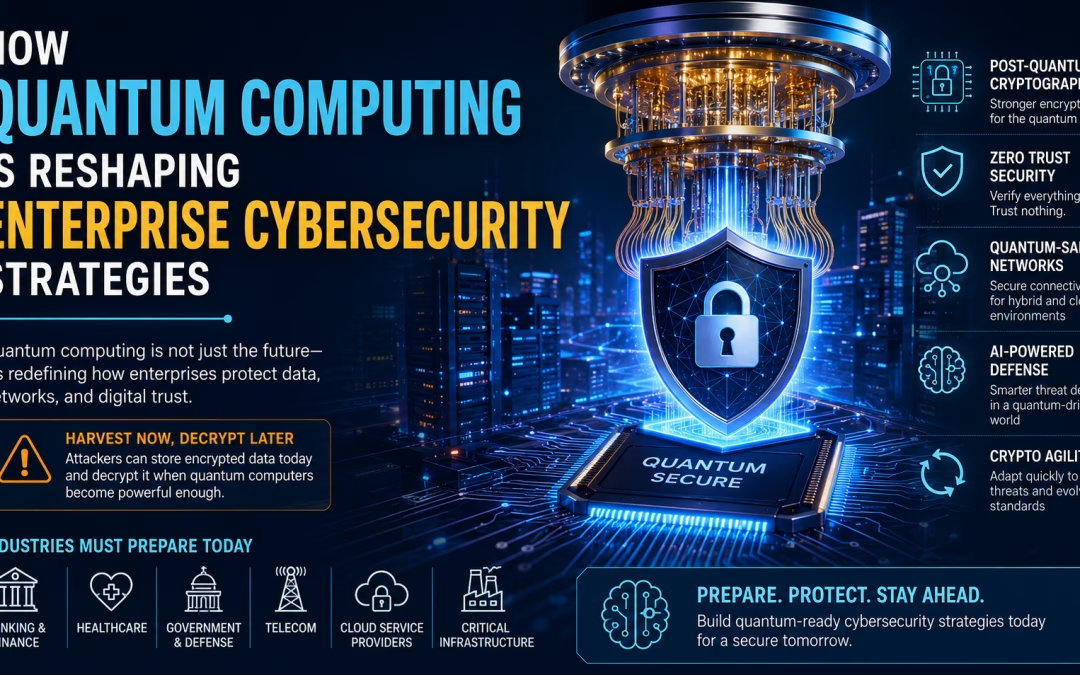
Quantum computing is changing cybersecurity strategy long before most organizations deploy a cryptographically relevant quantum computer. The reason is simple: the encryption protecting enterprise data, identities, VPNs, code-signing workflows, and digital trust systems is built on mathematical assumptions that quantum machines are expected to weaken or break at scale. NIST says its Post-Quantum Cryptography project exists to protect electronic information against that future threat, because quantum computers could eventually break many widely used cryptographic systems.
For enterprises, that means quantum risk is not only a future problem. It is also a present-day migration problem. Sensitive data captured today may remain valuable for years, which is why NIST explicitly highlights “harvest now, decrypt later” as a real concern and urges organizations to begin transitioning now.
Why enterprise security teams are rethinking the stack
Most enterprise security programs still depend on public-key cryptography for key exchange, authentication, and trust chaining. As quantum capabilities progress, the strategic response is shifting toward post-quantum cryptography, or PQC. NIST finalized its first three PQC standards in August 2024: FIPS 203, FIPS 204, and FIPS 205. Those standards introduced ML-KEM for key establishment, ML-DSA for digital signatures, and SLH-DSA as a hash-based signature option.
That standardization matters because it gives enterprises a concrete migration target instead of a vague research horizon. Security teams can now map systems to approved post-quantum algorithms, prioritize the most exposed assets, and plan upgrades in phases rather than waiting for a crisis. NIST’s NCCoE migration guidance says organizations need to identify quantum-vulnerable public-key algorithms across hardware, software, and services, then build roadmaps that prioritize the new NIST algorithms.
The biggest strategic shift: from static cryptography to crypto agility
Quantum readiness is not just about swapping RSA or ECC for a new algorithm. It is about building crypto agility into the enterprise so cryptographic methods can be updated without reengineering the entire environment. That includes applications, APIs, cloud connections, certificate management, identity systems, embedded devices, and vendor dependencies. ibm’s quantum-safe guidance frames the transition as a structured program, not a single replacement project, and emphasizes that organizations should prepare now for harvest-now-decrypt-later risks.
This is where many enterprises underestimate the work. Encryption is often buried deep in legacy systems, third-party integrations, and operational technology. CISA’s post-quantum initiative exists specifically to bring government and industry together around those risks, and CISA’s recent product-category guidance was created to help accelerate PQC adoption across hardware and software categories.
What changes in the enterprise security roadmap
The first practical step is a cryptographic inventory. Security teams need to know where key exchange, signatures, certificates, and encrypted channels are used. That includes TLS, VPNs, email security, code signing, remote access, backup systems, and long-lived archives. Once those dependencies are visible, the team can decide which systems need immediate remediation and which can be moved on the next lifecycle cycle. NIST’s migration materials specifically recommend understanding where quantum-vulnerable algorithms are used and developing a prioritized roadmap.
The second shift is to make identity and authentication quantum-ready. Enterprises often focus on data-at-rest encryption first, but authenticated communications and digital signatures are equally important. That is why NIST’s finalized PQC standards include signature algorithms, and why NSA’s CNSA 2.0 guidance states that its quantum-resistant algorithms are intended to be secure against both classical and quantum computers and will eventually be required for National Security Systems.
The third shift is network and transport modernization. TLS, IPsec, and secure messaging are central to enterprise trust. Cloudflare’s post-quantum work shows how vendors are already rolling out hybrid and post-quantum protections across large-scale internet infrastructure, and Cloudflare says it is targeting 2029 for full post-quantum security across its platform. That is a strong signal that enterprise networking roadmaps are already being rewritten around PQC readiness.
Where the business risk is highest
Quantum threats are especially important for industries that handle long-lived sensitive data: financial services, healthcare, government, telecom, defense, cloud providers, and critical infrastructure. In these sectors, data often has a secrecy lifetime measured in decades, not months. That is exactly why “harvest now, decrypt later” is so dangerous: encrypted records captured today may still be valuable when quantum decryption becomes practical.
This also changes procurement. Enterprises can no longer treat post-quantum support as a nice-to-have feature. It becomes a vendor-selection criterion. Security, architecture, and procurement teams should ask whether products support PQC roadmaps, whether certificate systems are crypto-agile, and whether signing, key exchange, and secure channel negotiation can be upgraded without major service disruption. That is the operational meaning of quantum readiness.
A practical enterprise response plan
A strong quantum security strategy usually starts with five moves:
First, inventory every cryptographic dependency across the estate.
Second, classify data by secrecy lifetime so the longest-lived assets receive priority.
Third, introduce crypto agility into applications, infrastructure, and vendor contracts.
Fourth, pilot the NIST-approved PQC standards in low-risk environments before broad rollout.
Fifth, align security, compliance, procurement, and engineering around one migration roadmap.
The organizations that move early gain more than technical protection. They gain time. PQC migration is a multi-year program, and the enterprises that start now are far less likely to face rushed, expensive, and error-prone replacements later. That is why NIST, CISA, and NSA have all pushed public guidance, standardization, and transition planning rather than waiting for the technology to mature further.
(FAQs)
1. What is quantum computing, and why is it a cybersecurity concern?
Quantum computing is an advanced computing technology that uses quantum bits (qubits) to perform complex calculations much faster than traditional computers. While it has the potential to solve scientific and business challenges, it also threatens current encryption methods such as RSA and ECC, which protect sensitive enterprise data. This is why organizations are preparing for quantum-resistant cybersecurity solutions.
2. What is Post-Quantum Cryptography (PQC)?
Post-Quantum Cryptography (PQC) refers to cryptographic algorithms designed to remain secure against attacks from both classical and quantum computers. The U.S. National Institute of Standards and Technology (NIST) has standardized several PQC algorithms that organizations can begin implementing to safeguard long-term sensitive information and prepare for the quantum era.
3. What is the “Harvest Now, Decrypt Later” (HNDL) threat?
“Harvest Now, Decrypt Later” is a cybersecurity strategy where attackers steal encrypted data today and store it until powerful quantum computers become capable of decrypting it in the future. This makes long-term confidential information—such as financial records, healthcare data, intellectual property, and government communications—particularly vulnerable if organizations delay adopting quantum-safe encryption.
4. How can enterprises prepare for quantum-safe cybersecurity?
Organizations should begin by identifying where cryptography is used across their IT infrastructure, including VPNs, cloud applications, databases, digital certificates, APIs, and communication systems. They should then develop a migration roadmap to NIST-approved Post-Quantum Cryptography, implement crypto-agile architectures, strengthen Zero Trust security models, and work with technology vendors that support quantum-resistant solutions.
5. Which industries are most affected by quantum computing security risks?
Industries that manage highly sensitive or long-lived data face the greatest quantum security risks. These include banking and financial services, healthcare, telecommunications, government agencies, defense organizations, cloud service providers, critical infrastructure, energy companies, and insurance firms. These sectors should prioritize quantum readiness to protect data against future decryption attacks and maintain regulatory compliance.
Conclusion
Quantum computing is reshaping enterprise cybersecurity strategies by forcing a transition from today’s static trust model to a future of quantum-safe, crypto-agile, and inventory-driven security operations. The shift is already underway. NIST has finalized its first PQC standards, CISA is coordinating industry readiness, NSA has published quantum-resistant requirements, and major infrastructure providers are moving ahead with post-quantum deployments.
For enterprises, the right response is not panic. It is preparation: discover what is vulnerable, protect what matters most, and build a cryptographic foundation that can survive the next generation of computing.
Contact Us | Our Blog | Our Services | Previous Post…
#ibmseimless #ibmSEIMless #QRN
by hannahadmin | Jul 27, 2026 | blog, QRN, Seimless
Meta’s Next Big Move Could Reshape Enterprise AI Infrastructure
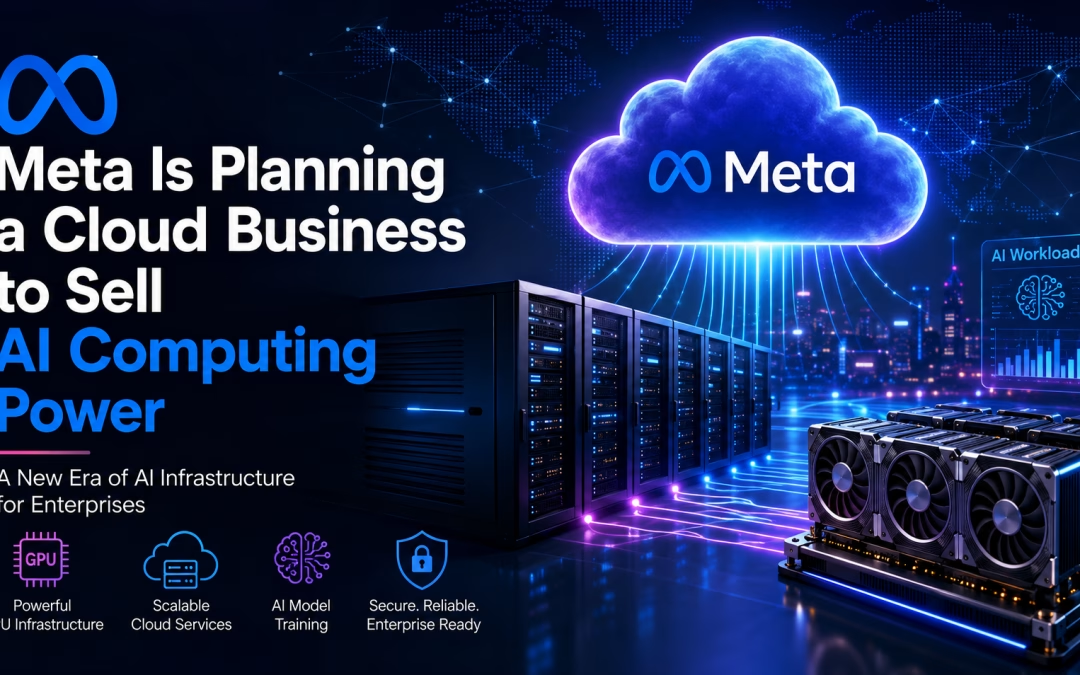
Artificial intelligence has entered a new era where computing power has become just as valuable as data. Organizations worldwide are racing to build AI models capable of solving complex business challenges, but the demand for Graphics Processing Units (GPUs) and high-performance AI infrastructure continues to outpace supply. Against this backdrop, Meta is reportedly preparing to enter the AI cloud computing market, positioning itself as a direct competitor to established cloud providers.
If successful, this strategic expansion could transform Meta from a social media powerhouse into one of the world’s leading AI infrastructure providers. For enterprises, developers, and technology leaders, this signals another major shift in how AI workloads may be deployed over the next decade.
The Growing Demand for AI Compute
Modern AI models require enormous computational resources for both training and inference. Whether organizations are developing large language models (LLMs), computer vision systems, or generative AI applications, they require thousands of GPUs operating together in highly optimized environments.
Current cloud providers such as Amazon Web Services (AWS), Microsoft Azure, and Google Cloud dominate this market. However, increasing demand has created GPU shortages, higher operational costs, and longer provisioning times.
Meta has already invested tens of billions of dollars into AI infrastructure to support products including:
- Meta AI
- Facebook recommendation systems
- Instagram personalization
- WhatsApp AI assistants
- Llama open-source AI models
Instead of using this infrastructure solely for internal development, Meta is reportedly exploring opportunities to commercialize excess computing capacity through cloud services.
Why Meta Is Entering the AI Cloud Market
Unlike traditional cloud providers that built infrastructure for general computing, Meta has spent years optimizing systems specifically for AI.
Its internal infrastructure already supports:
- Massive GPU clusters
- High-speed AI networking
- Distributed model training
- Large-scale inference
- Custom AI optimization tools
Opening these capabilities to external customers could create an entirely new revenue stream while maximizing utilization of its growing AI data centers.
This strategy also reduces dependence on advertising revenue, helping Meta diversify its business as AI becomes central to digital transformation.
Competing with Established Cloud Giants
Entering the cloud business is not a simple expansion.
Meta would compete directly against companies that have spent decades building enterprise cloud ecosystems.
Major competitors include:
However, Meta possesses several competitive advantages.
1. AI-First Infrastructure
Rather than focusing on traditional virtual machines and storage, Meta can build cloud services optimized specifically for AI development.
Organizations increasingly need GPU clusters—not generic servers.
2. Open-Source Leadership
Meta’s Llama family of models has become one of the most widely adopted open-source AI platforms.
Offering cloud services designed specifically around Llama could accelerate enterprise adoption.
3. Massive Data Center Investments
Meta continues investing billions into next-generation AI data centers designed to support future AI workloads.
These facilities include advanced networking, liquid cooling technologies, and high-density GPU deployments.
What Services Could Meta Offer?
Although official product details remain limited, an AI-focused cloud platform could include:
GPU-as-a-Service
Organizations could rent powerful GPU clusters without purchasing expensive hardware.
AI Model Training
Businesses could train custom foundation models using scalable infrastructure.
Model Inference
Applications could deploy AI models globally with low-latency inference capabilities.
Llama AI Platform
Native hosting, fine-tuning, and deployment services for Meta’s open-source Llama models.
AI Development Tools
Integrated environments supporting machine learning pipelines, model evaluation, and performance optimization.
Enterprise APIs
Secure APIs enabling businesses to integrate advanced AI into existing applications.
Why This Matters for Enterprises
Many organizations struggle to access affordable AI computing resources.
Meta entering this market may increase competition, leading to:
- Lower AI infrastructure costs
- More GPU availability
- Faster AI deployment
- Greater innovation
- Increased cloud flexibility
- Improved enterprise AI adoption
Businesses would also gain another option beyond the existing hyperscale providers, reducing vendor lock-in.
Challenges Meta Must Overcome
Building an enterprise cloud platform requires more than powerful hardware.
Meta must demonstrate:
Enterprise Security
Large organizations require strict identity management, compliance certifications, encryption, and governance.
Reliability
Cloud platforms demand near-perfect uptime with global redundancy.
Customer Support
Enterprise customers expect 24/7 technical support and solution architecture guidance.
Regulatory Compliance
Meeting standards such as GDPR, HIPAA, ISO 27001, SOC 2, and regional data residency requirements will be essential.
Enterprise Trust
Many organizations still primarily associate Meta with consumer platforms rather than mission-critical enterprise infrastructure.
Changing this perception will take time.
Implications for AI Innovation
More AI cloud providers mean greater access to computational resources.
This could accelerate innovation across industries including:
- Healthcare
- Financial Services
- Manufacturing
- Telecommunications
- Cybersecurity
- Retail
- Education
- Government
Small startups may also benefit by gaining affordable access to enterprise-grade AI infrastructure without investing millions in GPU hardware.
The Role of AI Infrastructure in Digital Transformation
AI is rapidly becoming the foundation of modern enterprise software.
Organizations are moving beyond experimentation toward production-scale AI systems that require resilient, scalable, and secure infrastructure.
Future success will depend not only on AI algorithms but also on the availability of powerful computing platforms capable of supporting continuous model training and real-time inference.
As demand continues to rise, infrastructure providers that deliver scalable AI compute with enterprise-grade reliability will play a critical role in shaping the next generation of digital transformation.
What This Means for Cybersecurity
AI cloud infrastructure also introduces new security considerations.
Organizations deploying sensitive AI workloads should evaluate:
- Data privacy protections
- Identity and access management
- Zero Trust architecture
- Secure model deployment
- Network segmentation
- AI governance
- Continuous threat monitoring
- Supply chain security
Providers that combine scalable AI infrastructure with strong cybersecurity practices will be best positioned to earn enterprise trust.
Looking Ahead
Meta’s reported plans to launch an AI cloud business highlight the growing importance of computing infrastructure in the AI economy. As organizations accelerate their adoption of machine learning and generative AI, demand for scalable, secure, and high-performance compute will only increase.
For enterprises, greater competition in AI cloud services could mean improved access to advanced infrastructure, more flexible deployment options, and potentially lower costs. For the broader technology industry, it reflects a shift where AI computing power is becoming a strategic service rather than merely an internal capability.
Whether Meta can establish itself alongside today’s leading cloud providers remains to be seen, but its investments in AI hardware, open-source innovation, and global infrastructure suggest it intends to be a significant player in the evolving AI cloud landscape.
Conclusion
The future of enterprise AI depends on access to scalable computing resources. Meta’s move toward commercial AI cloud services represents more than a business expansion—it reflects the industry’s transition toward AI-first infrastructure. As competition intensifies among cloud providers, organizations can expect continued innovation, improved performance, and broader access to the computational power required to build the next generation of intelligent applications.
For businesses planning long-term AI strategies, now is the time to evaluate infrastructure choices that prioritize security, scalability, resilience, and operational efficiency. Providers such as ibm/SEIMless help organizations modernize their networking, cybersecurity, and cloud environments, ensuring they are prepared to leverage advanced AI platforms as the technology landscape continues to evolve.
Contact Us | Our Blog | Our Services | See Previous Post…
by hannahadmin | Jul 22, 2026 | blog, telecom
How Artificial Intelligence Is Revolutionizing Global Communication Infrastructure
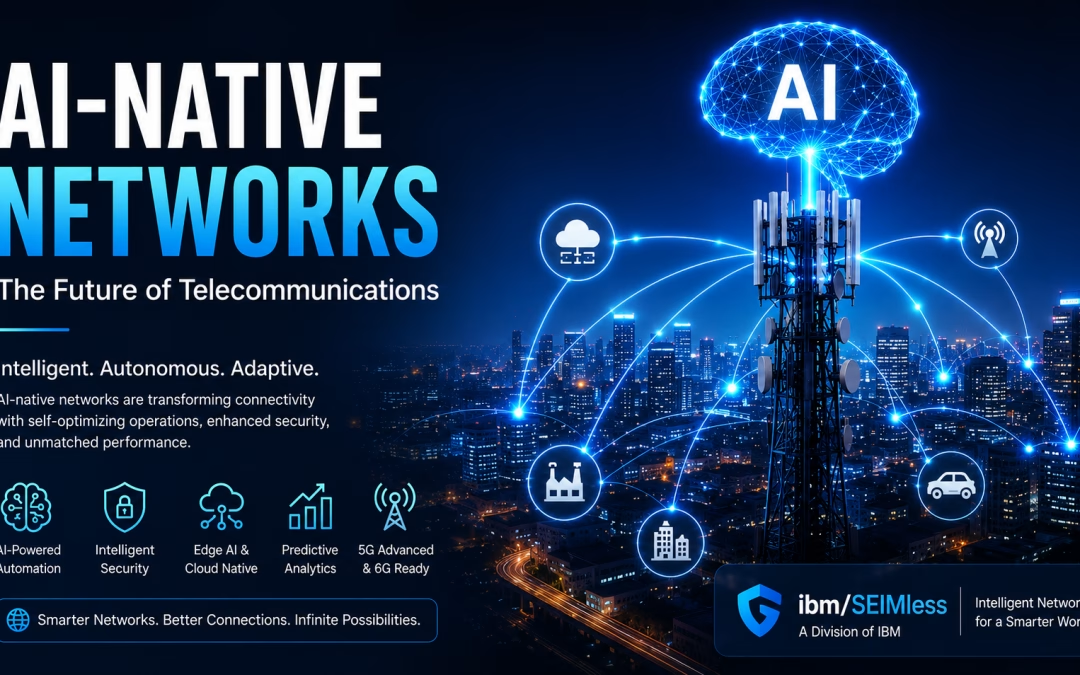
The telecommunications industry is entering a transformative era driven by Artificial Intelligence (AI). Traditional networks, designed primarily for connectivity, are evolving into intelligent ecosystems capable of learning, adapting, and optimizing themselves in real time. This new paradigm, known as AI-Native Networking, integrates AI into every layer of the network—from planning and deployment to operations, security, and customer experience.
As global data traffic continues to grow exponentially, fueled by cloud computing, IoT, autonomous vehicles, smart cities, immersive digital experiences, and billions of connected devices, conventional network architectures struggle to meet increasing demands. AI-native networks address these challenges by enabling predictive analytics, automated resource allocation, self-healing capabilities, intelligent security, and autonomous operations.
For enterprises, governments, telecom operators, and critical infrastructure providers, AI-native networking is not merely an upgrade—it is a strategic necessity. Organizations that adopt intelligent network architectures today will be better positioned to support 5G Advanced, emerging 6G technologies, quantum-safe communications, and next-generation digital services.
At ibm/SEIMless, we believe the future of telecommunications lies in secure, intelligent, autonomous, and resilient networking solutions. By combining advanced AI, cybersecurity, cloud-native infrastructure, and quantum-resistant technologies, businesses can create communication networks that are faster, more secure, and prepared for the digital challenges of tomorrow.
The Evolution of Telecommunications
Telecommunications has undergone remarkable transformation over the past four decades.
First Generation (1G)
The first generation of mobile communications introduced analog voice services. Although revolutionary at the time, 1G offered limited capacity, poor security, and low-quality voice transmission.
Second Generation (2G)
Digital communications arrived with 2G, enabling SMS messaging, improved voice quality, and stronger encryption. Mobile communication became more accessible and reliable for consumers worldwide.
Third Generation (3G)
The rise of smartphones brought the demand for mobile internet. 3G enabled web browsing, email, multimedia messaging, and early mobile applications, fundamentally changing how people interacted with digital services.
Fourth Generation (4G LTE)
4G transformed telecommunications by delivering high-speed broadband connectivity. Streaming media, cloud applications, remote collaboration, and mobile commerce flourished due to significantly improved network performance.
Fifth Generation (5G)
5G introduced ultra-low latency, massive device connectivity, network slicing, and enhanced mobile broadband. It created new opportunities for smart manufacturing, healthcare, autonomous transportation, industrial automation, and immersive technologies.
However, while 5G dramatically improved connectivity, managing increasingly complex network environments has become a major challenge. Millions of devices, distributed cloud environments, edge computing platforms, and growing cybersecurity threats require far more intelligent network management than traditional automation can provide.
What Are AI-Native Networks?
AI-native networks represent the next evolution of telecommunications. Unlike conventional networks where AI functions as an external management tool, AI-native networks embed artificial intelligence into the core architecture itself.
Every network component continuously learns from operational data, predicts future behavior, identifies anomalies, optimizes resources, and automatically responds to changing conditions without human intervention.
Rather than reacting to problems after they occur, AI-native networks anticipate issues before they impact users.
These intelligent systems leverage:
- Machine Learning
- Deep Learning
- Reinforcement Learning
- Large Language Models (LLMs)
- Predictive Analytics
- Digital Twins
- Edge AI
- Autonomous Decision Engines
- Intent-Based Networking
- Generative AI for Operations
Together, these technologies create networks capable of self-monitoring, self-optimizing, self-healing, and self-protecting.
Why Traditional Networks Are No Longer Enough
Modern telecommunications environments generate enormous volumes of operational data every second. Network engineers must manage:
- Billions of IoT devices
- Cloud-native applications
- Distributed edge infrastructure
- Hybrid multi-cloud environments
- Software-defined networking
- Virtualized network functions
- Massive cybersecurity threats
- Increasing customer expectations
Traditional monitoring systems rely heavily on manual intervention and predefined rules. This approach is no longer scalable.
Common challenges include:
- Unexpected service outages
- Network congestion
- Slow fault resolution
- Rising operational costs
- Complex security management
- Delayed capacity planning
- Inefficient resource utilization
AI-native networks address these limitations by enabling continuous learning and autonomous optimization, reducing downtime and improving overall service quality.
Core Characteristics of AI-Native Networks
1. Autonomous Operations
AI-native networks automate routine operational tasks such as configuration management, traffic engineering, software updates, and fault remediation. This minimizes human error and accelerates network responsiveness.
2. Predictive Intelligence
Instead of waiting for failures, AI models analyze historical and real-time telemetry to forecast equipment degradation, traffic surges, and potential outages. Operators can resolve issues proactively.
3. Self-Healing Infrastructure
When disruptions occur, AI-native systems automatically reroute traffic, isolate affected components, and restore services with minimal downtime, improving network resilience and customer satisfaction.
4. Intelligent Resource Allocation
AI dynamically allocates bandwidth, compute, and storage resources based on demand, ensuring efficient utilization and consistent application performance.
5. Built-In Security
Cybersecurity is integrated into the network fabric. AI continuously detects anomalies, identifies emerging threats, and initiates automated responses to mitigate risks before they escalate.
The Business Value of AI-Native Networks
Adopting AI-native networking delivers measurable benefits across industries:
- Reduced operational expenses through automation
- Improved network reliability and uptime
- Faster incident detection and resolution
- Enhanced customer experiences
- Greater scalability for future technologies
- Stronger cybersecurity posture
- Efficient energy consumption
- Accelerated service deployment
- Simplified network management
- Increased return on infrastructure investments
For telecom operators, enterprises, and public sector organizations, these advantages translate into improved competitiveness and long-term resilience.
Contact Us | Our Services | Our Blog | See Previous Post