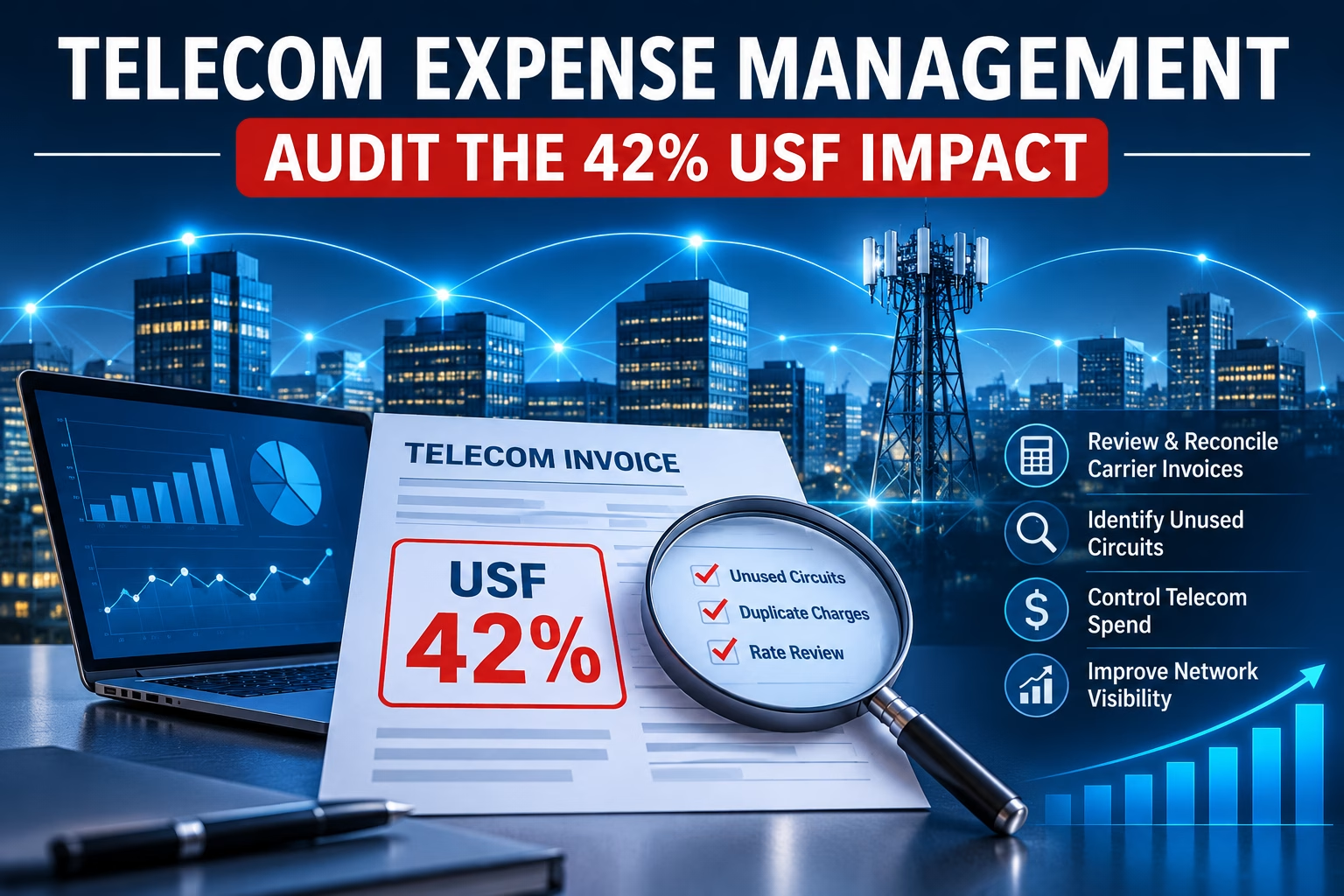
Telecom expense management just became more urgent for every U.S. business that pays a carrier. On September 14, the FCC proposed a 42.0% Universal Service Fund contribution factor for the fourth quarter of 2026, up from 38.8% in the third quarter and 37.0% in the second, according to USAC’s published factors. Carriers commonly pass that cost through on the interstate portion of your bill, so every circuit billed wrongly, every line nobody uses and every rate that drifted from your contract now costs more than it did a year ago.
| What is telecom expense management? Telecom expense management (TEM) is the ongoing practice of inventorying every telecom service, auditing carrier invoices against contracts, disputing errors, retiring unused services and allocating costs to the right owners, so a business pays only for what it ordered and actually uses. |
| Key Takeaways
• The proposed Q4 2026 USF factor is a record 42.0%; the surcharge on interstate charges has more than doubled since 2016. • Most overspend comes from the three-way mismatch: what you contracted, what is installed, and what you are billed rarely agree. • Forgotten circuits are also a security gap, because nobody patches or monitors a service nobody knows exists. • A disciplined 30-day audit is realistic, and it sets up smarter moves such as SD-WAN, cloud telephony and POTS replacement. |
What the 42% USF Factor Means for Your Telecom Expense Management Budget
The contribution factor is the percentage carriers pay into the Universal Service Fund, calculated quarterly from projected program costs and the revenue base. The Congressional Research Service reports the factor rose from 17.9% in the second quarter of 2016 to 37.0% in the second quarter of 2026. Program disbursements stayed relatively stable, around $8.45 billion in 2025, so the main driver is a shrinking base of voice revenue rather than rising costs.
| Quarter | USF contribution factor | Source |
| Q2 2016 | 17.9% | Congressional Research Service |
| Q4 2025 | 38.1% | FCC DA 25-840 |
| Q1 2026 | 37.6% | USAC |
| Q2 2026 | 37.0% | USAC |
| Q3 2026 | 38.8% | USAC |
| Q4 2026 | 42.0% (proposed) | FCC DA 26-946 |
Here is the arithmetic that matters to a CFO. Take a business with $10,000 a month of assessable interstate charges. At 38.8% the pass-through is $3,880 a month; at 42.0% it is $4,200. That is $320 more every month, or $3,840 a year, from a rate change alone (illustrative figures, not a quote). Multiply by multiple carriers and hundreds of circuits and the stakes are clear.
Will the surcharge come down?
Do not plan on it. The Supreme Court upheld the fund’s constitutionality in a 6-3 decision on June 27, 2025, and the roughly $8.6 billion program continues. Congress is weighing broader contribution bases, including broadband and edge providers, as the CRS report describes, but any change would take time. Budget for a high factor and manage everything you control.
A simple test for your USF line item
The FCC’s notice states that carriers may not recover through a federal universal service line item more than the factor times the interstate and international charges. Pull your Q4 invoices, isolate the USF-type line, and compare it with 42.0% of the interstate base. Anything above that, or a line with no explanation, belongs in a dispute. The FCC’s universal service page and the quarterly factor filings are the references to cite. Mobile carriers are treated differently in places, so confirm the rule for each service type.
Why Telecom Expense Management Fails: The Three-Way Mismatch
Most organizations that try telecom expense management stall for the same reason. Three records describe your telecom estate, and they almost never agree:
- The contract: the rates, terms, discounts, SLAs and renewal dates you signed.
- The inventory: the circuits, lines, numbers and devices actually installed and in use.
- The invoice: what each carrier actually bills, line by line.
We call the gap between them the three-way mismatch. Promotional rates expire quietly. A site closes but its circuit lives on. A migration adds new service while the old one keeps billing. Because each carrier invoice is huge, recurring and formatted differently, the mismatch compounds month after month with no single owner.
The oft-repeated claim that up to 80% of telecom invoices contain an error traces to a 2005 Gartner study, so treat it as directional rather than a current benchmark. What practitioners agree on is the structure: complex charges, many carriers and little staff time mean errors persist unless someone is actively watching. eWeek’s guide for CIOs makes the same point, and Network World explains why expertise matters when rooting out anomalies. Healthcare finance leaders are paying attention too: the HFMA’s 10-question telecom overspend assessment covers inventory visibility, invoice auditing, disconnecting unused services, contract benchmarking and credit recovery.
Where Telecom Expense Management Finds the Money: Eight Audit Targets
A good audit is a checklist, not a hunch. These are the places overspend most often hides.
| Audit target | What to check | Why it leaks money |
| 1. Rate vs. contract | Billed rates against contracted rates, per circuit | Rates drift after renewals, moves and re-papering |
| 2. Orphaned circuits | Services billing for closed sites or disconnected orders | Disconnects not processed; billing continues |
| 3. USF and surcharges | Line items against the published factor and interstate allocation | Misapplied surcharges and wrong jurisdictional splits |
| 4. Expired promotions | Term-end dates and month-to-month rolls | Discounts lapse; list pricing resumes |
| 5. Overlapping services | Legacy MPLS, POTS and PRI alongside newer services | Cutover finished, old service never cancelled |
| 6. Taxes and exemptions | Exemption certificates and tax lines | Taxes charged where an exemption applies |
| 7. Outage credits | SLA credits claimed for documented outages | Credits are rarely issued unless requested |
| 8. Mobile and pooled plans | Unused lines, over-sized plans, roaming | Lines outlive the employees who used them |
To size the prize with your own numbers, use simple math. If just 5% of a $500,000 annual telecom spend is billed in error, that is $25,000 a year, before counting back-credits you may be able to recover. Your first audit exists to replace that example with your real figure.
The Security Side of Telecom Expense Management
Telecom expense management is usually pitched as a finance project. It is also a security project. A circuit that appears on an invoice but not in your network diagram is a connection nobody monitors, patches or segments. The same is true of a forgotten remote-maintenance line on a building system, an old PRI trunk, or a modem on a fax line.
Federal guidance treats inventory as foundational. CISA’s Cross-Sector Cybersecurity Performance Goals start with knowing your assets, BOD 23-01 implementation guidance explains why asset discovery finds unmanaged assets that need to be brought under management, and NIST SP 800-53 includes a system component inventory control. The NIST Cybersecurity Framework 2.0 likewise begins with understanding what you have. Third parties matter as well: Verizon’s 2026 Data Breach Investigations Report pointed to third-party involvement in roughly half of breaches. Your carriers and managed providers are part of your attack surface.
The practical takeaway: when you reconcile invoices to inventory, hand every unexplained line to security as well as finance. A circuit you cannot justify is a circuit you should either retire or bring into your zero-trust design.
What Billing Rules Protect Business Customers in Telecom Expense Management
Business buyers often assume consumer protections apply to them. Often they do not. The FCC’s all-in pricing rule for cable and satellite TV covers residential video, and industry summaries note it does not apply to business customers with negotiated contracts. It also does not reach streaming, as U.S. PIRG notes.
What does apply to telephone bills is the FCC’s truth-in-billing rule in 47 CFR Part 64, Subpart Y. Under section 64.2401, charges must carry a brief, clear, plain-language description that lets customers judge whether the services billed match what they requested, and bills must disclose how to inquire about or contest charges. Some provisions do not apply to mobile providers, so check scope. Your strongest protection is still your contract: negotiated rates, SLA credits, dispute windows and auto-renewal terms. That is why contract abstraction sits at the heart of telecom expense management. (This is general information, not legal advice; involve counsel on disputes.)
Telecom Expense Management for Finance, Healthcare and Insurance
Financial services
Banks and broker-dealers must show control over third-party providers. The FFIEC IT Examination Handbook and New York’s NYDFS cybersecurity regulation (23 NYCRR Part 500), which includes third-party service provider policy, both reward firms that can produce a clean inventory of carriers, circuits and data paths on demand.
Healthcare
Under the HIPAA Security Rule, risk analysis depends on knowing where electronic protected health information travels, and fax and voice lines are part of that picture. A single view of telecom assets helps a compliance officer find the line nobody documented.
Insurance and professional services
Cyber insurance applications commonly ask about asset inventory and third-party connectivity. A reconciled telecom inventory shortens that questionnaire and strengthens your answers.
A 30-Day Telecom Expense Management Audit Plan
You do not need a multi-year program to begin. This seven-step plan fits a month.
- Gather the records (days 1–5). Collect three to six months of invoices from every carrier, all contracts and amendments, and any circuit, number or device lists.
- Build the inventory (days 5–10). One row per circuit, line or service: site, carrier, type, bandwidth, cost, contract end date and business owner.
- Abstract the contracts (days 8–14). Capture rates, terms, SLA credits, auto-renewal clauses and dispute windows.
- Reconcile the three-way mismatch (days 12–20). Match invoice to inventory to contract; flag every orphan, rate variance, surcharge anomaly and expired promotion.
- Dispute and recover (days 18–26). File disputes with documentation. Ask for credits covering the full lookback the contract permits.
- Route the security findings (days 20–26). Send unexplained circuits to your security team to retire, monitor or segment.
- Set the monthly rhythm (days 26–30). Move to monthly invoice review, owner sign-off on new orders and a renewal calendar that starts 180 days before each term ends.
In-House, Software or Managed Service for Telecom Expense Management?
| Approach | Strength | Watch-out |
| In-house spreadsheet | Low cost; full control | Breaks at scale; depends on one person; misses carrier-specific quirks |
| TEM software | Automates invoice ingestion and flags variances | Needs clean inventory and contracts; someone must still dispute and follow through |
| Managed advisory service | Combines tooling, carrier expertise and dispute follow-through | Choose a vendor-agnostic partner with no incentive to favor one carrier |
Most mid-size and enterprise teams land on a hybrid: automated tooling for the monthly routine and expert help for inventory clean-up, disputes and renewals. Disputes across several carriers usually need a dedicated owner to track each one to resolution.
How ibm/SEIMless Turns Telecom Expense Management Into Savings
ibm/SEIMless Communications Technologies Inc is a New York provider of communications, networking, security and cloud solutions for medium and enterprise organizations, and its services portfolio is vendor-agnostic. That matters for telecom expense management, because the advice you get should not depend on which carrier a vendor resells. Here is how the pieces connect.
See everything: Enterprise Technology Management
The starting point is Enterprise Technology Management, ibm/SEIMless’s offering for building a single, accurate view of telecom assets and expenses. That view is the inventory your audit, your security team and your renewal calendar all depend on.
Fix what the audit reveals
Audits tell you what to change. ibm/SEIMless can help you act on it across the portfolio:
- Replace aging copper and trunks: POTS, PRI and SIP options, plus our POTS line replacement guide as carriers retire copper.
- Modernize voice: cloud-based telephony and premises-based telephony, with PBX installations, PBX repair and cabling and infrastructure.
- Right-size the WAN: SD-WAN, MPLS replacement, MPLS, Ethernet, private line, SONET, wireless, wavelength and dark fiber See our dark fiber vs wavelength buyer’s guide.
- Retire paper and fax costs: Fax2Mail and scanning and retrieval.
- Consolidate software and desktops: Microsoft 365 and Teams, SharePoint and Desktop as a Service.
- Protect the savings: backup and recovery, private and hybrid cloud and EDR.
Build the next network quantum-ready
When an audit leads to a re-architecture, design it for the encryption timeline ahead. ibm/SEIMless is home to Exodus QRN, a quantum-resistant networking suite that includes Key Management, Data in Motion and Data at Rest, alongside the NxtGen Firewall and Zero Trust Content Security. Data stolen today can be decrypted later, so every circuit you keep should be one you intend to protect. For related guidance, read SD-WAN encryption keys and the key custody gap and Reduce, Replace, Recover for Cybersecurity Awareness Month.
Telecom Expense Management FAQ
What is telecom expense management?
Telecom expense management is the ongoing practice of inventorying telecom services, auditing carrier invoices against contracts, disputing errors, retiring unused services and allocating costs, so you pay only for what you ordered and use.
Why does the Universal Service Fund factor matter for my telecom bill?
The FCC proposed 42.0% for Q4 2026, up from 38.8% in Q3. Carriers commonly pass the cost through on the interstate portion of bills, so every misbilled or unused service now carries a larger surcharge.
How much can a telecom audit save?
It depends on how long invoices have gone unreviewed and how many carriers and circuits you have. As an illustration, 5% of a $500,000 annual spend billed in error is $25,000 a year. Your first audit should quantify your own number.
How often should we audit telecom invoices?
Review every invoice monthly, and run a deeper contract and inventory reconciliation at least annually and before any renewal, migration or carrier consolidation.
Does telecom expense management improve security?
Yes. A complete inventory exposes forgotten connections that nobody monitors or patches. Asset inventory is a baseline control in CISA’s performance goals and NIST guidance.
What does ibm/SEIMless need to start a telecom expense review?
Typically, recent carrier invoices, current contracts and any circuit or line lists you already have. From there, Enterprise Technology Management builds a single view of your telecom assets and expenses. See our FAQs or contact us.
| Stop Paying for Telecom You Cannot See
With the USF factor at a record, the cheapest dollar you will save this quarter is the one your carrier should not have billed. Talk to ibm/SEIMless about a telecom expense management review, then explore all services, read more on the blog or learn about us. Phone: 646-546-5245 Email: in**@**********ss.com Address: One Liberty Plaza, New York, NY 10006 |