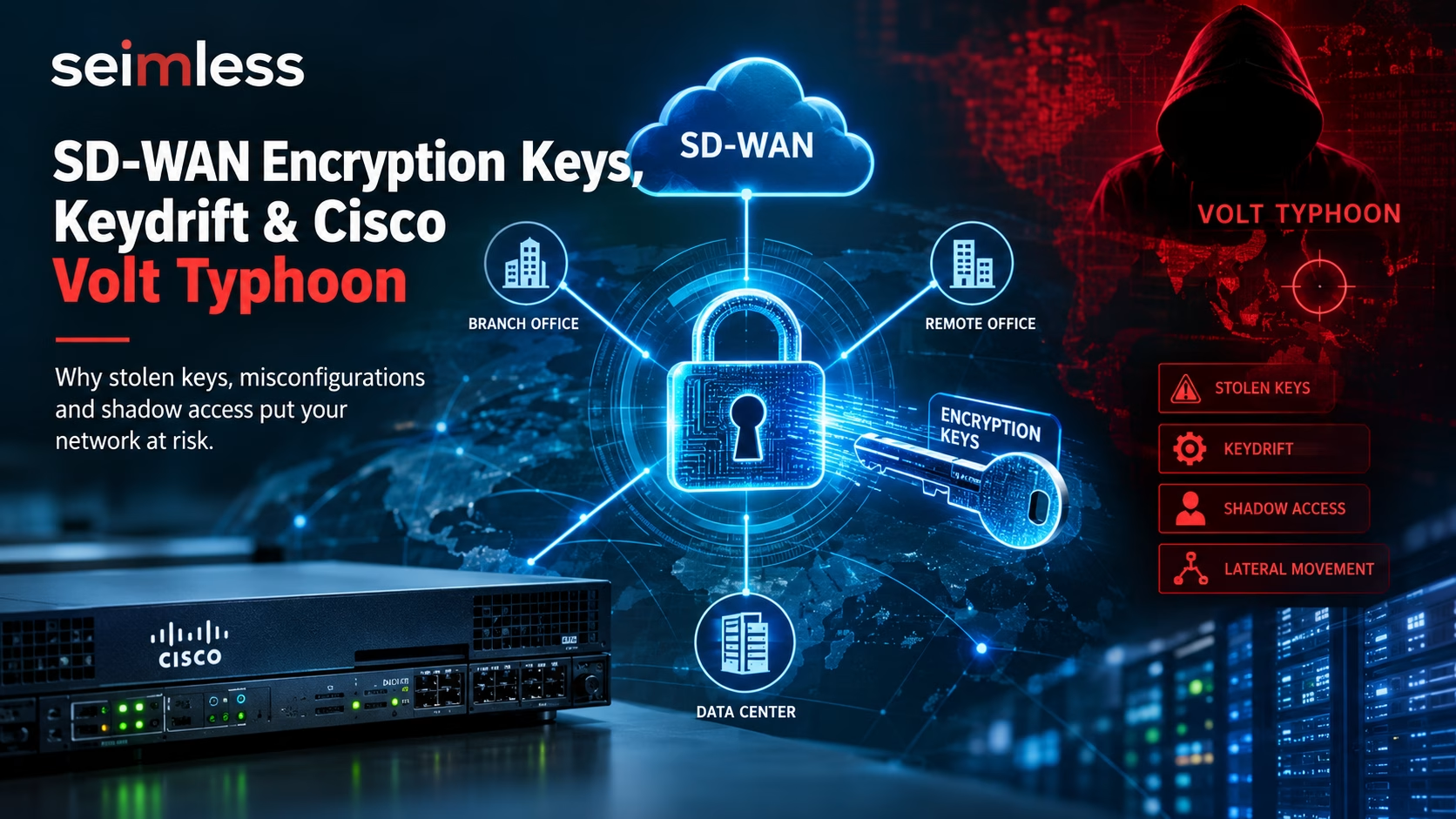
SD-WAN encryption keys just moved from a configuration detail to a front-line target. On October 28, 2026, Cisco Talos disclosed KeyDrift, custom malware planted on Cisco Catalyst SD-WAN controllers to harvest the keying material that protects traffic between an organization’s sites. SecurityWeek reported that the threat actor’s infrastructure overlaps with the Silent Train network associated with Volt Typhoon. The attackers did not need to break encryption. They collected the keys.
Definition: SD-WAN encryption keys are the cryptographic secrets that SD-WAN edge devices use to encrypt traffic between sites, typically IPsec data-plane keys that the control plane generates, distributes or coordinates. Anyone who obtains them can potentially read the traffic they protect.
Key Takeaways
- KeyDrift targeted the controllers that coordinate SD-WAN keys, not the traffic itself, after exploitation of CVE-2026-20127 (CVSS 10.0).
- Patching closes the door but does not evict malware or un-expose keys already taken. Rotation and compromise assessment come next.
- Post-quantum cryptography does not stop key theft. Key custody, segmentation and monitoring do.
- NIST finalized IR 8547 on October 27, 2026: RSA and ECC are deprecated after 2030 and disallowed after 2035.
- Treat every system that creates or distributes SD-WAN encryption keys as tier-zero infrastructure.
What Cisco Talos Found: KeyDrift and SD-WAN Encryption Keys
According to CyberPress’s analysis of the Talos report, KeyDrift hides inside Cisco SD-WAN controller processes, intercepts decrypted control traffic and extracts public IP addresses, peer system identifiers and a 32-byte field assessed to be AES-256 IPsec data-plane key material distributed through the Overlay Management Protocol. SecurityWeek adds that a second module, LittleFilch, collects keying material that Talos believes includes keys protecting data-plane traffic.
The initial access came through CVE-2026-20127, a maximum-severity authentication bypass in Cisco Catalyst SD-WAN Controller and Manager. Observed targets, per CyberPress, include space and satellite services, defense and aerospace technology organizations and policy research institutions.
This matters beyond those sectors, because SD-WAN encryption keys exist in every deployment. The design pattern, in which a central controller coordinates the keys that protect many branch tunnels, is common across SD-WAN products. The lesson applies to any vendor whose control plane touches key material, which is why this post focuses on architecture rather than a single product.
The Timeline: From Emergency Directive to KeyDrift
The October disclosure is the second act of a story that began in February. The table below shows how the pieces fit.
| Date (2026) | Event |
| Feb 25 | Cisco publishes its advisory for CVE-2026-20127. CISA adds it and CVE-2022-20775 to the Known Exploited Vulnerabilities catalog and issues Emergency Directive 26-03. |
| Feb 25–27 | Federal agencies must inventory SD-WAN systems, collect logs and snapshots and patch, with a deadline of 5 p.m. ET on February 27. |
| Early March | Cisco confirms exploitation of two more SD-WAN Manager flaws, CVE-2026-20122 and CVE-2026-20128. |
| Oct 27 | NIST finalizes IR 8547 on the post-quantum transition. |
| Oct 28 | Talos publishes KeyDrift analysis. Cisco SD-WAN exploitation is tied to Silent Train infrastructure. |
The February campaign was already notable for its tradecraft. The Hacker News reported that attackers used the built-in update mechanism to downgrade software, exploited CVE-2022-20775 to reach root, and then restored the original version to hide their tracks. Sophos and ExecutiveGov documented the federal response.
The Key Custody Gap: Why Attackers Chase SD-WAN Encryption Keys
We call the weakness behind this incident the key custody gap: the distance between where encryption is applied and where its keys are created, stored and reachable. When SD-WAN encryption keys live in or flow through an internet-reachable controller that depends on patch speed, the strength of AES-256 stops mattering. The attacker only has to beat the controller.
That is why keys are such an efficient prize. Stealing data means exfiltrating gigabytes and risking detection. Stealing keys means taking a few bytes once, then reading or forging traffic quietly for as long as those keys remain valid. A policy of long-lived keys makes the payoff larger.
Volt Typhoon’s reputation reinforces the concern. A joint CISA, NSA and FBI advisory described the group pre-positioning inside U.S. critical infrastructure networks for potential future disruption. Access to site-to-site keys is exactly the kind of foothold that serves long-term positioning.
What We Still Do Not Know About Stolen SD-WAN Encryption Keys
Credible reporting about SD-WAN encryption keys is careful here, and so should we be. Talos assessed with high confidence that the actor, tracked as UAT-11473, uses infrastructure that overlaps considerably with Silent Train. It did not say the two are the same group, and Lumen separately attributed exploitation of the flaw to Volt Typhoon. Talos has also not disclosed how many organizations were affected or whether stolen keys were ever used to decrypt traffic.
The safe reading is that keys on affected controllers should be treated as exposed until proven otherwise. That is a precaution, not a confirmed finding of decryption. Enterprises should avoid both complacency and panic, and focus on what they can control: patch status, key lifetimes and where keys live.
Why SD-WAN Encryption Keys Are Also a Quantum-Readiness Issue
It is tempting to file KeyDrift under classic vulnerability management and quantum risk under a separate roadmap. They are linked. Harvest-now-decrypt-later attacks assume an adversary can collect encrypted traffic today and read it once a quantum computer is available. An attacker who also holds the symmetric session keys does not have to wait. Key theft is the shortcut that makes quantum patience unnecessary.
To be precise, post-quantum cryptography addresses a different failure: the future break of public-key algorithms such as RSA and elliptic-curve Diffie-Hellman. It does not prevent malware from lifting keys out of a compromised process. A resilient design needs both: quantum-safe algorithms and disciplined key custody. For background on how the quantum threat reshapes encryption, see our guide to quantum computing and encryption.
What NIST’s Final IR 8547 Adds to the Picture
NIST’s final report landed one day before the Talos disclosure and sets the calendar for the algorithmic side of the problem. PostQuantum.com’s analysis summarizes the key points:
- RSA, ECDSA, EdDSA, Diffie-Hellman and related schemes are deprecated after 2030 and disallowed after 2035, now including 128-bit parameters such as P-256 that the 2024 draft had left acceptable until 2035.
- NIST recommends ML-KEM-768, defined in FIPS 203, as the default parameter set, and has selected HQC as an alternative key-encapsulation mechanism.
- Hybrid key establishment can still be FIPS 140-validated when at least one input comes from an approved scheme, in line with SP 800-227.
- TLS is named an early priority, with hybrid guidance expected in the next revision of SP 800-52.
The report aligns with Executive Order 14412 and OMB M-26-15, which set December 31, 2030 for priority federal key establishment and December 31, 2031 for signatures. Agency migration plans were due around October 22. For deadline details, read our Executive Order 14412 guide. NIST also tells organizations to start with cryptographic inventories, and a recent GAO report found that none of 24 federal agencies had fully addressed all three preparatory practices it assessed.
The enterprise takeaway: an SD-WAN fabric built on classical IPsec key exchange carries two clocks. One is the operational clock, in which keys can be stolen today. The other is the cryptographic clock, which expires classical key establishment by 2031 for federal priority systems. Plan for both in a single refresh.
A Seven-Step Playbook to Protect SD-WAN Encryption Keys
1. Treat controllers that hold SD-WAN encryption keys as tier-zero
Any system that generates, stores or distributes keys deserves the protection you give identity infrastructure. Remove public exposure of management and control interfaces, require strong authentication, and apply zero trust principles to administrative access.
2. Patch, then hunt
Confirm that fixes for CVE-2026-20127 and related flaws are applied. Then run the hunt and hardening steps described in the supplemental direction to ED 26-03. A patch does not remove an implant that was installed earlier. Our risk-based vulnerability management post explains how to prioritize exactly this kind of known-exploited exposure.
3. Rotate keys and re-establish trust
If a controller was exposed, rotate data-plane keys, certificates and credentials after remediation, following your vendor’s guidance. Rotating before you evict an attacker only hands them fresh keys.
4. Shorten the lifetime of SD-WAN encryption keys
The value of stolen SD-WAN encryption keys is their remaining lifetime. Align rekeying intervals with NIST SP 800-57 cryptoperiod guidance and the IPsec configuration advice in SP 800-77 Rev. 1.
5. Segment the management plane
Place controllers behind dedicated, monitored paths. Our NxtGen Firewall and Zero Trust Content Security pages describe how segmentation and policy enforcement reduce what an attacker can reach after a foothold.
6. Close the key custody gap for SD-WAN encryption keys
Move root key custody away from general-purpose, internet-adjacent systems and into hardened key management with clear separation of duties. Exodus Key Management is designed for this role, and NIST SP 800-175B provides the underlying key management principles.
7. Inventory cryptography and plan hybrid PQC
Build a cryptographic inventory of every tunnel, certificate and protocol in your WAN. Prioritize long-lived confidential data, and pilot hybrid key exchange where supported. Our certificate lifecycle management guide covers the operational side of crypto-agility.
Network-Layer Defenses That Protect SD-WAN Encryption Keys
No single control would have stopped KeyDrift, so protecting SD-WAN encryption keys takes layers. The Exodus quantum-resistant networking portfolio addresses different points in that chain. Exodus Data in Motion protects traffic on the wire, Data at Rest protects stored data and backups, and Exodus Aria ADR adds anomaly detection and response to surface the quiet behavior that implants like KeyDrift rely on. Pair them with endpoint detection and response and a verified backup and recovery plan so a compromised controller can be rebuilt from a known-good state.
If you are re-evaluating your WAN architecture entirely, our SD-WAN and MPLS replacement pages explain options, and private and hybrid cloud design can keep key-bearing systems off the open internet. Vendor-agnostic design is the point: the right answer depends on your carriers, regulators and risk tolerance.
End-of-Support Edge Devices Make Key Theft Easier
Exposure of SD-WAN encryption keys is worse when the device holding the keys no longer receives fixes. CISA’s BOD 26-02, issued February 5, 2026, orders federal agencies to inventory and then remove end-of-support edge devices, with removal of listed devices due roughly twelve months after issuance and the remainder at eighteen months. It binds only federal civilian agencies, but CISA encourages every organization to follow the same logic. Our Reduce, Replace, Recover post turns that logic into a network action plan.
Industry Lens: Financial Services, Healthcare and Insurance
Regulated sectors should map this incident to existing duties rather than wait for new rules:
- Financial services: NYDFS 23 NYCRR Part 500 expects encryption of nonpublic information in transit and risk-based vulnerability management, and the SEC cybersecurity disclosure rule requires timely disclosure of material incidents.
- Healthcare: the HIPAA Security Rule requires transmission security. Clinical sites linked over SD-WAN should confirm where their keys live. Our medical device cybersecurity post covers long-lived devices.
- Insurance: carriers increasingly ask how encryption keys are protected and how fast known-exploited flaws are fixed. Use the NIST Cybersecurity Framework 2.0 to document answers.
The same discipline applies to the new class of machine actors on your network. Our posts on AI agent traffic and blind agent transfer show why identity and key custody must extend to software, not just people. For the technology-choice question, see QKD vs PQC, and for NSA’s requirements for national security systems see the CNSA 2.0 FAQ.
Board-Level Questions About SD-WAN Encryption Keys
- Which systems in our WAN create or distribute encryption keys, and who can reach them?
- Are all known-exploited SD-WAN flaws patched, and did we hunt for implants afterward?
- How long do our site-to-site keys live, and when were they last rotated?
- Where is our cryptographic inventory, and which tunnels carry data that must stay confidential past 2035?
- Which edge devices are at or near end of support?
If any answer is “we do not know,” that is the first project. Our FBI data breach lessons and AI safety culture posts show the same pattern: the control that mattered was one nobody had checked.
Frequently Asked Questions About SD-WAN Encryption Keys
What are SD-WAN encryption keys?
They are the cryptographic secrets edge devices use to encrypt traffic between sites, usually IPsec data-plane keys that the control plane generates, distributes or coordinates. Whoever obtains them can potentially decrypt the traffic they protect.
What is KeyDrift malware?
KeyDrift is custom malware reported by Cisco Talos on October 28, 2026. It was planted on Cisco Catalyst SD-WAN controllers after exploitation of CVE-2026-20127 and was designed to persist and collect keying material that Talos assesses includes AES-256 IPsec data-plane keys.
Does post-quantum cryptography stop this kind of key theft?
No. PQC protects against future quantum attacks on public-key algorithms. It does not stop malware from stealing keys from a compromised controller. Key custody, segmentation, rotation and monitoring address that risk.
Was CVE-2026-20127 patched?
Yes. Cisco released fixes in February 2026 and CISA issued Emergency Directive 26-03. Patching does not remove an implant or revoke exposed keys, so a compromise assessment and key rotation are still needed.
What did NIST IR 8547 change?
The final report, published October 27, 2026, deprecates quantum-vulnerable public-key algorithms at all approved strengths after 2030 and disallows them after 2035, recommends ML-KEM-768 as the default, and confirms a FIPS 140 path for hybrid key establishment.
How can ibm/SEIMless help protect SD-WAN encryption keys?
ibm/SEIMless helps enterprises assess WAN key exposure and design quantum-resistant networking with Exodus Key Management, Data in Motion and Data at Rest, plus detection and segmentation. Contact us for a vendor-agnostic review.
Find Out Where Your SD-WAN Encryption Keys Live Before an Attacker Does
Our team will map your SD-WAN and WAN key exposure, then design a practical, quantum-resistant path forward.
Get Started Contact Us
ibm/SEIMless Communications Technologies, Inc.
Phone: 646-546-5245 · Email: in**@**********ss.com
One Liberty Plaza, New York, NY 10006
Additional reading: CISA ED 26-03 · NIST announcement on IR 8547 · Quantum Computing Report. Facts reflect public reporting as of October 30, 2026.