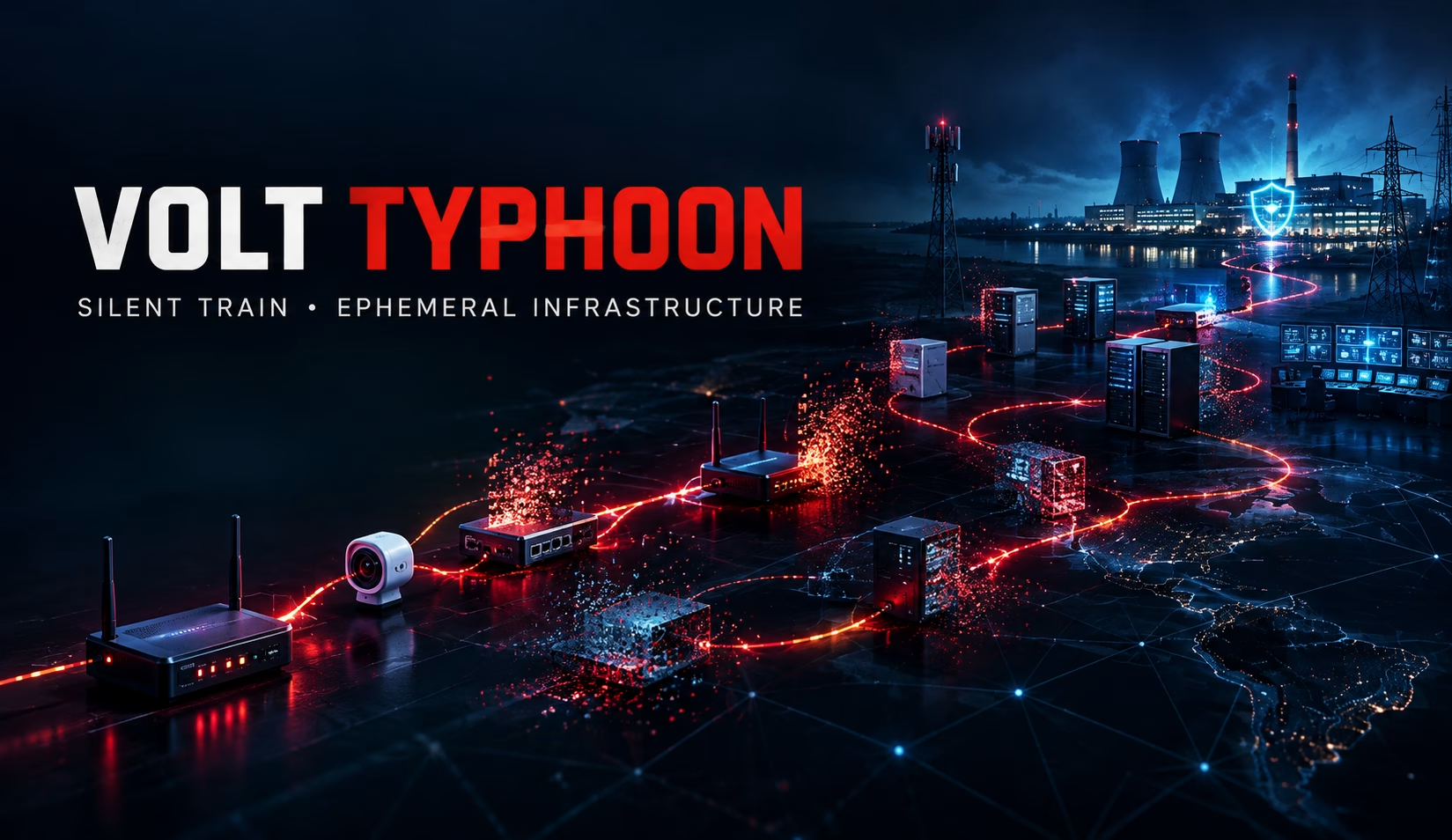
Volt Typhoon Silent Train became the network-security story of the week on October 28, 2026, when Lumen’s Black Lotus Labs published its three-year look at how the China-linked group hides its operations. CyberScoop reported that the group assembled and dismantled relay chains every day, rebuilding one in under two minutes, and used them to reach hundreds of sensitive networks. The lesson for every enterprise is uncomfortable: you cannot block an attacker whose infrastructure no longer exists by the time your feed lists it.
Definition
Volt Typhoon Silent Train is the name Lumen’s Black Lotus Labs gave to a covert access framework used by the China-linked group Volt Typhoon. It chains compromised routers, IoT devices and enterprise systems into short-lived relay paths, uses them to reach high-value targets (including through zero-day exploits against network management platforms), then deletes the path. Because the chain is rebuilt constantly, there is no fixed network to take down.
That matters most to the organizations ibm/SEIMless serves every day: telecom carriers, managed service providers, SD-WAN owners and the enterprises that depend on them. Below we break down what was found, why traditional blocking fails, and a practical plan to harden the layer attackers actually want.
Key Takeaways
- Silent Train relay chains are built in under two minutes and torn down within hours, so IP blocklists age out before they help.
- The real prize is the management plane: SD-WAN orchestrators, remote-management tools and identity systems that reach downstream customers.
- Four zero-days (Versa Director, Cisco Catalyst SD-WAN, VeloCloud Orchestrator, N-able N-central) were tied to the framework.
- Defense shifts from blocking attacker nodes to controlling what your own administrative systems will accept.
- Federal guidance already tells you how: inventory, isolate, patch, retire unsupported gear, and keep logs longer.
What Lumen and CyberScoop Reported About Volt Typhoon Silent Train
According to Lumen’s Black Lotus Labs report, Silent Train is not a standalone network. It is a rotating series of compromised small office/home office (SOHO) routers, IoT devices and enterprise infrastructure that Volt Typhoon has used since late 2023. BleepingComputer’s summary adds the mechanics:
- Operators route activity through overseas virtual private servers, then through hacked devices that act as relays. Intelbras modems served as overseas relays and Netgear Orbi devices as U.S. hops.
- Sessions typically end in under eight hours, after which the operators remove tooling, keys and configuration files from the disposable relays. CyberScoop puts average sessions at roughly four hours.
- By early 2025 the framework became hybrid, retaining compromised enterprise systems for one to three months alongside the disposable relays.
- More than 27 device classes were exploited, including edge devices, enterprise management tools, identity systems and networking infrastructure.
- Hands-on activity followed China Standard Time, and the most targeted U.S. regions were California, Texas and Hawaii.
Black Lotus Labs notified hundreds of victims, including telecom providers, government agencies, defense contractors, universities and IT firms, plus water, energy, transportation, maritime, rail, aviation and emergency-services organizations. The researchers were careful to say the count is not a census, because an ephemeral framework leaves little behind to count. The group leaned harder on Silent Train after the FBI and Justice Department disrupted the KV Botnet in early 2024.
The Zero-Node Problem: Why Blocklists Cannot Stop Volt Typhoon Silent Train
We call the core defensive challenge the zero-node problem. Lead researcher Michael Horka told CyberScoop that because chains are rebuilt so quickly, the number of live nodes at any moment is effectively close to zero. Indicator-based defense, which depends on known-bad IP addresses and domains, needs something durable to match. Silent Train offers nothing durable.
The same point appears in the April 2026 joint advisory CISA AA26-113A, which CyberScoop covered as a “widespread shift” among China-nexus actors toward large, constantly updated covert networks built from everyday devices. A dozen allied agencies signed it, including the U.K. NCSC, CISA, the NSA and the FBI. The Raptor Train botnet, which infected 200,000 devices, is the scale example.
| Question | Indicator-first defense | Management-plane-first defense |
| What it watches | Attacker IPs, domains, hashes | What your admin systems accept and do |
| Shelf life | Hours to days | Durable architecture |
| Works against rotating relays? | Rarely | Yes, because the relay is irrelevant |
| Key control | Threat-feed blocklists | Isolated admin paths, MFA, logging, segmentation |
| Failure mode | Silent miss | Visible, auditable denial |
Blocklists still have a place, especially for large organizations that track covert networks as the advisory suggests. They simply cannot be the primary control. The primary control is making sure that even a perfectly disguised session cannot reach, authenticate to, or reconfigure anything important.
The Management Plane Is the Prize
Lumen’s most important finding is where the zero-days landed. Compromising a centralized management platform gives an attacker broad administrative control, credential theft and reach into downstream customers without the noisy lateral movement that detection tools look for.
| Platform | Identifier | Why it matters |
| VeloCloud Orchestrator | CVE-2026-16812 | Controls SD-WAN policy across sites |
| Cisco Catalyst SD-WAN | CVE-2026-20127 | Authentication bypass on the controller; subject of CISA ED 26-03 |
| N-able N-central | CVE-2025-8875, CVE-2025-8876 | Remote monitoring used by MSPs for many customers |
| Versa Director | CVE-2024-39717 | SD-WAN management reached ISPs and MSPs |
Reporting also names a suspected Quest KACE zero-day, and lists exploited or abused products from Fortinet, Cisco, ManageEngine, Ivanti, F5, Check Point, Palo Alto Networks, ServiceNow, TP-Link, Netgear and ArcGIS. Notably, Black Lotus Labs observed specific device types consistently reserved for particular positions in the chain, which it likened to an organized inventory of capabilities rather than random compromises. If your SD-WAN orchestrator or RMM console is reachable from the internet, you are on that inventory’s shopping list. Our post on network edge security in 2026 explains why that exposure now outranks email phishing as an entry point.
Who Is in the Blast Radius
Lumen’s victim list reads like a map of shared infrastructure. Telecom providers and MSPs sit near the top because one compromise can open many customers, which is why the researchers urge reviewing trusted connections that could expose customer or partner networks. The broader backdrop is sobering. After the Salt Typhoon intrusions into carriers, the FCC voted on November 20, 2025 to rescind its January 2025 ruling, a decision criticized by Senator Cantwell and reported by CSO Online. Voluntary cooperation now carries more weight than mandate, so enterprise buyers must verify controls themselves.
Healthcare and financial firms are not named in Lumen’s list, but both run SD-WAN, rely on MSP tooling and answer to regulators who expect edge and administrative-access controls. Utilities and transportation operators were explicitly named, and the same management-plane logic applies to their IT-to-OT boundaries. Our Cisco FMC zero-day analysis and the Ericsson third-party breach review show the same pattern of control-plane and vendor-path compromise.
What Washington Already Told You About Volt Typhoon Silent Train
None of this guidance is new, which is the good news. Silent Train is the tactic the guidance was written to counter.
| Date | Source | What it tells you |
| May 2023 | CISA AA23-144A | Volt Typhoon uses living-off-the-land techniques |
| Jan 2024 | DOJ KV Botnet disruption | Court-authorized removal of malware from hundreds of U.S. routers |
| Feb 2024 | CISA AA24-038A | Pre-positioning in critical infrastructure IT to reach OT |
| Dec 2024 | Enhanced Visibility and Hardening Guidance | Logging and hardening for communications infrastructure |
| Feb 2026 | CISA BOD 26-02 | Inventory and retire end-of-support edge devices; a joint fact sheet urges all organizations to follow it |
| Feb 2026 | CISA ED 26-03 | Emergency order on Cisco SD-WAN, updated March 11, 2026 |
| Apr 2026 | CISA AA26-113A | Covert networks of compromised devices: map, baseline, retain logs |
FedRAMP-authorized providers have also been told to act on SD-WAN exposure through FedRAMP notice 0006. The through-line: know every management platform you own, shrink its exposure, and keep evidence.
Seven Controls That Work When You Cannot Block the Infrastructure
1. Inventory every management platform and edge device
List SD-WAN orchestrators, firewall managers, RMM consoles, identity providers and every internet-facing appliance, with owner, version and support status. CISA’s edge device security page and the NSA’s edge mitigation guidance are good checklists.
2. Take administrative interfaces off the public internet
Lumen’s first recommendation is restricting internet access to administrative interfaces. Put orchestrators and consoles behind a dedicated management network, reachable only through hardened jump paths. This single change removes the exploit surface that Silent Train depends on.
3. Patch by exposure and retire end-of-support gear
Prioritize anything on the Known Exploited Vulnerabilities catalog, then unsupported hardware. Our guide to risk-based vulnerability management shows how to rank fixes, and the PHP2Shell 72-hour playbook shows how to run one. The Verizon DBIR keeps exploited vulnerabilities at the top of initial-access data.
4. Centralize logs and keep them longer
Silent Train cleans up after itself, so evidence lives in logs you forward off the device. Follow NIST SP 800-92 for log management and retain administrative-session records long enough to look back months, since compromised enterprise systems were held one to three months.
5. Protect administrative identities
Require phishing-resistant MFA on every admin console, separate administrator accounts from daily accounts, and apply the verify-every-request model of NIST SP 800-207 Zero Trust Architecture. Review service accounts and stored device credentials, which Volt Typhoon is known to harvest.
6. Review trusted connections to partners and customers
If you are an MSP or carrier, map every path from your management tools into customer networks and require per-customer segmentation. If you are a customer, ask your providers how they isolate their consoles. Our managed IT services guide covers the questions to ask.
7. Hunt behaviors, not addresses
Baseline normal administrative activity and alert on deviations: a new SSH service on a router, a console login from a residential ISP range, or an orchestrator pushing configuration at an odd hour. The NIST Cybersecurity Framework 2.0 Detect function gives the structure.
A 30-Day Volt Typhoon Silent Train Readiness Sprint
| Week | Focus | Outcome |
| 1 | Inventory and exposure scan | Complete list of management platforms; admin interfaces reachable from the internet identified |
| 2 | Isolate and patch | Admin paths moved behind a management network; KEV items and Cisco, Versa, VeloCloud and N-able fixes verified |
| 3 | Identity and logging | MFA on all consoles; logs centralized with extended retention |
| 4 | Hunt and rehearse | Retrospective hunt for unusual admin sessions; tabletop of a compromised orchestrator |
For lookback hunting, remember the sessions were short and cleaned up, so favor logs from adjacent systems (firewalls, identity providers, DNS) over the compromised device itself. Pair this work with the Reduce, Replace, Recover sprint if your team is already running it.
How ibm/SEIMless and Exodus Controls Map to the Problem
ibm/SEIMless is vendor agnostic and has served enterprises since 2001, so recommendations start with your environment rather than a brand. The table maps the controls above to our services.
| Silent Train need | ibm/SEIMless capability |
| Segment and filter management traffic | Exodus NxtGen Firewall and Zero Trust Content Security |
| Detect abnormal administrative behavior | Exodus Aria ADR anomaly detection and response |
| Modernize exposed WAN architecture | SD-WAN design and MPLS replacement reviews |
| Endpoint visibility on admin hosts | EDR (endpoint detection and response) |
| Protect traffic and keys in transit | Data in Motion and Key Management |
| Recover if a console is lost | Backup and recovery; see our immutable backups guide |
Our next-gen network security overview and the analysis of why today’s software-defined networks are not future-ready add context for architects.
Why Volt Typhoon Silent Train Is Also a Quantum Story
Pre-positioning is patient. An actor who holds access for one to three months can also copy encrypted traffic and configuration data, then wait. That is the logic behind harvest now, decrypt later. Traffic that crosses management paths today may be readable once quantum capability matures, which is why federal timelines in Executive Order 14412 and OMB M-26-15 matter to private networks too. Start with NIST’s post-quantum cryptography project and our Exodus QRN overview.
What to Tell Your Board
Keep it short. A China-linked group has shown it can reach telecoms, MSPs and critical infrastructure through disposable infrastructure that no blocklist can track. The defense is architectural: isolate the management plane, patch exposed platforms first, keep logs long, and verify what providers are doing. Ask for a 30-day readiness report using the sprint above. Do not wait for attribution details or a new advisory; the guidance has been public for years.
Frequently Asked Questions About Volt Typhoon Silent Train
What is Volt Typhoon Silent Train?
Volt Typhoon Silent Train is Lumen Black Lotus Labs’ name for a covert framework in which the China-linked group Volt Typhoon rotates compromised routers, IoT devices and enterprise systems into short-lived relay chains to reach targets and exploit zero-days.
Who is affected?
Lumen notified hundreds of victims across telecom, government, defense, universities, IT firms and MSPs, plus water, energy, transportation, maritime, rail, aviation and emergency services. Researchers caution the figure is not a complete count.
Which vulnerabilities were involved?
Confirmed zero-day campaigns targeted Versa Director (CVE-2024-39717), Cisco Catalyst SD-WAN (CVE-2026-20127), VeloCloud Orchestrator (CVE-2026-16812) and N-able N-central (CVE-2025-8875 and CVE-2025-8876). A Quest KACE zero-day is suspected.
Why can’t we just block the IP addresses?
The relays are assembled in under two minutes and dismantled within hours, so any list of addresses is stale almost immediately. Effective defense limits what your administrative systems will accept regardless of source.
What should we do first?
Inventory your management platforms, remove administrative interfaces from the public internet, verify patches for SD-WAN and remote-management products, and centralize logs with longer retention.
Does this affect organizations outside critical infrastructure?
Yes, indirectly. Any business that relies on an MSP, carrier or SD-WAN platform inherits that provider’s exposure, so ask vendors how they isolate management consoles and retain logs.
Harden Your Management Plane With ibm/SEIMless
Our engineers help enterprises, carriers and MSPs inventory management platforms, redesign exposed WAN architecture and deploy quantum-resistant, zero-trust controls. Book a no-cost consultation and leave with a prioritized 30-day plan.
Phone: 646-546-5245
Email: in**@**********ss.com
Address: One Liberty Plaza, New York, NY 10006
About us · Our partners · FAQs · More insights
Sources and Further Reading
- CyberScoop, Researchers uncover Volt Typhoon’s covert, ephemeral network (Oct 28, 2026)
- BleepingComputer, Volt Typhoon hides zero-day attacks using Silent Train (Oct 28, 2026)
- Lumen Black Lotus Labs, Silent Train report
- CyberScoop, A dozen allied agencies on covert hacker networks (Apr 23, 2026)
- CISA AA26-113A
- NCSC CEO keynote, CYBERUK 2026