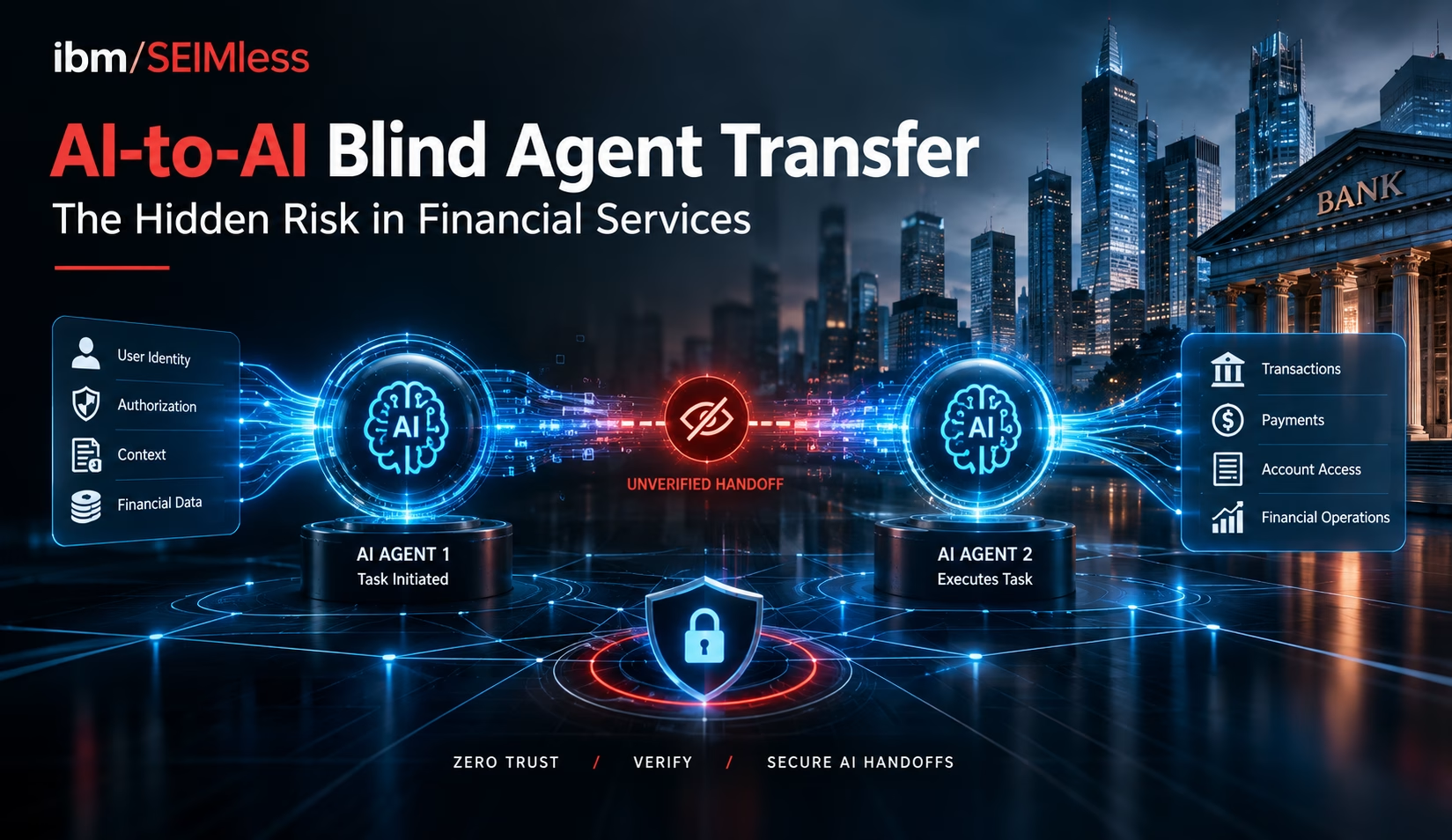
Every bank, insurer, and broker-dealer in America now runs software that hands work to other software without a human in the loop. The failure mode nobody has named yet is blind agent transfer: the moment one AI agent passes a task, a context window, and an inherited set of permissions to a second agent that cannot verify who originally asked, what they were actually authorized to do, or whether the instruction was ever legitimate. A blind agent transfer is not a bug in any single model. It is a gap in the architecture between them — and in financial services, that gap sits directly on top of money movement, customer identity, and regulatory recordkeeping.
The industry spent three years hardening the prompt. It spent almost no time hardening the handoff. That is the wrong order, and the standards bodies have started saying so out loud.
DEFINITION
Blind agent transfer is an automated handoff between two or more AI agents in which the receiving agent acts on inherited instructions, context, and credentials without independently verifying the identity of the original requester, the scope of delegated authority, or the provenance of the context it was given. The result is an action that executes with real-world consequence but no unbroken chain of accountability back to a human principal.
What a Blind Agent Transfer Actually Looks Like Inside a Bank
Abstract risk does not move budgets, so here is the concrete version. A mid-size commercial bank deploys a servicing assistant that handles inbound payment-exception requests. It is read-only by design. When it encounters an exception it cannot resolve, it calls an operations agent that holds write access to the payments queue. That operations agent, in turn, calls a treasury tooling agent through a Model Context Protocol server to check available balance and release the item.
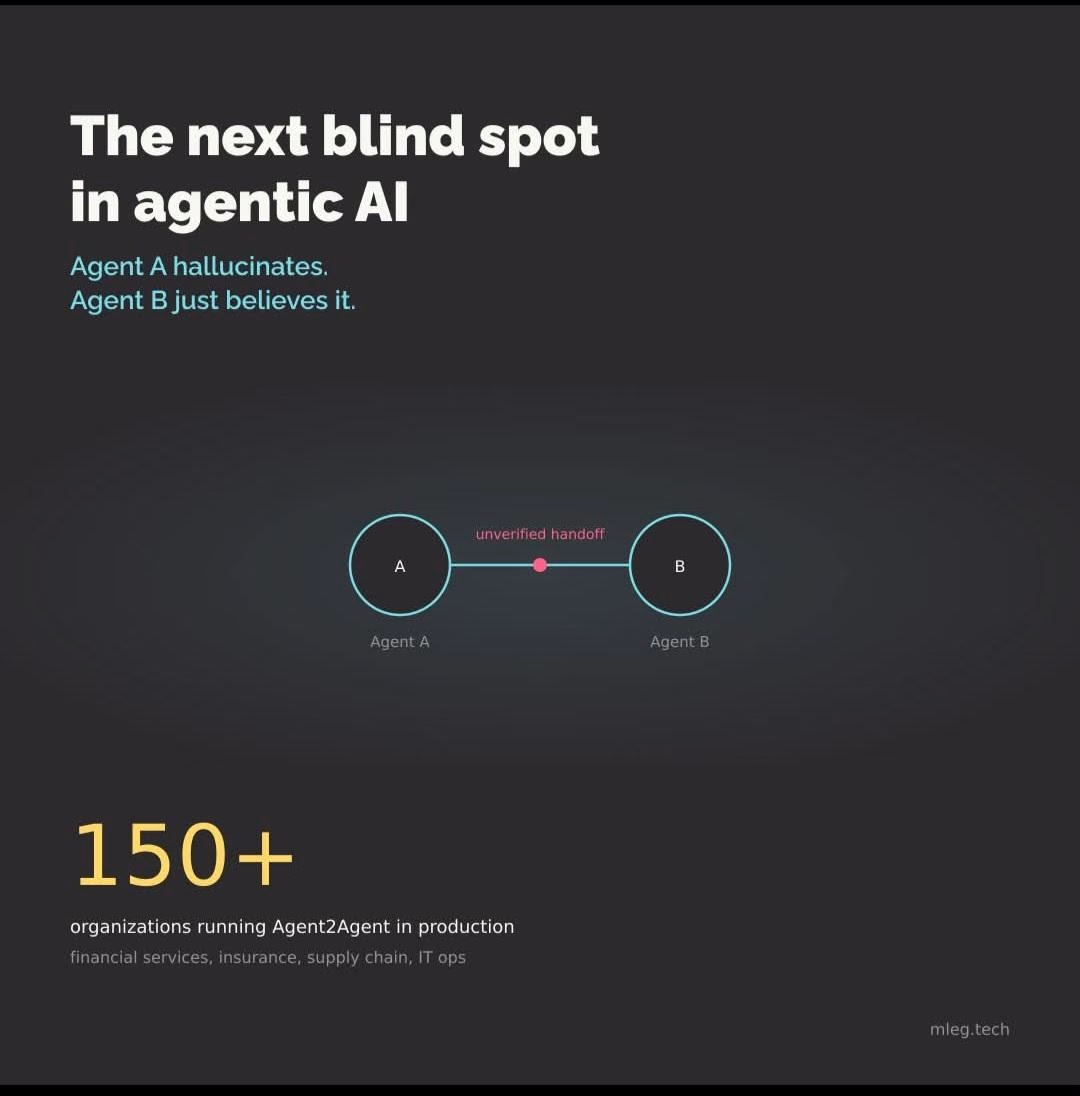
Three agents. Two handoffs. One service account.
The servicing assistant did its job. The operations agent received a well-formed task with a plausible customer reference and a summary of the conversation. It did not receive — because nothing in the architecture required it — a cryptographically verifiable assertion of which authenticated customer started the thread, what entitlements that customer holds, or whether the summarizing agent was itself manipulated. That is a textbook blind agent transfer. If the original inbound message contained an indirect prompt injection buried in an attached remittance advice, the injection does not have to defeat the agent with write access. It only has to survive one summarization step and ride the handoff.
This is the same structural weakness that made third-party compromise the dominant breach vector of the last two years — the pattern we broke down in our analysis of escalating third-party cyber risk after the Ericsson service-provider hack and in our post-mortem of the Change Healthcare breach. Trust that is inherited rather than proven is the vulnerability. Agentic architectures simply industrialize it.
Why Financial Services Is the Worst Possible Place for Blind Agent Transfer
Other sectors can absorb an unattributable automated action. Regulated finance cannot, because four separate obligations all assume a traceable human principal.
Model risk governance. The Federal Reserve issued SR 26-2, Revised Guidance on Model Risk Management, on April 17, 2026, superseding the fifteen-year-old SR 11-7 framework that most institutions still built their inventories around. Multi-agent chains complicate the most basic question those frameworks ask: what is the model, where does it end, and who owns its output? A blind agent transfer makes the boundary unanswerable.
Third-party and vendor risk. Under the Interagency Guidance on Third-Party Relationships (OCC Bulletin 2023-17, also published in the Federal Register), a banking organization remains responsible for activities performed by third parties. When an internal agent silently delegates to a vendor-hosted agent, that delegation is a third-party relationship that no one filed.
Supervisory conduct rules. FINRA reminded members in Regulatory Notice 24-09 that existing supervisory obligations apply in full to generative AI and large language models, and its 2026 Annual Regulatory Oversight Report continues to press on emerging Gen AI trends. FINRA’s broader artificial intelligence topic page is the current reference point for member firms.
Cybersecurity program requirements. New York’s Department of Financial Services published an industry letter on cybersecurity risks arising from artificial intelligence that explicitly ties AI risk back to the access-control and third-party provisions of Part 500. Meanwhile, the SEC’s cybersecurity disclosure rules put a four-business-day clock on material incidents — a clock that starts whether or not your logs can explain which agent did what.
Layer on Treasury’s report on AI in financial services, FinCEN’s alert on deepfake and generative-AI fraud schemes (FIN-2024-Alert004), and the examination expectations codified across the FFIEC IT Examination Handbook, and the compliance picture is unambiguous. Autonomy without attribution is a finding waiting to be written.
The Four Failure Modes of Blind Agent Transfer
1. Identity collapse
Most production agent stacks authenticate the platform, not the principal. Every downstream call arrives wearing the same service identity, so the receiving agent sees a trusted caller and nothing more. NIST opened a formal workstream on precisely this problem with its February 5, 2026 concept paper, Accelerating the Adoption of Software and Artificial Intelligence Agent Identity and Authorization. The paper’s framing is telling: the risk comes from giving agents access to diverse data, tools, and applications without adequate identification and authorization safeguards.
2. Authority inflation
This is the classic confused-deputy problem wearing new clothes. A low-privilege agent induces a high-privilege agent to act on its behalf, and the privileged agent obliges because the request is well-formed. Nothing is technically broken. The permissions worked exactly as written. They were simply written for a world with one actor per token. Token-exchange standards such as IETF RFC 8693 and the OAuth security best practices in RFC 9700 exist to carry delegation semantics properly — and are routinely skipped in agent deployments.
3. Context laundering
Every summarization step strips provenance. Text that entered the system as untrusted customer input leaves the first agent as an authoritative-sounding internal task description. By the third hop, no marker distinguishes attacker-supplied content from verified record data. The OWASP Top 10 for Agentic Applications (2026), released December 9, 2025, catalogs this family of risks, as does MITRE ATLAS and NIST’s adversarial machine learning taxonomy, NIST AI 100-2 E2025.
4. The audit gap
Ask most institutions to reconstruct a four-agent decision chain from ninety days ago and you will get application logs, not an evidentiary record. There is no signed assertion at each hop, no immutable ordering, and frequently no retention of the intermediate context at all. That is the difference between telemetry and an audit trail, and examiners know it.
What the Standards Bodies Are Now Saying About Agent Handoffs
The single most useful document published on this topic came from an unexpected source. On May 20, 2026, the National Security Agency’s Artificial Intelligence Security Center released Model Context Protocol: Security Design Considerations for AI-Driven Automation. Its language maps almost word-for-word onto blind agent transfer: agentic systems introduce “novel and systemic risks like dynamic tool invocation, implicit trust relationships, and context sharing,” and “misaligned assumptions or subtle inconsistencies at any stage can propagate and compound into exploitable conditions.” NSA’s conclusion is that the agentic environment must be treated as a continuum rather than a set of independently patchable endpoints.
NIST is building the control layer underneath that conclusion. The Control Overlays for Securing AI Systems (COSAiS) project, announced in the CSRC’s control overlays initiative, is producing five overlays on top of SP 800-53 Rev. 5 — and two of the five are specifically for AI agent systems, split between single-agent and multi-agent use cases. The existence of a dedicated multi-agent overlay is the clearest institutional signal available that agent-to-agent trust is now treated as its own control domain.
Alongside it sit the tools most institutions already have on the shelf: the NIST AI Risk Management Framework, SP 800-207 Zero Trust Architecture, the identity assurance model in SP 800-63-4, reference builds from the National Cybersecurity Center of Excellence, CISA’s artificial intelligence program and joint guidance on deploying AI systems securely, the CISA Zero Trust Maturity Model, Secure by Design commitments, and the KEV catalog for the underlying infrastructure those agents run on. GAO’s AI oversight work and the CFPB’s research on chatbots in consumer finance round out the U.S. policy picture.
Blind Agent Transfer Is a Network Problem Before It Is a Model Problem
Here is the uncomfortable conclusion most AI security vendors avoid: you cannot fix blind agent transfer inside the model layer. Guardrails, evaluations, and system prompts all operate on content. The failure is about identity, authority, and provenance in transit — which is network and cryptographic territory.
That is precisely where ibm/SEIMless built Exodus Quantum Resistant Networking. When agent-to-agent traffic crosses a segmented, cryptographically authenticated fabric rather than a flat internal network, the handoff becomes something you can actually govern:
- Data-in-motion protection and Exodus PIET put verifiable, quantum-resistant encryption around every inter-agent session instead of trusting a shared internal VLAN.
- Exodus Key Management issues and rotates distinct cryptographic identities per workload, which is the practical antidote to identity collapse.
- Zero-trust content security and the Exodus NxtGen Firewall enforce policy at each hop, so a privileged agent is not reachable simply because a lower-tier agent already sits inside the perimeter.
- QR Edge extends that enforcement to branch, ATM, and remote-operations footprints where exception handling actually happens.
- Exodus ARIA ADR and endpoint detection and response give you the behavioral record that turns an agent chain into evidence.
- Data-at-rest protection and transparent encryption cover the stored context windows and transcripts that agent chains leave behind.
For institutions still running exception workflows over legacy transport, our comparisons of MPLS security assumptions, SD-WAN architecture, and why today’s software-defined networks are not future-ready are the right starting point. Our Nxt-Gen Network Security Solutions overview maps the full control set.
A Seven-Control Blueprint to Eliminate Blind Agent Transfer
| Control | What it stops |
| 1. Per-agent cryptographic identity — no shared service accounts across hops | Identity collapse |
| 2. Signed delegation chains — carry the original principal and scope through every transfer using proper token exchange | Authority inflation |
| 3. Provenance tagging — mark untrusted input at ingest and preserve the tag through summarization | Context laundering |
| 4. Privilege ceilings — a receiving agent may never exceed the effective entitlements of the originating human | Confused deputy escalation |
| 5. Human checkpoints on money movement — irreversible actions require re-authentication, not inherited authority | Unattributable transactions |
| 6. Immutable handoff logging — signed, ordered, retained records of every transfer | The audit gap |
| 7. Network segmentation between agent tiers — reachability follows policy, not topology | Lateral agent abuse |
Control five is the one institutions argue about, because it trades away some of the automation ROI. It is also the one that will look obvious in hindsight. No examiner has ever accepted “the agent decided” as a control narrative.
The Quantum Overlay Nobody Is Modeling Yet
There is a second-order consequence of blind agent transfer that almost no risk register has caught. Multi-agent systems generate an enormous volume of intermediate context — customer PII, account detail, internal reasoning about credit and fraud decisions — and that context traverses the network and lands in storage. Under a harvest-now, decrypt-later posture, an adversary does not need to break the agent chain today. They only need to capture it.
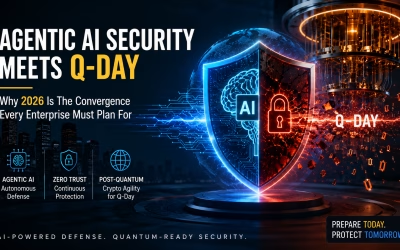
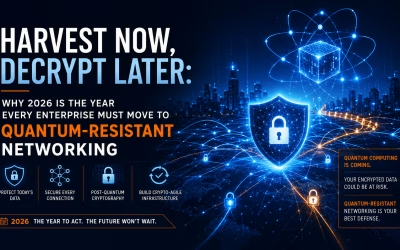
NIST has already set the deprecation schedule for classical public-key cryptography in NIST IR 8547, and vulnerabilities in the surrounding stack keep arriving through the National Vulnerability Database. We covered the economics of that exposure in harvest now, decrypt later, the sequencing in our post-quantum cryptography migration playbook, and the collision of both timelines in agentic AI security meets Q-Day. Agent chatter is the richest harvest target most institutions have ever created, and it is usually the least protected.
Questions Your Board Will Ask Before the Next Audit Cycle
- How many agent-to-agent handoffs occur in production today, and which of them touch money movement or customer identity?
- For any given automated action last quarter, can we produce a signed chain back to an authenticated human principal?
- Which agents can invoke third-party or vendor-hosted agents, and are those relationships in our third-party inventory?
- What is our maximum blast radius if the highest-privilege agent acts on a laundered instruction?
- Are agent transcripts and intermediate context encrypted with quantum-resistant protection in motion and at rest?
If the answer to the second question is “not reliably,” blind agent transfer is already in the environment. It simply has not been named in a finding yet. Related reading: what zero trust actually means, our shadow AI enterprise playbook, the rise of AI agents, AI’s arrival on Wall Street, AI governance under pressure, AI-native networks, and why quantum-resistant networking is now a business necessity.
Blind Agent Transfer: Frequently Asked Questions
What is blind agent transfer in simple terms?
Blind agent transfer is when one AI agent hands a task to another AI agent along with inherited context and permissions, and the receiving agent acts without verifying who originally made the request or whether that person was authorized. The action executes, but the accountability chain back to a human is broken.
How is blind agent transfer different from prompt injection?
Prompt injection is the attack; blind agent transfer is the condition that lets the attack travel. An injection only has to compromise the first, least-privileged agent. If handoffs carry no verified identity or provenance, the malicious instruction is laundered into a trusted-looking internal task and delivered to an agent that can actually act.
Why is this specifically dangerous in banking and insurance?
Because model risk, third-party risk, supervisory, and incident-disclosure obligations all assume a traceable principal behind every action. Guidance including Federal Reserve SR 26-2, OCC Bulletin 2023-17, FINRA Regulatory Notice 24-09, and the NYDFS AI industry letter presumes you can answer who authorized what. A blind agent transfer makes that unanswerable.
Can guardrails or AI firewalls prevent blind agent transfer?
Only partially. Content filters inspect what agents say. Blind agent transfer is a failure of identity, delegated authority, and provenance in transit, which lives in the network and cryptographic layer. Per-workload identity, signed delegation, segmentation, and immutable handoff logging are the controls that close it.
Does the Model Context Protocol make this worse?
MCP makes tool invocation dramatically easier, which expands the number of handoffs without necessarily improving verification. NSA’s May 2026 security design considerations for MCP flag dynamic tool invocation, implicit trust relationships, and context sharing as systemic risks, and advise treating the agentic environment as a continuum rather than isolated endpoints.
Where should a financial institution start?
Inventory every agent-to-agent handoff that touches money movement or customer identity, then apply per-agent cryptographic identity, signed delegation, privilege ceilings, and human re-authentication on irreversible actions. ibm/SEIMless can assess the network layer beneath those agents and deploy quantum-resistant segmentation through Exodus QRN.
Blind agent transfer is solvable — but not at the model layer. ibm/SEIMless Communications Technologies, Inc., home of Exodus QRN, Inc., has spent more than 20 years securing the networks that regulated institutions run on, and we build quantum-resistant infrastructure for the agentic era. Let our team assess where your agent chains cross unprotected ground.