The FBI data breach disclosed in late September 2026 is not just another government headline. A criminal extortion crew walked through a public jobs portal, pivoted into cloud storage, and left the nation’s premier law-enforcement agency grappling with fallout that reaches into the homes of its own agents. If it can happen to the Bureau, the uncomfortable question for every CISO in financial services, healthcare, and insurance is simple: what does your HR system know, and who else can reach it?
Below, we break down what happened, how the attack worked, why experts call it a counterintelligence disaster, and the seven practical lessons your organization should act on this quarter.
| What happened in the FBI data breach?
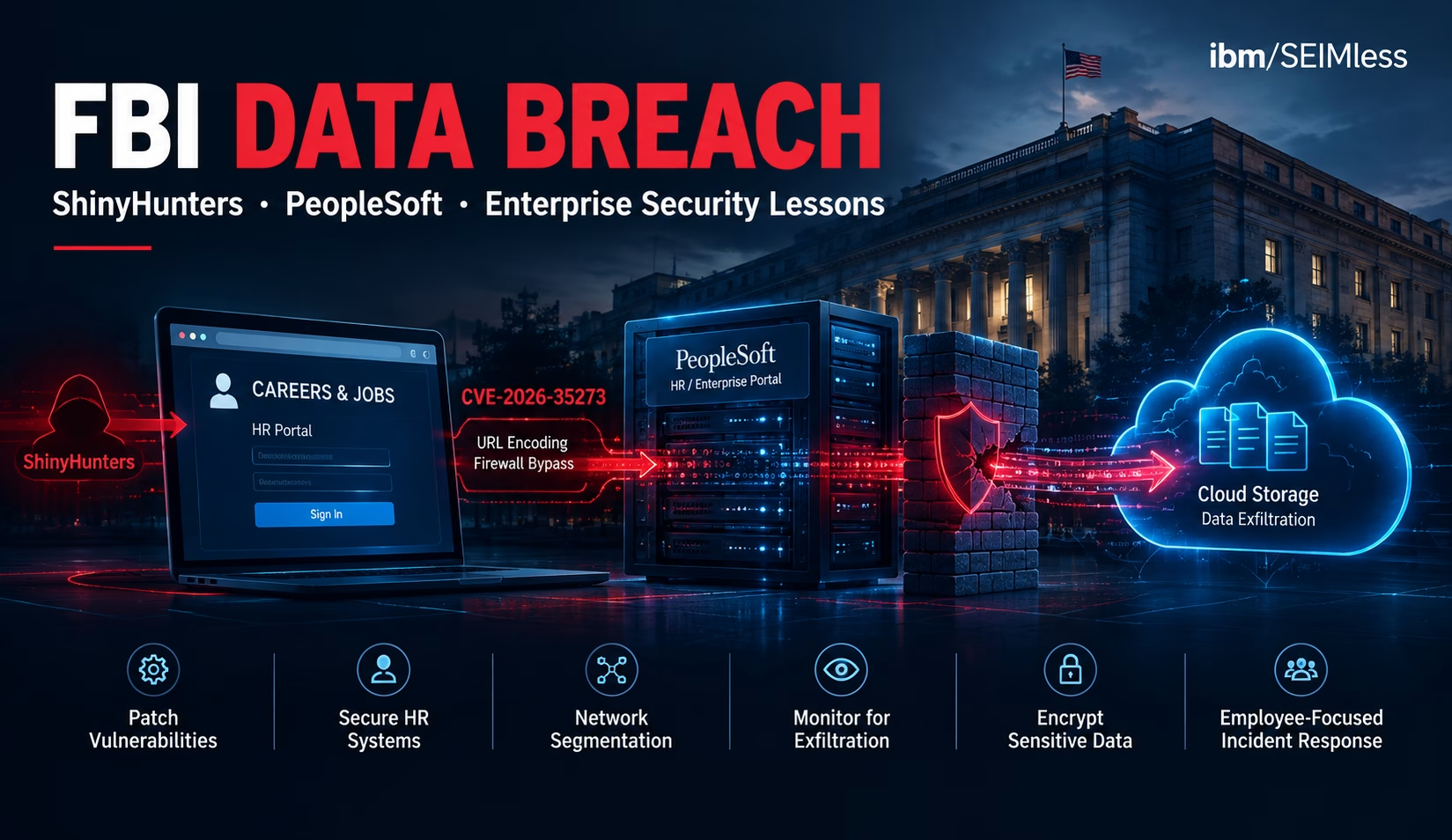
In September 2026, the extortion group ShinyHunters claimed it stole 2–3 terabytes of personal data on FBI employees and job applicants by exploiting Oracle PeopleSoft behind the fbijobs.gov portal, then moving into FBI storage on AWS GovCloud. The FBI told staff it is assuming data on all employees was stolen. |
| Key takeaways
• Entry came through an internet-facing HR application, not an email or a password. • Researchers link the intrusion to Oracle PeopleSoft flaw CVE-2026-35273 and a one-character trick that slipped past firewall rules. • Stolen data reportedly includes home addresses, Social Security numbers, spouses, emergency contacts, and assignments in sensitive units. • The group claims it is using the same flaw against Fortune 500 companies, so private enterprises are in scope. • Enterprises should patch the code, not just block the string, and treat HR platforms as crown-jewel systems. |
FBI Data Breach Timeline: From a Jobs Portal to Agency-Wide Fallout
The sequence unfolded over roughly one week, but it began months earlier in a very different sector.
| Date (2026) | Event |
| May 15 | The FBI’s Internet Crime Complaint Center publishes PSA I-051526-PSA, describing ShinyHunters as a group “specializing in large-scale data breaches and extortion.” |
| May 27 – June 9 | ShinyHunters exploits a zero-day in Oracle PeopleSoft, mostly against universities, according to Google Threat Intelligence. SecurityWeek reports Google notified more than 100 organizations. |
| June | Oracle issues an out-of-band Security Alert for CVE-2026-35273. CISA adds the flaw to its Known Exploited Vulnerabilities catalog. |
| September 22 | ShinyHunters claims it breached the FBI and defaces the jobs site. TechCrunch, CyberScoop, and Reuters via U.S. News report the claims; fbijobs.gov goes offline. |
| September 23 | The FBI confirms it is investigating, as CBS News and The Record report. The group shares 5,000 sample records with reporters. |
| September 25 | Google publishes details of a renewed PeopleSoft mass-exploitation campaign. The FBI emails staff that it is “operating under the assumption that the hackers have stolen data on all FBI employees.” |
| September 28 | The FBI reportedly declares an internal “cyber security incident”. ShinyHunters tells Nextgov/FCW it never intended to publish the data. |
Notably, the attackers did not demand money. Their stated demand was that the FBI take down the May advisory, which the group called false. The group later described the episode as “a marketing campaign,” but it has not said whether the records were deleted. This is also not the Bureau’s first incident of the year: Federal News Network notes that in March 2026 the FBI disclosed suspicious activity on an internal system holding surveillance data.
How the Attack Worked: PeopleSoft, a One-Character Bypass, and AWS GovCloud
According to ASIS Security Management, an FBI spokesperson told 404 Media that the group used a PeopleSoft vulnerability for initial access, then reached AWS GovCloud servers and downloaded 2–3 terabytes. BleepingComputer reports the group claimed access to HR, criminal justice, and medical services, while Vectra AI’s analysis links the intrusion to CVE-2026-35273 in the portal at apply.fbijobs.gov.
Google’s research explains the mechanics. The flaw sits in PeopleSoft’s Environment Management Hub (PSEMHUB) and allows Java deserialization, which means an attacker can send crafted data that the server turns into running code. Rapid7 confirmed active exploitation in June. Many organizations answered the alert with a web application firewall (WAF) rule blocking requests to “/PSEMHUB/”. In September, attackers simply wrote the path as “/%50SEMHUB/”. The “%50” is the URL-encoded letter “P”. The firewall compared the raw text and saw no match. PeopleSoft decoded it and processed the request normally.
From there, Google observed web shells, a backdoor called SIDEEYE, Neo-reGeorg tunneling, and MeshCentral remote-management agents across higher education, technology, healthcare, transportation, and government.
The virtual-patch illusion
We call this failure mode the virtual-patch illusion: the confidence created when a firewall or IPS rule blocks the known shape of an exploit while the vulnerable code stays live behind it. A virtual patch buys time. It is not a fix. Attackers only need one encoding, casing, or path variation the rule’s author did not anticipate. Google’s guidance is blunt: apply Oracle’s patch, because WAF rules are not a substitute.
This matches the wider trend. The Verizon 2026 Data Breach Investigations Report found vulnerability exploitation has overtaken stolen credentials as the top initial access method, and that only 26% of CISA known-exploited vulnerabilities were fully remediated, with a median patch time of 43 days. We covered the same shift in network edge security in 2026.
Why the FBI Data Breach Is a Counterintelligence Problem, Not Just a Privacy One
In Lawfare, Justin Sherman called the incident “a counterintelligence disaster.” The group’s sample reportedly included home addresses, phone numbers, dates of birth, spouse details, and job descriptions touching human intelligence, telecom intercept, and clandestine work. GovInfoSecurity and Engadget describe the scale of what the group says it holds.
CNN reports the stolen records cover people in counterintelligence units focused on China and Russia. Security expert Andrew Brandt told The Record that “the bigger worry is ShinyHunters selling the data to other criminal or nation-state groups.” That creates four distinct risks:
- Profiling and recruitment. Foreign services can identify who handles what, then look for financial or personal pressure points.
- Combined with older leaks, the data could help expose undercover personnel.
- Physical safety. Home addresses enable doxing, swatting, and harassment — tactics the FBI’s own PSA attributes to ShinyHunters.
- Precision phishing. Real spouses, emergency contacts, and office assignments make social engineering far more convincing.
History shows the risk is real. The 2015 OPM background-investigation breach exposed records on 21.5 million people and still shapes clearance policy a decade later. CNN also recalls a 2018 case in which a drug cartel used a hacker to track an FBI official in Mexico City. Adversaries treat this data as an intelligence asset, which is why the Justice Department now restricts bulk sensitive-data transfers under its Data Security Program.
The Fallout Inside the Bureau: Assume Total Compromise
The FBI’s decision to assume every employee is affected is the correct posture when you cannot yet scope the loss. NIST SP 800-61 Rev. 3 (April 2025) encourages exactly this kind of risk-based decision-making under uncertainty. The cyber, security, and victim services divisions are all involved, according to Fox News and CNN reporting.
But reporting also shows the human cost of weak communication. Agents worry about family safety while they travel. One former agent told CNN, “Management is lost. They’re not providing any clear advice.” When official guidance lags, rumor fills the gap, and rumor is exactly what social engineers exploit.
The lesson from the FBI data breach for enterprises: your breach playbook needs an employee track, not just a regulator and customer track. Staff need to know what was taken, what to watch for, and how to freeze credit using the FTC’s credit freeze guidance and IdentityTheft.gov.
Your HR System Is an Intelligence Target Too
It is tempting to file the FBI data breach under “government problem.” That would be a mistake. BleepingComputer reports ShinyHunters says it is now exploiting the same flaw against Fortune 500 companies. PeopleSoft, Workday, SAP SuccessFactors, and similar platforms run payroll and recruiting for banks, hospital systems, and insurers across America, and they hold the same categories of data the attackers took from the Bureau.
- Financial services: Staff in wire operations, treasury, and trading become targets for coercion and business email compromise. NYDFS Part 500 now requires universal MFA and asset inventories, both of which apply to HR platforms.
- Healthcare: Workforce records often sit beside occupational health data. Large incidents land on the public HHS breach portal.
- Insurance: Claims adjusters and SIU investigators, like FBI agents, deal with people who have motives to find them.
Third parties raise the stakes, as the FBI data breach shows with a commercial HR product at its center. Verizon found third-party involvement jumped 60% year-on-year to nearly half of all breaches. Our analysis of the Ericsson service-provider breach and of dozens of breaches linked to a single threat actor shows how one flaw in a shared platform cascades across many victims.
Seven Lessons from the FBI Data Breach for Enterprise Security Leaders
1. Patch the code, then keep the virtual patch
Treat WAF rules as a bridge, never the destination. Track every item on CISA’s KEV list to closure. Our KEV coverage explains how to prioritize.
2. Normalize before you match
Ask your firewall vendor whether rules inspect decoded, canonicalized requests. The Exodus NxtGen Firewall and Zero Trust Content Security are built around inspecting what the application actually receives.
3. Classify HR platforms as crown jewels
Map HR, payroll, and applicant systems as high-impact under NIST SP 800-53 and your NIST Cybersecurity Framework 2.0 profile. Remove public exposure of admin components like PSEMHUB entirely.
4. Break the path from app to cloud storage
The attackers moved from one web server to terabytes in cloud storage. The CISA Zero Trust Maturity Model calls for segmentation and least-privilege access so one compromised host cannot reach everything. Our AWS cloud services and private and hybrid cloud designs apply those controls.
5. Watch for exfiltration, not just intrusion
Terabytes do not leave quietly. Behavioral analytics such as Exodus Aria ADR and endpoint detection and response flag unusual archive creation, tunneling, and outbound volume.
6. Encrypt data at rest with keys attackers cannot reach
If stolen files are encrypted and the keys live elsewhere, a copy is far less valuable. That is the job of Exodus QRN Data at Rest, Exodus Transparent Encryption, and Exodus Key Management.
7. Build an employee-first breach playbook
Pre-write staff notices, safety reporting channels, and identity-protection steps, and rehearse them. Write CISA Secure by Design expectations into vendor contracts so your software suppliers own their share of the risk.
Where Quantum-Resistant Networking Fits
This FBI data breach did not involve broken encryption. But it illustrates the core logic behind harvest now, decrypt later: identity data has a very long shelf life. An agent’s Social Security number, birth date, and family ties will be just as useful to an adversary in 2036 as they are today.
Any sensitive dataset copied now in encrypted form, whether from a cloud bucket or a network tap, may become readable once quantum computers mature. That is why Exodus QRN and Exodus QRN Data in Motion pair segmentation with quantum-resistant protection for data traveling between offices, data centers, and clouds. Good hygiene stops today’s breach. Quantum-resistant design keeps tomorrow’s decryption from turning old theft into new damage.
How ibm/SEIMless Helps Protect Employee and Customer Data
For more than 20 years, ibm/SEIMless has stayed vendor-agnostic, which lets us see where popular platforms fall short. Today we combine that perspective with our full services portfolio to help medium and enterprise organizations:
- Find internet-exposed applications like HR portals and close unpatched KEV items.
- Segment application tiers from cloud storage and sensitive data stores.
- Detect exfiltration early through managed Security as a Service.
- Recover fast with immutable backup and recovery.
- Future-proof sensitive data against quantum decryption with the Exodus QRN suite.
For related reading, see why big security budgets still fail, how attackers abuse hiring workflows, what the AT&T breach settlement means, and our shadow AI playbook.
Frequently Asked Questions About the FBI Data Breach
Who was behind the FBI data breach?
The extortion group ShinyHunters claimed responsibility in September 2026. The FBI confirmed it is investigating the group’s claims about the fbijobs.gov portal and has told staff to assume all employee data was taken.
What data was stolen?
Reported data includes names, home addresses, phone numbers, dates of birth, Social Security numbers, spouse and emergency-contact details, field office assignments, and job descriptions for sensitive roles, plus applicant records.
How did hackers get into the FBI’s systems?
Reporting and research indicate they exploited Oracle PeopleSoft (CVE-2026-35273) behind the jobs portal, using a URL-encoding trick to bypass firewall rules, then moved into FBI storage on AWS GovCloud.
Did ShinyHunters demand a ransom?
No financial ransom was reported. The group demanded the FBI remove its May 15, 2026 public service announcement, and later said it did not intend to publish the data.
Is my organization at risk from the same PeopleSoft flaw?
If you run PeopleSoft PeopleTools 8.61 or 8.62 without Oracle’s June 2026 fix, yes. Apply the patch, remove or disable PSEMHUB, check logs for encoded variants of the path, and rotate credentials reachable from that server.
What should companies learn from the FBI data breach?
Patch vulnerable code instead of relying on firewall rules, treat HR systems as crown jewels, segment applications from cloud storage, monitor for bulk exfiltration, encrypt data at rest, and prepare an employee-focused response plan.