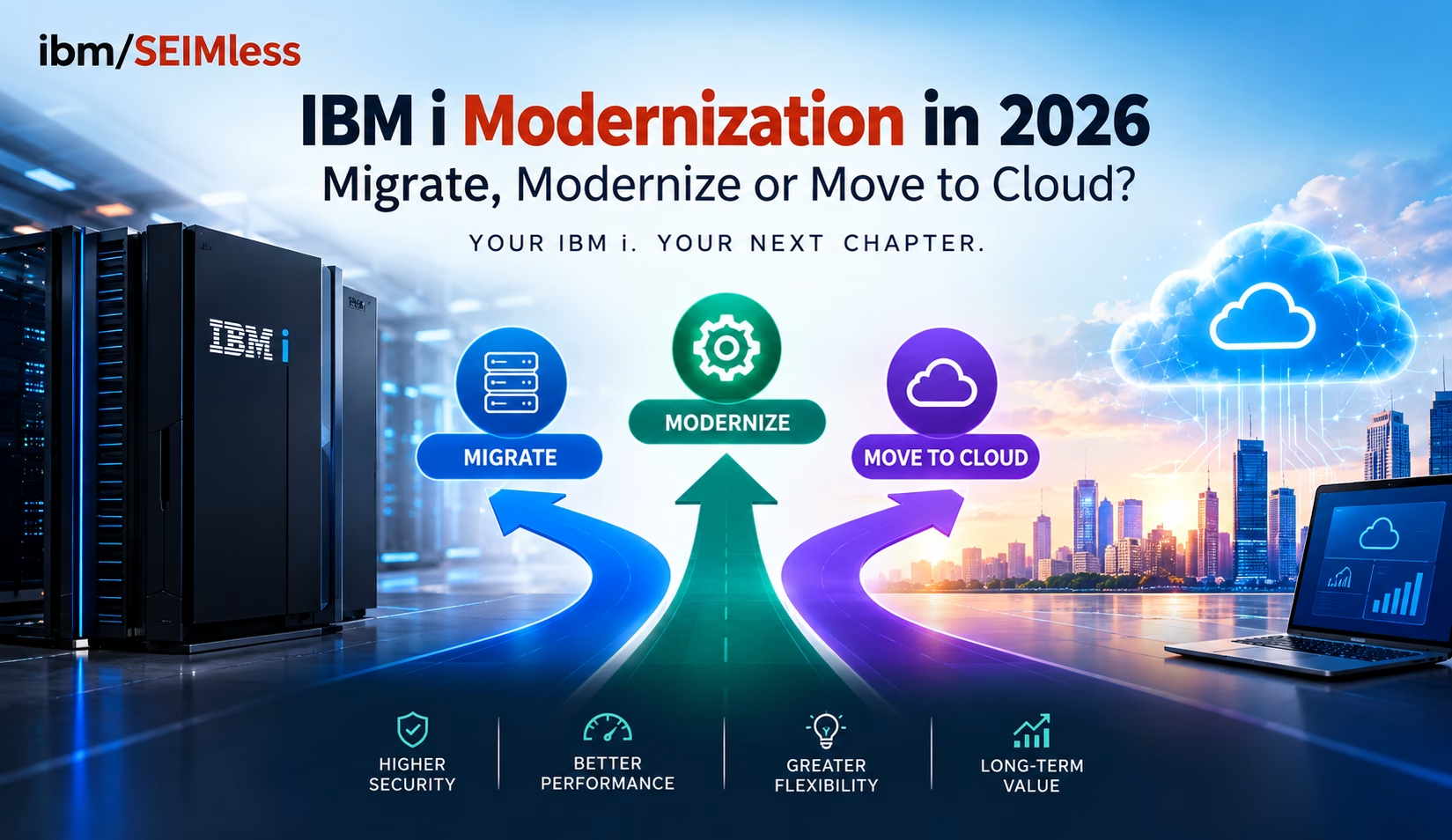
IBM i modernization has moved from a “someday” project to a board-level decision in 2026. The platform many people still call the AS/400 quietly runs core banking, policy administration, claims, patient billing, warehouse management and ERP workloads across the United States, and it keeps doing so with remarkable reliability.
What has changed is the context. IBM shipped new hardware and a new OS release, support deadlines are arriving, and RPG skills are getting scarce. This guide compares your IBM i modernization options, costs and risks, and gives you a roadmap for your leadership team.
| What is IBM i modernization? IBM i modernization is the process of updating the hardware, operating system release, applications, integrations and operating model around IBM i workloads so they stay supported, secure and connected. It can mean refreshing Power servers on-premises, moving to hosted or cloud Power infrastructure, refactoring RPG code, or combining all three. |
| KEY TAKEAWAYS
■ IBM i 7.4 reaches end of standard support on September 30, 2026, and IBM i 7.6 runs only on Power10 and Power11 servers, so release and hardware planning now go together. ■ Modernization rarely means “rip and replace.” Most organizations keep IBM i and modernize the infrastructure, code, integrations and security around it. ■ Your realistic options are on-premises refresh, IBM Power Virtual Server, managed hosting or colocation, and RPG refactoring or re-platforming. ■ High availability, disaster recovery and security hardening (MFA, exit points, encryption) should be designed into the plan, not bolted on after cutover. ■ A phased roadmap that starts with an inventory and a skills assessment lowers risk more than any single technology choice. |
Why IBM i Modernization Is Urgent in 2026
IBM i’s stability can hide technical debt: aging releases, green screens, undocumented programs and integrations only one or two people understand. Three forces make 2026 the moment for IBM i modernization: a refreshed hardware platform, closing support windows and a shrinking talent pool.
The Current IBM i and Power Roadmap
According to the IBM Power11 launch announcement, Power11 became generally available on July 25, 2025, and IBM cites 99.9999% uptime for the Power E1180, zero planned downtime for system maintenance, and quantum-safe cryptography built on NIST-approved algorithms. The same announcement introduced IBM Power Cyber Vault for immutable snapshots and ransomware detection that IBM says can alert in less than one minute.
On the software side, the IBM i 7.6.0 support page lists general availability on April 18, 2025. IBM’s IBM i 7.6 base enhancements overview states that the release supports selected servers with Power11 and Power10 processors, and it adds integrated MFA, a new authentication exit point and IBM i Secure Boot support on Power11.
Support Deadlines You Cannot Ignore
Auditors, cyber insurers and regulators increasingly question unsupported operating systems. Here are the dates IBM publishes on its IBM i release life cycle page:
| IBM i release | General availability | Support status (per IBM) |
| 7.2 | May 2, 2014 | Standard support ended April 30, 2021; extended service listed through April 30, 2026 |
| 7.3 | April 15, 2016 | Standard support ended September 30, 2023; extended service listed through September 30, 2028 |
| 7.4 | June 21, 2019 | End of marketing April 30, 2026; end of standard support September 30, 2026 |
| 7.5 | May 10, 2022 | Supported; end date to be announced with 12 months’ notice |
| 7.6 | April 18, 2025 | Current release; Power10 and Power11 only |
The IBM i 7.4 lifecycle page confirms that standard support ends on September 30, 2026, with extended support available through September 30, 2029. Extended support is a bridge, not a destination.
The IBM i Skills Gap
Fortra’s 2026 IBM i Marketplace Survey results report that IBM i skills overtook cybersecurity as the community’s number-one concern, ending cybersecurity’s nine-year run at the top. The same survey found a record 70% of respondents planning hardware, software or combined upgrades in 2026.
The U.S. Bureau of Labor Statistics projects that employment of computer programmers will decline 7 percent from 2025 to 2035. Fewer programmers overall means fewer people who will learn RPG on the job.
Lessons From Federal Legacy Modernization
The federal government offers a useful cautionary tale. In July 2025, the U.S. Government Accountability Office reported that agencies were running 11 critical legacy systems between 23 and 60 years old, and that only 3 of the 11 agencies had complete modernization plans. GAO also noted that about 80 percent of federal IT spending goes to operating and maintaining existing systems.
The lesson for enterprises: legacy system modernization fails more often from missing plans and undocumented dependencies than from technology. CISA reinforces this by listing use of unsupported or end-of-life software among its cybersecurity bad practices for organizations supporting critical infrastructure.
Industries That Still Depend on IBM i
IBM i remains embedded in regulated, operationally intense industries:
- Financial services: core banking, loan servicing, payments and general ledger systems.
- Insurance: policy administration, rating, claims and agency management.
- Healthcare: patient accounting, revenue cycle, pharmacy and payer systems.
- Distribution and manufacturing: ERP, warehouse management, order entry and EDI.
Each sector carries resilience obligations. Banks answer to the FFIEC Business Continuity Management booklet. Healthcare organizations must meet the HIPAA Security Rule, which requires plans for backing up ePHI, restoring lost data and operating in emergency mode. New York financial and insurance firms are subject to NYDFS 23 NYCRR Part 500, whose expanded MFA requirements took full effect in November 2025.
Your Four IBM i Modernization Options
The best IBM i modernization path depends on workload size, internal skills, compliance obligations and how much code you plan to keep.
Option 1: Stay On-Premises and Refresh Hardware
Moving to Power10 or Power11 with IBM i 7.5 or 7.6 keeps applications intact and restores vendor support. It suits organizations with strong operations teams and existing data centers.
The trade-off is capital expense and continued reliance on in-house staff for patching, backups and HA.
Option 2: IBM Power Virtual Server in IBM Cloud
IBM describes Power Virtual Server as a cloud offering for deploying virtual servers on Power infrastructure, with support for AIX, IBM i and Linux. The IBM Power Virtual Server product page positions it for backup and disaster recovery, development and test, and flexible workload placement.
This IBM Power Virtual Server migration path shifts capital expense to operating expense. You still own the application and security configuration, so plan for connectivity, licensing and cloud governance.
Option 3: Managed Hosting or Colocation
Many mid-sized shops get the best balance from a hosted Power environment run by a specialist. You keep IBM i and your applications; the provider handles hardware, upgrades, monitoring and backup.
ibm/SEIMless delivers IBM i Series, PureFlex and AS/400 migrations into hosted environments designed to simplify deployment and reduce hardware and operational costs. If you are weighing hosted versus colocated models, our guide to choosing the right hosting and co-location solution walks through the decision.
Option 4: Re-Platform or Refactor RPG
IBM defines RPG modernization as updating aging midrange business software so it can connect to modern systems and outlast a shrinking pool of programmers. Common techniques include converting fixed-format RPG to free-form, replacing legacy file definitions with SQL, wrapping business logic as APIs, and replacing green screens with web interfaces. IBM also points to AI coding assistance for explaining, converting and testing RPG.
Full re-platforming off IBM i, for example rewriting onto a new ERP or a cloud-native stack on Microsoft Azure or Amazon Web Services, is the highest-effort option. Before you commit, run a structured comparison like the one in our post on evaluating ERP systems in a live business case.
IBM i Modernization Cost and Risk Comparison
This qualitative comparison is a starting framework, not a quote; actual costs vary by core count, licensing, storage and HA design.
| Factor | On-prem refresh | Power Virtual Server | Managed hosting / colocation | Refactor or re-platform |
| Upfront cost | High (capital purchase) | Low | Low to moderate | Moderate to very high |
| Ongoing cost model | Maintenance plus staff | Consumption-based | Predictable monthly fee | Depends on target platform |
| Application change | None | Minimal | Minimal | Significant |
| Skills dependency | High internal | Moderate internal | Shared with provider | New skills required |
| Migration risk | Low | Moderate | Low to moderate | High |
| Time to value | Weeks to months | Weeks to months | Weeks to months | Months to years |
| HA/DR options | Self-built | Cloud-based DR | Provider-managed replication | Rebuilt on new platform |
| Best fit | Large, stable teams | Cloud-first strategies | Mid-sized, lean IT teams | Apps that no longer fit |
Many IBM i modernization programs blend options: hosted production, cloud DR and gradual refactoring of critical RPG modules.
High Availability and Disaster Recovery for IBM i
IBM i modernization is the ideal time to fix resilience gaps. A new platform with the same weak recovery plan simply moves the risk.
Replication Approaches
IBM i offers several proven approaches to IBM i high availability:
- Logical replication: software-based, journal-driven replication of objects and data to a target system.
- Hardware and storage replication: PowerHA SystemMirror for i uses independent auxiliary storage pools with geographic or storage-based mirroring.
- Continuous availability: IBM Db2 Mirror for i synchronously mirrors database updates between two nodes, which IBM describes as delivering a recovery time objective of zero.
ibm/SEIMless provides IBM i Series high availability through SafeData/HA, which replicates your data in real time to a secure off-site data center and can become your production environment during an emergency or planned upgrade. We complement that with backup and recovery services for point-in-time restore.
Build DR Around Recognized Standards
Use NIST SP 800-34, the Contingency Planning Guide, to define RTO, RPO, test schedules and roles. Then map your plan against the CISA #StopRansomware Guide, which recommends maintaining offline, encrypted backups and regularly testing restoration. Replication alone is not a backup: ransomware replicates as fast as good data.
Security Hardening for Modernized IBM i
IBM i is highly securable, but many environments still run legacy system values, over-privileged profiles and open network servers. Hardening belongs in every IBM i modernization plan.
Lock Down the Network Doors
ODBC, FTP, DDM and remote command servers open paths into IBM i. IBM documents how to use security exit programs to monitor and control access through these exit points. Pair exit point controls with network segmentation and next-generation firewalls.
Add Multi-Factor Authentication
IBM i 7.6 introduces IBM i integrated MFA using time-based one-time passwords with no additional software required. Align your authenticator choices with NIST SP 800-63B-4 and prioritize privileged and remote access first.
Encrypt Data at Rest and in Motion
IBM i 7.6 adds ASP 1 encryption, and NIST finalized its first three post-quantum encryption standards in August 2024. Long-lived financial, insurance and health records are prime targets for harvest-now, decrypt-later attacks.
ibm/SEIMless helps protect those records with Exodus quantum-resistant data at rest encryption, built to work with existing storage systems, and quantum-resistant data in motion for replication and user traffic. For the bigger picture, see our post-quantum cryptography migration playbook.
Why It Matters Financially
IBM’s 2026 Cost of a Data Breach research puts the global average breach cost at a record USD 4.99 million, up 12% year over year. The FBI’s 2025 Internet Crime Report recorded more than 1 million complaints and nearly $21 billion in reported losses.
Step-by-Step IBM i Modernization Roadmap
Use this phased IBM i modernization roadmap to turn strategy into action. Frame it with the Govern, Identify, Protect, Detect, Respond and Recover functions of the NIST Cybersecurity Framework 2.0 so security is part of every phase.
- Inventory everything. Catalog LPARs, OS releases, PTF levels, licensed programs, third-party software, integrations, batch jobs and data volumes.
- Map the business. Identify which applications support revenue, compliance and customer-facing processes, and set RTO and RPO targets for each.
- Assess skills and succession. Document who knows what, which programs lack documentation and where you rely on a single person.
- Check support and compatibility. Confirm vendor support for IBM i 7.5 or 7.6 and Power10 or Power11 before choosing a target.
- Choose the platform. Compare on-premises, Power Virtual Server and hosted options using the table above and a three-to-five-year total cost of ownership.
- Design HA, DR and security first. Define replication, backup immutability, MFA, exit point policies and encryption before migration day.
- Pilot and test. Migrate a non-production partition, run parallel processing and test failover and restore.
- Cut over in waves. Move production during planned windows with documented rollback steps.
- Modernize the code incrementally. Refactor high-value RPG modules, expose APIs and replace green screens where users benefit most.
- Operate and improve. Monitor, patch, test DR at least annually and revisit the roadmap every year.
You can extend this roadmap across your enterprise IT infrastructure services, including private and hybrid cloud and infrastructure as a service. If your team is stretched, managed IT services can absorb day-to-day operations so your experts focus on the business.
Common AS/400 Modernization Mistakes to Avoid
AS/400 modernization projects stumble in predictable ways:
- Treating the move as a hardware swap and ignoring integrations, EDI and batch schedules.
- Replicating to a DR site without ever testing a full failover.
- Leaving default system values and powerful profiles unchanged after migration.
- Rewriting stable code instead of refactoring the modules that block growth.
- Waiting for a key employee to retire before documenting their knowledge.
Frequently Asked Questions
What is the difference between IBM i and AS/400?
AS/400 was the original 1988 name of IBM’s midrange system. The platform later became iSeries and System i, and today the operating system is called IBM i running on IBM Power servers. Many people still say AS/400 out of habit, but modern IBM i supports SQL, open-source languages, web services and current security features such as integrated MFA in IBM i 7.6.
When does IBM i 7.4 support end?
IBM lists September 30, 2026 as the end of standard support for IBM i 7.4, with end of marketing on April 30, 2026. IBM also lists extended support through September 30, 2029. Organizations on 7.4 should plan an upgrade to IBM i 7.5 or 7.6, keeping in mind that IBM i 7.6 requires Power10 or Power11 hardware.
Can IBM i run in the cloud?
Yes. IBM Power Virtual Server in IBM Cloud supports IBM i, AIX and Linux on Power infrastructure. Managed hosting providers also offer dedicated or shared Power environments in secure data centers. Mainstream x86 clouds do not run IBM i natively, so moving to AWS or Azure usually means re-platforming the application or connecting to a Power-based environment.
Is IBM i modernization the same as replacing IBM i?
No. In most cases IBM i modernization keeps the platform and updates what surrounds it: hardware, OS release, HA/DR, security, user interfaces, APIs and RPG code. Replacing IBM i entirely is one option, but it carries the highest cost and risk. Many organizations get faster results by refactoring critical modules and moving infrastructure to a hosted or cloud model.
How long does an IBM i migration take?
Timelines depend on partitions, data volume, integrations and testing. A lift-and-shift to new Power hardware, a hosted environment or Power Virtual Server is often measured in weeks to months. Refactoring RPG applications or re-platforming to a new ERP typically runs months to years. A thorough inventory and pilot migration are the best ways to set a realistic schedule.
What is the best disaster recovery approach for IBM i?
The best approach combines replication for fast failover with immutable, offline backups for ransomware recovery. Options include logical replication, PowerHA SystemMirror for i and Db2 Mirror for i for continuous availability. Define recovery time and recovery point objectives first, then test full failover and restore at least annually, following NIST SP 800-34 contingency planning guidance.
Talk to ibm/SEIMless About Your IBM i Modernization Plan
For more than 20 years, ibm/SEIMless has helped financial services, insurance and healthcare enterprises migrate, protect and run the systems their customers depend on. Whether you face the IBM i 7.4 deadline, a Power11 refresh or a move to hosted IBM i with real-time replication, our vendor-agnostic team will help you choose the IBM i modernization path that fits your people, budget and risk profile.
Get Started with a no-pressure IBM i assessment, or Contact Us to speak with a specialist today.
- Phone: 646-546-5245
- Email: in**@**********ss.com
- Address: One Liberty Plaza, New York, NY 10006