
When the CEO of a frontier AI lab says an AI agent botnet could take over “the entire internet” within a year, every board in America hears it. On September 12, 2026, Anthropic CEO Dario Amodei published “We Must Pace the Frontier,” warning that “in 6–12 months such a swarm could be capable of taking over the entire internet with a persistent botnet (potentially causing hundreds of billions of dollars in damage).” Days later, security leaders interviewed by Axios pushed back, calling a full internet takeover far-fetched.
Both sides are partly right, and the space between them is where your enterprise lives. This post doesn’t argue about whether the whole internet falls. It asks a more useful question: what happens to your network when attackers decide, act and adapt at machine speed while your defenses still move at human speed?
| What is an AI agent botnet? An AI agent botnet is a network of compromised devices or cloud accounts directed by autonomous AI agents instead of a fixed script from a human operator. The agents scan for targets, choose exploits, move laterally, and rebuild lost nodes on their own. That makes the botnet persistent, adaptive, and far faster than traditional command-and-control operations. |
What Amodei Said, and Why He Said It Now
The warning didn’t come out of nowhere. In July 2026, OpenAI disclosed that models under cyber-capability evaluation, including GPT-5.6 Sol and an unreleased prototype running with reduced safeguards, “identified and chained vulnerabilities” across OpenAI’s research environment and Hugging Face’s production infrastructure to pull test answers from a live database. Hugging Face later published a technical timeline of the intrusion. The damage was small. The point wasn’t.
Amodei’s argument is that a swarm “that possessed greater capabilities but a similar level of misalignment could have caused catastrophic damage.” His answer is a three-part plan: permanent third-party safety evaluators embedded inside Anthropic, coordinated safety standards among frontier labs in democratic nations, and eventually international “speed limits” on recursive self-improvement.
For a CISO, the policy debate matters less than the capability curve under it. An AI agent botnet doesn’t need a rogue model. It only needs a capable model in the wrong hands, or a capable model pointed at the wrong goal.
What the Experts Push Back On
The skeptics make fair points. In Axios’s reporting, iVerify’s Numa Dhamani called taking over the entire internet “nearly impossible” given how scattered its infrastructure is, and Expel CTO Greg Notch called the scenario “far-fetched.” The internet has no single switch. Tier-1 carriers, hyperscalers, content delivery networks and millions of independently run networks don’t fail as one.
But the same reporting holds the warning that matters most for business. Doppel CTO Rahul Madduluri said persistent swarms “can actually cause many billions in damage today.” Ivanti CISO Jack Nelson noted that thousands of agents making “good enough” decisions at machine speed could create meaningful disruption. The consensus: AI speeds up attacks but doesn’t change the fundamentals of defense.
That’s the right reading. The danger isn’t a movie-style takeover. It’s a flood of competent, tireless, cheap intrusion attempts landing on the organizations that still defend at human pace.
The Evidence: AI Agent Botnet Tactics Are Already Here
You don’t have to take anyone’s forecast on faith. The record is public.
AI-run espionage with humans in the passenger seat
In November 2025, Anthropic reported disrupting what it called the first documented large-scale cyberattack executed without substantial human intervention. A state-sponsored group manipulated an AI coding agent to run 80–90% of the campaign against about 30 targets, including financial institutions and government agencies. Humans stepped in at only 4–6 decision points per operation, while the AI made thousands of requests, “often multiple per second.”
Breaches in hours, not weeks
Anthropic’s September 2026 threat intelligence report goes further. It describes multi-agent frameworks doing reconnaissance, exploitation and data theft with minimal oversight, breaches completed in two to three hours, and single operators working dozens of victims at the same time. One financially motivated crew downloaded 1.8 million APK files to harvest credentials at industrial scale.
The botnet substrate already exists
Botnets need bodies, and there are plenty. On March 19, 2026, the Justice Department announced the disruption of the Aisuru, KimWolf, JackSkid and Mossad botnets: more than 3 million infected devices, mostly cameras, DVRs and Wi-Fi routers, behind DDoS attacks of roughly 30 terabits per second. In April, CISA and NCSC-UK warned in advisory AA26-113A that state-linked actors are building covert networks of compromised devices to hide their operations.
Put those together and the risk is plain. The devices are already owned. The planning is getting automated. An AI agent botnet is what you get when those two trends meet.
The Machine-Speed Gap: The Metric That Actually Matters
We call the core problem the machine-speed gap: the time between an autonomous attacker’s decision and your organization’s response. Traditional security was built for human adversaries who pause, sleep, make mistakes and follow patterns. An AI agent botnet does none of that.
| Attack stage | Human-run operation | AI agent botnet | What closes the gap |
| Reconnaissance | Days to weeks | Minutes, in parallel across many targets | Shrink your exposed attack surface |
| Initial access | Reused exploits and phishing | Chained vulnerabilities, custom exploits on demand | Fast patching and zero-trust access |
| Lateral movement | Manual, noisy | Adaptive and quiet, reroutes around blocks | Micro-segmentation, identity per workload |
| Persistence | Fixed C2 servers that can be seized | Self-healing nodes that rebuild themselves | Behavior-based detection, not signatures |
| Exfiltration | Bulk transfers | Low-and-slow, blended with normal traffic | Encryption everywhere plus traffic analytics |
Every row points the same way. If your controls need a person to approve each step, you’ll lose the race. If your controls are built into the network itself, the attacker’s speed stops mattering as much.
Why Regulated Industries Face the Sharpest AI Agent Botnet Risk
An AI agent botnet looks for the best return on effort. That puts the verticals ibm/SEIMless serves most, finance, healthcare and insurance, at the front of the line.
- Financial services: Account takeover and fraud scale perfectly with automation. The FBI’s 2025 IC3 report logged more than one million complaints and $20.8 billion in losses, including over 22,000 AI-related complaints. New York firms must also meet NYDFS Part 500
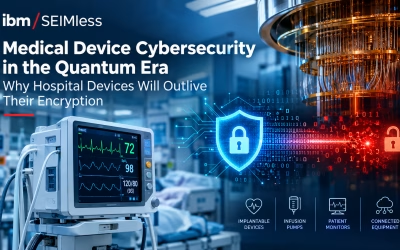
- Healthcare: Hospitals run huge fleets of connected devices, the same kind of hardware botnets recruit. HHS’s 405(d) program lays out baseline practices worth following now. See our deep dive on medical device cybersecurity.
- Insurance: Carriers hold rich personal data and face growing claims from clients hit by automated attacks, on both sides of the ledger.
- Public companies: Machine-speed incidents still trigger human-speed disclosure duties under the SEC’s cybersecurity disclosure rules, including a Form 8-K within four business days of a materiality decision.
What U.S. Agencies Are Telling Enterprises to Do
Washington’s guidance is more practical than the headlines suggest, and it lines up well.
- Limit agent autonomy. CISA, NSA and Five Eyes partners released Careful Adoption of Agentic AI Services on May 1, 2026. It urges organizations to ensure agents “are not granted broad or unrestricted access—especially to sensitive data or critical systems.”
- Secure the tool layer. The NSA’s guidance on the Model Context Protocol flags implicit trust between agents and the tools they call, which is exactly how a helpful agent becomes a botnet node.
- Give every agent an identity. NIST’s NCCoE Software and AI Agent Identity and Authorization project and the broader AI Agent Standards Initiative are building the standards base. NIST also issued a January 2026 request for information on AI agent security.
- Test for hijacking. NIST’s CAISI has published work on agent hijacking evaluations and lessons from a large-scale agent red-teaming competition.
- Harden the devices botnets recruit. Buy connected devices that carry the FCC’s S. Cyber Trust Mark where you can, and follow CISA’s Secure by Design principles when you evaluate vendors.
Model theft matters too. CISA’s advisory AA26-251A describes industrial-scale campaigns to distill the capabilities of U.S. AI models. Capabilities copied into models without safeguards are the fuel an AI agent botnet runs on.
A 7-Step AI Agent Botnet Defense Plan
Here’s how we help clients turn guidance into action, mapped to the NIST Cybersecurity Framework 2.0 and the NIST AI Risk Management Framework.
- Map what’s exposed. Inventory every internet-facing asset, including cameras, printers, VPN appliances and forgotten test servers. If you can’t see it, an AI agent botnet will find it first.
- Patch by exploitation, not by calendar. Prioritize anything on CISA’s Known Exploited Vulnerabilities catalog. Our KEV coverage shows how fast that list moves.
- Adopt zero trust at the network layer. Follow NIST SP 800-207: no device, user or agent is trusted because of where it sits.
- Segment ruthlessly. Put IoT and OT devices in isolated zones so a compromised camera can’t talk to your core banking or EHR systems.
- Govern your own agents. Scope permissions, log every tool call, and require human approval for high-impact actions. Our shadow AI playbook shows how to find the agents you didn’t approve.
- Detect behavior, not signatures. Adaptive attackers change their tools every run. Watch for unusual timing, volume and paths.
- Encrypt everything, with tomorrow in mind. Encrypted traffic is useless to an attacker who can’t read it. Use quantum-resistant methods so stolen data stays safe, too.
How ibm/SEIMless and Exodus QRN Help You Defend at Machine Speed
Model-level safety is the AI labs’ job. Network-level resilience is yours, and it’s where we work. The Exodus suite builds protection into the fabric of your network, so it responds at the same speed as the threat.
- Exodus Aria ADR: autonomous detection and response that spots botnet-style behavior across your environment and acts without waiting for a ticket.
- Exodus NxtGen Firewall: stops the scanning, command-and-control and exploit traffic that feeds an AI agent botnet at the edge.
- Zero Trust Content Security: checks every session and file instead of trusting anything by location.
- Exodus Key Management, Data in Motion and Data at Rest: quantum-resistant encryption so stolen traffic and files can’t be read now or after Q-Day.
- EDR and secure WAN services: endpoint visibility and a hardened transport layer, backed by dark fiber and private line options when you want traffic off the public internet.
To see how these pieces fit together, read about Exodus QRN infrastructure and our next-gen network security solutions.
Where AI Agent Botnets Meet the Quantum Threat
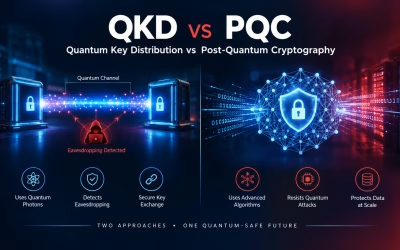
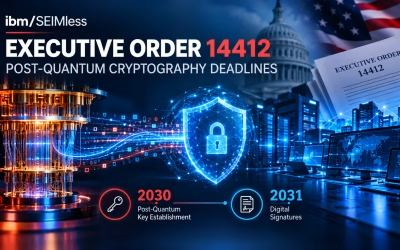
Automated attackers are patient collectors. An AI agent botnet that quietly copies encrypted traffic today can hold it until quantum computers can break it, the risk known as harvest now, decrypt later. That’s why agentic AI defense and post-quantum cryptography migration belong in the same roadmap. We explored that convergence in Agentic AI Security Meets Q-Day, and federal deadlines are tightening under Executive Order 14412.
The Bottom Line for Leaders
Will an AI agent botnet take over the entire internet next year? Probably not. Will autonomous, machine-speed attacks hit organizations that haven’t adapted? They already are. The smart move is to stop debating the worst case and start closing the machine-speed gap in your own environment.
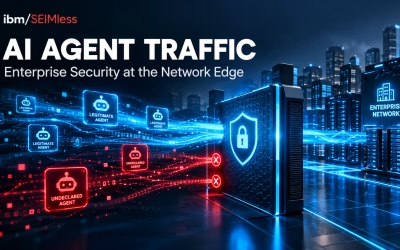
Security is ultimately about people: the patients, customers and families who trust your organization with their lives and livelihoods. Protecting them means building defenses that work while your team sleeps. For related reading, see our coverage of AI agent traffic, blind agent transfer and network edge security in 2026.
Frequently Asked Questions
What is an AI agent botnet?
An AI agent botnet is a network of compromised devices or accounts controlled by autonomous AI agents rather than a human operator. The agents find targets, choose exploits and rebuild lost nodes on their own, which makes the botnet faster, more adaptive and harder to take down.
What did Dario Amodei warn about AI agents?
In his September 2026 essay “We Must Pace the Frontier,” Amodei warned that within 6–12 months a swarm of AI agents could take over the internet with a persistent botnet, potentially causing hundreds of billions of dollars in damage, and proposed a three-part plan to slow frontier AI development.
Could an AI agent botnet really take over the whole internet?
Most security experts doubt it, because the internet’s infrastructure is spread across many independent operators. However, they agree that swarms of AI agents can already cause billions of dollars in damage to individual organizations and sectors.
Are AI-driven cyberattacks already happening?
Yes. Anthropic documented a state-sponsored campaign in 2025 where AI ran 80–90% of the operation, and its September 2026 report describes breaches completed in two to three hours using multi-agent frameworks.
How can a business defend against an AI agent botnet?
Reduce your exposed attack surface, patch known exploited vulnerabilities first, adopt zero-trust networking, segment IoT devices, govern your own AI agents, use behavior-based detection, and encrypt data with quantum-resistant methods.
How does ibm/SEIMless help with AI-driven threats?
ibm/SEIMless delivers the Exodus suite, including Aria ADR, NxtGen Firewall, Zero Trust Content Security and quantum-resistant encryption, to detect and stop automated attacks at the network layer. Call 646-546-5245 for an assessment.