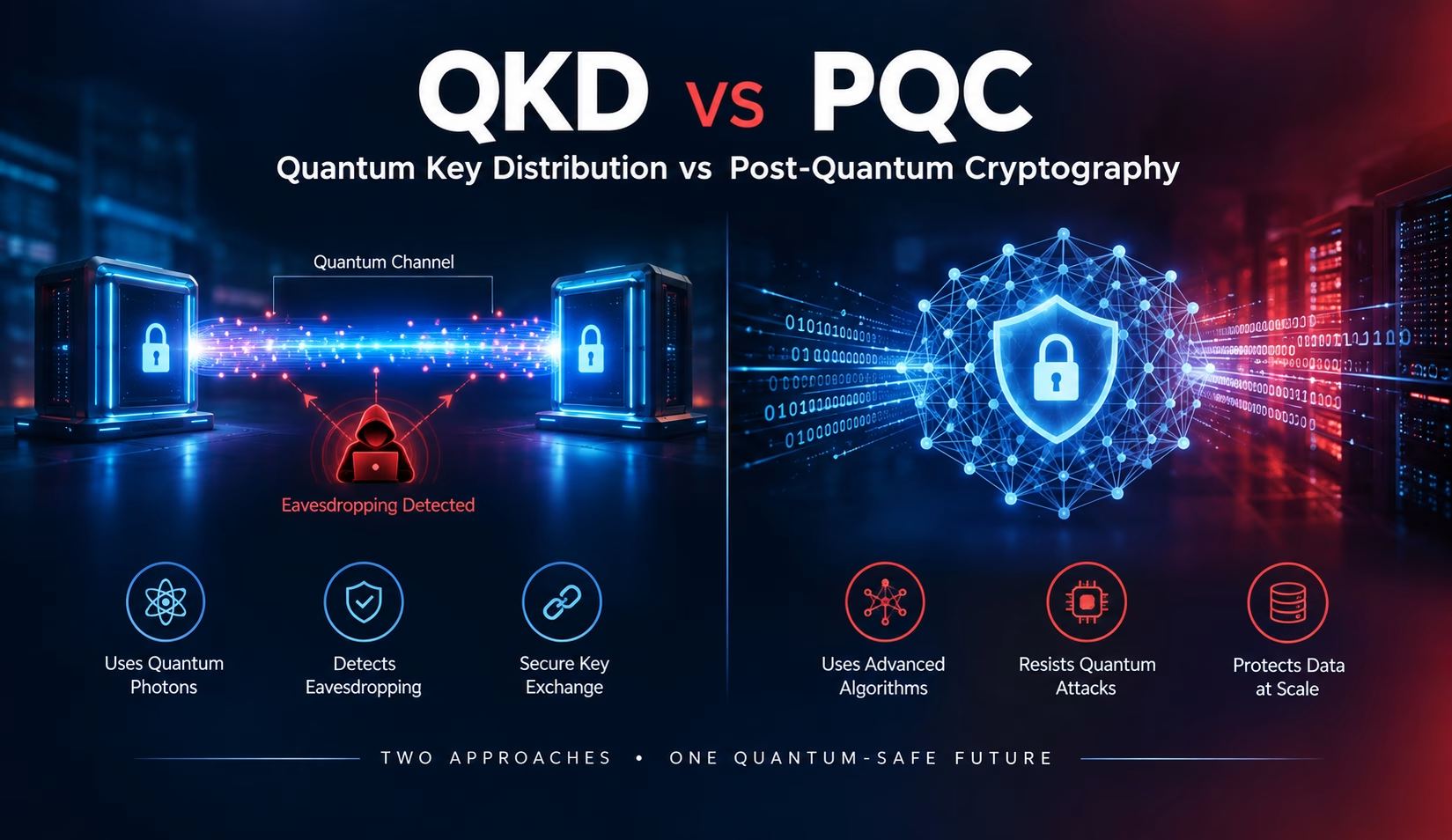
Every quantum-security conversation eventually reaches the same fork in the road: QKD vs PQC. Do you protect your network with quantum physics — quantum key distribution over dedicated fiber — or with new mathematics, the post-quantum cryptography algorithms NIST standardized in 2024? For years, vendors on both sides blurred the answer. In 2026, the U.S. government stopped blurring it. The National Security Agency, the Pentagon, and the Office of Management and Budget have all chosen post-quantum cryptography as the foundation of the federal migration, and the Pentagon has formally barred QKD as a security mechanism for its systems.
That doesn’t make quantum networking a dead end. The same White House that set the PQC deadlines is funding quantum networks for sensing, timing, and distributed computing. For CIOs and CISOs in financial services, healthcare, insurance, and the defense supply chain, the practical question is not which camp wins. It is what to build first, what to buy with confidence, and what to hold as an option. This guide answers the QKD vs PQC question the way regulators now expect you to answer it.
Quick answer — QKD vs PQC: Quantum key distribution (QKD) uses the physics of single photons to share encryption keys over a dedicated optical link and detect eavesdropping. Post-quantum cryptography (PQC) uses new math problems — such as NIST’s ML-KEM and ML-DSA — that run in software and hardware on existing networks and resist attack by quantum computers. U.S. policy treats PQC as the required foundation. QKD, where it is used at all, is a supplementary layer on specific links and never a substitute for PQC authentication.
QKD vs PQC in Plain Terms: Two Very Different Answers to Q-Day
Both technologies exist because of one threat. A cryptographically relevant quantum computer running Shor’s algorithm would break RSA and elliptic-curve cryptography, the public-key math that protects nearly every VPN, TLS session, and digital signature in use today. Adversaries already collect encrypted traffic to decrypt later, the harvest now, decrypt later strategy that makes this a present-day risk.
How quantum key distribution works
QKD sends key material encoded in the quantum states of photons. Because measuring a quantum state disturbs it, an eavesdropper on the line introduces detectable errors. The two endpoints compare samples, discard compromised bits, and keep a shared secret. The idea is elegant: security rests on physics rather than on an assumption that a math problem is hard. As the U.S. Department of Energy explains in its primer on quantum networks, these systems rely on superposition, no-cloning, and entanglement.
How post-quantum cryptography works
PQC replaces vulnerable algorithms with ones built on problems that neither classical nor quantum computers are known to solve efficiently. In August 2024, NIST finalized its first three PQC standards: FIPS 203 (ML-KEM) for key establishment, and FIPS 204 (ML-DSA) and FIPS 205 (SLH-DSA) for digital signatures. In March 2025, NIST selected HQC as a backup key-establishment algorithm based on different math. PQC is software and firmware. It runs over the fiber, MPLS, broadband, and wireless links you already own.
What the NSA Says About QKD — and Why It Matters to Every Buyer
The clearest statement in the QKD vs PQC debate comes from the NSA. Its public guidance on quantum key distribution and quantum cryptography says the agency does not recommend QKD for National Security Systems and does not anticipate certifying or approving QKD security products unless its limitations are overcome. The NSA lists five of them:
- A partial solution. QKD produces keys but does not authenticate who is on the other end. You still need classical or post-quantum signatures to prevent a man-in-the-middle.
- Special-purpose hardware. QKD requires dedicated fiber or free-space optical equipment. It cannot be delivered as a software update or a network service.
- Cost and insider risk. Distance limits force “trusted relays,” secured facilities where keys exist in the clear and insiders become part of the threat model.
- Hard to validate. Real-world security depends on engineering, not theory. Hardware flaws can open side channels the physics never anticipated.
- Denial of service. The same sensitivity that detects eavesdropping lets an attacker disrupt the link simply by disturbing it.
The NSA concludes that post-quantum cryptography is the more cost-effective and easily maintained solution. For regulated enterprises, that statement matters beyond defense. Banking, healthcare, and insurance examiners anchor their expectations to NIST and NSA guidance, so a security architecture that cannot be mapped to those references is harder to defend in an audit.
The Pentagon Drew a Hard Line on QKD vs PQC
Defense leadership has gone further than advice. A November 18, 2025 DoD CIO memorandum, Preparing for Migration to Post Quantum Cryptography, states that components shall not use quantum confidentiality technologies — naming QKD, solutions that combine QKD with other key establishment, and quantum communications or networking — as a means of achieving confidentiality, authentication, or key distribution.
The Department of War then made the position permanent in its Post-Quantum Cryptography Strategy, announced in a June 23, 2026 release. The strategy repeats that QKD and quantum networking will not be used to achieve security, and adds a line every vendor should read twice: solutions that lack PQC authentication — migrating confidentiality only — will not be considered fully PQC. Its deadlines are blunt. All systems must support PQC by December 31, 2030 or be phased out, and all systems must use PQC by December 31, 2031. DefenseScoop reported that the strategy describes insecure communications in a quantum era as an “existential threat” to military operations.
If you sell to the defense industrial base, this is not an abstract debate. QKD does not count toward your PQC obligations, and a QKD-first architecture could be one you have to re-engineer.
OMB M-26-15 and Executive Order 14412: The Civilian Clock Is Running
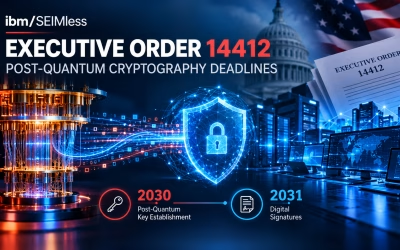
On the civilian side, Executive Order 14412, signed June 22, 2026, set the federal PQC calendar we analyzed in our Executive Order 14412 deadline guide. Two days later, OMB issued Memorandum M-26-15, Execution of the Migration to Post-Quantum Cryptography. It gives agencies 120 days — roughly October 22, 2026 — to submit PQC migration plans, calls for TLS 1.3 support by January 2, 2030, and targets completion of prioritized migrations by December 31, 2030.
Notice what the memo does not contain: any reference to quantum key distribution. The execution guidance is built entirely on NIST’s lattice-based and hash-based algorithms. The joint CISA, NSA, and NIST quantum-readiness factsheet takes the same path, focusing on inventory, vendor engagement, and PQC roadmaps. For federal contractors and the regulated industries that follow federal guidance, the QKD vs PQC decision has effectively been made for the compliance baseline.
Quantum Networking Isn’t Dead — Washington Is Funding It for Other Jobs
Here is the nuance most QKD vs PQC articles miss. The companion order, Executive Order 14413, Ushering in the Next Frontier of Quantum Innovation, directs agencies to prioritize research, testing, and evaluation of quantum sensing and quantum networking. Commerce is tasked with quantum-network-enhanced timing, Energy with networking for distributed quantum computing, and NASA with space applications.
The National Science Foundation describes the same direction in its June 2026 feature on quantum networks: linked sensors, GPS-free positioning, and pooled quantum processors, supported by regional test beds and quantum repeater research. So the federal message is consistent once you see it clearly. Quantum networks are a strategic technology for measurement and computation. For protecting data today, the government’s answer is post-quantum cryptography.
As FedTech Magazine’s 2026 federal QKD guide summarizes, CISA remains focused on the PQC migration and the DoD CIO’s post-quantum director has said QKD “does not meet our security requirements.” Infrastructure — dedicated links, endpoint hardware, and repeaters — remains the core obstacle for dispersed networks.
QKD vs PQC Side by Side: An Enterprise Comparison
| Factor | Quantum Key Distribution (QKD) | Post-Quantum Cryptography (PQC) |
| Security basis | Physics of photons; security depends heavily on hardware engineering | Math problems believed hard for quantum and classical computers |
| Authentication | None on its own — needs signatures | Built in (ML-DSA, SLH-DSA) |
| Infrastructure | Dedicated fiber or free-space optics; trusted relays over distance | Runs on existing networks, devices, and clouds |
| Standards status | Not approved for NSS; barred as a security mechanism in DoD | NIST FIPS 203, 204, 205 final; HQC in progress |
| Compliance credit | Does not satisfy federal PQC mandates | Required under EO 14412, M-26-15, and DoW strategy |
| Scale and cost | Point-to-point; high cost per link | Scales like software; cost driven by inventory and upgrades |
| Best fit today | Research, specialized dedicated links, defense-in-depth where policy allows | Every enterprise WAN, data center, cloud, and endpoint |
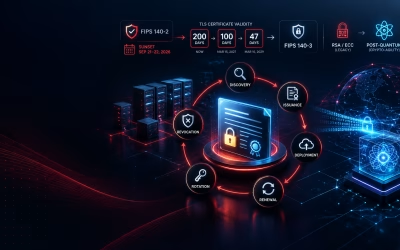
PQC has real costs too. Keys and signatures are larger — an ML-KEM-768 encapsulation key is 1,184 bytes versus 32 bytes for X25519 — which affects handshakes, constrained devices, and certificate chains. That is why crypto-agility, not a one-time swap, is the goal. Our certificate lifecycle management guide covers the operational side.
Where QKD Can Still Add Value — Honestly Scoped
The QKD vs PQC framing implies a winner-takes-all choice. It isn’t. Outside the Department of War’s systems and National Security Systems, an organization may choose to add physics-based key exchange as an extra layer — for example, between two owned data centers linked by dark fiber or wavelength services. Used this way, QKD is defense-in-depth on top of PQC, never a replacement for it.
Ask three questions before spending on it:
- Is PQC authentication already in place on this link? If not, fix that first. Keys without authenticated endpoints are an open door.
- Who controls the trusted nodes? Any relay where keys exist in the clear becomes a crown-jewel facility.
- What happens during an outage? If an attacker can force the link down, your failover path must be PQC-protected, not legacy RSA.
A PQC-First Roadmap for Financial, Healthcare, and Insurance Networks
For most enterprises, resolving QKD vs PQC comes down to sequencing. We recommend a five-step path aligned with the federal timeline and our post-quantum cryptography migration playbook:
- Inventory your cryptography. Identify every protocol, certificate, key, and library — including in medical devices, branch appliances, and third-party SaaS.
- Protect data in transit first. Harvest-now attacks target traffic, so start with quantum-resistant tunnels for data in motion across your WAN and SD-WAN, and plan the exit from legacy links through MPLS replacement.
- Centralize key management. Crypto-agility depends on knowing where keys live and rotating them on demand. Exodus Key Management provides centralized generation, distribution, storage, and rotation.
- Secure stored data. Long-retention records — loan files, patient histories, claims — need protection for data at rest and database-level transparent encryption.
- Evaluate QKD last, and only where policy permits. Treat it as an optional layer on specific dedicated links once PQC coverage is proven.
How Exodus QRN Resolves the QKD vs PQC Dilemma
ibm/SEIMless spent two decades as a vendor-agnostic integrator before becoming an OEM, and that history shapes how Exodus QRN approaches quantum security. The platform is built around crypto-agility — the memory, compute, and flexibility to add post-quantum algorithms as standards mature — with quantum random number generation for high-quality key entropy and centralized encryption and policy management across physical, virtual, and cloud environments.
Where a client has the dedicated optical infrastructure and a policy environment that allows it, quantum key distribution can be layered in. But our design principle mirrors federal guidance: post-quantum cryptography carries the compliance and authentication load, and nothing depends on QKD alone. Paired with the Exodus NxtGen Firewall and zero-trust content security, Exodus QRN protects today’s traffic while keeping your options open for tomorrow’s quantum networks. You can read more about the architecture in our Exodus QRN infrastructure overview.
We believe security is ultimately about people: patients whose records must stay private for decades, families whose savings depend on trusted banking rails, and teams who deserve infrastructure that won’t be obsolete before it is paid off. Choosing well now protects all of them.
QKD vs PQC: Frequently Asked Questions
What is the main difference in QKD vs PQC?
QKD uses the physics of photons to share keys over dedicated optical links. PQC uses new mathematical algorithms, standardized by NIST, that run on existing networks and devices and resist quantum attacks.
Does the NSA approve quantum key distribution?
No. The NSA does not recommend QKD for National Security Systems and does not anticipate certifying QKD security products unless its limitations — authentication, hardware, trusted relays, validation, and denial of service — are resolved.
Can the Department of War or its contractors use QKD for security?
Not as a security mechanism. The DoD CIO’s November 2025 memo and the 2026 DoW PQC Strategy state that QKD and quantum networking will not be used to achieve confidentiality, authentication, or key distribution.
Does QKD satisfy Executive Order 14412 or OMB M-26-15?
No. The federal migration is built on NIST PQC algorithms. OMB M-26-15 does not mention QKD, and agency migration plans are due about 120 days after June 24, 2026.
Is quantum key distribution completely obsolete?
No. Executive Order 14413 prioritizes quantum networking for sensing, timing, and distributed computing. Where policy allows, QKD can add defense-in-depth on dedicated links, but only on top of PQC.
Where should an enterprise start with post-quantum security?
Start with a cryptographic inventory, then protect data in transit with quantum-resistant networking, centralize key management, and secure long-retention data at rest. Evaluate QKD only after PQC coverage is in place.
Contact Us | Our Blog | Our Services | See Previous Post…
Related reading: The Impact of Quantum Computing on IPsec · IBM and Cisco’s Quantum Networking Partnership · Why Quantum-Resistant Networking Is a Business Necessity · All ibm/SEIMless insights