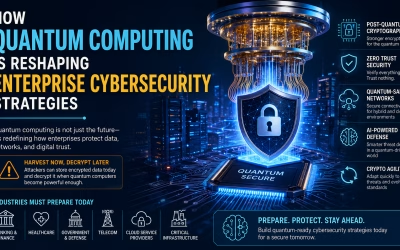
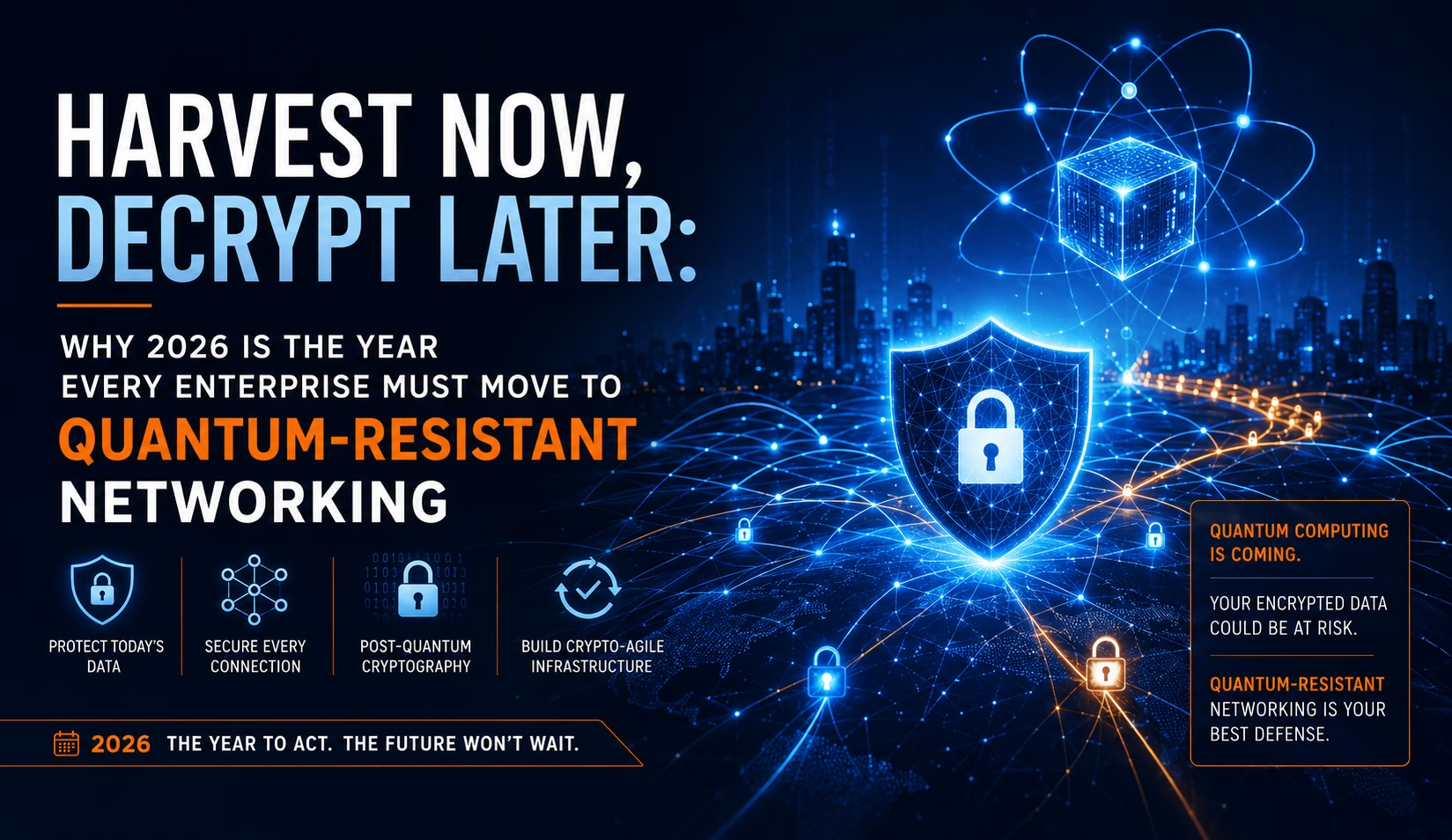
Ask most executives when quantum computing becomes a security problem, and they’ll say “in ten years.” That answer is already wrong. The most dangerous quantum attack doesn’t require a working quantum computer today — it requires only patience. Adversaries are copying your encrypted traffic right now, warehousing it, and waiting for the day a cryptographically relevant quantum machine can unlock it. Security researchers call it “harvest now, decrypt later,” and it has quietly turned 2026 into the most important migration year in the history of enterprise cryptography.
| In 2024, the U.S. government finalized the first post-quantum encryption standards. In 2025 and 2026, federal agencies, defense contractors, and regulated industries began operating under hard migration timelines. If your network still relies exclusively on RSA and elliptic-curve cryptography, every long-lived secret you transmit has a shelf life measured against Q-Day. Quantum-resistant networking is no longer a research topic. It’s a procurement decision. |
The Clock Already Started: What “Harvest Now, Decrypt Later” Really Means
Public-key cryptography — the math behind HTTPS, VPNs, digital signatures, and virtually every secure connection your business makes — rests on problems that are hard for classical computers but trivial for a sufficiently large quantum computer. A future quantum machine running Shor’s algorithm could unravel RSA and elliptic-curve keys in hours instead of the billions of years it would take today’s supercomputers.
The uncomfortable part is the timeline mismatch. You don’t need a quantum computer to steal the data — you only need it to decrypt the data later. That means a health system’s records, a bank’s transaction history, or a defense supplier’s design files that must stay confidential for 15, 25, or 50 years are already exposed the moment they cross a network protected only by classical encryption. That’s why the U.S. Cybersecurity and Infrastructure Security Agency urges organizations to begin inventorying and migrating today (CISA Post-Quantum Cryptography Initiative).
What Changed in 2024–2026: The New Standards Are Now the Baseline
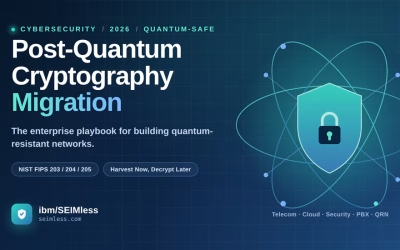
For years, “quantum-safe” was aspirational because there was no official standard to build toward. That ended in August 2024, when the National Institute of Standards and Technology published the first finalized post-quantum cryptographic standards after nearly a decade of global evaluation (NIST Post-Quantum Cryptography Project). Three of them now anchor every serious migration plan:
- FIPS 203 (ML-KEM) — a module-lattice key-encapsulation mechanism that protects the key exchange establishing secure sessions; the workhorse for network traffic (read FIPS 203).
- FIPS 204 (ML-DSA) — a lattice-based digital signature standard for authentication and code signing (read FIPS 204).
- FIPS 205 (SLH-DSA) — a stateless hash-based signature scheme that provides an algorithmically diverse backup, so the ecosystem doesn’t rest on lattice math alone.
NIST’s guidance is blunt: apply these standards now. Because rip-and-replace is never realistic at enterprise scale, migration is being deployed in a hybrid model — classical and post-quantum algorithms running together. The NIST National Cybersecurity Center of Excellence has published detailed crypto-agility guidance for exactly this transition (NCCoE Migration to PQC).
The 2026 Deadlines Bearing Down on U.S. Enterprises
A series of U.S. government mandates now sets the pace for the entire private sector, because vendors, contractors, and regulated industries inherit these requirements downstream:
- The White House Office of Management and Budget directed federal agencies to inventory cryptographic systems and build funded migration plans under memorandum M-23-02 (OMB Migration to PQC memo).
- The National Security Agency’s CNSA 2.0 suite sets aggressive adoption timelines for national security systems (NSA CNSA 2.0 requirements).
- The federal National Quantum Initiative continues to coordinate cross-agency security policy and workforce readiness (gov Technology Security).
If your organization sells to the government, operates in healthcare or financial services, or handles data with a long confidentiality horizon, these mandates are already your problem. Building this readiness into your enterprise IT infrastructure today is far cheaper than an emergency retrofit later.
Why Traditional SIEM and Network Security Aren’t Enough Anymore
Detection and encryption solve different halves of the problem. A traditional Security Information and Event Management platform is superb at spotting anomalies and flagging intrusions after an attacker is inside. But “harvest now, decrypt later” is a passive attack — the adversary may simply copy encrypted traffic at a peering point, generating no alert at all. You cannot detect your way out of a math problem.
The industry felt this shift acutely over the past year as the SIEM market consolidated and long-standing platforms reached end-of-support milestones. Even IBM’s own quantum-safe roadmap now treats cryptographic discovery and remediation as first-class disciplines alongside monitoring (IBM Quantum Safe). The lesson: next-generation network security has to protect data in transit at the cryptographic layer, not merely watch for break-ins after the fact.
What Quantum-Resistant Networking Actually Looks Like
1. Crypto-agility by design
Build infrastructure that can swap algorithms without ripping out hardware. Standards will keep evolving; your network should absorb those changes gracefully. This is the single most important design principle of a future-proof build.
2. Hybrid key exchange
Running a classical algorithm and a NIST post-quantum algorithm together keeps a connection secure even if one is later found weak. Major providers already deploy hybrids in production — Cloudflare, for example, moved post-quantum key agreement to general availability across dozens of products (Cloudflare: Post-Quantum Cryptography Goes GA).
3. A physically resilient backbone
Encryption protects the payload, but the transport layer matters too. Dedicated, privately controlled fiber shrinks the number of points where traffic can be quietly copied. That’s why dark fiber services and future-proof communications are core pillars of a quantum-resistant posture, not afterthoughts.
4. Quantum-safe cloud and hybrid environments
Workloads spread across public and private clouds multiply the number of key exchanges that need hardening. A private hybrid cloud architecture lets you apply consistent quantum-safe policy across environments instead of chasing gaps.
A Practical Five-Step Migration Roadmap for 2026
- Inventory your cryptography. Map every system, certificate, VPN, and application that uses public-key cryptography, and flag the data with the longest confidentiality lifespan first.
- Triage by risk and data longevity. Prioritize the long-lived, high-value secrets that “harvest now, decrypt later” targets.
- Deploy hybrid post-quantum cryptography. Start with your highest-risk links and roll out NIST-aligned hybrid key exchange, validating interoperability as you go.
- Harden the transport layer. Reduce exposure with dedicated fiber, segmented architecture, and monitored routes.
- Institutionalize crypto-agility. Ongoing managed IT services turn this from a one-time project into a durable capability.
Become Quantum-Ready with ibm/SEIMlessFrom cryptographic discovery to quantum-resistant fiber, cloud, and managed security, ibm/SEIMless designs enterprise networks built for the post-quantum era — with a single point of contact and a business-first, vendor-agnostic approach. Explore our security services. |
Frequently Asked Questions
Is the quantum threat real if quantum computers can’t break encryption yet?
Yes. The immediate risk is data theft, not decryption. Attackers harvest encrypted data now and decrypt it once quantum hardware matures, so any information that must remain secret for years is already at risk today.
What are FIPS 203, 204, and 205?
They are the first finalized U.S. post-quantum cryptography standards from NIST, covering quantum-safe key exchange (ML-KEM), digital signatures (ML-DSA), and a hash-based signature backup (SLH-DSA).
Does my business have to comply if we’re not a government agency?
Often, yes — indirectly. Federal mandates flow downstream to contractors, healthcare, financial services, and any vendor in a regulated supply chain.
How long does a post-quantum migration take?
For most enterprises it is a multi-year program, which is precisely why 2026 is the year to start.
The Bottom Line
Quantum-resistant networking has crossed the line from emerging trend to strategic necessity. The standards are finalized, the deadlines are real, and the “harvest now, decrypt later” threat is actively working against every organization still running purely classical encryption. To see how it fits your environment, learn more about ibm/SEIMless or start on our homepage.