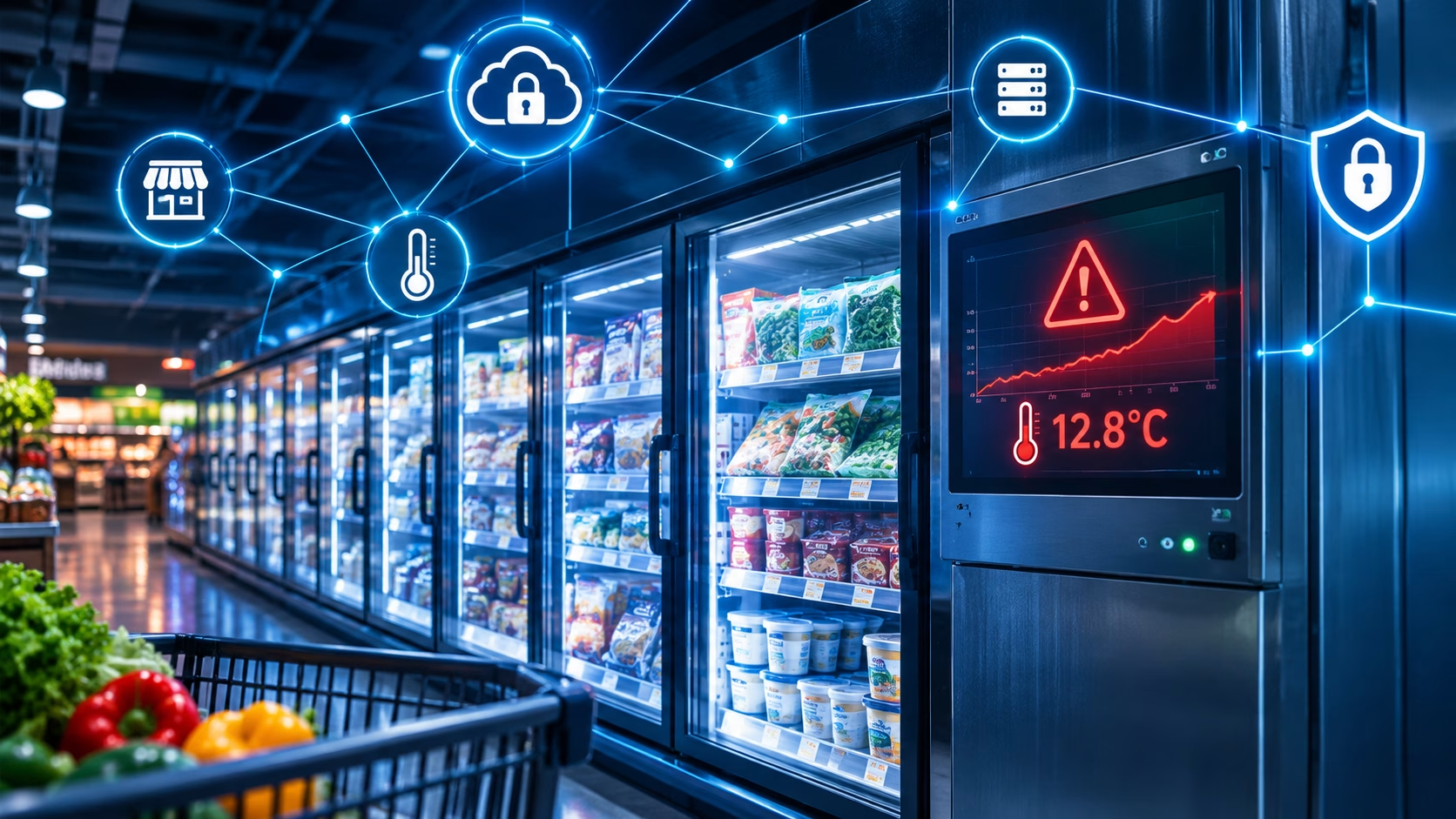
Cold chain cybersecurity became a boardroom topic in October 2026, when attackers reached into refrigeration controllers and told hundreds of supermarkets’ freezers to defrost overnight. SecurityWeek reported that hackers reportedly raised temperatures to 50 degrees Celsius (122 degrees Fahrenheit), spoiling food and causing significant financial damage. A second wave followed three weeks later. Nothing about these attacks required breaking encryption or defeating a firewall; it required finding a controller that was reachable and trusting its login. This guide explains what happened, why the lesson reaches far beyond grocery stores into hospitals, pharmacies, laboratories and insurers, and how to build a practical cold chain cybersecurity program around your network.
Definition: Cold chain cybersecurity is the protection of the networked controllers, sensors, remote-access paths and alarms that keep temperature-sensitive goods, such as food, medicines and biologics, within safe limits from storage through delivery.
Key Takeaways on Cold Chain Cybersecurity
- Two waves, hundreds of stores: about 700 supermarkets on October 11 to 12, then more than 100 more on November 1 to 2.
- The weak point was reachability: internet-exposed management interfaces, default or shared credentials, and legacy controllers that no longer get updates.
- Alarms were targeted too: officials said the attackers changed settings, disabled remote access and alarms, and altered pumping cycles.
- Not just groceries: any operation that stores medicines, samples, vaccines or food on networked equipment shares the exposure.
- The fix is mostly network design: inventory, isolate, broker remote access, and keep an independent alarm path.
What Happened: Two Waves That Put Cold Chain Cybersecurity on the Agenda
According to SecurityWeek’s reporting on the second wave, the first attack hit overnight October 11 to 12, forcing refrigeration units at about 700 supermarkets into defrost mode, including Intermarché, Carrefour, Coopérative U and Monoprix stores. France’s CERT-FR initially linked the compromises to Danfoss AK-SM and AK-SC controllers, then extended its alert a day later to Copeland and Dixell XWEB systems. Facilities Dive reports losses of tens of millions of dollars in discarded product.
| Wave | When | Scale | Notes |
| 1 | Overnight October 11 to 12, 2026 | About 700 stores, mainly France; smaller numbers in several other countries | Controllers forced into defrost; fires reportedly occurred |
| 2 | Overnight November 1 to 2, 2026 | More than 100 stores across Belgium, Estonia, Ireland, Luxembourg, Netherlands, Sweden; issues also in Finland, Italy, Portugal | Some units set as high as 50°C; Carrefour said 15 of about 700 Belgian stores were affected |
No group has claimed responsibility, and investigators have not established whether the waves are linked. The Belgian federal prosecutor has opened an investigation, and Dark Reading notes that the motive is unknown. Separately, Cooling Post reported that security firm Profero attributed a different attack on an Israeli food processor, which reprogrammed refrigeration controllers and destroyed compressors, to an Iranian state-directed persona. Treat these as signs that temperature control is now a deliberate target, and that cold chain cybersecurity deserves the same budget line as any other critical system.
Why Cold Chain Cybersecurity Is a Network Problem: The Set-Point Problem
We call the core issue the set-point problem: the number that keeps product safe, the temperature setting, can be changed by anyone who reaches the right interface. When that interface sits on the public internet, an IP address becomes a physical-safety risk. The controllers involved were built to run reliably for decades, not to defend themselves. Armis, as quoted by Facilities Dive, says Modbus and similar protocols were designed for isolated networks, often without authentication or encryption, and that 91 percent of the building systems it observed communicate over insecure protocols.
Exposure was measurable. Censys counted just over 1,000 exposed Danfoss StoreView interfaces worldwide, and estimated the share of exposed instances that are patched at roughly 41 percent in France, 68 percent in Belgium, 37 percent in the Netherlands and 58 percent in Sweden. France’s exposed count fell from 1,825 to 220 after the October attacks, which shows how quickly operators can cut exposure once they decide to. Danfoss told customers on October 13 to disconnect systems from the internet and reconnect only through a secure network, and most stores complied. Some did not.
Legacy equipment limits what cold chain cybersecurity can do through patching
Danfoss said most hacked units were legacy products it no longer updates. Researcher Kevin Beaumont noted that many affected devices are end of life with no patch available, and the CEO of refrigeration contractor Sabcobel said a software update alone does not fully fix the weakness, since some equipment needs physical modification. That is the same trap we described in our guide to end-of-support edge devices: when a device cannot be patched, the network around it has to carry the protection.
How the Access Likely Worked: What Cold Chain Cybersecurity Teams Know and Do Not
The exact method is unconfirmed. Dark Reading lists the contributing factors researchers cite: unpatched vulnerabilities, including three in Danfoss AK-SM 800A controllers and two in Copeland controllers that Claroty’s Team82 disclosed in August, plus default passwords, vendor-shared service codes and static credentials reused across many sites. Claroty also described a hidden authentication mechanism that could be abused to bypass normal login. Security firm Lupovis observed login attempts using factory-default credentials that the vendor publishes.
Two details deserve attention. First, Sabcobel, the refrigeration contractor for Delhaize, said attackers got into individual supermarkets’ systems rather than the contractor’s own. Second, Intermarché described one incident as affecting a service provider that manages refrigeration. Those accounts differ, which is common early in an investigation. For buyers, the practical lesson is that you must know both your own exposure and your contractors’ access paths, a theme we explored in third-party risk management after the Sageworks shutdown.
Beyond Supermarkets: Where Else Cold Chain Cybersecurity Matters
Cold chain cybersecurity is not only a grocery concern. Dark Reading points out that the same combination of internet connectivity, remote access and weak practices can put temperature-controlled infrastructure in other critical sectors at risk, and cites pharmaceuticals and food distribution as examples. Extending that logic, these operations belong on your list:
- Hospitals and pharmacies: medication refrigerators, ultra-cold freezers and blood storage often run on networked monitors managed by facilities or a vendor, outside the IT team’s view.
- Laboratories and biobanks: irreplaceable samples depend on stable temperature for years.
- Food service and distribution: multi-site chains share remote-access accounts across stores.
- Insurers and lenders: spoilage, business interruption and credit exposure follow when a policyholder or borrower loses inventory to a cyber event.
Facilities Dive notes that BACnet, common in U.S. buildings, has similar legacy gaps because it predates network connectivity. The risk is not only European.
A Seven-Control Cold Chain Cybersecurity Plan
| # | Control | What good looks like |
| 1 | Inventory | Every refrigeration and monitoring device recorded with model, firmware, site, network address, remote-access method and support owner |
| 2 | Remove internet exposure | No management interface reachable from the public internet; verified by an external scan |
| 3 | Broker remote access | Vendors connect through an authenticated, multi-factor, session-recorded gateway, not a standing open port |
| 4 | Unique credentials | Defaults and shared service codes removed; one credential per person or vendor, revocable in a day |
| 5 | Segmentation | Controllers in their own zone; office, guest and payment networks cannot reach them |
| 6 | Independent alarms | Temperature alerts on a path that does not depend on the controller or its network; manual checks as a backup |
| 7 | Replace or isolate legacy | Unsupported units on a replacement schedule, and fully isolated until then |
Of the seven cold chain cybersecurity controls, number six matters because the reported attacks disabled remote access and alarms. If the only alarm travels over the compromised path, nobody learns about the problem until product is lost. Pair that with a written spoilage playbook: who decides when to move or discard stock, who calls the insurer, and who documents conditions.
The U.S. government has published directly relevant guidance for cold chain cybersecurity and other operational technology. CISA’s BOD 23-02 on internet-exposed management interfaces sets the standard federal agencies follow, and its logic applies to any controller. CISA’s primary mitigations for operational technology, NIST SP 800-82 Rev. 3 and the ISA/IEC 62443 series provide detailed frameworks, while MITRE ATT&CK for ICS maps adversary techniques. CISA’s industrial control systems hub publishes advisories, including one on an authentication flaw in Danfoss AK-SM 800A system managers, according to Facilities Dive.
Network Architecture That Shortens the Blast Radius
Most cold chain cybersecurity controls are network controls, which is where ibm/SEIMless works. A modern next-generation firewall enforces the boundary around the controller zone. Zero trust content security and per-application access replace the standing vendor port. An SD-WAN fabric and MPLS replacement design keep store and facility traffic on private, segmented paths rather than open internet exposure. Monitoring such as Exodus Aria ADR and EDR on the supporting laptops and servers help you spot unusual access, and backup and recovery keeps the records you need after an incident. Our post on the SonicWall MFA bypass covers why the remote-access gateway itself needs the same scrutiny, and securing applications anywhere explains consistent policy across environments.
Two more infrastructure points are easy to miss. Alarm and monitoring panels often still ride copper lines that carriers are retiring, so see our POTS line replacement guide before a cutover silences an alert. And cellular or broadband links added by contractors tend to go undocumented, which is why our telecom expense management guide treats inventory as a security task. An honest note: we do not know how the European intrusions began, and no product listed here is claimed to have prevented them. The aim is to remove the conditions the reporting describes.
Regulatory and Sector Lens for U.S. Operators
- Healthcare: the HIPAA Security Rule requires contingency planning, and the HHS 405(d) program offers practices for connected medical and facility systems. The CDC publishes a vaccine storage and handling toolkit, and the FDA’s Drug Supply Chain Security Act page covers product integrity.
- Food: the FDA’s Food Safety Modernization Act emphasizes preventive controls, and a cyber-induced temperature failure is a preventive-control failure.
- Banks and lenders: the FFIEC business continuity booklet expects dependencies to be mapped, including those of borrowers in critical sectors.
- Insurers: state laws modeled on the NAIC Insurance Data Security Model Law require access controls, and underwriters increasingly ask about OT exposure.
- Everyone: the NIST Cybersecurity Framework 2.0 and CISA’s Cross-Sector Cybersecurity Performance Goals give a common language, and the FBI Internet Crime Complaint Center is where to report an incident.
For threat context, see the Dragos OT Cybersecurity Year in Review, CISA’s Known Exploited Vulnerabilities catalog, and ongoing coverage from BleepingComputer and Censys on exposed devices.
What We Still Don’t Know
Public reporting on these cold chain cybersecurity incidents has not established how attackers gained access, whether the October and November waves share an actor, or what the motive was. Danfoss’s own pages were not available to automated readers during our research, so product and firmware specifics here come from press reports and should be checked against vendor bulletins. Counts of affected stores differ by source and will keep changing. Plan against the conditions, exposure, weak credentials and legacy gear, rather than against any single named actor.
A 30-Day Cold Chain Cybersecurity Plan
| Week | Action | Output |
| 1 | Inventory refrigeration and monitoring devices; run an external scan for exposed interfaces; close any you find | Device register; exposure report |
| 2 | Replace default and shared credentials; collect remote-access details from every vendor and contractor | Credential reset log; vendor access map |
| 3 | Move controllers into an isolated zone; route vendor access through a brokered, multi-factor gateway; test the independent alarm path | Segmentation diagram; alarm test record |
| 4 | Rank legacy units for replacement; write and rehearse the spoilage playbook with facilities, IT and your insurer | Replacement schedule; tabletop results |
Frequently Asked Questions About Cold Chain Cybersecurity
What is cold chain cybersecurity?
It is the protection of the networked controllers, sensors, remote-access paths and alarms that keep temperature-sensitive goods within safe limits from storage through delivery.
What happened in the European supermarket refrigeration attacks?
Attackers forced refrigeration controllers into defrost overnight on October 11 to 12, 2026, hitting about 700 supermarkets, mostly in France. A second wave on November 1 to 2 affected more than 100 stores across six countries, with problems reported in three more.
How did attackers reach the controllers?
The exact method is unconfirmed. Reporting points to internet-reachable controllers used for remote maintenance, unpatched flaws, default or reused credentials and legacy equipment that no longer receives updates.
Could this happen to hospitals, pharmacies or laboratories?
The same conditions exist wherever temperature-controlled storage is networked. Reporting noted that temperature-sensitive medicines face similar exposure, so healthcare operators should review their own refrigerators and freezers.
What is the first step to improve cold chain cybersecurity?
Inventory every networked refrigeration and monitoring device, then remove any management interface reachable from the public internet. Danfoss told customers to disconnect and reconnect only through a secure network.
Does segmentation really help?
Yes. Isolating controllers, brokering vendor access and keeping alarms on an independent path limits what a stolen credential can reach, though it does not replace patching or replacing unsupported equipment.
Do You Know Which Controllers Are Reachable Today?
ibm/SEIMless Communications Technologies, Inc. and Exodus QRN, Inc. help healthcare, financial services and insurance organizations segment, monitor and secure the networks behind their critical operations, including the ones facilities teams run. Let’s map your cold chain cybersecurity exposure and close it together.
Call: 646-546-5245
Email: in**@**********ss.com
Address: One Liberty Plaza, New York, NY 10006
Sources and Further Reading
- SecurityWeek: Refrigeration controller hack spoils food across European supermarkets
- SecurityWeek: Over 100 European stores hit as supermarket fridge attacks resume
- Dark Reading: Fresh European fridge attacks put cold-chain security in focus
- Facilities Dive: Hack of Danfoss refrigeration controllers in Europe causes tens of millions in losses
- BleepingComputer: Cyberattack shuts down refrigerators at French supermarkets
- eSecurity Planet Cybersecurity Dive · SANS Institute · CIS Critical Security Controls