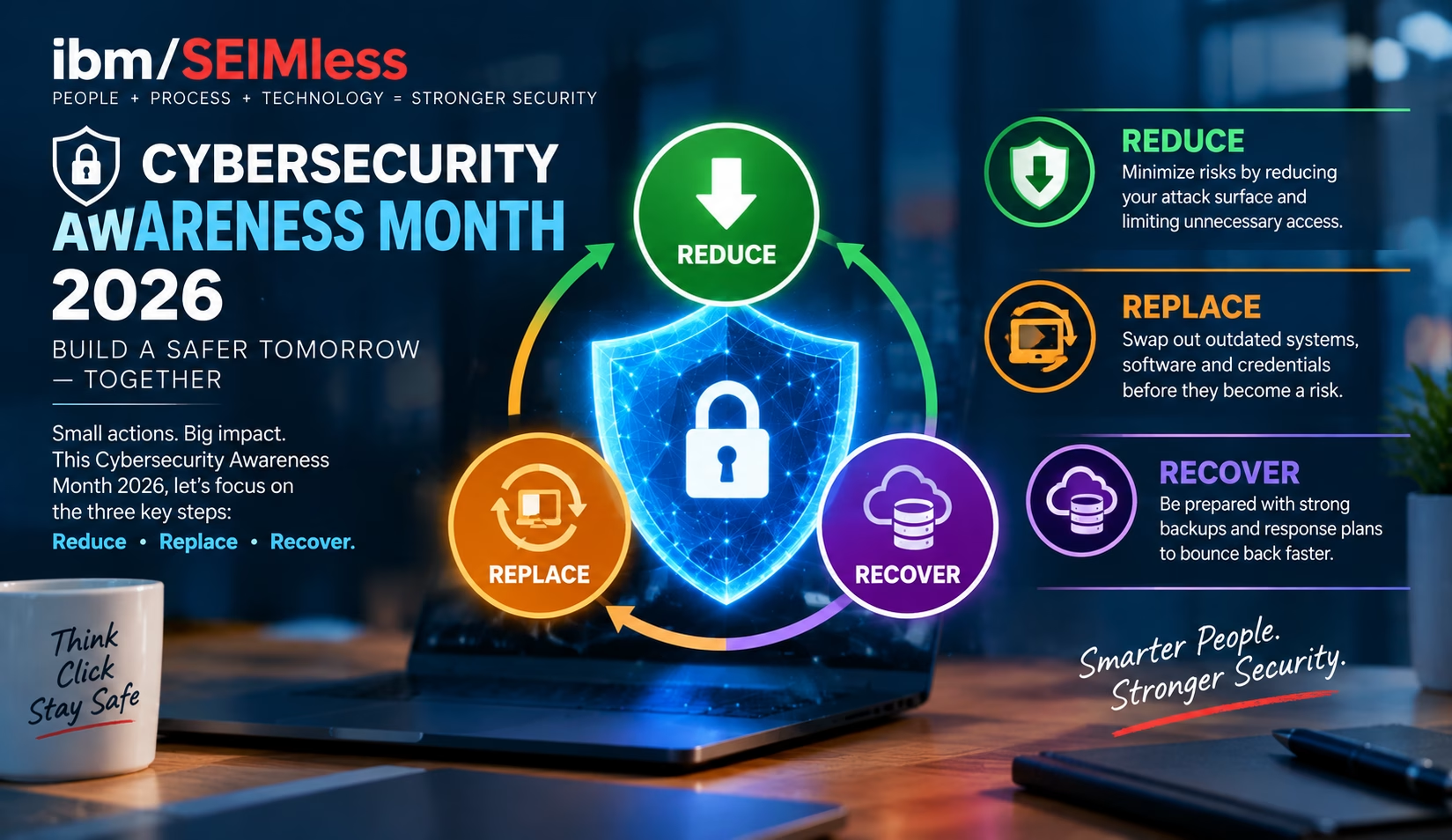
Cybersecurity Awareness Month 2026 is about halfway done, and most enterprises have already sent the posters, the phishing quiz, and the reminder about strong passwords. Those habits matter. But this year’s campaign carries a second, quieter message aimed at the people who run networks: CISA’s “Securing the Next 250” asks organizations to practice the 3Rs of cybersecurity: Reduce, Replace, Recover. With about two weeks left in October, this guide turns that slogan into a concrete plan for your network, your devices, and your recovery capability.
| What is Cybersecurity Awareness Month?
Cybersecurity Awareness Month is the annual October campaign led by the U.S. Cybersecurity and Infrastructure Security Agency (CISA) and the National Cybersecurity Alliance. The 2026 edition, the 23rd, runs October 1–31 under two themes: CISA’s “Securing the Next 250,” which asks organizations to reduce attack surfaces, replace end-of-support technology, and recover quickly, and the Alliance’s “Don’t Make It Easy for Them,” which focuses on everyday security habits. |
| Key Takeaways
Cybersecurity Awareness Month 2026 runs two themes: CISA’s “Securing the Next 250” and the Alliance’s “Don’t Make It Easy for Them.” The 3Rs map directly to network work: shrink exposure, retire unsupported systems, and rehearse recovery. Awareness changes behavior; architecture decides whether a mistake becomes a breach. We call the distance between them the awareness-to-architecture gap. Several Microsoft products hit end of support on October 13, 2026, and the copper phone network is being retired on a published schedule. You can finish a meaningful 3Rs sprint before October 31. |
Cybersecurity Awareness Month 2026: Two Themes, One Message
The National Cybersecurity Alliance’s theme, “Don’t Make It Easy for Them,” frames security as small, repeated habits: unique passwords, multifactor authentication, spotting phishing, and installing updates. CISA’s theme looks further out. Tied to America’s 250th anniversary, “Securing the Next 250” aims at critical infrastructure owners and the vendors that serve them, as Industrial Cyber summarized it. CISA’s awareness month toolkit offers free messaging and graphics for both.
The HIPAA Journal’s coverage points out that securing critical infrastructure is a national priority under the White House’s March 2026 Cyber Strategy for America. That elevates the 3Rs of Cybersecurity Awareness Month 2026 from a slogan to a statement of national expectations. If your business supplies hospitals, banks, utilities, or government agencies, your customers will soon expect you to practice them.
The Awareness-to-Architecture Gap
Here is the uncomfortable truth behind Cybersecurity Awareness Month 2026: training raises the odds that an employee does the right thing, but it cannot make every employee right every time. Attackers know it. Clark Hill’s analysis notes that Mandiant has seen traditional email phishing decline as an initial infection vector from 2022 through 2025, while voice phishing and text phishing have risen. Users are now being attacked through channels no email filter watches.
The awareness-to-architecture gap is the distance between what people are told to do and what the environment lets happen when they do not. Closing it means building networks where one bad click, one stolen password, or one unpatched appliance does not hand over the whole company. The 3Rs are CISA’s blueprint for exactly that.
Reduce: Shrink the Attack Surface Before Attackers Find It
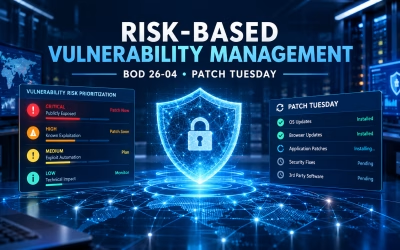
CISA’s first R asks organizations to keep systems current, patch promptly, and cut unnecessary exposure. It also warns that defenders are overwhelmed: total CVEs published in 2026 passed the entire 2025 total by the end of August, so the advice is to patch smarter by prioritizing known-exploited flaws. This week made the point vividly. Microsoft released fixes for a record 1,400-plus vulnerabilities, and an Ivanti VPN zero-day let an attacker bypass a fully patched device. Cybersecurity Awareness Month 2026 landed in the middle of that surge. We break down the prioritization model in Risk-Based Vulnerability Management; here is how Reduce looks in network terms.
- Inventory what is exposed. You cannot reduce a surface you have not mapped. List internet-facing gateways, firewalls, VPNs, and remote-management tools.
- Remove what you do not need. Retire dormant VPN accounts, unused ports, and forgotten test systems.
- Segment aggressively. Use SD-WAN and Exodus NxtGen Firewall policies so a compromised branch or device cannot reach everything.
- Verify, then trust. Adopt Zero Trust Content Security, guided by CISA’s Zero Trust Maturity Model.
- Watch the endpoints. Endpoint detection and response catches what training and filters miss.
CISA also lists basic measures for every business: phishing education, stronger passwords, multifactor authentication, and prompt updates, followed by system logging, backups, encryption at rest and in transit, an incident response plan, reporting incidents to CISA, and preparing for disruptions. Its small and medium business guidance and the Cross-Sector Cybersecurity Performance Goals turn those into checklists.
Replace: Retire Technology That No Longer Gets Security Updates
The second R is the one most budgets avoid. When software or hardware reaches end of support, vendors stop shipping fixes, and every new vulnerability becomes permanent. CISA’s BOD 26-02 addresses this specifically for edge devices at the network boundary, where an unsupported appliance is an open door.
The calendar is not abstract. According to TechRepublic and Windows Report, Windows 11 version 24H2 Home and Pro, Windows 10 Enterprise LTSB 2016, and the Office, Visio, and Project LTSC 2021 releases all reached end of support on October 13, 2026, and Windows 11 23H2 Enterprise and Education follow on November 10. Use Microsoft’s lifecycle database to check every build you run.
| What is ending | Date | What to do |
| Windows 11 24H2 Home/Pro, Windows 10 LTSB 2016, Office LTSC 2021 | Oct 13, 2026 | Upgrade, or isolate and monitor until you can |
| Windows 10 ESU Year 1 coverage | Oct 13, 2026 | Decide on Year 2, upgrade, or desktop-as-a-service; see our Windows 10 ESU decision guide |
| IBM i 7.4 standard support | Sep 30, 2026 (extended support to Sep 30, 2029) | Plan the move; see IBM i Modernization in 2026 |
| Copper POTS lines | AT&T shutoffs begin Nov 15, 2026 | Migrate life-safety lines; see POTS Line Replacement |
| Windows 11 23H2 Enterprise/Education | Nov 10, 2026 | Schedule upgrades before the next Patch Tuesday |
“Replace” does not always mean buying new hardware. Desktop-as-a-Service can move aging endpoints off the risk list, private and hybrid cloud can retire fragile on-premises servers, and a managed carrier migration, such as the MPLS replacement path, can remove legacy circuits. Where replacement must wait, isolate the system, restrict its traffic, and monitor it closely, because an unsupported device that cannot be patched must be contained.
Recover: Assume a Failure, Then Prove You Can Bounce Back
Of the 3Rs in Cybersecurity Awareness Month 2026, Recover is the one most easily faked on paper.
CISA’s third R reflects a hard-won lesson: some attacks will succeed. The agency urges owners and operators to build isolation and recovery capability so vital systems keep running in an isolated state while compromised systems are restored. Its CI Fortify initiative applies the same logic to operational technology in a geopolitical conflict. Recovery is where many “we have backups” claims fall apart, because backups were never tested, never isolated, or reachable by the same stolen administrator credential that started the incident.
- Make backups immutable. Follow the design in our immutable backups guide and the backup and recovery service so ransomware cannot delete your restore points.
- Rank your systems by recovery priority. Define recovery time and recovery point objectives for each, using NIST SP 800-34 on contingency planning.
- Practice the restore. Run a tabletop and at least one real restore before year end, and time it.
- Protect data even if it is stolen. Encryption through Data at Rest and Data in Motion controls limits what attackers can use.
- Know who you will call. Keep CISA’s #StopRansomware resources and the FBI’s Internet Crime Complaint Center in your response plan, and report incidents to CISA at gov/report.
A 16-Day Sprint to Finish Cybersecurity Awareness Month 2026 Strong
If your Cybersecurity Awareness Month 2026 plan started late, compress the work. Every item below can begin before October 31.
| Dates | Focus | Deliverable |
| Oct 15–18 | Reduce | List of internet-facing assets and the KEV-listed flaws on them |
| Oct 19–23 | Replace | End-of-support inventory with owner, date, and plan per system |
| Oct 24–28 | Recover | Immutability check on backups and one timed test restore |
| Oct 29–31 | Report | One-page 3Rs scorecard for leadership and your board |
For small teams, the FTC’s small business cybersecurity resources and the NIST Cybersecurity Framework provide structure without requiring a dedicated security department.
Beyond Cybersecurity Awareness Month 2026: Encryption for the Next 250
A campaign built around the next 250 years should make leaders ask how long today’s secrets must stay secret. Adversaries can copy encrypted traffic now and decrypt it when quantum computers mature, a threat we explain in Harvest Now, Decrypt Later. The federal deadlines in Executive Order 14412 already put a clock on migration, and our post-quantum migration playbook shows where to start. Add an encryption-inventory line to your 3Rs scorecard now, and consider Exodus QRN quantum-resistant networking for data with a long confidentiality life.
Industry Lens: Where the 3Rs Hit Hardest
Financial services teams juggle voice-phishing fraud, third-party risk, and strict recovery expectations, so Recover and exposure reduction lead their plans. Healthcare providers carry the heaviest Replace burden because long-lived clinical devices outlast their software support; start with segmentation and our guidance on medical device cybersecurity. Insurance carriers and their brokers should expect underwriting reviews of end-of-support inventories and backup immutability. In all three, Cybersecurity Awareness Month 2026 guidance applies to the vendors and partners you depend on are part of your attack surface, which is why CISA’s guidance reaches the supply chain as well as the operators.
Turn Cybersecurity Awareness Month 2026 Into a Year-Round Program
Cybersecurity Awareness Month 2026 works only if it leaves something behind: an inventory, a policy, a tested plan. Adaptive Security recommends measuring behavior, such as how often and how quickly employees report suspicious messages, rather than counting completed trainings. Absolute Security adds that the 3Rs start with knowing which devices qualify, a reminder that visibility precedes every other control. Pair those people metrics with the network metrics above, and your next board report will show both halves of the gap closing. The Alliance’s own StaySafeOnline resources offer year-round material for staff.
For Cybersecurity Awareness Month 2026 and beyond, ibm/SEIMless helps organizations connect those halves: managed network and security services, next-gen network security, and quantum-resistant infrastructure designed for the Reduce, Replace, and Recover work above.
Cybersecurity Awareness Month 2026 FAQ
What is the theme of Cybersecurity Awareness Month 2026?
There are two. CISA’s theme is “Securing the Next 250,” which pairs with the 3Rs of cybersecurity (Reduce, Replace, Recover), and the National Cybersecurity Alliance’s theme is “Don’t Make It Easy for Them.” The month runs October 1–31, 2026.
What are the 3Rs of cybersecurity?
CISA’s 3Rs are Reduce attack surfaces by patching and prioritizing, Replace end-of-support devices and software, and Recover quickly by practicing plans that sustain operations after an incident.
Is Cybersecurity Awareness Month only for critical infrastructure?
No. CISA aims the 3Rs at critical infrastructure owners and operators, but it encourages every business to adopt basics such as phishing education, multifactor authentication, prompt updates, backups, encryption, and an incident response plan.
What reached end of support on October 13, 2026?
Reporting from TechRepublic and Windows Report lists Windows 11 24H2 Home and Pro, Windows 10 Enterprise LTSB 2016, and Office, Visio, and Project LTSC 2021. Windows 11 23H2 Enterprise and Education follow on November 10, 2026.
What is the awareness-to-architecture gap?
It is the distance between what employees are trained to do and what the network allows when they make a mistake. Closing it means segmentation, zero trust access, endpoint detection, immutable backups, and encryption so one error does not become a breach.
How can ibm/SEIMless support the 3Rs?
ibm/SEIMless provides next-gen network security, SD-WAN, backup and recovery, private and hybrid cloud, desktop-as-a-service, and Exodus quantum-resistant networking. Call 646-546-5245 or email in**@**********ss.com to start a conversation.
| Ready to Strengthen Your Network? Talk to ibm/SEIMless
Since 2001, ibm/SEIMless Communications Technologies, Inc., home of Exodus QRN, has helped medium and enterprise organizations across the U.S. and Canada design secure, vendor-agnostic networks. Book a free consultation and we will map your exposure, your recovery readiness, and your next best step. Phone: 646-546-5245 Email: in**@**********ss.com Headquarters: One Liberty Plaza, New York, NY 10006 |