What Organizations Must Learn from the Latest Supply Chain Attack
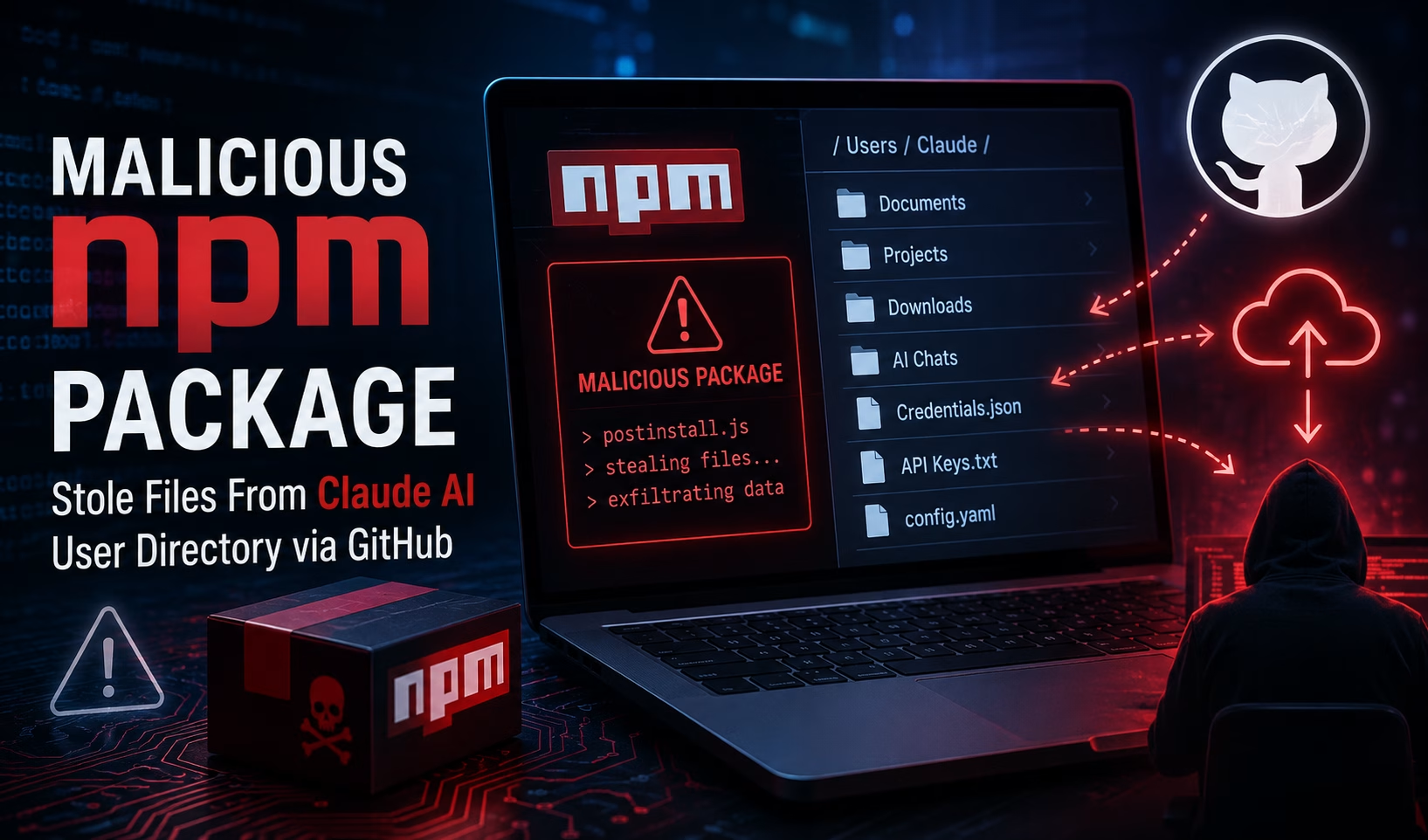
Malicious npm Package Stole Files From Claude AI User Directory via GitHub
The open-source ecosystem continues to be one of the most valuable resources for developers worldwide. However, its popularity also makes it a prime target for cybercriminals. A recently discovered malicious npm package demonstrated how attackers can weaponize trusted development platforms to compromise users and steal sensitive information.
According to security researchers, the malicious package specifically targeted users of Claude AI by attempting to access files stored within local user directories and exfiltrate data through GitHub repositories. The incident highlights a growing trend in software supply chain attacks, where attackers exploit trusted developer tools and repositories rather than directly targeting organizations.
For businesses, government agencies, and technology providers, this event serves as another reminder that cybersecurity threats increasingly originate from legitimate-looking software components.
Understanding the Attack
The malicious npm package appeared to function as a legitimate development dependency. Once installed, it executed hidden code designed to locate sensitive files associated with Claude AI user environments.
Instead of triggering traditional malware alerts, the package leveraged normal developer workflows. By abusing GitHub-related functionality, the malware attempted to transfer harvested data to attacker-controlled infrastructure.
This attack demonstrates several concerning trends:
- Increased targeting of AI development environments
- Abuse of trusted open-source repositories
- Stealthy exfiltration techniques
- Software supply chain compromise
- Credential and sensitive file theft
Modern attackers understand that compromising a developer workstation can provide access to source code, API keys, authentication tokens, proprietary data, and cloud environments.
Why npm Remains a High-Value Target
The npm ecosystem contains millions of packages used by organizations of every size. While this extensive ecosystem accelerates innovation, it also creates a significant attack surface.
Threat actors commonly exploit npm through:
Typosquatting
Creating packages with names similar to popular libraries.
Dependency Confusion
Tricking systems into downloading malicious packages instead of trusted internal dependencies.
Account Takeovers
Compromising maintainer accounts to inject malicious code into legitimate packages.
Hidden Payloads
Embedding obfuscated malware that activates after installation.
As organizations increasingly adopt AI development tools, attackers are now targeting developer environments where valuable intellectual property resides.
The Growing Intersection of AI and Cybersecurity
Artificial Intelligence platforms have transformed software development. Tools such as Claude AI, GitHub Copilot, and other AI assistants enable developers to accelerate coding, debugging, and research activities.
Unfortunately, attackers have adapted quickly.
AI environments often contain:
- Proprietary source code
- Research documents
- Business intelligence
- API credentials
- Authentication tokens
- Cloud configuration files
- Internal project documentation
A compromised AI workstation can provide attackers with direct access to sensitive organizational assets.
This is why organizations must implement a comprehensive cybersecurity strategy that protects both traditional IT infrastructure and emerging AI workflows.
Supply Chain Security Is Now a Boardroom Issue
Software supply chain attacks have evolved from isolated incidents into strategic cyber threats.
High-profile attacks over recent years have demonstrated that attackers increasingly prefer infiltrating trusted software ecosystems instead of breaching hardened enterprise perimeters.
The latest npm incident reinforces several security realities:
Trust Must Be Verified
Organizations should never assume a package is safe simply because it exists within a trusted repository.
Continuous Monitoring Is Essential
Security teams require real-time visibility into package installations, updates, and unusual behaviors.
Zero Trust Principles Apply to Development Environments
Every component should be authenticated, validated, and continuously monitored.
AI Systems Require Dedicated Security Controls
AI tools are becoming critical business assets and must receive the same protection as production systems.
How Organizations Can Reduce Supply Chain Risk
Organizations can significantly reduce exposure by implementing several best practices.
1. Enforce Dependency Scanning
Automated dependency analysis can identify malicious or vulnerable packages before deployment.
2. Adopt Software Bill of Materials (SBOM)
SBOM frameworks provide visibility into software components and dependencies.
3. Implement Least-Privilege Access
Developers and applications should only receive permissions required for their specific functions.
4. Monitor GitHub and Repository Activity
Suspicious commits, package updates, and repository changes should trigger security reviews.
5. Strengthen Endpoint Protection
Modern endpoint detection and response (EDR) solutions can identify unusual package behaviors.
6. Secure AI Development Workflows
AI-assisted development environments require dedicated monitoring, access controls, and threat detection mechanisms.
The Role of Quantum-Resistant Security in Future Defense Strategies
As cyber threats become increasingly sophisticated, organizations must prepare for future attack vectors as well.
Ibm/SEIMless Communications Technologies, Inc. continues to focus on advanced cybersecurity and Quantum Resistant Network (QRN) technologies designed to help organizations protect sensitive communications against emerging threats.
Future-ready security architectures should incorporate:
- Quantum-resistant encryption
- Secure communications infrastructure
- Advanced identity protection
- Zero-trust networking
- Supply chain security monitoring
- AI security governance
Organizations seeking long-term resilience must consider not only today’s threats but also the evolving cyber landscape of tomorrow.
Learn more about advanced cybersecurity and quantum-resistant communications solutions at https://seimless.com.
Industry Resources and References
Security professionals can further explore software supply chain security through trusted industry resources:
- National Institute of Standards and Technology (NIST) Software Supply Chain Security Guidance: https://www.nist.gov
- Cybersecurity and Infrastructure Security Agency (CISA): https://www.cisa.gov
- Open Worldwide Application Security Project (OWASP): https://owasp.org
- GitHub Security Lab: https://securitylab.github.com
These resources provide valuable guidance for securing software development pipelines and mitigating supply chain risks.
Final Thoughts
The malicious npm package targeting Claude AI users demonstrates how rapidly cybercriminals are adapting their techniques to exploit modern development environments.
The attack was not merely a malware incident—it was a warning about the growing convergence of AI platforms, open-source ecosystems, and software supply chain vulnerabilities.
Organizations that proactively strengthen dependency management, monitor development environments, and adopt advanced security architectures will be significantly better positioned to defend against future threats.
As software ecosystems continue to evolve, cybersecurity must remain an integral part of every development workflow. The organizations that prioritize supply chain security today will be the ones best prepared for tomorrow’s threat landscape.