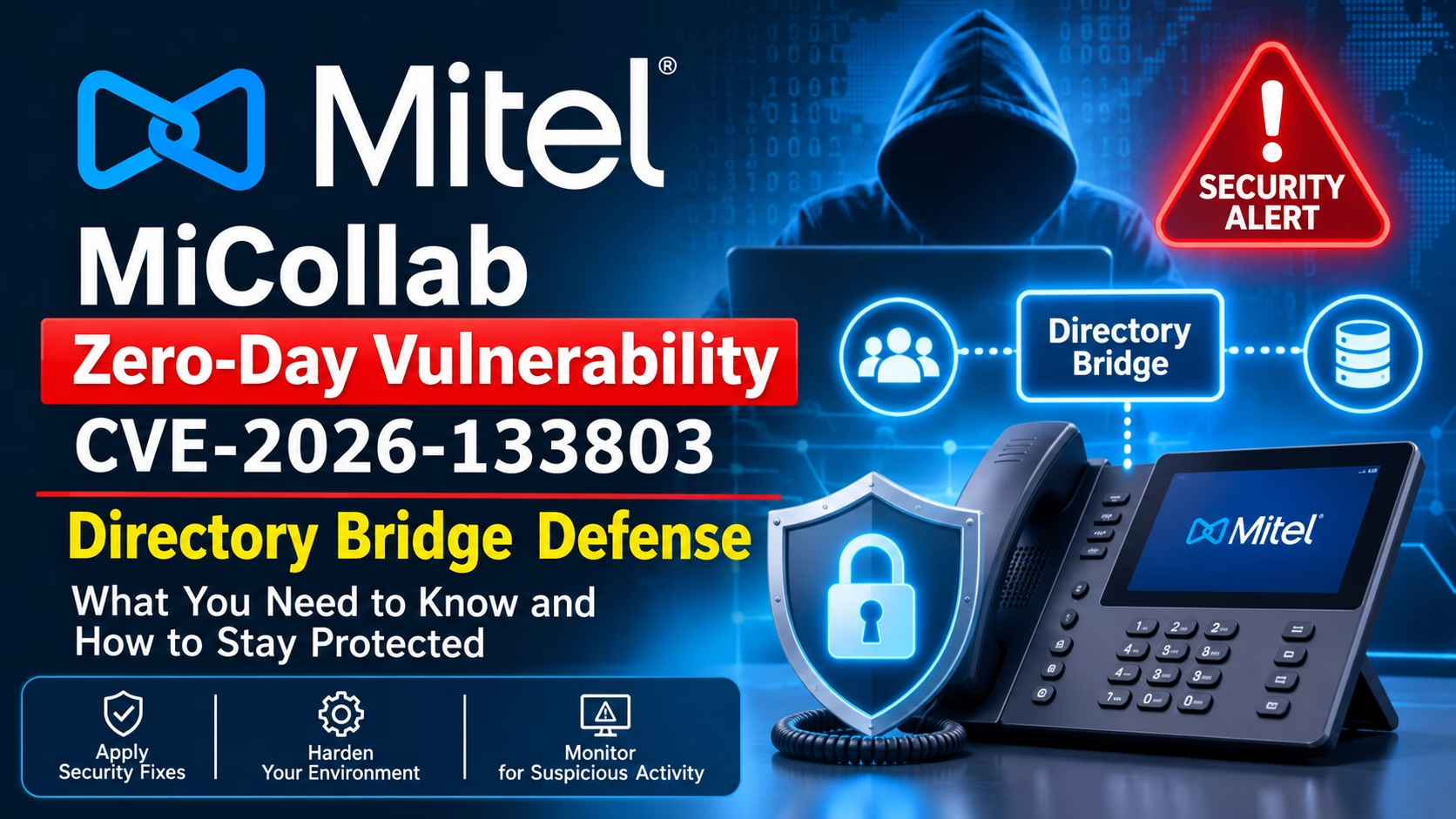
A Mitel MiCollab zero-day campaign shows how fast a communications server can become an identity incident. On November 25, 2026, CISA added five exploited MiCollab flaws to its Known Exploited Vulnerabilities catalog, and The Factum’s summary of Accenture’s Apex Labs research says unknown actors used them as zero-days, planting a web shell on November 15, a day before Mitel published its advisory. At one victim, the attacker went from a first request to root in about 30 minutes and to a domain controller in about 32. This guide explains the five flaws, the attack path, what is confirmed and what is not, and a 30-day plan to reduce your exposure to a Mitel MiCollab zero-day and the next one like it.
Definition: A Mitel MiCollab zero-day is a previously unpatched flaw in Mitel’s MiCollab collaboration platform that attackers exploit before the vendor fixes it. In the November 2026 campaign, the flaws sit in the audio, web and video conferencing component and need no login.
Key Takeaways on the Mitel MiCollab Zero-Day
- Exploited before the patch: Apex Labs dates exploitation before Mitel’s November 16 advisory (MISA-2026-0012), and Mitel’s note, updated November 24, does not mention live attacks.
- Five pre-authentication flaws: file upload, XML injection, unauthorized access, command injection and authentication bypass.
- Speed: first command about 12 minutes after the first request, root within 30 minutes, a domain controller at 32 minutes, backup and database servers within about 20 hours.
- The bridge was a stored credential: MiCollab’s own LDAP bind account opened the door to Active Directory.
- Patching is not proof of safety: check for compromise that began before November 16.
What Happened in the Mitel MiCollab Zero-Day Campaign
| When | Event | Source |
| November 9, 2026 | A second organization’s MiCollab server opens an HTTPS channel to the same attacker infrastructure; how it was entered is unproven | Cybermerge |
| November 15, 2026 | Web shell activity seen on a victim’s MiCollab server before 23:00 UTC | Cybermerge, The Factum |
| November 16, 2026 | Mitel publishes advisory MISA-2026-0012 and fixes | Cybermerge |
| November 24, 2026 | Mitel updates its advisory; it does not mention exploitation | The Factum |
| November 25, 2026 | CISA adds all five CVEs to KEV; federal deadlines are November 28 for four and December 9 for the fifth | The Factum, PivotNews |
The Five CVEs Behind the Mitel MiCollab Zero-Day
All five sit in the audio, web and video conferencing (AWV) component of MiCollab 10.3 and earlier, per Aviatrix’s summary. The weakness types map to standard categories such as unrestricted file upload (CWE-434), command injection (CWE-78) and improper authentication (CWE-287).
| CVE | Flaw type | Reported score |
| CVE-2026-133275 | Arbitrary file upload | 5.3 |
| CVE-2026-133303 | XML injection leading to command execution | 9.8 |
| CVE-2026-133311 | Unauthorized access, information disclosure | 5.9 |
| CVE-2026-133323 | Blind command injection | 9.8 in one record, 10.0 in its description |
| CVE-2026-133324 | Authentication bypass | 5.3 |
Notice the scores. Three of the five look modest, and one carries conflicting numbers. That matters, because the lower-scored flaws are the ones a scoring-driven queue would defer. We made a similar point about GeoServer’s chained flaws earlier this week.
How the Attack Moved From Voice Server to Domain Controller
- Unauthenticated requests hit the conferencing component, and the attacker planted a web shell.
- Commands ran about 12 minutes after the first request, and root followed within 30 minutes.
- The bridge. At about 32 minutes the attacker used the LDAP bind credentials MiCollab stores to log in to a domain controller over LDAPS.
- The attacker then Kerberoasted service accounts, according to Accenture.
- About 20 hours in, the attacker reached backup and database servers and took business data.
The directory-bridge problem
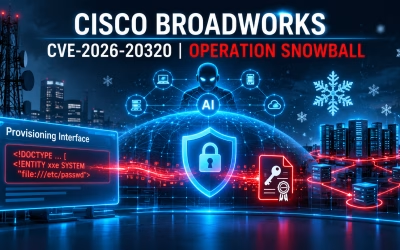
Communications servers need to look up users, so they hold a directory account. We call the resulting risk the directory-bridge problem: an internet-facing server carrying a credential that reaches the identity tier is a bridge, and an attacker who owns the bridge walks straight across. The server does not look like a crown jewel, and its account is rarely reviewed. In the Cisco BroadWorks case the prize was the provisioning plane. Here it is the directory account. Both are trust relationships that nobody put on a diagram.
Was AI Involved in the Mitel MiCollab Zero-Day Attacks?
Accenture assesses it was likely. The attacker’s server contacted two commercial AI services, and after eight hours of silence that traffic resumed at the same second as the authentication-bypass request. The victim’s logs showed a steady stream of commands with no sampled operator traffic. Accenture suggests uses such as triage of stolen data or help with the web shell, and it assesses the aim may have been extortion.
Apex Labs is also clear about its limits. The AI contacts do not by themselves prove an automated attack, no known criminal group has been linked, and the extortion motive is an assessment. For defenders the practical lesson stands either way: the time between first request and domain controller was measured in minutes, which is the same compression described in our AI agent security analysis.
What Is Confirmed and What Is Not About the Mitel MiCollab Zero-Day
Confirmed in reporting: five flaws in MiCollab 10.3 and earlier; pre-patch exploitation at one victim per Accenture; CISA’s KEV listing and deadlines; and a second server talking to the same infrastructure since November 9.
Not confirmed: the attacker’s identity, the volume and type of data taken, how the second server was entered, and whether it was entered before patching. The fixed build numbers are not stated in the secondary sources I reviewed. One write-up floats a possible link to Iran-linked groups for other targets in the same KEV batch, but it hedges the claim and does not tie it to MiCollab, so we do not rely on it. One article also mentions November 17 as a patch date, which conflicts with Mitel’s November 16 release, so check the advisory directly. I could not retrieve Accenture’s original report or Mitel’s advisory.
An honest note: ibm/SEIMless does not claim that any named product would have prevented these flaws. The bugs are the vendor’s to fix. The network and identity design around the server decides how far an attacker gets.
Why the Mitel MiCollab Zero-Day Matters to Financial Services, Healthcare and Insurance
Collaboration platforms carry voice, chat, meetings and contact-center traffic for banks, hospitals and insurers, and they are usually joined to Active Directory for single sign-on. Those are typical deployments, not a claim about any one customer. The risk is the one in the headline: a server built for convenience that holds a credential into the identity tier.
The cost framing is familiar. Verizon’s 2026 Data Breach Investigations Report, per secondary coverage, puts vulnerability exploitation at 31% of initial access, up from 20%, and IBM’s 2026 Cost of a Data Breach study reports a U.S. average of $11.5 million. Regulators expect a working process for this exact event, including New York’s 23 NYCRR Part 500, the HIPAA Security Rule, FFIEC guidance and the NAIC’s insurer data security model. For federal agencies, BOD 22-01 sets the clock once a flaw is listed as exploited. NIST has long published security guidance for voice-over-IP systems (SP 800-58).
The Same KEV Batch: A Reminder About Network Appliances
CISA’s November 25 additions also included a Juniper Session Smart Conductor flaw, CVE-2026-103406 (CVSS 9.8), a command injection in a provisioning service that can yield root. Per Cybermerge, fixes arrived October 28 in versions 7.2.3, 7.1.7 and 7.0.5, and the guidance is to keep the product off the internet so that only the router fleet can reach it. It is a different product with the same shape: a management or provisioning plane reachable from places it should not be. Our firewall management interface guide and SD-WAN overview cover that pattern.
Quick Checks: Is Your Mitel MiCollab Zero-Day Exposure Real?
- Find every MiCollab server and its version. Anything at 10.3 or earlier needs the fixed release named in the advisory.
- Check exposure. Is the conferencing component reachable from the internet? Remove it from the open internet or put it behind a VPN or allowlist.
- Hunt for web shells under the conferencing web root and for files dated around or before November 16. MITRE tracks the technique as server software component: web shell.
- Review outbound traffic. Look for HTTPS from the server to destinations it does not normally contact. Accenture has published indicators; use those rather than guessing.
- Review the directory account. Rotate the MiCollab LDAP bind password, review its logons, and treat any logon from a new source or a spike in service-ticket requests as an Active Directory incident. The help desk and AD CS guide covers identity containment.
- Check backups. The attacker reached backup servers, so confirm that copies are immutable and separate from domain credentials.
Seven Controls That Cut Collaboration Server Risk
| Control | Why it helps | Step it weakens |
| 1. Patch and verify | Removes the known flaws | Entry |
| 2. Take conferencing components off the open internet | Pre-authentication bugs need reachability | Entry |
| 3. Least-privilege directory account | A read-only, scoped account limits what a stolen credential reaches | The bridge |
| 4. Restrict outbound traffic | Blocks callbacks and tool downloads | Execution, theft |
| 5. Segment from identity and backup systems | A compromised server cannot talk to domain controllers freely | Escalation, theft |
| 6. Detect Kerberoasting and web shells | Catches the middle of the chain | Escalation |
| 7. Isolated, immutable backups | Keeps recovery out of attacker reach | Impact |
These match the layered approach in NIST SP 800-40 Rev. 4, the NIST Cybersecurity Framework and the CIS Controls. MITRE lists the entry step as exploitation of a public-facing application.
Network Architecture: Where Exodus Fits
These are the generic roles our portfolio plays in a design like this, with no claim that any product would have stopped these specific flaws.
- NxtGen Firewall segmentation and egress policy keep a collaboration server away from domain controllers and backups and limit where it can call out.
- Zero Trust Content Security puts an identity-aware layer in front of conferencing and web components, as in secure applications anywhere.
- Aria ADR supports detection and response on unusual directory activity and outbound traffic.
- Key Management and Data in Motion help protect credentials and traffic between servers, and Data at Rest protects what attackers go after in backups and databases.
- Endpoint detection and response can flag web-shell behavior and unexpected shells on servers.
Voice and collaboration also have a modernization side. As carriers retire copper, our POTS line replacement guide and telecom expense audit are good moments to ask who hosts, patches and monitors each voice platform, a question we raise in our third-party risk guide. Servers that no longer get fixes are a separate risk, covered in end-of-support edge devices.
A 30-Day Plan for the Mitel MiCollab Zero-Day
| Window | Actions | Owner |
| Days 1 to 2 | Inventory MiCollab and other collaboration servers. Identify internet-exposed components and close them. Start web shell and outbound-traffic hunts. | IT, security |
| Days 3 to 7 | Apply the fixed release from the advisory. Rotate the directory bind account and review its logons and Kerberos activity. | Voice, identity |
| Days 8 to 14 | Reduce the directory account’s privileges. Segment collaboration servers from domain controllers and backups. Apply egress allowlists. | Network |
| Days 15 to 21 | Build detections for web shells, Kerberoasting and unusual directory queries from server accounts. | Security operations |
| Days 22 to 30 | Add collaboration platforms to vendor and patch-SLA reviews. Test restoration from isolated backups. | Risk, IT |
Frequently Asked Questions About the Mitel MiCollab Zero-Day
What is the Mitel MiCollab zero-day?
It is a group of five pre-authentication flaws in the audio, web and video conferencing component of Mitel MiCollab, tracked as CVE-2026-133275, -133303, -133311, -133323 and -133324. Accenture’s Apex Labs says attackers used them before Mitel published its advisory and patches on November 16, 2026. CISA has added all five to its Known Exploited Vulnerabilities catalog.
Which MiCollab versions are affected?
Reporting says MiCollab 10.3 (10.3.0.18) and earlier are affected, in the audio, web and video conferencing component. The secondary reports I reviewed do not state the fixed build numbers, so confirm the exact patched release in Mitel advisory MISA-2026-0012 before you upgrade.
Why did the attackers reach the domain controller so fast?
According to Accenture’s analysis at one victim, the attacker used the LDAP bind credentials that MiCollab stores to log in to a domain controller about 32 minutes after first contact, then went after service accounts. The speed came from a trusted service account on an internet-facing server, not from a flaw in Active Directory.
Was AI used in the attacks?
Accenture assesses that AI-assisted tooling was likely used, because the attacker’s server contacted two commercial AI services and the traffic resumed at the same second as the authentication-bypass request. Accenture also says those contacts do not by themselves prove an automated attack, and no known criminal group has been linked.
Is patching enough?
No. Exploitation began before the patches existed, so a patched server may already have been compromised. Patch, then hunt for web shells under the conferencing web root, unusual outbound HTTPS, and new logons by the MiCollab directory account, and rotate that account’s password.
How can a business reduce risk from collaboration servers?
Keep conferencing components off the open internet or behind an allowlist, give the directory service account the least privilege it needs, restrict the server’s outbound traffic, segment it from identity and backup systems, and monitor for web shells and unusual directory queries.
Do You Know What Your Voice and Collaboration Servers Can Reach?
ibm/SEIMless Communications Technologies, Inc. and Exodus QRN, Inc. help financial services, healthcare and insurance organizations segment, monitor and secure the networks behind their communications platforms, identities and data. Let’s map your Mitel MiCollab zero-day exposure, including the directory accounts nobody reviews, and close it together.
Call: 646-546-5245
Email: in**@**********ss.com
Address: One Liberty Plaza, New York, NY 10006
Sources and Further Reading
- The Factum: Unknown actors exploited five Mitel MiCollab flaws as zero-days and stole business data
- Cybermerge: Mitel MiCollab flaws were exploited before the patch shipped
- Aviatrix Threat Research: 10 exploited CVEs including Mitel MiCollab
- PivotNews: Attackers exploited five Mitel MiCollab zero-days, possibly with AI help
- Mitel security advisory MISA-2026-0012 CISA Known Exploited Vulnerabilities catalog
- Also consulted: SecurityWeek’s reporting and Accenture Apex Labs’ research (via secondary coverage; not retrieved).
- SANS Institute BleepingComputer · FBI IC3 · Dark Reading