by hannahadmin | May 25, 2026 | blog, Seimless
How Modern Threat Actors Are Weaponizing Signed Drivers to Bypass Security Controls
In today’s evolving cybersecurity landscape, attackers are no longer relying solely on traditional malware techniques. A growing number of advanced persistent threat (APT) groups and ransomware operators are leveraging a tactic known as Bring Your Own Vulnerable Driver (BYOVD) to disable security controls, elevate privileges, and gain deep access into enterprise environments — all without requiring physical hardware manipulation.
At ibm/SEIMless, we continuously monitor emerging attack methodologies that threaten enterprise infrastructure, critical communication systems, and endpoint security frameworks. BYOVD has rapidly become one of the most dangerous kernel-level attack techniques because it abuses trusted, signed drivers already recognized by operating systems.
This article explores the BYOVD perspective, how vulnerable drivers become exploitable, the risks facing organizations, and the defensive strategies modern enterprises should implement immediately.
What Is BYOVD (Bring Your Own Vulnerable Driver)?
BYOVD is a cyberattack technique where attackers intentionally install a legitimately signed but vulnerable driver onto a target system. Once loaded into the Windows kernel, the vulnerable driver provides attackers with privileged access capable of bypassing endpoint security protections.
Unlike traditional exploits that depend on unpatched operating systems or hardware vulnerabilities, BYOVD attacks exploit weaknesses inside trusted third-party drivers.
These drivers are often:
- Digitally signed and trusted by Windows
- Previously used by legitimate vendors
- Vulnerable due to insecure kernel memory operations
- Capable of disabling security tools at kernel level
The dangerous aspect of BYOVD is trust abuse. Since the driver is signed and appears legitimate, many operating systems initially allow it to load without triggering immediate suspicion.
Why Attackers Prefer Vulnerable Drivers
Modern endpoint protection systems have become increasingly effective at detecting conventional malware. To evade these defenses, attackers now operate closer to the operating system kernel.
BYOVD techniques provide several advantages:
Kernel-Level Privilege Escalation
Attackers gain direct access to low-level system functions, allowing them to manipulate processes, memory, and security components.
Security Tool Neutralization
Many vulnerable drivers allow the termination or disabling of:
- Endpoint Detection & Response (EDR)
- Antivirus engines
- Kernel monitoring systems
- Memory integrity protections
Reduced Detection Rates
Since the driver itself is legitimate and signed, security solutions may initially trust its execution.
Persistence and Stealth
Kernel access enables attackers to establish long-term persistence while remaining difficult to detect using user-mode monitoring tools.
How BYOVD Attacks Work
A typical BYOVD attack chain includes several stages:
1. Initial Access
Attackers gain access through phishing, credential theft, exposed services, or malware deployment.
2. Driver Deployment
A vulnerable signed driver is dropped onto the system and loaded into kernel space.
3. Exploitation
The attacker interacts with the vulnerable driver using crafted I/O control requests (IOCTLs) to execute privileged operations.
4. Security Bypass
Security software is disabled or tampered with, opening the system for deeper compromise.
5. Payload Execution
Ransomware, credential theft modules, persistence implants, or lateral movement tools are deployed.
Real-World Rise of BYOVD Threats
BYOVD is no longer theoretical. Security researchers have observed ransomware groups and sophisticated threat actors actively weaponizing vulnerable drivers in enterprise attacks.
Common trends include:
- Abuse of old hardware utility drivers
- Exploitation of gaming anti-cheat drivers
- Use of vulnerable motherboard or firmware utilities
- Deployment of legacy monitoring drivers with insecure memory access
Attackers specifically target drivers capable of arbitrary kernel memory read/write operations because they enable unrestricted system control.
Why Traditional Security Is Struggling
Conventional endpoint security solutions primarily monitor user-mode activity. BYOVD bypasses these protections by operating directly inside the kernel.
This creates several challenges:
| Security Challenge |
BYOVD Impact |
| Trusted driver loading |
Appears legitimate |
| Kernel execution |
Evades user-mode monitoring |
| Signed certificates |
Reduces suspicion |
| Direct memory access |
Enables deep tampering |
| Security service termination |
Disables defenses before detection |
Organizations relying solely on signature-based detection remain highly exposed.
Defensive Strategies Against BYOVD Attacks
Organizations must adopt layered kernel-aware defenses to mitigate BYOVD risks effectively.
Implement Driver Blocklists
Microsoft maintains vulnerable driver blocklists that should remain continuously updated across enterprise systems.
Enable Memory Integrity Protections
Features such as Hypervisor-Protected Code Integrity (HVCI) help prevent unauthorized kernel modifications.
Monitor Driver Loading Events
Security teams should continuously analyze:
- Unsigned or unusual driver loads
- Legacy hardware utility installations
- Abnormal kernel activity
- Unauthorized service creation
Maintain Aggressive Patch Management
Outdated third-party drivers significantly increase attack exposure.
Deploy Behavioral Threat Detection
Behavioral analytics can identify suspicious privilege escalation and kernel tampering patterns before full compromise occurs.
Apply Zero Trust Principles
Restrict administrative privileges and enforce strict execution policies across endpoints and servers.
The Strategic Importance of Kernel Security
As threat actors evolve, kernel-level security is becoming essential for enterprise cyber resilience. BYOVD demonstrates how trusted software components can become offensive tools when supply-chain trust is abused.
Future cybersecurity strategies must prioritize:
- Driver integrity verification
- Hardware-assisted isolation
- Runtime behavioral analysis
- Secure boot enforcement
- Continuous kernel telemetry monitoring
Organizations that fail to modernize endpoint defense architectures risk becoming vulnerable to increasingly stealthy attacks.
How ibm/SEIMless Helps Enterprises Reduce Advanced Threat Exposure
At ibm/SEIMless, we help organizations strengthen their cybersecurity posture through advanced communication security, resilient infrastructure strategies, and next-generation threat awareness initiatives.
Our approach focuses on:
- Advanced enterprise security architectures
- Secure communications infrastructure
- Threat intelligence integration
- Vulnerability risk reduction
- Critical systems protection
- Zero trust security alignment
As cyber threats continue moving deeper into system architecture layers, organizations require proactive defense strategies capable of identifying and mitigating modern attack vectors before exploitation occurs.
Final Thoughts
BYOVD attacks represent a major shift in modern cyber warfare. By abusing trusted yet vulnerable drivers, attackers bypass conventional defenses and operate directly within the operating system kernel.
The future of cybersecurity will depend heavily on an organization’s ability to detect, monitor, and secure trusted system components before adversaries weaponize them.
Businesses must move beyond traditional endpoint protection and adopt a proactive kernel-aware defense strategy capable of resisting advanced threats operating beneath the surface.
Explore Advanced Security Solutions with ibm/SEIMless
Protect your enterprise infrastructure against emerging cyber threats with intelligent, future-ready security strategies.
Contact Us | Our Services
by hannahadmin | May 13, 2026 | blog, Seimless
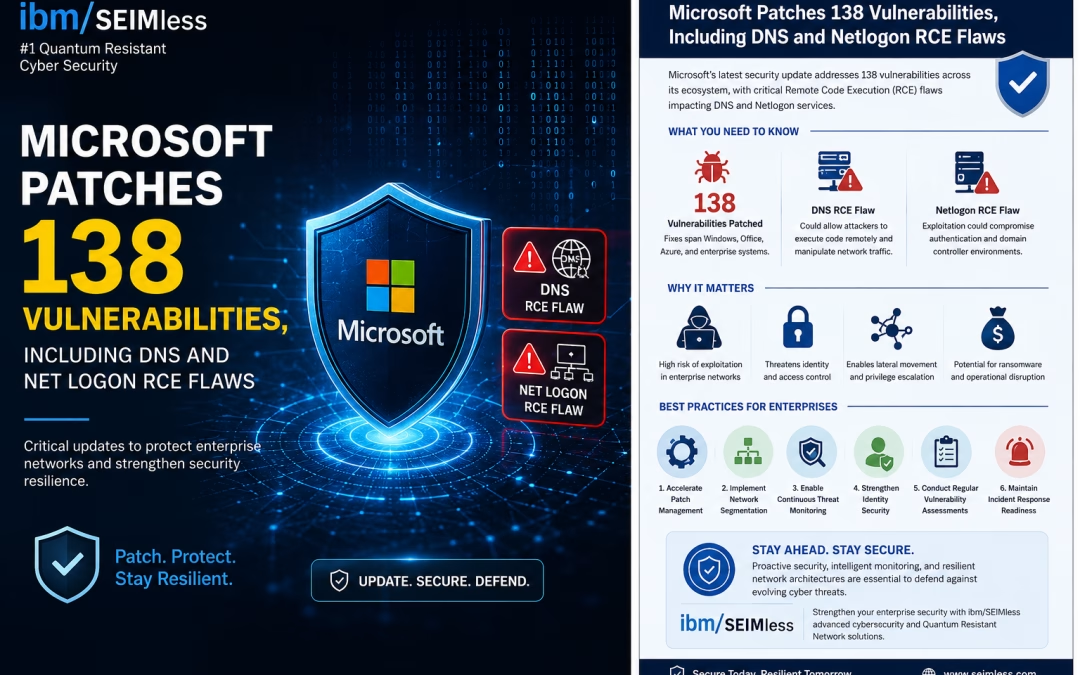
Cybersecurity teams worldwide are once again on high alert after Microsoft released security patches addressing 138 vulnerabilities across its ecosystem. Among the most concerning are critical Remote Code Execution (RCE) flaws affecting DNS services and Netlogon protocols — vulnerabilities capable of enabling attackers to gain unauthorized access, disrupt enterprise operations, and potentially compromise entire network infrastructures.
The latest Patch Tuesday release underscores a growing reality for organizations: threat actors continue targeting foundational network services that many enterprises depend upon daily. From hybrid cloud environments to legacy on-premises infrastructure, unpatched vulnerabilities remain one of the most exploited attack vectors in modern cybersecurity operations.
For enterprises, the implications extend far beyond routine system maintenance. Critical services like DNS and Netlogon are deeply embedded within authentication, domain management, and network communication processes. Exploitation of these weaknesses could allow attackers to execute malicious code remotely, elevate privileges, move laterally across networks, and deploy ransomware at scale.
Why These Vulnerabilities Matter
Remote Code Execution vulnerabilities are considered among the most dangerous categories of cybersecurity threats because they allow attackers to execute arbitrary code on targeted systems without physical access. In enterprise environments, DNS and Netlogon services are often trusted implicitly, making them attractive targets for advanced threat actors.
The DNS vulnerability patched by Microsoft could potentially enable attackers to manipulate network traffic, redirect communications, or compromise internal systems by exploiting weaknesses in name resolution services. Meanwhile, flaws within Netlogon services may allow attackers to interfere with authentication mechanisms inside Active Directory environments.
Security researchers warn that vulnerabilities affecting authentication and directory services frequently become high-priority targets for nation-state actors and ransomware groups due to their potential impact on enterprise identity infrastructures.
Organizations operating outdated Windows Server environments, poorly segmented networks, or delayed patch management processes may face elevated exposure risks.
The Expanding Threat Landscape
The scale of this month’s security release highlights the increasing complexity of modern attack surfaces. Enterprises today operate across multi-cloud environments, remote work infrastructures, edge devices, and interconnected third-party ecosystems. Each connected endpoint creates additional opportunities for exploitation if security hygiene is not continuously maintained.
Cybercriminals are accelerating exploitation timelines, often weaponizing disclosed vulnerabilities within days of public disclosure. This creates significant pressure on IT and security teams to rapidly validate, prioritize, and deploy patches while minimizing operational disruptions.
The rise of AI-assisted cyberattacks further complicates the threat landscape. Automated reconnaissance, phishing campaigns, and exploit development tools are enabling attackers to scale operations faster than ever before.
As organizations continue digital transformation initiatives, proactive vulnerability management is becoming a mission-critical cybersecurity requirement rather than a routine IT function.
Best Practices for Enterprises
To reduce exposure to critical vulnerabilities such as DNS and Netlogon RCE flaws, organizations should implement several cybersecurity best practices:
1. Accelerate Patch Management
Deploy security updates immediately after validation and prioritize critical infrastructure systems exposed to external networks.
2. Implement Network Segmentation
Separate critical authentication systems and domain controllers from general user environments to reduce lateral movement opportunities.
3. Enable Continuous Threat Monitoring
Utilize Security Information and Event Management (SIEM) platforms and behavioral analytics to identify abnormal authentication activities.
4. Conduct Regular Vulnerability Assessments
Frequent scanning and penetration testing help organizations identify exploitable weaknesses before attackers do.
5. Strengthen Identity Security
Apply least-privilege access models, enforce multi-factor authentication, and continuously monitor privileged accounts.
6. Maintain Incident Response Readiness
Organizations should maintain updated incident response playbooks to rapidly contain threats if exploitation occurs.
The Role of Proactive Cybersecurity
Security patching alone is no longer sufficient in today’s rapidly evolving threat environment. Enterprises require layered cybersecurity strategies that combine prevention, detection, response, and recovery capabilities.
Advanced security operations platforms, threat intelligence integration, endpoint monitoring, and zero-trust architectures are increasingly essential for defending enterprise infrastructures against modern cyber threats.
At ibm/SEIMless, we understand that organizations require more than reactive security measures. Our advanced cybersecurity and Quantum Resistant Network solutions are designed to help enterprises strengthen resilience against evolving digital threats while maintaining operational continuity.
As cyberattacks continue targeting critical infrastructure and enterprise authentication systems, proactive security modernization becomes vital for long-term business protection.
Call To Action
Protect your organization against evolving cyber threats with advanced cybersecurity solutions from ibm/SEIMless.
Discover how intelligent threat monitoring, resilient network architectures, and Quantum Resistant security technologies can help secure your enterprise infrastructure against emerging vulnerabilities and sophisticated cyberattacks. Contact Us | See Our Services
by hannahadmin | May 7, 2026 | blog, Seimless
Cybersecurity threats targeting third-party vendors continue to expose critical weaknesses across global enterprise ecosystems. In the latest high-profile incident, Swedish telecommunications giant Ericsson confirmed that its U.S. subsidiary suffered a data breach after attackers compromised one of its external service providers. The breach reportedly exposed sensitive employee and customer information, reinforcing the growing risks associated with supply chain and vendor-based cyberattacks.
For enterprises operating large-scale digital infrastructures, the incident is another reminder that cybersecurity resilience must extend beyond internal systems and include every third-party partner, contractor, and cloud-based provider connected to operational environments.
What Happened in the Ericsson Data Breach?
According to breach disclosure reports, Ericsson’s external service provider detected suspicious activity on April 28, 2025. A subsequent investigation revealed that unauthorized actors may have accessed a subset of sensitive files between April 17 and April 22, 2025. (BleepingComputer)
Investigators determined that the attackers potentially obtained access to personally identifiable information (PII) associated with employees and customers. Various reports indicate the exposed information may include:
- Names and addresses
- Social Security numbers
- Government-issued identification details
- Financial account information
- Dates of birth
- Certain medical information
The breach reportedly affected more than 15,000 individuals, according to multiple cybersecurity reporting sources.
Ericsson stated that there is currently no confirmed evidence of misuse of the compromised data. However, affected individuals are being notified while identity protection and monitoring services are being offered.
The Growing Threat of Third-Party Vendor Attacks
The Ericsson incident highlights a rapidly expanding cybersecurity challenge: supply chain compromise.
Modern enterprises increasingly depend on cloud vendors, SaaS providers, outsourcing firms, and managed service providers to operate efficiently. While these relationships improve scalability and agility, they also dramatically expand the attack surface available to cybercriminals.
Recent industry analysis shows attackers are increasingly targeting third-party environments because vendors often maintain privileged access to sensitive enterprise data and systems.
This trend mirrors previous high-impact breaches involving:
- MOVEit Transfer vulnerabilities
- SolarWinds supply chain compromise
- Okta support system intrusions
- Conduent vendor-related exposure incidents
Organizations can no longer treat vendor security assessments as annual compliance exercises. Continuous monitoring, zero-trust architectures, and real-time threat intelligence sharing are becoming essential operational requirements.
Why Telecom Infrastructure Companies Are Prime Targets
Telecommunications providers represent highly attractive targets for cybercriminal groups and nation-state actors due to the immense amount of sensitive infrastructure and subscriber data they manage.
Companies like Ericsson support critical communications infrastructure, including:
- 5G deployments
- Enterprise networking
- Cloud communications
- National telecom backbones
- Government and defense-related systems
As global telecom ecosystems become more interconnected, attackers increasingly view third-party service providers as a lower-resistance entry point into larger enterprise networks.
Cybersecurity analysts continue to warn that sophisticated threat actors are exploiting vendor trust relationships to bypass traditional perimeter defenses.
Key Lessons for Enterprises
The Ericsson breach delivers several important lessons for organizations worldwide:
1. Vendor Risk Management Must Be Continuous
Security questionnaires alone are insufficient. Organizations must continuously evaluate vendor security posture, patching practices, and access privileges.
2. Least-Privilege Access Is Critical
Third-party vendors should only receive the minimum system access necessary to perform operational functions.
3. Incident Response Must Include External Partners
Organizations need coordinated incident response playbooks that involve vendors, legal teams, regulators, and cybersecurity providers.
4. Zero Trust Is No Longer Optional
Zero-trust network architectures can help reduce lateral movement opportunities during third-party compromises.
5. Data Minimization Reduces Exposure
Enterprises should carefully limit the amount of sensitive information stored within vendor-managed systems.
Industry Response and Regulatory Implications
As regulatory scrutiny surrounding data privacy intensifies globally, incidents like the Ericsson breach are likely to accelerate discussions around:
- Third-party cybersecurity accountability
- Vendor breach disclosure requirements
- Critical infrastructure protection mandates
- Enterprise cyber resilience frameworks
Regulators and cybersecurity agencies worldwide continue pushing organizations toward stronger governance standards for supply chain security and incident reporting.
Additional cybersecurity coverage and breach intelligence can be reviewed through:
How ibm/SEIMless Helps Organizations Strengthen Cyber Resilience
At ibm/SEIMless, we understand that modern cybersecurity requires proactive defense strategies built for evolving threat landscapes. Organizations must secure not only their internal infrastructure but also the expanding ecosystem of vendors, cloud providers, and digital partners connected to their operations.
Our advanced cybersecurity and quantum-resistant communication solutions help enterprises:
- Strengthen vendor risk management
- Improve network visibility
- Enhance threat detection capabilities
- Build resilient communication infrastructures
- Prepare for emerging post-quantum security threats
As cyberattacks continue evolving in sophistication, businesses that invest early in resilient architectures and proactive security governance will be better positioned to defend critical assets and maintain customer trust.
Final Thoughts
The Ericsson U.S. data breach demonstrates how third-party vulnerabilities can quickly become enterprise-wide security crises. In an era of interconnected digital ecosystems, organizations must move beyond traditional perimeter defenses and adopt comprehensive cyber resilience strategies that address supply chain risks head-on.
Cybersecurity is no longer just about protecting internal systems — it is about securing the entire digital trust chain.
#CyberSecurity #DataBreach #Ericsson #SupplyChainSecurity #VendorRisk #CyberThreats #TelecomSecurity #NetworkSecurity #InformationSecurity #ibmSEIMless
Contact Us | Our Services | About us

by hannahadmin | May 5, 2026 | blog, Seimless
The rapid convergence of artificial intelligence and financial markets has reached a pivotal milestone as Anthropic announces a strategic collaboration with leading Wall Street institutions, including Blackstone, Goldman Sachs, and Hellman & Friedman. This partnership signals a transformative shift in how enterprise AI is deployed across global financial ecosystems.
At the core of this initiative is the creation of a $1.5 billion AI-driven enterprise services platform, designed to integrate Anthropic’s advanced Claude AI models into private equity portfolios and large-scale financial operations. (The Wall Street Journal)
This move is not merely an investment—it represents a structural evolution in enterprise consulting, often described as the emergence of an “AI-native consulting layer” that could rival traditional firms. (Business Insider)
Strategic Impact on Financial Ecosystems
Anthropic’s collaboration introduces a new generation of AI agents capable of automating complex workflows such as:
- Financial modeling and valuation analysis
- Regulatory compliance and audit processes
- Credit risk assessments and reporting
These AI-driven capabilities are already gaining traction among major institutions like Citi, Visa, and AIG, demonstrating strong enterprise adoption momentum. (Reuters)
Additionally, the integration of AI into financial infrastructure is expected to compress deployment timelines from months to days, significantly improving operational agility and ROI for financial firms. (Axios)
Cybersecurity & Risk Considerations
As AI adoption accelerates, cybersecurity becomes a critical pillar. Anthropic’s advanced models—particularly those focused on vulnerability detection—are being tested across Wall Street to enhance resilience against emerging threats. (Bloomberg)
However, this rapid innovation also introduces systemic risks, prompting regulatory discussions at the highest levels of financial governance.
What This Means for Enterprises
For organizations navigating digital transformation, this partnership highlights three key imperatives:
- AI-first strategy is no longer optional
- Financial services are leading enterprise AI adoption
- Cybersecurity must evolve alongside AI capabilities
ibm/SEIMless Perspective
At ibm/SEIMless, we recognize that the fusion of AI and financial systems is redefining enterprise security, data integrity, and operational intelligence. As organizations adopt AI-native architectures, Quantum Resistant Networks and secure communication frameworks become essential to safeguard next-generation infrastructures.
🔗 Explore enterprise-grade secure communication solutions: https://seimless.com
📣 Call to Action
Enterprises must act now to align AI innovation with security-first architectures. Partner with ibm/SEIMless to future-proof your digital ecosystem against evolving AI-driven threats. Contact Us

by hannahadmin | May 4, 2026 | blog, Seimless
The Cybersecurity and Infrastructure Security Agency (CISA) has issued a critical alert by adding newly identified vulnerabilities affecting ConnectWise and Microsoft Windows to its Known Exploited Vulnerabilities (KEV) Catalog—a strong indicator of real-world cyberattacks currently in progress.
According to recent threat intelligence reports, these vulnerabilities are already being weaponized by advanced threat actors, making immediate remediation essential for enterprises worldwide. (The Hacker News)
🔍 What’s New in the KEV Catalog?
CISA added the following two high-risk vulnerabilities on April 28, 2026:
1. ConnectWise ScreenConnect Vulnerability (CVE-2024-1708)
- Type: Path Traversal
- Severity: High (CVSS 8.4)
- Impact: Remote Code Execution (RCE), unauthorized data access
- Affected Software: ConnectWise ScreenConnect (≤ v23.9.7)
This flaw allows attackers to manipulate file paths and gain access outside intended directories, potentially enabling full system compromise. It has also been observed being chained with other vulnerabilities to deploy ransomware campaigns. (SC Media)
👉 Learn more from ConnectWise Security Advisory
2. Microsoft Windows Shell Vulnerability (CVE-2026-32202)
- Type: Protection Mechanism Failure
- Severity: Medium (CVSS 4.3)
- Impact: Spoofing, unauthorized network interactions
- Affected Systems: Microsoft Windows OS
This vulnerability allows attackers to spoof legitimate network resources, potentially leading to credential theft and lateral movement across enterprise environments. It has been linked to nation-state threat groups and targeted campaigns across global regions. (Security Affairs)
👉 Official details available via CISA KEV Catalog
⚠️ Why KEV Inclusion Matters
The KEV catalog is not just a vulnerability list—it is a priority remediation directive. Inclusion means:
- ✅ Verified active exploitation in the wild
- ✅ Mandatory patching deadlines for U.S. federal agencies
- ✅ High likelihood of widespread enterprise targeting
CISA has mandated remediation deadlines (e.g., May 12, 2026), emphasizing urgency across both public and private sectors. (The Hacker News)
🎯 Threat Landscape Insight
Cybercriminal groups, including state-sponsored actors, are increasingly exploiting:
- Remote Monitoring & Management (RMM) tools like ConnectWise
- Core operating system components like Windows Shell
- Multi-stage exploit chains for ransomware deployment
These vulnerabilities are particularly dangerous because they:
🛡️ Recommended Mitigation Strategies
Organizations should take immediate action:
1. Patch Immediately
- Update ConnectWise ScreenConnect to latest secure versions
- Apply Microsoft security updates without delay
2. Network Segmentation
- Limit exposure of RMM tools
- Restrict internal lateral movement pathways
3. Monitor Indicators of Compromise (IoCs)
- Watch for unusual file access or execution patterns
- Monitor spoofed network requests and abnormal authentication flows
4. Zero Trust Implementation
- Enforce strict identity verification
- Reduce reliance on implicit trust models
💡 SEIMless Security Perspective
At ibm/SEIMless, we emphasize proactive defense strategies using Quantum-Resistant Network Architectures and AI-driven threat detection to mitigate evolving cyber risks.
The inclusion of these vulnerabilities in KEV reinforces a key cybersecurity principle:
“If it’s in KEV, it’s already too late to delay.”
📢 Call to Action
Don’t wait for exploitation to impact your infrastructure.
👉 Visit https://seimless.com to explore:
- Advanced Threat Intelligence Solutions
- Quantum-Resistant Security Frameworks
- Enterprise-Grade Cyber Defense Strategies
Secure your network before attackers exploit the gap.

by hannahadmin | May 1, 2026 | blog, Seimless
Emerging Threat: Python-Based Backdoor Exploiting Tunneling Services
A newly identified cyber threat is raising alarms across enterprise security teams. According to The Hacker News cybersecurity report, researchers have uncovered a stealthy Python-based backdoor framework known as DEEP#DOOR, engineered to steal browser-stored credentials and cloud authentication data using advanced tunneling techniques. (The Hacker News)
Unlike conventional malware, this threat leverages public tunneling infrastructure to bypass traditional detection controls, making it highly evasive and persistent.
How the Attack Works (Technical Breakdown)
1. Obfuscated Initial Access
The attack begins with a malicious batch script loader, which disables endpoint defenses and deploys an embedded Python payload directly in memory—minimizing detection signatures. (Securonix)
2. Multi-Layer Persistence Mechanisms
Once executed, the malware establishes persistence through:
- Registry Run keys
- Scheduled tasks
- Startup folder scripts
- WMI event subscriptions
This layered persistence ensures long-term system compromise even after partial remediation. (Securonix)
3. Tunneling-Based Command & Control (C2)
Instead of traditional C2 servers, attackers use public tunneling services to:
- Create encrypted communication channels
- Evade firewall and network monitoring tools
- Mask attacker infrastructure
This approach significantly reduces forensic traceability and detection rates.
🔍 What Data Is at Risk?
The DEEP#DOOR backdoor is not just a remote access tool—it is a full-scale credential harvesting engine capable of extracting:
- Browser-stored passwords and session cookies
- Cloud service credentials (AWS, Azure, GCP)
- SSH keys and developer secrets
- Clipboard data and keystrokes
- Screenshots, microphone, and webcam feeds
Such capabilities enable account takeover, lateral movement, and cloud infrastructure compromise. (Securonix)
☁️ Why This Matters for Cloud & Enterprise Security
Modern enterprises rely heavily on cloud-first architectures and browser-based authentication. This makes credential theft one of the most critical attack vectors.
According to insights aligned with CISA (Cybersecurity & Infrastructure Security Agency) guidelines, compromised credentials are a leading cause of:
- Data breaches
- Unauthorized cloud access
- Critical infrastructure disruption (Kaspersky ICS CERT)
The use of tunneling services further complicates detection by blending malicious traffic with legitimate outbound connections.
🛡️ Detection & Mitigation Strategies
To defend against such advanced threats, organizations must adopt proactive and layered cybersecurity approaches:
✅ Endpoint & Behavioral Monitoring
Deploy advanced EDR/XDR solutions capable of detecting:
- Suspicious Python execution
- Obfuscated scripts
- Unauthorized persistence mechanisms
✅ Network Traffic Analysis
Monitor outbound connections to:
- Unknown tunneling domains
- Unusual encrypted traffic patterns
✅ Identity & Access Security
✅ Threat Intelligence Integration
Leverage platforms like:
These frameworks help map adversary tactics and strengthen detection engineering.
🚀 How ibm/SEIMless Secures Your Enterprise
At ibm/SEIMless, we specialize in Quantum-Resistant and Advanced Cybersecurity Solutions designed to counter evolving threats like Python-based backdoors.
🔐 Our Capabilities:
- Real-time threat detection & response
- AI-driven anomaly detection
- Secure communication frameworks
- Cloud & endpoint protection at scale
We help enterprises move from reactive security to predictive defense.
📢 Call to Action
Cyber threats are evolving faster than ever—and traditional defenses are no longer enough.
👉 Visit https://seimless.com to explore how ibm/SEIMless can protect your organization from next-generation cyber threats.
👉 Get a free security consultation and secure your infrastructure today.
📊 FAQ
Q1: What is a Python backdoor?
A Python backdoor is malicious code written in Python that enables unauthorized remote access and data exfiltration.
Q2: Why are tunneling services dangerous in cyberattacks?
They hide attacker communication within legitimate traffic, bypassing traditional security controls.
Q3: How can businesses protect against credential theft?
By implementing MFA, endpoint detection, Zero Trust security, and continuous monitoring.
#CyberSecurity #PythonMalware #CloudSecurity #ThreatIntelligence #DataProtection #ZeroTrust #Infosec #ibmSEIMless #AIsecurity #CredentialTheft