by hannahadmin | Oct 9, 2025 | blog, Seimless
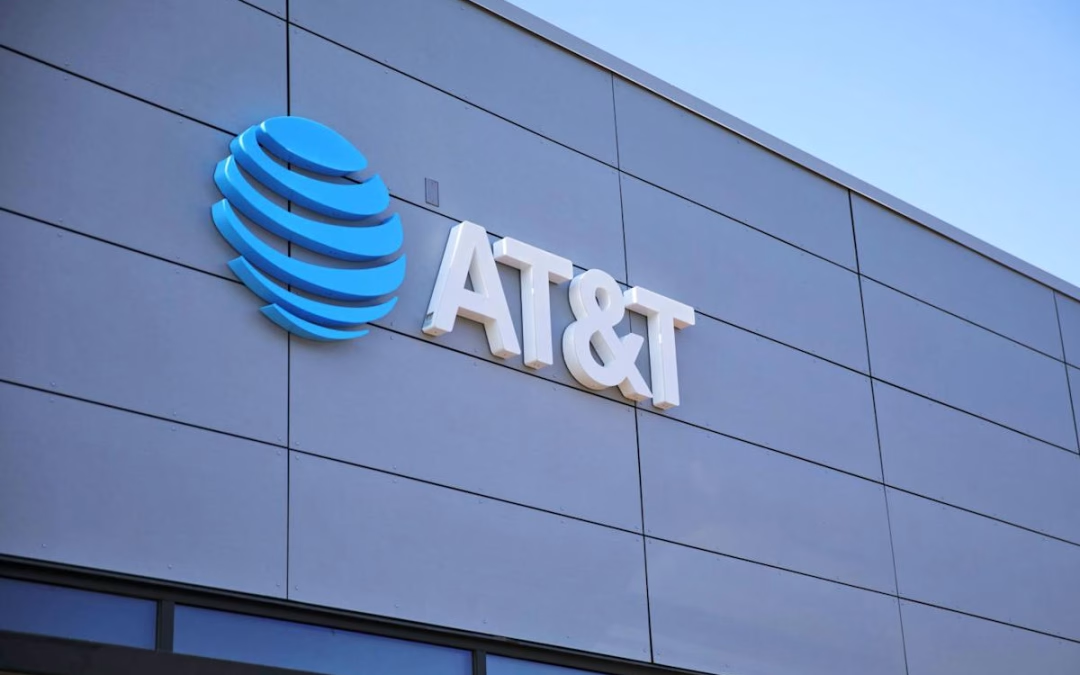
On September 25, 2025, a widespread 911 outage disrupted emergency services across parts of Mississippi, Louisiana, and Alabama, raising serious concerns about infrastructure resilience and public safety. According to AT&T, the outage was caused by fiber optic cable cuts made by unknown third parties—a rare but impactful incident that temporarily severed critical communication lines.
Timeline of the Outage
- Initial Reports: Outages began surfacing around 2:00 p.m. local time in Mississippi.
- Affected Areas: Major cities including Jackson, Baton Rouge, and New Orleans reported complete or partial 911 service failures.
- Restoration: By 4:45 p.m., AT&T confirmed that services had been restored across all affected regions.
Cause and Response
AT&T attributed the outage to accidental fiber cuts by third parties, not a cyberattack. Emergency management agencies in all three states mobilized quickly, issuing alternate emergency contact numbers via social media and local news outlets. Some counties, like Livingston Parish in Louisiana, maintained service through Next Generation 911 systems, which use modern infrastructure to bypass legacy copper lines.
Public Safety Implications
The incident highlights several vulnerabilities:
- Infrastructure Fragility: A single fiber cut can disrupt emergency services across multiple states.
- Lack of Redundancy: Many regions still rely on outdated systems without backup protocols.
- Communication Gaps: Residents in affected areas faced delays or failed connections during emergencies.
Local governments scrambled to provide temporary solutions, but the outage exposed the urgent need for more robust and decentralized emergency communication systems.
What’s Next?
AT&T has pledged to investigate the incident and improve safeguards against future disruptions. Meanwhile, state agencies are reviewing contingency plans and exploring upgrades to Next Generation 911 systems to ensure continuity during infrastructure failures.

by hannahadmin | Oct 9, 2025 | blog, Seimless
In a landmark moment for the tech industry, OpenAI has reached a staggering $500 billion valuation, officially becoming one of the most valuable startups in the world. This milestone was achieved through a secondary share sale involving current and former employees, who sold approximately $6.6 billion worth of equity to a consortium of high-profile investors.
The Rise of a Tech Titan
Founded in 2015 as a nonprofit research lab, OpenAI has evolved into a global leader in artificial intelligence. Its flagship product, ChatGPT, revolutionized the AI landscape and became the fastest-growing consumer software application in history. The company’s valuation has surged from $300 billion earlier this year to $500 billion in October 2025, reflecting explosive growth in both revenue and user adoption.
The Deal Behind the Valuation
The $500 billion valuation was not the result of a traditional funding round. Instead, it came from a secondary share sale that allowed employees to cash out equity. Investors in the deal included:
-
- Thrive Capital
- SoftBank Group Corp
- Dragoneer Investment Group
- Abu Dhabi’s MGX
What’s Driving Investor Confidence?
Several factors are fueling investor enthusiasm:
- Revenue Growth: OpenAI generated $4.3 billion in revenue in the first half of 2025—16% more than its total earnings in 2024.
- Strategic Partnerships: The company has inked mega-deals with Oracle and SK Hynix to expand its AI infrastructure.
- Global Expansion: OpenAI is building data centers in South Korea and collaborating with Samsung and SK Hynix on its Stargate project.
- Talent Retention: The share sale provides liquidity to employees, helping retain top AI talent amid fierce competition from tech giants like Meta.
Implications for the AI Ecosystem
OpenAI’s valuation surge underscores the growing importance of generative AI in global markets. As industries race to integrate AI into their operations, OpenAI stands at the forefront—driving innovation, shaping policy debates, and redefining the boundaries of machine intelligence.

by hannahadmin | Oct 9, 2025 | blog, Seimless
In a groundbreaking collaboration, OpenAI and legendary designer Jony Ive are developing a revolutionary AI-powered device that promises to redefine human-machine interaction. But as the tech world watches with anticipation, the project is grappling with significant technical and philosophical hurdles that could delay its launch, originally slated for 2026.
A Glimpse into the Vision
The device, envisioned as a palm-sized, screenless assistant, aims to interact with users through audio and visual cues alone. Designed to be “always on,” it would listen, observe, and learn from its surroundings—offering a seamless, ambient AI experience. With hardware led by Ive’s design firm LoveFrom and software powered by OpenAI’s cutting-edge models, the gadget aspires to be more than a tool—it’s meant to be a helpful companion.
Technical Roadblocks
Despite the ambitious vision, the project is facing several critical challenges:
- Compute Infrastructure: OpenAI is reportedly struggling to secure the real-time processing power needed to support continuous audio-visual data streams. Unlike tech giants like Amazon and Google, OpenAI lacks the hardware backbone to scale this device for mass consumption.
- Software Complexity: Engineers are working to define the assistant’s “personality”—a delicate balance between professionalism and friendliness. Avoiding the pitfalls of overly robotic or intrusive behavior is proving to be a nuanced challenge.
- Privacy Concerns: The “always-on” nature of the device raises serious questions about user privacy. Developers are debating how to ensure the assistant listens and responds appropriately without becoming invasive.
Philosophical Design Challenges
Creating an AI that feels like “a helpful friend” rather than a cold machine or an overly intimate companion is no small feat. The team is experimenting with conversational models that avoid sycophancy, excessive directness, or feedback loops—issues that have plagued previous AI assistants.
What’s Next?
While the hardware is reportedly progressing, the software and infrastructure hurdles have cast uncertainty over the launch timeline. OpenAI’s recent partnerships with Apple’s supply chain manufacturers, including Luxshare and Goertek, suggest a serious push toward production—but only time will tell if the vision can be realized.
Why It Matters
If successful, this device could mark a paradigm shift in how we interact with AI—moving from screen-based interfaces to ambient, context-aware companions. It’s a bold step toward a future where technology blends invisibly into our lives.
by hannahadmin | Aug 15, 2025 | blog, Seimless
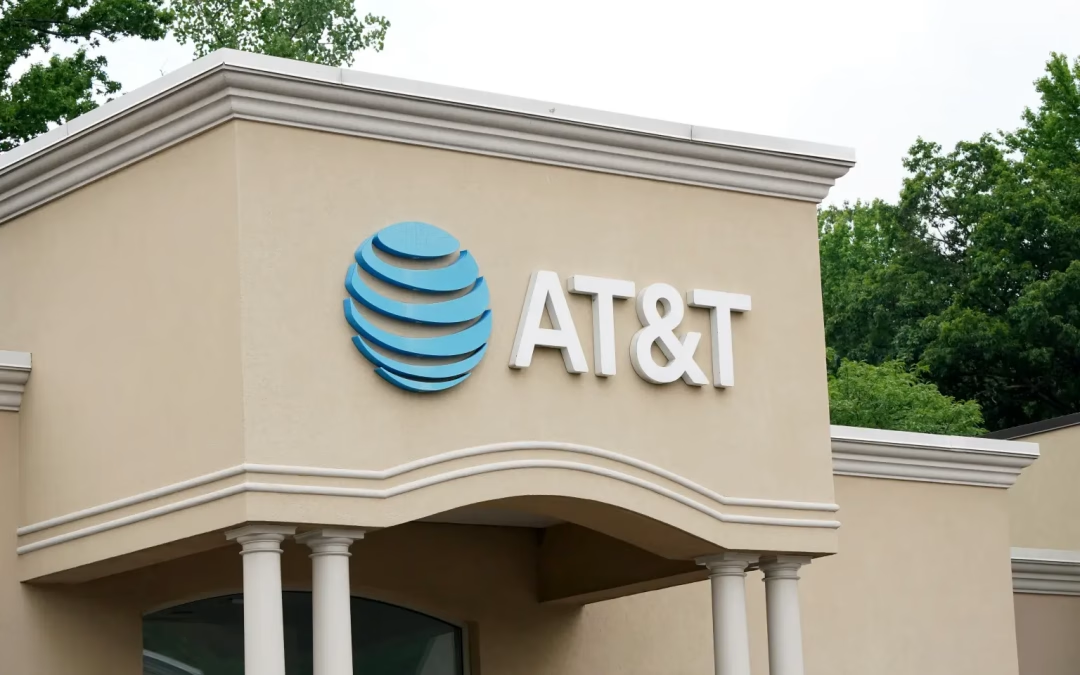
Former and current AT&T customers are eligible to receive up to $7,500 as part of a settlement involving class-action lawsuits over two major data breaches.
The telecommunications giant said earlier this month that it has reached a proposed settlement of $177 million – including $149 million for the first class-action lawsuit and $28 million for the second.
The first case involved a data breach revealed in March 2024 that impacted 73 million current and former account holders.
Hackers stole personal information like birth dates and Social Security numbers and spread this data across the dark web.
A second breach announced in July 2024 compromised the call and text records of “nearly all” of AT&T’s customers. Those logs were downloaded by hackers onto a third-party platform.
The $177 million settlement is still awaiting approval, with a final hearing scheduled for Dec. 3 in the US District Court for the Northern District of Texas.
How do I know if I am eligible?
Current and former customers can file for compensation if their data was jeopardized in the breach ahead of the December hearing.
Eligible customers will receive an email alert from at***********@********sa.com – the address for Kroll Settlement Administration.
Customers who are unsure if they qualify can call (833) 890-4930, KSA said.
How do I file for payment?
To receive compensation, you must fill out a claim form at telecomdatasettlement.com by Nov. 18.
If you choose to file a claim, you forfeit your right to sue AT&T.
How much payment can I expect?
Those impacted by the March 2024 data breach are eligible for up to $5,000, according to the settlement website. They can make claims for losses “that occurred in 2019, or later.”
Customers affected by the July 2024 breach are eligible for up to $2,500 “for losses that occurred on or after April 14, 2024.”
Those impacted by both hacks are eligible for up to $7,500 as an “overlap settlement class member.”
AT&T will require documentation of the losses to show they are “fairly traceable” to the data breaches.

by hannahadmin | Jun 11, 2025 | blog, Seimless
Executive Summary
Enterprise Resource Planning (ERP) software has evolved from simple back-office automation tools to mission-critical platforms that power every facet of an organization—from finance to supply chain, HR to customer engagement. With options ranging from on-premise deployments to fully cloud-native ERP platforms, understanding how to compare ERP systems and choose the right one for your unique needs is more important than ever.
This whitepaper will guide you through:
- How to choose between cloud-based and on-premise ERP platforms
- Criteria for identifying a good ERP system vs. an ineffective one
- The latest ERP trends in 2025
- A comparative breakdown of the top 10 ERP solutions
- Decision-making criteria to help you choose the right ERP for your enterprise
Cloud vs. On-Premise ERP: Core Differences
| Feature |
Cloud ERP |
On-Premise ERP |
| Deployment |
Vendor-hosted (SaaS) |
Installed locally on company servers |
| Maintenance |
Vendor handles updates |
IT staff manages updates & patches |
| Cost Model |
Subscription (OPEX) |
One-time license + maintenance (CAPEX) |
| Scalability |
Highly scalable |
Limited by internal hardware |
| Security |
Cloud provider’s responsibility |
Full control internally |
| Customization |
Limited without vendor support |
Deep customization possible |
| Best For |
Fast-growing, multi-location, SMB to mid-market firms |
Large enterprises with strict compliance or unique processes |
Key Takeaway:
Choose Cloud ERP for speed, scalability, and lower upfront cost. Choose On-Premise ERP for greater control, security, and customization—often preferred in highly regulated sectors like government, defense, or manufacturing.
What Makes ERP Software Effective?
Characteristics of an Effective ERP Solution:
- Unified modules across departments (finance, HR, CRM, inventory)
- Strong integration APIs for third-party apps
- Real-time analytics and dashboards
- Intuitive user interface (UX)
- Customizable workflows
- Mobile access and cross-platform support
- Role-based access and layered security
Signs of an Ineffective ERP:
- Siloed modules with poor interconnectivity
- Frequent downtime or bugs during updates
- Long implementation cycles (12+ months)
- Limited support for compliance or industry standards
- High total cost of ownership with low ROI
- Poor vendor training or customer service
Trends in ERP Software – 2025
1. AI-Powered Insights
Modern ERPs are embedding AI/ML for real-time forecasting, fraud detection, and predictive inventory management.
2. Composable ERP Architecture
Companies now favor modular, API-first systems that integrate best-of-breed apps (CRM, payroll, billing) rather than monolithic ERPs.
3. Industry-Specific ERPs
Niche platforms tailored to manufacturing, healthcare, logistics, or retail offer better functionality out of the box.
4. Low-Code/No-Code ERP Customization
Platforms now empower business users—not just IT—to modify workflows and dashboards with minimal coding.
5. ERP + Cybersecurity Fusion
Integrated identity management, encryption, and compliance auditing are now standard in cloud ERPs.
Top 10 ERP Solutions for 2025 (Cloud & On-Premise)
| ERP Vendor |
Cloud/On-Premise |
Ideal For |
Key Strengths |
| SAP S/4HANA |
Both |
Large enterprises, manufacturers |
Real-time analytics, deep customizations, global compliance |
| Oracle Fusion Cloud ERP |
Cloud |
Mid to large enterprises |
Powerful finance and procurement modules, AI integrations |
| Microsoft Dynamics 365 |
Cloud/Hybrid |
SMBs to Enterprises |
Seamless integration with MS apps, modular licensing |
| NetSuite by Oracle |
Cloud |
Mid-market firms |
Quick to deploy, strong financials, multi-entity support |
| Infor CloudSuite |
Cloud |
Healthcare, manufacturing, logistics |
Industry-specific features, strong analytics |
| Workday |
Cloud |
HR, finance-focused firms |
Leading HCM and finance suite, user-friendly interface |
| Epicor |
Both |
Manufacturing, distribution |
Strong shop floor and inventory modules, IoT ready |
| Odoo |
Both |
SMBs |
Open-source, modular, very customizable |
| Acumatica |
Cloud |
SMB to mid-market |
Affordable, open APIs, excellent mobile UX |
| IFS Cloud |
Cloud |
Field service, aviation, utilities |
Strong in asset and service management, industry-driven |
Comparing ERP Solutions – Why Choose One Over the Other?
| Vendor |
Best Use Case |
Why Choose It |
| SAP S/4HANA |
Complex global enterprises |
Scalability, multi-currency, industry modules |
| Oracle Fusion |
High-performance finance operations |
Advanced automation, deep AI |
| Microsoft D365 |
Growing businesses |
Flexibility, Microsoft ecosystem alignment |
| NetSuite |
Mid-market, fast-deploy |
Quick time to value, user-friendly |
| Infor |
Logistics & healthcare |
Pre-built verticals, compliance support |
| Workday |
HR-centric enterprises |
Best-in-class talent and workforce management |
| Epicor |
Manufacturing-heavy firms |
MES integration, real-time shop floor data |
| Odoo |
Startups and SMBs |
Cost-effective, open-source, modular |
| Acumatica |
Cloud-native SMBs |
Flexible pricing, great partner ecosystem |
| IFS |
Asset-intensive sectors |
Field service, project management, mobility |
How to Choose the Right ERP for Your Business
1. Assess Internal Readiness
- Is your team equipped to manage on-premises deployments?
- Do you have a dedicated IT and cybersecurity function?
2. Define Business Goals
- Do you need fast deployment, or highly customized workflows?
- Is rapid scaling more important than granular control?
3. Evaluate Budget Constraints
- Can you afford large CAPEX upfront, or prefer OPEX subscription?
- What is the 3–5 year TCO (Total Cost of Ownership)?
4. Check Integration Needs
- What third-party systems must be integrated (CRM, e-commerce, payroll)?
- Do you require open APIs or pre-built connectors?
5. Prioritize Compliance and Security
- Are you under HIPAA, GDPR, SOX, or CMMC mandates?
- Does the vendor provide role-based security and audit logs?
Conclusion
ERP selection is not just a software decision—it’s a business transformation strategy. Whether you lean toward a cloud-native ERP for agility or an on-premise platform for control and compliance, ensure that your choice aligns with your company’s growth trajectory, IT maturity, and industry requirements.
Organizations must look beyond features and pricing to evaluate ERP platforms based on flexibility, scalability, integration capability, and long-term vendor viability. The ERP you choose today will define how efficiently your company operates tomorrow.
Call to Action
Ready to evaluate ERP systems or compare platforms in a live business case? Request our ERP Decision Matrix and Vendor Scorecard Templates, or speak to one of our ERP transformation consultants for a free discovery session.
https://www.seimless.com/services/
https://cloudcallcenter.io/

by hannahadmin | Jun 11, 2025 | blog, Seimless
Executive Summary
As enterprises face increasing demands for cloud access, remote work, real-time collaboration, and cybersecurity, selecting the right Internet Service Provider (ISP) and network topology has become mission-critical. Developing a custom network strategy to navigate today’s networking choices, which are more complex than ever, spanning Managed vs. Unmanaged networks, and topologies like MPLS, Metro Ethernet, Dedicated Internet Access (DIA), SD-WAN, and Quantum-Resistant SD-WAN (QRSD-WAN).
This whitepaper provides a comprehensive guide to:
- Choosing between managed and unmanaged network services
- Evaluating modern WAN topologies
- Identifying which solution best fits your business model
- Understanding what makes a good ISP versus a poor one
- Reviewing the latest trends in network connectivity
- Comparing the Top 10 Enterprise ISP Solutions for 2025
Managed vs. Unmanaged Networks: What’s Right for You?
| Feature |
Managed Network |
Unmanaged Network |
| Control |
ISP/vendor-controlled |
Customer-managed |
| Support |
24/7 monitoring & maintenance |
Self-troubleshooting |
| Security |
Built-in firewalls, threat detection |
Custom security stack required |
| Cost |
Higher monthly cost |
Lower cost, more internal resources needed |
| Best For |
Companies with small IT teams or mission-critical uptime needs |
Companies with strong in-house IT and desire for network customization |
Key Considerations:
- Choose Managed if uptime, redundancy, and support are more important than granular control.
- Choose Unmanaged if you need flexible routing, customization, or already operate a robust network operations team.
Understanding Network Topologies
1. MPLS (Multiprotocol Label Switching)
- Strengths: Predictable performance, low latency, secure private circuits.
- Weaknesses: Expensive, limited cloud flexibility.
- Best For: Banks, healthcare, and global enterprises with centralized data centers.
2. Metro Ethernet
- Strengths: Scalable bandwidth, low latency in urban areas, cost-effective for local/regional sites.
- Weaknesses: Geographic limitations.
- Best For: Urban or campus-based businesses with high-speed requirements.
3. Dedicated Internet Access (DIA)
- Strengths: SLA-backed, symmetrical speeds, always-on access.
- Weaknesses: Higher cost than broadband, less secure without overlay.
- Best For: Organizations needing guaranteed bandwidth for cloud/SaaS.
4. SD-WAN (Software-Defined WAN)
- Strengths: Dynamic path selection, cloud-optimized, bandwidth aggregation, application-aware routing.
- Weaknesses: Relies on underlying broadband; security must be layered.
- Best For: Multi-site enterprises, especially those using SaaS or IaaS heavily.
5. QRSD-WAN (Quantum-Resistant SD-WAN)
- Strengths: All SD-WAN benefits plus quantum-safe encryption and zero-trust architecture.
- Weaknesses: Emerging technology; fewer providers, higher cost.
- Best For: Defense, finance, critical infrastructure, or businesses with long data retention obligations.
What Makes an ISP Solution Effective?
Qualities of a Reliable ISP:
- SLA-Driven Performance (latency, uptime, packet loss)
- Real-Time Network Visibility & Analytics
- Built-In Security Services (DDoS protection, firewalls)
- Scalability (up to multi-gig bandwidth)
- Cloud On-Ramps (direct AWS, Azure, Google Cloud connections)
- Edge PoPs (Points of Presence) close to your locations
Signs of an Ineffective ISP:
- Hidden overages or burst fees
- Lack of proactive monitoring
- High latency or packet loss
- No direct support—outsourced NOC
- Poor integration with cloud or hybrid environments
Top Trends in ISP and Network Services (2025)
1. Rise of QRSD-WAN for Post-Quantum Security
Leading ISPs are deploying quantum-resistant encryption algorithms for long-term data confidentiality.
2. Cloud-Native Networking
ISPs now offer direct cloud integrations (Cloudflare, ZScaler, AWS Direct Connect) as standard.
3. AI-Driven Network Monitoring
AI predicts failures, reroutes traffic, and optimizes bandwidth in real time—especially in SD-WAN deployments.
4. Zero Trust Networking
Managed ISPs now deploy identity-first access models with micro-segmentation.
5. ISP-as-a-Service
Vendors now bundle connectivity with security, WAFs, and performance monitoring under single contracts.
Top 10 Enterprise ISP and Network Providers (2025)
- AT&T Business
- Best For: Global MPLS, 5G WAN backup
- Strengths: Global reach, robust managed services, QRSD-WAN integrations
- Lumen (formerly CenturyLink)
- Best For: DIA and metro fiber
- Strengths: Dense metro Ethernet, real-time analytics, low latency
- Comcast Business
- Best For: North American mid-market
- Strengths: Affordable DIA and SD-WAN bundles
- Verizon Business
- Best For: SD-WAN and wireless backup
- Strengths: Edge-compute ready, cloud integrations, strong uptime SLAs
- Cogent Communications
- Best For: Affordable global DIA
- Strengths: Low latency backbone, fast installs, strong SLA guarantees
- Zayo Group
- Best For: Fiber-rich deployments
- Strengths: Dark fiber, high-speed transport, private cloud connectivity
- Masergy (now part of Comcast)
- Best For: Secure SD-WAN
- Strengths: Managed security and performance-based routing
- Cato Networks
- Best For: Cloud-native SD-WAN + SASE
- Strengths: Full SASE stack, cloud-delivered, QR-ready encryption
- Aryaka
- Best For: Global hybrid WANs
- Strengths: Fully managed SD-WAN with low-latency backbone
- Google Cloud Network (via Partners)
- Best For: AI & cloud-native firms
- Strengths: Cloud-optimized networking, edge integration, private cloud routing
Decision Framework: How to Choose
| Business Goal |
Recommended Topology |
Suggested ISP |
| Highly secure global ops |
MPLS or QRSD-WAN |
AT&T, Verizon, Aryaka |
| Urban site expansion |
Metro Ethernet |
Lumen, Comcast, Zayo |
| Remote workforce |
SD-WAN or QRSD-WAN |
Masergy, Cato, Google Cloud |
| High bandwidth SaaS/Cloud use |
DIA + Cloud On-Ramps |
Lumen, Cogent, Google Cloud |
| Lowest latency possible |
DIA or QRSD-WAN |
Cogent, Cato, Zayo |
Final Considerations
Before selecting an ISP or network solution, assess the following:
- Number of locations & user density
- Cloud reliance (SaaS, IaaS, PaaS)
- Compliance requirements (HIPAA, PCI, CMMC)
- In-house IT capabilities
- Projected growth over 3–5 years
Conclusion
The right ISP and network design isn’t a commodity—it’s a strategic enabler. Whether you choose MPLS for guaranteed delivery, SD-WAN for cloud optimization, or QRSD-WAN to future-proof your infrastructure, matching your selection to business goals and security needs is essential. Partnering with the right provider ensures performance, uptime, scalability, and compliance.
https://www.seimless.com/contact-us/
https://cloudcallcenter.io/