by hannahadmin | Mar 10, 2026 | blog, Seimless
In the modern digital ecosystem, organizations generate and store enormous volumes of sensitive information—from financial records and intellectual property to defense communications and healthcare data. While much attention is often focused on protecting data in transit, an equally critical challenge is securing data at rest—information stored in databases, cloud environments, servers, and storage infrastructure.
With the rapid advancement of quantum computing, traditional encryption models face growing risks. The EXODUS QRN – Data at Rest framework, developed under ibm/SEIMless, addresses this challenge by delivering advanced security architecture designed to protect stored information against both classical and emerging quantum-era threats.
Understanding Data at Rest Security
Data at rest refers to digital information stored in persistent storage systems such as:
- Enterprise databases
- Cloud storage platforms
- Data centers and servers
- Backup archives
- Edge storage environments
If these systems are compromised, attackers can gain access to massive volumes of sensitive data without needing to intercept network communications.
According to the National Institute of Standards and Technology, strong cryptographic protection for stored data is a foundational requirement for modern cybersecurity frameworks. Their guidance on data protection highlights encryption, access control, and key management as core safeguards for stored information.
Similarly, cybersecurity leaders emphasize encryption and governance controls to mitigate breaches targeting stored datasets.
The Emerging Quantum Threat to Stored Data
Traditional encryption algorithms such as RSA and ECC rely on mathematical problems that are difficult for classical computers to solve. However, quantum computers have the potential to break these algorithms using quantum techniques such as Shor’s Algorithm.
This creates a major long-term risk known as “Harvest Now, Decrypt Later.” Attackers may steal encrypted databases today and wait until quantum computing matures to decrypt the information in the future.
Organizations responsible for protecting long-lived sensitive information—such as government agencies, financial institutions, and healthcare systems—must therefore implement quantum-resistant security models for stored data.
EXODUS QRN – A Quantum-Resistant Approach to Data at Rest
EXODUS QRN, developed within the ibm/SEIMless technology ecosystem, introduces an advanced architecture for protecting stored data in high-risk and mission-critical environments.
The EXODUS QRN – Data at Rest model focuses on multiple integrated layers of security:
1. Quantum-Resistant Cryptography
Implementation of post-quantum cryptographic algorithms designed to remain secure even against large-scale quantum computing attacks.
2. Secure Key Lifecycle Management
Advanced cryptographic key generation, distribution, storage, and rotation processes that ensure long-term encryption resilience.
3. Zero-Trust Data Storage Architecture
Access to stored data is continuously authenticated and verified, eliminating implicit trust within storage systems.
4. Multi-Layer Encryption Framework
Data is encrypted at multiple layers—application, database, and storage—ensuring defense-in-depth protection.
5. Immutable Data Integrity Controls
Advanced integrity verification ensures stored information cannot be altered without detection.
Strategic Advantages for Organizations
Adopting the EXODUS QRN – Data at Rest model offers several key advantages:
Long-Term Data Protection
Ensures sensitive information remains secure even as quantum computing capabilities evolve.
Regulatory Compliance
Supports compliance with modern cybersecurity frameworks and international data protection regulations.
Reduced Breach Impact
Encrypted storage significantly limits the damage attackers can cause even if infrastructure is compromised.
Future-Proof Infrastructure
Organizations transition toward next-generation cryptographic standards before quantum threats materialize.
The ibm/SEIMless Vision
At ibm/SEIMless, innovation is focused on building Quantum Resistant Networks (QRN) capable of protecting data across the entire lifecycle—whether in transit, in use, or at rest.
Through the EXODUS QRN architecture, ibm/SEIMless is developing next-generation security technologies designed for:
- Government and defense infrastructure
- Financial systems
- Critical enterprise networks
- High-security communications environments
This forward-looking approach ensures organizations can protect their most valuable digital assets well into the quantum future.
Call to Action
The transition to quantum-resistant cybersecurity has already begun. Organizations that act now will be best positioned to safeguard sensitive data against future computational breakthroughs.
To learn how EXODUS QRN – Data at Rest and other advanced security innovations from ibm/SEIMless can protect your digital infrastructure, visit:
👉 https://seimless.com
Explore how ibm/SEIMless is building the next generation of quantum-resistant networks and secure data architectures for the evolving cybersecurity landscape.
by hannahadmin | Mar 6, 2026 | blog, Seimless
In a significant development within the cybersecurity and artificial intelligence landscape, the United States Department of Defense—commonly known as the Pentagon—has formally designated Anthropic as a potential supply-chain risk.
This decision signals a broader shift in how governments evaluate AI vendors involved in sensitive digital ecosystems, national defense technologies, and critical infrastructure networks.
For organizations responsible for mission-critical communications, including government contractors and advanced technology firms, this designation underscores the urgent need for secure, transparent, and quantum-resilient infrastructure.
Companies like SEIMless Communications Technologies, Inc. (ibm/SEIMless), headquartered in New York, are responding to this new security paradigm by developing Quantum Resistant Networks (QRN) designed to protect sensitive data from both classical and emerging quantum threats.
Understanding the Pentagon’s Supply-Chain Risk Designation
Supply-chain risk designations typically occur when a vendor’s technologies, data handling practices, or operational dependencies raise concerns regarding:
- Data sovereignty
- Foreign technology dependencies
- Algorithmic transparency
- Cybersecurity vulnerabilities
- Insider threat exposure
With AI systems increasingly integrated into defense logistics, surveillance analytics, communications platforms, and autonomous systems, even small vulnerabilities can create large-scale national security risks.
When the Pentagon identifies a potential risk within the AI supply chain, it often triggers:
- Procurement restrictions
- Additional security reviews
- Vendor compliance audits
- Contract re-evaluations
Such actions ripple across the broader technology ecosystem, forcing organizations to reassess their AI infrastructure and digital trust frameworks.
Why AI Supply Chains Are Becoming a National Security Priority
Artificial intelligence platforms increasingly operate as foundational infrastructure within both public and private sectors. Unlike traditional software vendors, AI providers manage complex models, training data pipelines, and continuous learning mechanisms.
This introduces several security concerns:
1. Data Integrity Risks
AI systems trained on compromised or manipulated datasets can produce unreliable or biased outputs.
2. Model Manipulation
Adversarial attacks may exploit model weaknesses to manipulate decision-making processes.
3. Cloud Dependency Vulnerabilities
Centralized AI services may expose sensitive operational data to external infrastructure risks.
4. Quantum-Era Encryption Threats
Emerging quantum computing capabilities could eventually break traditional cryptographic protections.
These risks explain why governments are shifting toward secure AI supply chains combined with next-generation encryption technologies.
The Role of Quantum-Resistant Networks
At ibm/SEIMless, security architecture focuses on post-quantum communications infrastructure designed to withstand both present-day cyber threats and future quantum decryption capabilities.
Through its advanced Exodus QRN framework, the company is developing network ecosystems that deliver:
- Quantum-resistant encryption
- Secure decentralized key management
- Defense-grade communications protocols
- AI-compatible cybersecurity frameworks
More details on this architecture can be explored at
👉 https://www.seimless.com
These technologies aim to ensure that sensitive government and enterprise data remains secure even as computing power dramatically evolves.
What This Means for Government Contractors and Enterprises
The Pentagon’s action is likely to influence procurement decisions across the broader federal ecosystem. Organizations operating within defense or critical infrastructure sectors should consider several strategic steps:
Conduct AI Vendor Risk Assessments
Evaluate whether AI service providers comply with strict cybersecurity and transparency standards.
Implement Post-Quantum Security Strategies
Prepare for the future of cryptography by adopting quantum-resistant encryption frameworks.
Secure Communications Infrastructure
Transition from legacy systems toward secure digital communications networks designed for high-risk environments.
Strengthen Data Governance Policies
Ensure AI training datasets and operational pipelines maintain full traceability and integrity.
The Future of Secure AI Ecosystems
The Pentagon’s designation is not simply about one vendor—it reflects a broader transformation in how AI technology, cybersecurity, and national security intersect.
In the coming years we will likely see:
- Increased federal regulation of AI supply chains
- Mandatory AI risk certification frameworks
- Expansion of post-quantum cybersecurity standards
- Greater demand for trusted communications infrastructure
Technology leaders like ibm/SEIMless are actively working to support this transition through secure communications platforms and quantum-resistant networks capable of protecting critical systems worldwide.
Conclusion
The designation of Anthropic as a supply-chain risk represents a pivotal moment in the governance of artificial intelligence technologies within national security environments.
As AI systems continue to power defense operations, enterprise decision platforms, and critical infrastructure networks, security, transparency, and quantum-resilience will become essential requirements.
Organizations seeking to future-proof their communications and cybersecurity infrastructure can explore advanced secure networking solutions at:
👉 https://www.seimless.com
With emerging threats evolving rapidly, investing in quantum-resistant communications and trusted AI infrastructure is no longer optional—it is a strategic necessity.
by hannahadmin | Mar 2, 2026 | blog, Seimless
In a rapidly evolving threat landscape where quantum computing is no longer theoretical, Exodus QRN—a subsidiary innovation under SEIMless Communications Technologies, Inc. (IBM/SEIMless)—is redefining how mission-critical data is secured, transmitted, and sustained across high-risk environments in the United States.
Headquartered in the USA, SEIMless is pioneering Quantum Resistant Networks (QRN) to ensure enterprises, defense contractors, financial institutions, healthcare systems, and government agencies remain protected against next-generation cyber threats.
What Is Exodus QRN?
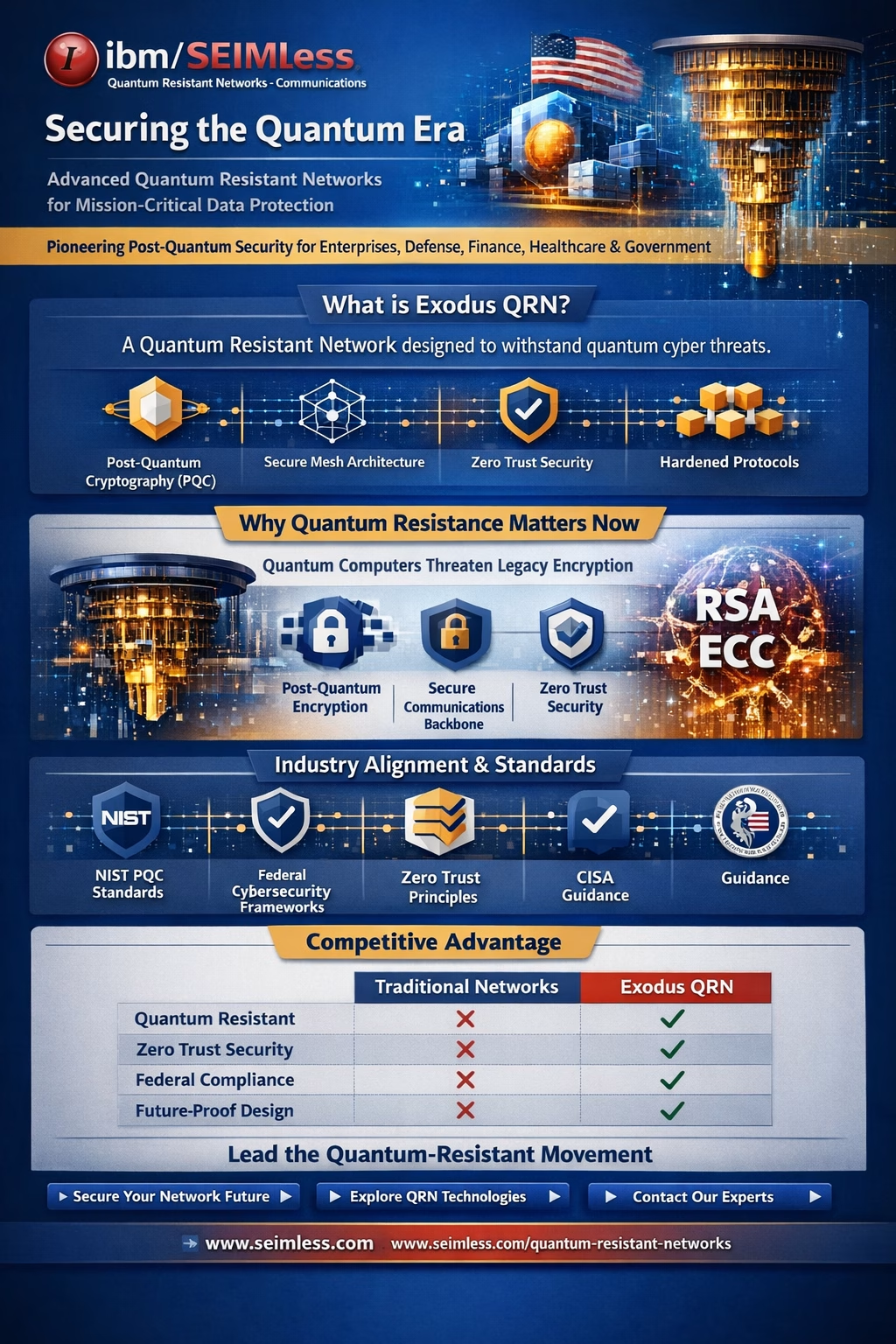
Exodus QRN (Quantum Resistant Network) is an advanced, post-quantum cryptographic network architecture engineered to withstand attacks from quantum-capable adversaries. Unlike traditional encryption models vulnerable to Shor’s and Grover’s algorithms, Exodus QRN integrates:
-
Post-Quantum Cryptography (PQC) frameworks
-
Secure mesh-based communications architecture
-
Zero-trust layered security models
-
Hardened transport-layer protocols
-
Future-proof encryption lifecycle management
This approach aligns with guidance from the National Institute of Standards and Technology (NIST), which is actively standardizing post-quantum cryptographic algorithms for national security resilience.
Why Quantum Resistance Matters Now
Quantum computing advancements from major research institutions and global tech enterprises are accelerating rapidly. Once large-scale quantum systems become operational, legacy RSA and ECC encryption protocols could be rendered obsolete.
According to research initiatives supported by the U.S. Department of Defense, quantum readiness is no longer optional—it is a strategic imperative.
Exodus QRN addresses this urgency by delivering:
-
Immediate quantum-resistant encryption readiness
-
Scalable enterprise deployment frameworks
-
Infrastructure modernization without operational disruption
-
Compliance alignment with emerging federal security mandates
Core Capabilities of Exodus QRN
1. Post-Quantum Encryption Integration
Implements cryptographic primitives designed to resist quantum decryption models.
2. Secure Communications Backbone
Optimized for mission-critical sectors, including:
-
Defense & Aerospace
-
Financial Infrastructure
-
Energy & Utilities
-
Healthcare Data Networks
-
Federal & State Agencies
3. Zero Trust Architecture
Continuous identity verification, endpoint authentication, and traffic segmentation ensure perimeter-less defense.
4. Infrastructure Hardening
Exodus QRN reinforces network nodes with encrypted routing, hardened firmware layers, and tamper-resistant transport protocols.
How SEIMless Leads the Quantum-Resistant Movement
SEIMless Communications Technologies focuses on delivering secure, scalable, and sovereign network solutions. With Exodus QRN, the company positions itself as a U.S.-based leader in:
-
Secure telecom modernization
-
Defense-grade communication platforms
-
Next-generation encryption architecture
-
Quantum-resilient data transport systems
Explore our mission and technology approach here:
👉 https://www.seimless.com
Learn more about our Quantum Resistant Network initiatives:
👉 https://www.seimless.com/quantum-resistant-networks
Industry Alignment & Standards
Exodus QRN is engineered in accordance with:
-
NIST Post-Quantum Cryptography standards
-
Federal cybersecurity modernization frameworks
-
Zero Trust security architecture principles
-
Advanced secure communications research models
These frameworks are increasingly referenced by agencies including the Cybersecurity and Infrastructure Security Agency (CISA) for strengthening national cyber defense posture.
Competitive Advantage of Exodus QRN
| Feature |
Traditional Networks |
Exodus QRN |
| Quantum-Resistant Encryption |
❌ |
✅ |
| Zero Trust Model |
Limited |
Fully Integrated |
| Federal-Grade Compliance |
Partial |
Designed for Alignment |
| Future-Proof Architecture |
No |
Yes |
| Infrastructure Scalability |
Moderate |
Enterprise-Level |
The Strategic Impact
Exodus QRN is not simply a network upgrade—it is a foundational shift toward quantum-resilient digital sovereignty.
Organizations adopting Exodus QRN today gain:
-
Long-term encryption viability
-
Reduced future migration costs
-
Proactive compliance positioning
-
Enhanced national and enterprise security posture
Partner With SEIMless Today
As quantum computing advances, the window for proactive protection narrows. SEIMless provides the infrastructure, expertise, and strategic roadmap required to safeguard mission-critical systems.
🔹 Secure Your Network Future: https://www.seimless.com
🔹 Explore Quantum Resistant Technologies: https://www.seimless.com/quantum-resistant-networks
🔹 Contact Our Experts: https://www.seimless.com/contact

by hannahadmin | Feb 6, 2026 | blog, Seimless
A swarm of bots armed with your credit card information sounds like a glaring-red signal to cancel the card. But a swarm of bots with your credit card information—and permission to buy those jeans you’ve been eyeing? Doesn’t sound so bad.
Yet “shopping” with tools like OpenAI or Perplexity could wreak havoc on companies that already struggle to distinguish between so-called good and bad bots, warns Experian in its 2026 Future of Fraud Forecast, published today. The No. 1 threat to companies, according to the forecast, is “machine-to-machine mayhem” in which cybercriminals blend good bots doing your shopping with bad bots tasked with fraud.
“It’s not enough anymore to say that it’s a bot, so we need to stop this traffic,” said Kathleen Peters, chief innovation officer for fraud and identity at Experian North America. “Now, we need to say, ‘Is it a good bot or is it a malicious bot?’”
The U.S. Federal Trade Commission last year found that consumers lost more than $12.5 billion to fraud, while nearly 60% of companies reported an increase in losses from 2024 to 2025. Strikingly, financial losses ballooned by 25% even as the number of fraud reports held steady at 2.3 million a year, showing that schemes are getting more effective at cheating consumers and companies out of their money.
In a separate survey released in July, Experian reported that 72% of business leaders believe that AI-enabled fraud and deepfakes will be among their top operational challenges this year.
The company predicts this year will be a “tipping point” for AI-enabled fraud that will force conversations about liability and regulation around agentic AI in e-commerce, Peters said. “We want to let the good agents through to provide convenience and efficiency, but we need to make sure that doesn’t accidentally become a shortcut for bad actors,” she said.
Some e-commerce companies already block AI agents. Amazon, for example, generally blocks bots from independent third parties from browsing and shopping on its platform, and sued to block Perplexity AI agents from shopping autonomously late last year. The e-commerce giant has publicly stated the move is to protect security and privacy.
Yet Peters warns that retailers will soon need to grapple with how to manage AI bots once consumers give agents permission to shop for them. She notes that retailers will need to confirm that a consumer gave the agent permission; that the agent is faithful to the consumer’s intent; that the agent has permission to buy and not just browse; and that there’s an actual consumer behind the bot, and not another cybercriminal.
Disruption is also on the table. Retailers want direct engagement with customers to recommend products, build loyalty, and gather data. Some—or all—of that could be crippled if an autonomous agent just completes a transaction and then vanishes.
Deepfake employees infiltrate companies
The second greatest threat for the year, according to Experian, are deepfake candidates infiltrating remote workforces. This threat has already materialized: The FBI and Department of Justice issued multiple warnings last year about documented North Korean operatives posing as IT workers to get jobs and send their salaries back to the regime. These fake IT workers use deepfake technology and identity manipulation to gain employment at hundreds of U.S. companies.
Experian predicts employment fraud will escalate as improved AI tools allow deepfake candidates to get through interviews more easily. Companies will unwittingly onboard these fake employees and grant them access to internal systems.
Beyond state-backed fraud, Peters said the tight labor market could also spur desperate job seekers to monetize their skills to get a job or to help a candidate get through an interview. Lucrative, fully remote data science jobs with robust salaries usually require technical proficiencies that are gauged in an interview. As deepfake tools improve, it will likely get harder for companies to tell how an interviewee is faring.
“It’s a very competitive job market out there, and individuals may offer their services to get through a technical interview,” she said.
Threats on the horizon
The forecast warns of three other trends expected to ramp up in 2026.
- Smart home devices, including virtual assistants, smart locks, and security systems, will introduce new weaknesses that cybercriminals could exploit.
- Website cloning could overwhelm fraud teams as AI tools make it simpler to replicate legitimate websites for attacks.
- Intelligent bots with high emotional IQs will carry out automated romance and family-member-in-need scams with intense sophistication.
Just as companies are looking to increase their efficiency through AI, cybercriminals are getting more efficient. AI has “democratized” access to these powerful tools to not just engineers, but fraudsters as well, Peters said. “With less expertise, they’re able to create more convincing scams and more convincing text messages that they can blast out at scale.”

by hannahadmin | Jan 30, 2026 | blog, Seimless
Fed chair | President Donald Trump announced on Friday that he will nominate Kevin Warsh to succeed Jerome Powell as chair of the Federal Reserve, ending a monthslong selection process that has challenged the board’s independence. Warsh served as a Fed governor from 2006 to 2011 and was a finalist for the job that went to Powell in 2017. He has emerged as a critic of the central bank, claiming it needs “regime change.” He also supports lowering interest rates, aligning with the president. Warsh must be confirmed by the Senate before taking on the role.