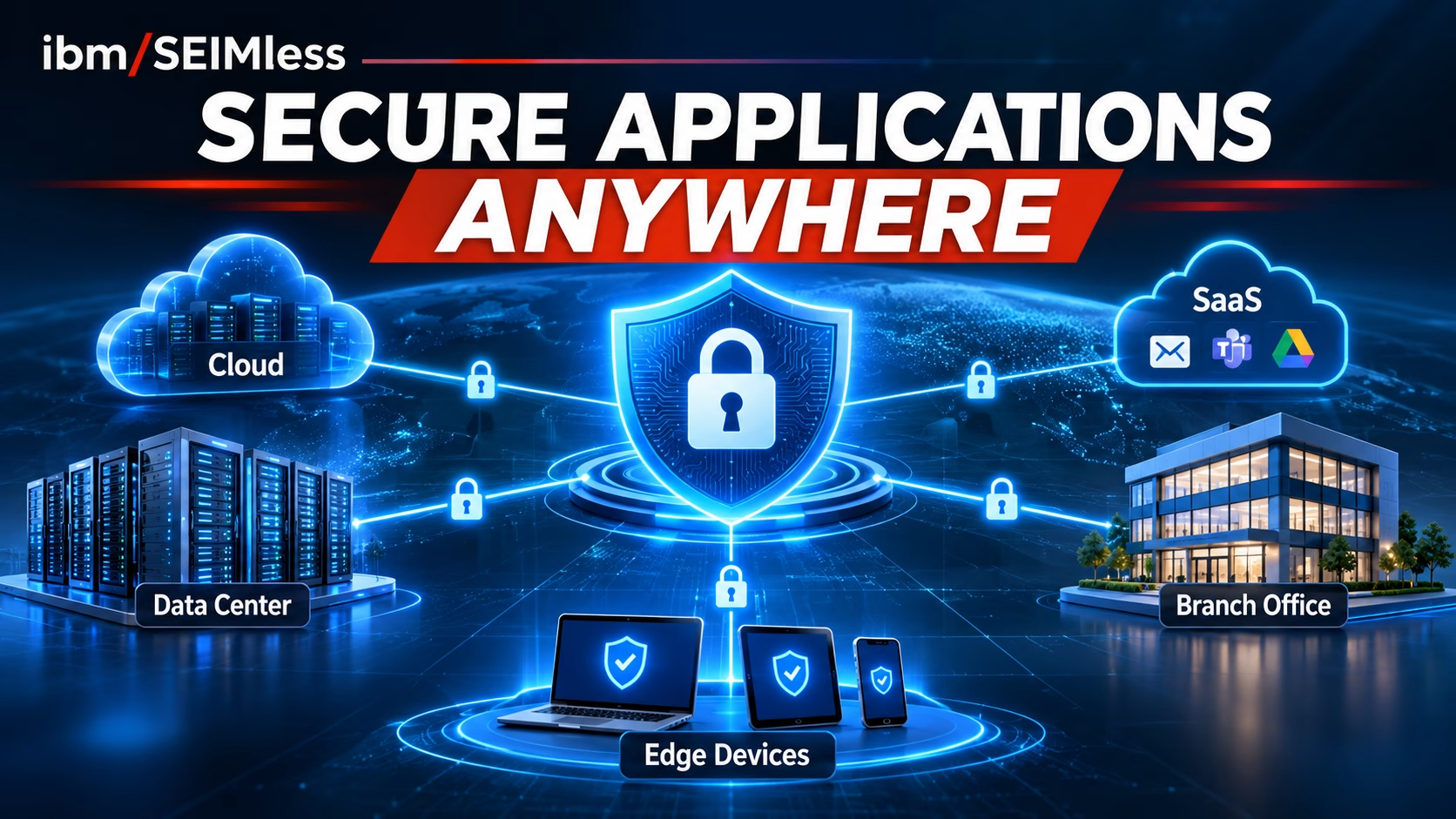
Your applications no longer live in one place, so your protection cannot either. A customer portal may run in a public cloud, its database in a colocation cage, its identity provider in SaaS, and its users in forty cities. To secure applications anywhere, a security team needs more than a long list of tools. It needs one policy that follows each application into every environment it touches. This guide explains how to build that, what federal guidance says about it, and how ibm/SEIMless approaches it through the Exodus Quantum Resistant Networking portfolio.
Quick definition
To secure applications anywhere means every application gets the same identity verification, access policy, traffic inspection, encryption and audit logging regardless of where it runs: data center, public cloud, SaaS, branch or edge. Protection attaches to the application, not to the environment hosting it.
Key takeaways
- Exploiting vulnerabilities is now the top way breaches start, at 31% of initial access in Verizon’s 2026 report, and web applications remain among the most targeted assets.
- The real risk is the protection-parity gap: the same application is defended differently in each environment it runs in.
- NSA, NIST and OMB guidance all point to one model: verify every request, enforce policy at the application layer, and keep that policy identical across locations.
- “One platform” only counts if a single policy change reaches every environment and produces a single audit trail.
- Encryption choices made now should survive the post-quantum transition.
- Anyone who wants to secure applications anywhere should begin with an application inventory, not a product purchase.
Why “anywhere” is now the default
A decade ago, “where does this app run?” had a one-word answer. Today the honest answer is “it depends on the component.” Front ends sit behind content delivery networks, services run in containers across two clouds, legacy systems stay on premises, and employees reach everything from home networks and personal devices. Every hop is a place where policy can be missing or different. Teams that want to secure applications anywhere have to accept this first.
Attackers have noticed. Verizon’s 2026 Data Breach Investigations Report found that exploitation of vulnerabilities rose to 31% of initial access, up from 20% a year earlier, overtaking credential abuse at 13%. Coverage of the report points to web applications, VPNs and remote access infrastructure as the most commonly exploited asset categories. CISA’s Known Exploited Vulnerabilities catalog adds new entries almost weekly, and our own analysis of a record 1,413-patch Tuesday shows why patching alone cannot keep pace.
The cost of falling behind is concrete. IBM’s 2026 Cost of a Data Breach Report puts the average U.S. breach at $11.5 million, and the average time to identify and contain a breach rose to 247 days. The longer an attacker lives inside a poorly watched environment, the more that number grows.
The protection-parity gap: why the same app is safer in one place than another
Here is the pattern we see in enterprise reviews. A team hardens an application in its primary cloud with a web application firewall, strict identity rules and full logging. Months later, a disaster-recovery copy launches in a second environment. The firewall is a different product with a different rule language. Logging goes to a different console. Nobody rewrote the access rules because nobody owned them. Same application, different protection.
We call this the protection-parity gap: the measurable difference between the security controls an application receives in its best-protected environment and its least-protected one. Attackers do not need to beat your strongest control. They look for the environment with the weakest one, so any plan to secure applications anywhere has to measure this gap first.
The gap is not an exotic edge case. OWASP’s Top 10:2025 keeps broken access control in first place and moved security misconfiguration from fifth to second. Both are parity problems. They happen when rules differ, drift or go missing between one deployment and the next.
Where parity usually breaks
| Control | What differs by environment | What an attacker gains |
| Identity and access | Separate directories, local accounts, inconsistent MFA on legacy apps | Stolen credentials work in the weakest place |
| Traffic inspection | Different firewall and WAF engines, different signature timing | An exploit blocked in one cloud passes in another |
| Segmentation | Security groups, VLANs and mesh policies written separately | Easy lateral movement after one foothold |
| Encryption | Different TLS versions, cipher suites and key custody | Weak links where traffic crosses environments |
| Logging and detection | Different formats, retention and alerting | Longer dwell time, weaker forensics |
| Recovery | Backups configured per environment, not per application | Ransomware reaches the copy you rely on |
What federal guidance says about securing applications everywhere
You do not have to invent this model. U.S. standards bodies have described it in detail, and their guidance is a useful yardstick for any vendor pitch.
NSA: the application and workload pillar
The NSA’s cybersecurity information sheet, Advancing Zero Trust Maturity Throughout the Application and Workload Pillar, lists five capabilities: application inventory, secure software development and integration, software risk management, resource authorization and integration, and continuous monitoring. It names inventory as the first step because you cannot protect what you have not identified. The agency’s full zero trust guidance series pairs this pillar with network, data and visibility pillars, which is the right way to think about it: application security is a team sport. It is a sound blueprint for anyone who needs to secure applications anywhere.
NIST: policy that ignores location
NIST SP 800-207A addresses cloud-native applications across multi-cloud and on-premises environments directly. It calls for identity-based policies, in addition to network parameters, enforced by gateways, proxies and service identities irrespective of where an application runs. It builds on SP 800-207, the foundational zero trust architecture document, and on the hands-on examples in the NCCoE’s zero trust implementation project.
OMB and CISA: treat every application as internet-facing
The White House’s federal zero trust strategy, OMB M-22-09, asks agencies to treat applications as internet-connected and test them rigorously. CISA’s Zero Trust Maturity Model gives a staged path, and its Cloud Security Technical Reference Architecture explains how shared responsibility changes across cloud service models. Private companies are not bound by these documents, but regulators and auditors increasingly use them as the benchmark.
What “one platform” must actually do
“One platform” is the most overused phrase in security marketing. Reduce it to testable requirements. A platform that lets you secure applications anywhere should pass all seven of these checks.
- One policy, many enforcement points. You write an access rule once. It takes effect in the data center, the cloud and the branch without being retyped.
- Identity at the center. Decisions use user, device and workload identity, not just IP addresses, consistent with NIST SP 800-207A.
- Inspection that travels. Threat prevention and content security apply to traffic wherever the application sits.
- Segmentation by application. Micro-segments follow workloads, so a breach in one place does not become a breach everywhere.
- Encryption you control. Consistent protection for data in motion and at rest, with key management that does not depend on a single cloud provider.
- One audit trail. A single, tamper-resistant record of who reached what. Our post on the VMware ESX audit-logging zero-day explains why a system should never be the only witness to its own actions.
- Recovery that matches protection. Backups that attackers cannot alter, defined per application, as covered in our guide to immutable backups.
If you want to secure applications anywhere with confidence, use a simple vendor test: ask for a live demonstration of changing one access policy and watching it apply in two environments at once. If the demo requires two consoles, you have found the parity gap in the vendor’s own product.
How ibm/SEIMless helps you secure applications anywhere
ibm/SEIMless has spent more than 20 years as a vendor-agnostic carrier, cloud and communications partner, which is why we saw early where SD-WAN and SASE leave gaps. Our Exodus portfolio takes the network-layer approach, because every application, whatever its environment, depends on the network path that reaches it.
- Edge and branch connectivity. SD-WAN and MPLS replacement give distributed sites a predictable, secure path to applications. See why SD-WAN alone is not ready for next-generation attacks.
- Next-gen network security. The NxtGen network security family, including the Exodus NxtGen Firewall, Zero Trust Content Security and Exodus Aria ADR, brings inspection and detection and response to the traffic that reaches your applications.
- Encryption and key custody. Exodus Key Management, Data in Motion and Data at Rest address protection of information as it moves between and rests within environments.
- Hosting, cloud and endpoints. Private and hybrid cloud, Desktop as a Service, endpoint detection and response and backup and recovery cover the places where applications and the people using them actually live.
Because our team is vendor agnostic, we start from your application inventory and your regulatory obligations, then recommend what fits. We do not start from a product we need to sell. Our goal is to help you secure applications anywhere without rebuilding them. Browse our full service catalog to see how the pieces connect.
Secure applications anywhere, and stay secure after Q-Day
Application traffic crosses networks you do not own. Anything an adversary records today can be decrypted later if it is protected by cryptography that quantum computers will break, the “harvest now, decrypt later” problem. Federal policy is already moving: Executive Order 14412 sets post-quantum migration deadlines for agencies and their supply chains, and NIST’s post-quantum cryptography project has published the standards behind it.
For application owners, the practical lesson is crypto-agility: keep an inventory of where each application uses TLS, VPNs and stored-data encryption, so algorithms can change without rebuilding the application. Our deep dives on the EO 14412 deadline clock and certificate lifecycle management show how to start.
Secure applications anywhere in regulated industries
Consistent protection is not only a security preference for regulated firms. It is a compliance one, and regulators expect the same controls in every place data is processed. That is why financial, healthcare and public-sector teams need to secure applications anywhere, not only in the primary site.
- Financial services. The FFIEC IT Examination Handbook expects examiners to see consistent controls over third-party and cloud-hosted systems, and the SEC cybersecurity disclosure rules require timely reporting of material incidents. Uneven protection makes both harder to defend.
- The HIPAA Security Rule requires access control, audit controls and transmission security for systems that handle electronic protected health information, in every location. For devices, read our analysis of medical device cybersecurity.
- Government and contractors. FedRAMP authorization and NIST SP 800-53 controls apply wherever federal data is processed.
- Carriers increasingly ask for evidence of MFA, segmentation and tested backups across all environments, not just the flagship one.
The NIST Cybersecurity Framework 2.0 gives a common vocabulary for reporting this to boards. Its new Govern function is a natural home for an application-protection standard that crosses environments.
Secure applications anywhere: a 90-day roadmap
Here is a practical sequence a security and network team can complete in one quarter.
Days 1–30: see everything
- Build an application inventory. For each app record where it runs, who reaches it, what data it handles and which controls apply in each location.
- Rank the top five by business impact and score each environment against the seven requirements above.
- Identify end-of-support systems; our Windows 10 ESU guide shows how to weigh the options.
Days 31–60: close the biggest gaps
- Standardize MFA, TLS versions and logging formats first. These deliver the fastest parity gains.
- Replace per-environment firewall rules with one policy source of truth.
- Review software-supply-chain practices against NIST’s Secure Software Development Framework (SP 800-218) and CISA’s Secure by Design principles when evaluating suppliers.
Days 61–90: prove it
- Protect APIs deliberately. NIST’s SP 800-228 offers guidance for API protection in cloud-native systems, and our post on AI agent traffic explains why non-human callers change the picture.
- Run a tabletop exercise built on an incident with ransomware reaching a secondary environment. The FBI’s Internet Crime Complaint Center reports give realistic loss data for the scenario.
- Re-score the five priority applications. Your goal is a shrinking gap between best and worst environment, reported quarterly.
Frequently asked questions
What does it mean to secure applications anywhere?
It means every application receives the same identity checks, access policy, traffic inspection, encryption and logging wherever it runs. Protection follows the application instead of the environment.
Why is consistent protection across environments so hard?
Each environment has its own tools, policy language and log format. Rules get copied by hand and drift over time, so one application ends up defended differently in different places. We call that difference the protection-parity gap.
Is a single platform better than best-of-breed point tools?
It is better when it enforces one policy everywhere and produces one audit trail. A bundle of loosely connected products does not qualify. Ask for a live demo of one policy change taking effect in two environments.
How does zero trust apply to applications?
NSA’s application and workload pillar and NIST SP 800-207A describe per-request authentication and authorization using user, device and workload identity, with policy enforced regardless of location.
Does protecting applications anywhere include quantum-resistant encryption?
It should. Data that must stay confidential for years can be captured now and decrypted later. Executive Order 14412 and OMB M-26-15 are moving agencies and suppliers toward post-quantum cryptography, so choose platforms that support crypto-agility.
Where should an enterprise start?
Start with an application inventory. Then measure how protection differs by environment for your five most critical applications, and close the largest gaps first. That sequence is the fastest way to secure applications anywhere in practice.
Ready to secure applications anywhere?
Talk with an ibm/SEIMless architect about your applications, your environments and the gap between them. We will help you build a protection plan that follows every workload.
Call: 646-546-5245
Email: in**@**********ss.com
Visit: One Liberty Plaza, New York, NY 10006
Sources: Verizon 2026 DBIR; IBM Cost of a Data Breach Report 2026; OWASP Top 10:2025; NSA CSI (May 2024); NIST SP 800-207, 800-207A, 800-53, 800-218, 800-228; OMB M-22-09; CISA; Federal Register EO 14412. This article is informational and is not legal or compliance advice.