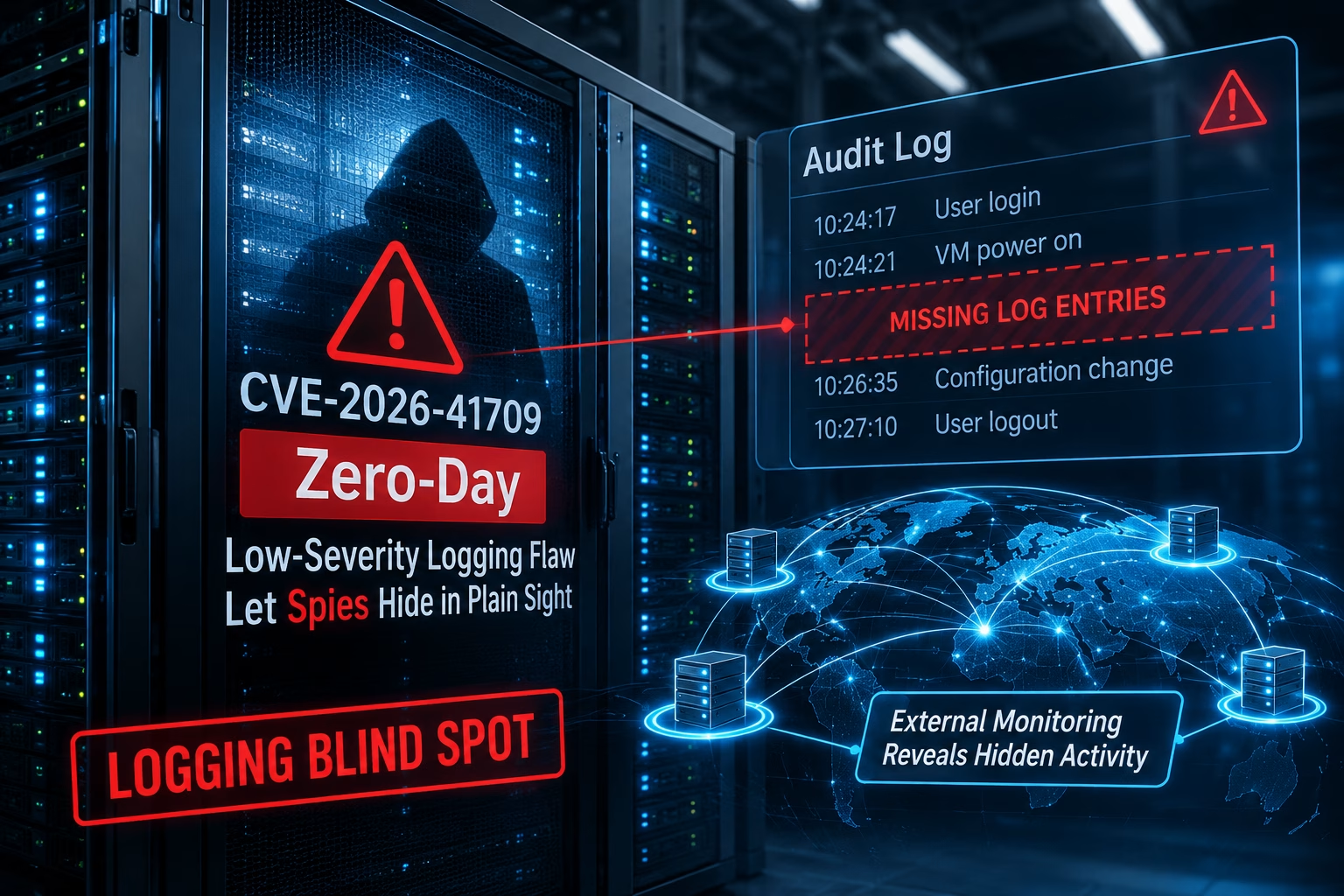
The VMware ESX zero-day disclosed in late October 2026 is a rare kind of vulnerability: it steals nothing, crashes nothing, and scores just 2.7 out of 10. Yet the U.S. Cybersecurity and Infrastructure Security Agency (CISA) has added it to the Known Exploited Vulnerabilities catalog, and a China-nexus espionage group used it against American law firms. The reason is simple. The flaw let an intruder act on the hypervisor without leaving the usual trail. For any enterprise that depends on virtual infrastructure, this VMware ESX zero-day raises a question that patching alone cannot answer: if your logs say nothing happened, how do you know?
What is the VMware ESX zero-day? The VMware ESX zero-day is CVE-2026-41709, an insufficient-logging vulnerability in Broadcom’s ESX hypervisor that lets a malicious administrator perform certain operations without them being recorded. Rated low severity (CVSS 2.7), it was exploited by the China-nexus group Warp Panda to reduce audit-trail visibility, and CISA added it to its KEV catalog on October 28, 2026.
Key Takeaways
- The VMware ESX zero-day (CVE-2026-41709) needs administrator access first, so it is a post-breach concealment tool, not an entry point.
- Federal civilian agencies must patch by November 11, 2026; every other organization running affected builds should treat that date as a benchmark.
- Patching cannot restore records that were never written. Compare host logs against evidence collected elsewhere.
- We call this the self-witness problem: when the only record of an action is written by the system the actor controls.
- The durable fix is independent evidence at the network and identity layers, plus segmentation of management interfaces.
What Happened: CISA Adds CVE-2026-41709 to the KEV Catalog
On Wednesday, October 28, 2026, CISA warned that attackers were exploiting a VMware ESX flaw and told federal agencies to remediate within two weeks. SecurityWeek reported that the bug lets someone logged in as an administrator carry out certain operations without being logged, and that CISA gave no detail on the exploitation it had observed. CrowdStrike supplied the missing context the same day in its 2026 Legal Threat Landscape Report, naming the China-nexus actor Warp Panda as the group that used it as a zero-day.
The vulnerability itself is not new to the public record. Broadcom published the fix in advisory VMSA-2026-0006 on July 29, 2026, crediting a CrowdStrike researcher for the report. The flaw is tracked in the National Vulnerability Database as a missing-logging weakness (CWE-778). What changed in October was the evidence that real intruders had been using it, in intrusions CrowdStrike dated as late as early 2026.
That sequence matters for defenders. Many teams deprioritized the July patch because the score was low and the description read like a housekeeping bug. This is exactly the scenario that risk-based vulnerability management is designed to catch: severity scores describe a flaw, while exploitation evidence describes a threat.
Why the VMware ESX Zero-Day’s 2.7 CVSS Score Hides a High-Impact Problem
CVSS rates a flaw by its direct technical effect. Broadcom’s vector for this issue reflects network reachability, low complexity, a high privilege requirement, and limited integrity impact. On paper that is modest, because an attacker who already holds administrator rights can usually do far worse than skip a log line.
The score misses the strategic value. Espionage groups do not want noise; they want months of quiet access. An audit gap on the hypervisor removes the one record that would let a responder answer who changed a virtual network, who registered an unknown virtual machine, or who touched a management function. This is why CISA’s Binding Operational Directive 26-04 pushes agencies to weigh exploitation and exposure alongside raw severity.
In short, the VMware ESX zero-day is a reminder that “low” in a scoring system and “low” in an investigation are very different things.
Who Is Warp Panda and How the VMware ESX Zero-Day Attack Chain Works
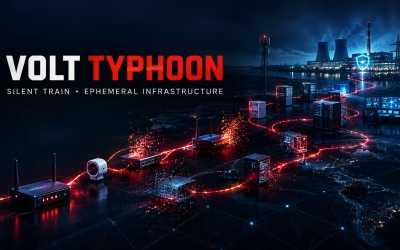
CrowdStrike first described Warp Panda in December 2025, calling it a sophisticated China-nexus adversary active since at least 2022 against U.S. legal, technology, and manufacturing organizations. The group is associated with the BRICKSTORM backdoor and two ESXi implants named Junction and GuestConduit. Joint reporting from CISA, NSA, and Canada’s Cyber Centre in Malware Analysis Report AR25-338A describes BRICKSTORM as a backdoor for VMware vSphere and Windows built for long-term persistence.
Step 1: Enter through an exposed edge device
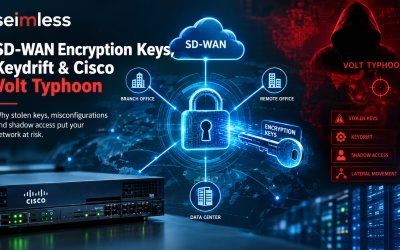
CrowdStrike says Warp Panda typically gains initial access by exploiting internet-facing edge devices such as VPN appliances, then pivots to vCenter using valid credentials or known vulnerabilities. This pattern connects directly to the lessons in our analysis of SD-WAN encryption keys and the KeyDrift malware: the network edge is where trust is won or lost.
Step 2: Settle into the virtualization layer
Once inside, the group places implants on vCenter and ESXi. The joint CISA report notes that in one investigated incident, actors moved from a web server in a demilitarized zone to an internal vCenter server. From there, they reached domain controllers and, in that case, exported cryptographic keys from an identity federation server.
Step 3: Blind the logs
This is where the VMware ESX zero-day fits. By performing operations that ESX does not record, the actor reduces the audit trail defenders depend on. Broadcom’s description does not say which exact log component is affected, so teams should avoid assuming every missing event traces to this bug.
Step 4: Extend to the cloud and lock in access
CrowdStrike reported that by summer 2025 the group had reached Microsoft Azure environments at multiple victims, accessing email, OneDrive, and SharePoint, and that in at least one case it registered its own multifactor device. A password reset alone does not evict an actor that controls an authentication factor.
The Self-Witness Problem: When Logs Come From the System Under Attack
Security programs lean on a quiet assumption: the system will honestly report what happens to it. We call the failure of that assumption the self-witness problem. A self-witness is any log written by the same platform an administrator controls. If that platform can be told not to write, or can be edited afterward, its testimony is only as good as the administrator’s honesty.
The VMware ESX zero-day is a clean example, but it is not the only one. Attackers have long cleared event logs, disabled agents, and tampered with history on compromised hosts. What makes the hypervisor special is its position. It sits beneath guest operating systems, so endpoint tools inside those guests cannot see what happens to the layer underneath. If the hypervisor under-reports, nothing above it can correct the record.
NIST has treated this as a control concern for years. In SP 800-53 Rev. 5, the audit family includes protection of audit information, with enhancements that call for storing records on a separate system from the one being audited. NIST SP 800-92 frames log management as an enterprise discipline with centralized collection and integrity protection, not a per-host afterthought. The ESX case shows why those controls exist.
VMware ESX Zero-Day Timeline: From Patch to Public Warning
| Date | Event |
| Dec 4, 2025 | CISA, NSA, and Cyber Centre publish BRICKSTORM malware analysis; CrowdStrike publishes Warp Panda profile. |
| Early 2026 | Most recent Warp Panda intrusion in which CrowdStrike observed CVE-2026-41709 abused as a zero-day. |
| Jul 29, 2026 | Broadcom publishes VMSA-2026-0006 with the fix. |
| Oct 28, 2026 | CrowdStrike names the zero-day; CISA adds it to the KEV catalog. |
| Nov 11, 2026 | Federal civilian agency remediation deadline. |
Public reporting has not included indicators of compromise for this specific flaw, so detection depends on behavior and on comparing independent evidence sources rather than on a signature.
Why Virtualization Is the Blind Spot in Enterprise Security
Most organizations run their most valuable workloads on virtual machines: databases, identity servers, file stores, and applications. Security budgets, however, have historically concentrated on endpoints and the perimeter. The management plane that controls all those virtual machines often receives less monitoring than a single laptop.
Attackers have noticed. NIST’s SP 800-125 and SP 800-125A Rev. 1 already describe the hypervisor as a high-value target requiring its own baseline of protections. Compromise there can expose every guest at once, which is why a quiet foothold on vCenter is worth more to an espionage group than dozens of workstation infections. Endpoint tooling such as endpoint detection and response remains essential, but it cannot see beneath the guest.
The lesson parallels our AI agent botnet analysis: when an adversary moves at machine speed or hides in infrastructure you trust, defenders need controls that do not depend on the adversary’s cooperation.
Seven Steps to Respond to the VMware ESX Zero-Day
- Patch on exploitation evidence, not score. Apply the builds listed in Broadcom’s advisory, including ESXi80U3j-25429389 for ESX 8.0 and the 9.x builds named there. Broadcom’s matrix for this CVE does not list ESX 7.0, so ask your vendor what guidance applies to older hosts.
- Remove management exposure. Confirm vCenter and ESX management interfaces are not reachable from the internet and sit on a dedicated, tightly filtered management network.
- Inventory the edge. List every VPN, gateway, and remote-access appliance, since that is where this actor enters. Pair it with the CISA Zero Trust Maturity Model to prioritize.
- Forward logs off-host. Send ESX, vCenter, identity provider, and firewall logs to a collection platform that ESX administrators cannot alter, with defined retention.
- Hunt for gaps and persistence. Compare network flow records against hypervisor logs for activity with no matching entry. Review unregistered or newly created virtual machines, as CrowdStrike advises, and check for BRICKSTORM indicators using the joint CISA report.
- Reset authentication factors, not just passwords. Audit multifactor device registrations, revoke active cloud sessions on sensitive accounts, and remove dormant administrators.
- Rehearse the response. Align your playbook with NIST SP 800-61 Rev. 3 and decide in advance who calls counsel, insurers, and regulators if gaps appear.
Teams under time pressure should note that this VMware ESX zero-day plan complements, rather than replaces, the broader patch discipline in our guide to Reduce, Replace, Recover.
Moving Evidence Outside the Trust Boundary With Network-Layer Controls
After the VMware ESX zero-day, the most reliable witness is one the attacker does not control. The network is a strong candidate, because traffic must cross it regardless of what a compromised host chooses to log. That is the thinking behind the ibm/SEIMless security stack, which treats the network as an independent source of truth:
- Exodus NxtGen Firewall segments management planes and records east-west and outbound sessions outside the hypervisor.
- Exodus Aria ADR adds anomaly detection and response so unusual administrative patterns surface even when a host log is silent.
- Zero Trust Content Security limits what any single compromised account can reach.
- Exodus Key Management keeps cryptographic keys away from the systems an intruder is most likely to reach.
- Data in Motion and Data at Rest protection reduce the value of anything copied from a virtual machine.
Recovery planning also matters. If a hypervisor is compromised, clean restoration depends on trustworthy copies, which is why immutable backups and a documented backup and recovery design belong in the same conversation. Organizations consolidating workloads can also review our private and hybrid cloud options and the SD-WAN services that connect them.
Compliance After the VMware ESX Zero-Day: What Regulators Expect From Audit Trails
Audit integrity is not only a technical preference; it is a compliance expectation across regulated industries.
- Financial services: The New York Department of Financial Services cybersecurity regulation requires audit trails designed to detect and respond to cybersecurity events. The FFIEC IT Handbook sets similar supervisory expectations.
- Public companies: The SEC’s cybersecurity disclosure rules require timely assessment of material incidents. Missing logs make materiality hard to judge.
- Healthcare: The HIPAA Security Rule includes audit controls for systems containing electronic protected health information.
- Insurance and legal: Carriers increasingly ask how logs are protected, and law firms, the documented targets here, hold privileged material whose exposure creates client-notification duties.
- Federal logging baseline: OMB memorandum M-21-31 remains a useful maturity model for logging even outside government.
Mapping these duties to the NIST Cybersecurity Framework 2.0 and the CISA Cross-Sector Performance Goals gives auditors one coherent story.
From Silent Intrusion to Long-Term Exposure
An actor that sits unseen in virtual infrastructure can copy data at leisure. For law firms and other holders of long-lived secrets, the harm may arrive years later, which is the same logic behind harvest-now-decrypt-later collection. If stolen material is encrypted with algorithms that will weaken, today’s quiet theft becomes tomorrow’s disclosure. NIST’s October 2026 guidance on transitioning to post-quantum cryptography and the Executive Order 14412 deadlines make this a planning item now. Our primer on quantum computing and encryption explains the stakes, and validated modules under the NIST Cryptographic Module Validation Program are a sensible procurement filter.
Governance matters here too. Our review of the FBI data breach showed how a patched-looking system can still hide compromise, and the containment gap in the OpenAI incident shows how segmentation failures widen damage. Both reinforce the same principle: assume the host can be wrong, and verify from outside.
Frequently Asked Questions About the VMware ESX Zero-Day
What is the VMware ESX zero-day CVE-2026-41709?
It is an insufficient-logging flaw in Broadcom’s VMware ESX hypervisor. A malicious administrator can perform certain operations without them being recorded. Broadcom rated it low (CVSS 2.7), but Warp Panda used it as a zero-day, and CISA added it to the KEV catalog on October 28, 2026.
Why does a low CVSS score not mean low risk?
CVSS measures a flaw’s direct impact in isolation. This one needs administrator privileges and grants no access alone. Its value to an attacker lies in what it hides, because a missing audit trail makes later steps harder to detect and investigate.
Who must patch and by when?
Federal civilian agencies must apply fixes by November 11, 2026. Other organizations are not bound by that date, but active exploitation means anyone running affected builds should patch promptly using the versions in Broadcom’s advisory VMSA-2026-0006.
Does patching restore logs that were never written?
No. Patching stops future unlogged activity but cannot recreate missing records. Compare host logs with network flow data, identity provider logs, and firewall records to look for historical gaps.
What is the self-witness problem?
It is the weakness that appears when the only record of an administrator’s actions is written by the system that administrator controls. The remedy is independent evidence collected outside that trust boundary.
How does ibm/SEIMless help protect virtualized environments?
ibm/SEIMless delivers secure network and infrastructure services, including next-generation firewalls and segmentation, anomaly detection and response, key management, data-in-motion and data-at-rest protection, backup and recovery, and managed IT services. Call 646-546-5245 or email in**@**********ss.com.
Don’t Let Your Hypervisor Be the Only Witness
ibm/SEIMless helps enterprises build network-level visibility, segmentation, and recovery so a single silent flaw like the VMware ESX zero-day never erases the record. Talk to our engineers about an independent logging and management-plane review for your virtual infrastructure.
Phone: 646-546-5245
Email: in**@**********ss.com
Address: One Liberty Plaza, New York, NY 10006
Additional U.S. Sources and References
- Cybersecurity Dive: China-nexus actor and BRICKSTORM in U.S. vCenter environments
- CISA alert: PRC state-sponsored actors use BRICKSTORM malware
- Joint BRICKSTORM malware analysis report (PDF)
- Broadcom knowledge base: BRICKSTORM backdoor to vSphere
- NIST SP 800-207: Zero Trust Architecture
- Report a cyber incident to CISA
- FBI Internet Crime Complaint Center (IC3)
- FTC Safeguards Rule guidance