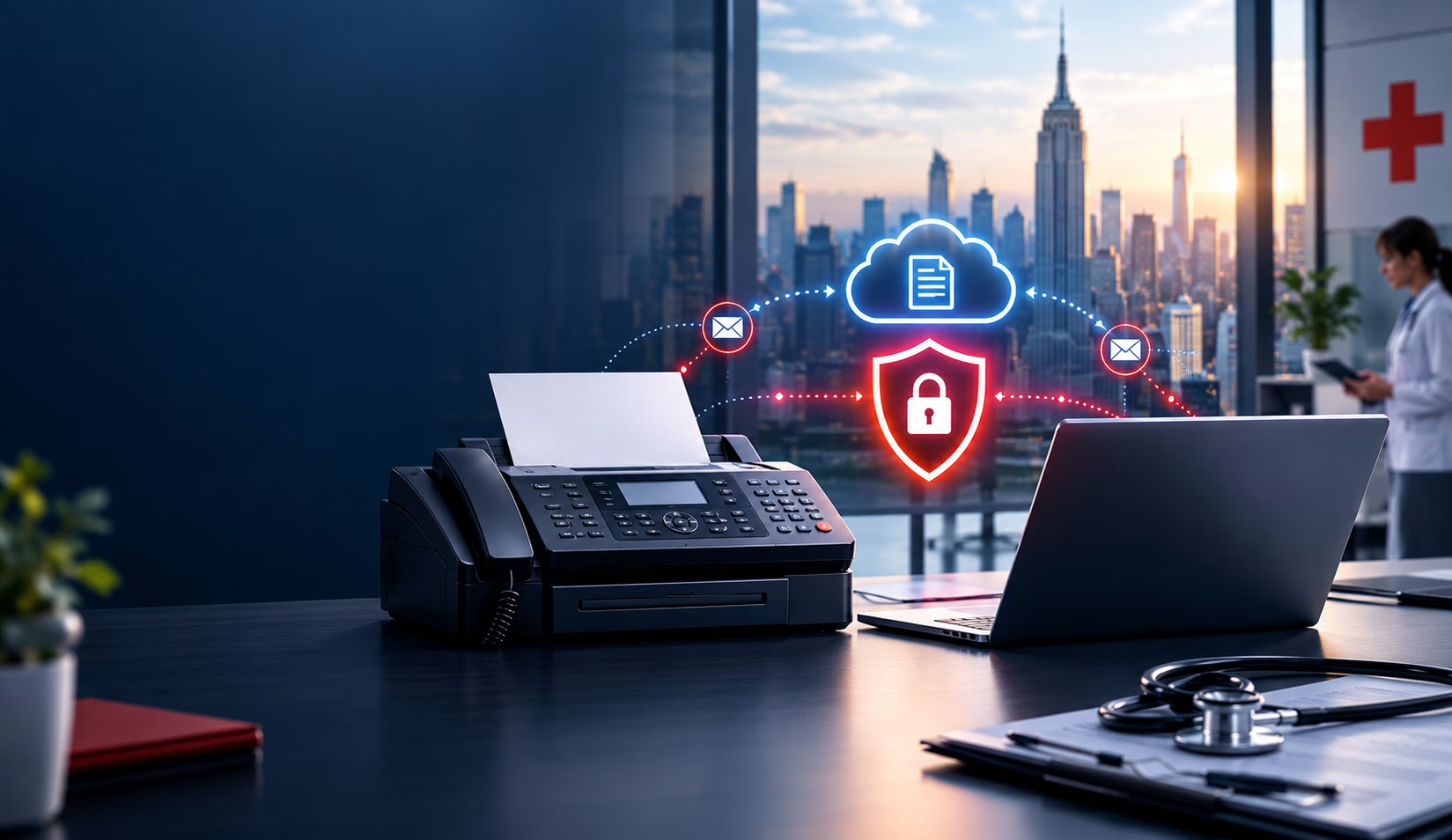
Building a HIPAA compliant fax process is one of the least glamorous and most overlooked security projects in New York healthcare. Referrals, lab results, prior authorizations and records requests still move by fax every day, and each one carries electronic protected health information. Meanwhile, the regulatory picture is shifting: HHS has pushed the final HIPAA Security Rule overhaul out to 2027, which tempts some organizations to wait. That would be a mistake, because the current rule already covers every system that stores or transmits patient data, including your fax path.
Definition: HIPAA compliant fax A HIPAA compliant fax process sends and receives protected health information with safeguards required by the HIPAA Security Rule: a signed business associate agreement with any vendor that handles the data, encryption, individual access controls, audit logs, delivery confirmation, and documented procedures for misdirected faxes.
Why a HIPAA Compliant Fax Still Matters in 2026
Fax survives because it works across organizations that cannot agree on anything else. According to MyPaperlessFax, the CMS interoperability rule (CMS-0057-F) pushes payers toward APIs but does not require anyone to abandon fax. Fax simply becomes a secondary channel that still has to run inside controlled workflows.
The deadline pressure is also misunderstood. An Alston & Bird advisory from July 2026 reports that HHS now targets July 2027 for finalizing the Security Rule update, after a May 2026 goal passed without action (the federal regulatory agenda tracks the timing). Finalization still looks likely in some form, per the same advisory. As Paubox also covered, the delay does not suspend today’s requirements, and OCR continues to run its enforcement program. Organizations that fix their fax workflow now will be ready for whatever the final rule says, and will not be scrambling later.
This is a proven New York pattern: the practice that has not touched its fax setup since 2015, a shared inbox that eight people read, and a multifunction printer in a hallway. Our medical device cybersecurity guide describes the same dynamic with older equipment: devices outlive the assumptions that protected them.
What Makes a HIPAA Compliant Fax Setup: The Checklist
Fax gets no special exemption. HIPAA Vault, a vendor that sells cloud fax and therefore has a stake in the answer, lists the elements below. They line up with the broader guidance in NIST SP 800-66 Rev. 2 on implementing the Security Rule.
| Control | What it means in practice |
| Business associate agreement | Signed with any third party that stores or relays faxes containing PHI |
| Encryption in transit and at rest | Protects content on the wire and in queues, archives and mailboxes |
| Individual access control | Named users and roles, not shared logins or generic inboxes |
| Audit logging | Who sent, viewed, forwarded, exported or deleted each fax |
| Delivery confirmation | Proof of receipt and a process for failures |
| Retention and disposal | Defined periods and secure deletion, including from mailboxes |
| Misdirected-fax procedure | Documented risk assessment and reporting path |
| Resilience | Redundancy and tested recovery |
One important nuance from MyPaperlessFax: the Security Rule covers servers, cloud instances, connectors, databases and downstream repositories whenever they handle ePHI. If a fax lands in email and gets saved to a file share, the file share is in scope too. That is where most HIPAA compliant fax programs quietly fail.
The Fax Shadow Perimeter: Where a HIPAA Compliant Fax Program Breaks
We call the gap the fax shadow perimeter: the set of devices, lines, mailboxes and folders that handle patient data but sit outside normal security monitoring because everyone thinks of fax as “just a phone thing.” Four failure modes recur.
1. Misdirected faxes
HIPAA Vault describes misdirected faxes as among the most common healthcare data incidents. A fax containing PHI that reaches the wrong recipient may be a reportable breach depending on a risk assessment, and the HHS breach notification rule sets a 60-day outer limit for notifying affected individuals after discovery. Speed-dial errors and outdated numbers are the usual culprits.
2. Shared inboxes and generic accounts
MyPaperlessFax calls shared accounts and generic inboxes hard to justify in regulated environments. When eight staff members read “fa*@**********ce.com,” you cannot say who opened a record. Our post on Copilot oversharing and SharePoint permission debt shows how quickly a loosely permissioned mailbox becomes an AI-searchable data lake.
3. Unprotected email transport
Some services route fax content through email without adequate encryption, even where a business associate agreement exists, HIPAA Vault warns. A fax-to-email workflow is only as strong as the weakest hop between the sender and the device that opens the attachment.
4. Forgotten hardware and lines
Multifunction printers with stored images, unattended output trays and analog lines nobody inventories round out the list. These are the devices that never appear in a vulnerability scan, which is why risk-based vulnerability management starts with a complete asset inventory.
Key takeaways
- HIPAA compliant fax is about the whole path, not just the sending service.
- The Security Rule update is delayed to 2027; existing obligations apply now.
- Shared inboxes, unencrypted relays and misdirected faxes are the top failure points.
- Copper retirement forces a fax decision on your schedule or the carrier’s.
- Document your design, because auditors ask for proof, not intent.
HIPAA Compliant Fax vs. Email vs. Portal: Choosing the Channel
Many practices ask whether to drop fax entirely. Usually the answer is to keep it as one controlled channel among several.
| Channel | Strengths | Watch-outs |
| Analog fax machine | Familiar; no internet path | Depends on a phone line; no audit trail; paper left unattended; carrier network gives no encryption or logging |
| Cloud fax with BAA | Encryption, logs, delivery proof, no hardware | Vendor risk; must be configured for healthcare, since consumer plans do not qualify |
| Fax-to-email | Faxes arrive in a managed mailbox with permissions and retention | Only as safe as the mail path and mailbox access |
| Secure portal or API | Strongest audit and identity controls | Both parties must adopt it |
For most New York practices, the practical target is a managed fax-to-email design with individual access, encryption, and logging, plus a roadmap toward portals and APIs as trading partners adopt them.
The Copper Sunset Problem for Your HIPAA Compliant Fax Line
Analog fax machines assume a copper line. Carriers are retiring that copper, and our POTS line replacement guide walks through the FCC’s modernization order and the carrier schedules, including AT&T shutoffs beginning November 15, 2026. If the replacement is a voice-over-IP adapter, fax transmissions can degrade or fail without anyone noticing, which means a patient referral may never arrive.
Moving fax into the cloud or into email removes the dependency on a physical line, but it adds new questions about encryption, permissions and retention. Voice and fax transport also matter, so review your POTS, PRI and SIP design alongside any cloud-based telephony or premise-based telephony plans, so that fax is a deliberate decision rather than an afterthought.
Designing a HIPAA Compliant Fax-to-Email Workflow With Fax2Mail
ibm/SEIMless offers Fax2Mail, which converts incoming faxes into email. Whether a particular deployment meets HIPAA depends on how it is designed and what surrounds it, which is exactly what a review establishes. We do not assume compliance by product name. Here are the design questions we work through with clients:
- Who receives which faxes? Route by department or role into individual or role-based mailboxes, not one shared address.
- How is the message protected in transit and at rest? Confirm transport encryption, mailbox encryption and who holds the keys.
- Where do attachments go next? Define whether they are saved to a file share, an EHR, or scanning and retrieval, and secure each destination.
- What is logged? Keep records of receipt, access, forwarding and deletion.
- How long do faxes live? Set retention and deletion in line with policy.
- What happens on failure? Alert on failed transmissions and define the misdirected-fax procedure.
The same thinking applies to workflow automation that touches patient documents, and to Microsoft 365 and Teams or SharePoint where those faxes ultimately land.
Surrounding Controls That Strengthen a HIPAA Compliant Fax Process
A secure fax workflow lives inside a larger environment. ibm/SEIMless and Exodus QRN pair document and telecom services with security services that reduce the damage if something goes wrong:
- Exodus Transparent Encryption, data at rest, data in motion and key management to protect stored and moving records.
- Zero Trust Content Security and the Exodus NxtGen Firewall to control what reaches mailboxes and file shares.
- Exodus Aria ADR and EDR for detection on the endpoints that open faxed documents.
- SaaS security as a service for cloud mail and collaboration tools.
- Backup and recovery, informed by our immutable backups guide, so a ransomware event does not erase your records.
There is also a long game. Records faxed and archived today may need confidentiality for decades. Data captured now can be decrypted later if quantum computing matures, the harvest-now-decrypt-later risk we explain in our quantum computing and encryption overview. Explore our broader services catalog to see how the pieces connect.
New York Obligations Beyond a HIPAA Compliant Fax Policy
HIPAA is the floor, not the ceiling. This is general information, not legal advice.
- HIPAA breach reporting: The Breach Notification Rule and the HHS breach portal make larger incidents publicly visible.
- Encryption safe harbor: HHS guidance on unsecured PHI explains when properly encrypted data may avoid breach notification. HIPAA Vault highlights the same principle, so encryption design matters.
- New York State: The New York Attorney General’s data breach reporting page covers notification duties under state law, including the SHIELD Act framework.
- Insurers and financial entities: NYDFS 23 NYCRR Part 500 applies to DFS-regulated organizations.
- Frameworks: HHS Security Rule guidance and the NIST Cybersecurity Framework give a defensible structure for your risk analysis.
- Sector guidance: HHS’s 405(d) program and CISA’s healthcare sector resources offer practical benchmarks.
A 30-Day HIPAA Compliant Fax Audit
Use this sequence to find and close gaps without disrupting patient care.
- Days 1–5, inventory. List every fax number, machine, multifunction printer, fax service and fax-enabled mailbox. Include the departments nobody mentions.
- Days 6–10, trace the path. Follow a test fax from sender to final storage. Document each system it touches.
- Days 11–15, fix access. Replace shared inboxes with role-based access. Remove departed staff. Turn on logging.
- Days 16–20, verify protection. Confirm encryption, business associate agreements and retention settings at every hop.
- Days 21–25, plan the copper exit. Match every analog line to a tested replacement and schedule cutovers.
- Days 26–28, drill. Run a misdirected-fax tabletop exercise with a documented risk assessment.
- Days 29–30, document. Update your risk analysis and policies, and file the evidence where an auditor can find it.
For the governance side, our guide to Cybersecurity Awareness Month’s reduce, replace, recover framework offers a useful way to structure the project.
HIPAA Compliant Fax by Sector: Healthcare, Legal, Insurance
Medical practices and hospitals. Referral and results workflows are the highest-volume, highest-risk path. Prioritize individual access and misdirected-fax handling.
Law firms. Personal injury and health-law practices receive medical records constantly and often act as business associates. Treat inbound fax like any other privileged intake.
Insurers and brokers. Claims and underwriting files arrive by fax in surprising volume. Map them into your document retention rules.
Financial and professional services. Fax persists for signatures and legacy counterparties. Even outside HIPAA, the same controls reduce exposure.
Book Your Free HIPAA Compliant Fax Security Review
Find the Gaps Before an Auditor Does
In a free consultation, the ibm/SEIMless team will map your fax shadow perimeter, review your Fax2Mail design options, and plan the copper-line transition. We are vendor agnostic and have served enterprises since 2001, so recommendations fit your environment, not a quota.
Call to book an appointment: 646-546-5245
Email: in**@**********ss.com
ibm/SEIMless Communications Technologies, Inc. · One Liberty Plaza, New York, NY 10006
HIPAA Compliant Fax FAQ
- What makes a fax HIPAA compliant?
A signed business associate agreement with any vendor handling the data, encryption, individual access controls, audit logging, delivery confirmation, retention rules and a documented misdirected-fax procedure.
- Is fax-to-email HIPAA compliant?
Not automatically. It is compliant only if the whole path is protected: the fax service, mail transport, mailbox permissions and the devices that open the attachment.
- Is the HIPAA Security Rule update final?
No. HHS proposed changes in January 2025, and a July 2026 advisory reports a July 2027 target. The existing Security Rule applies today.
- What happens if a fax goes to the wrong number?
It may be a reportable breach depending on a risk assessment. If PHI was compromised, notify affected individuals no later than 60 days after discovery and report to HHS.
- How does the copper phone line sunset affect fax?
Analog fax machines rely on POTS. As carriers retire copper, offices need a tested replacement, because fax over VoIP can fail silently. Cloud or fax-to-email designs remove that dependency.
- How can ibm/SEIMless help?
We offer a free review covering Fax2Mail design, mailbox permissions, encryption, copper sunset planning, backup and recovery. Contact us or call 646-546-5245.
References and Further Reading
- Spruce Health: HIPAA and faxing dos and don’ts
- Accountable: HIPAA Security Rule final rule summary
- EtherFax: Why healthcare still relies on fax
- HHS HIPAA Privacy Rule
Facts reflect public reporting as of October 26, 2026 and may change. This article is general information, not legal advice. Product capabilities of any fax or email service must be confirmed for your specific configuration.