Risk-based vulnerability management stopped being optional on October 13, 2026. That Tuesday, Microsoft shipped fixes for a record 1,413 vulnerabilities in a single release, more than any full year in the company’s history. The same day, researchers at Volexity revealed that an attacker had chained three zero-days to take root control of a fully patched Ivanti VPN. Two stories, one lesson: counting patches no longer tells you how safe you are. Knowing which weaknesses attackers can actually reach, and what to do while a fix is pending, does.
| What is risk-based vulnerability management?
Risk-based vulnerability management is a security program that ranks every known weakness by the real-world likelihood and impact of its exploitation (internet exposure, confirmed attacks, how easily an exploit can be automated, and what an attacker gains) rather than by raw severity scores or CVE counts. It then sets remediation deadlines and compensating controls to match each tier of risk. |
| Key Takeaways
Risk-based vulnerability management matters because October 2026’s Patch Tuesday exceeded every previous annual total, yet only one of its bugs was confirmed under attack. CISA’s BOD 26-04 replaces flat deadlines with a four-factor risk model: exposure, KEV status, automatability, and technical impact. The Ivanti Connect Secure chain proves a patched edge device can still fall, so compensating controls are part of the program, not a footnote. Start your queue at the internet-facing edge: VPNs, firewalls, gateways, and email security appliances. Measure time-to-mitigate for tier-one exposures, not the number of patches deployed. |
What Happened on October 13, 2026: The Numbers Behind the Record
Microsoft’s October release covered Windows, Office, developer tools, and server products. CyberScoop reported 1,413 CVEs, surpassing the company’s previous annual record of 1,261 set in 2020. Totals differ by outlet (BleepingComputer counted 1,411; SecurityWeek and TechRepublic reported about 1,413), so treat the exact figure as approximate. You can browse the full list in Microsoft’s October release notes.
| Product family | CVEs in the October 2026 release |
| Windows | 1,102 |
| Office | 134 |
| Developer tools | 61 |
| SharePoint Server | 36 |
Source: CyberScoop, October 14, 2026.
Only one flaw was confirmed as exploited: CVE-2026-96951, a Windows Shell security feature bypass (CVSS 8.8) that lets attackers sidestep the Mark of the Web warning on downloaded files. CISA added it to the Known Exploited Vulnerabilities catalog on Tuesday with a federal remediation date of October 16. Tenable’s Satnam Narang noted that 26 Windows Shell vulnerabilities have been patched in 2026 versus three in all of 2025, a sign of how intensively researchers and their AI tooling are probing that component.
Microsoft itself acknowledged the triage burden by introducing “risk cohorts”, groups of updates that call for a similar customer assessment regardless of severity rating. It is a vendor-side nod to the idea at the heart of risk-based vulnerability management.
The Patch-Volume Paradox: Discovery Is Scaling Faster Than Exploitation
We call this the patch-volume paradox: the more vulnerabilities the industry discovers, the less useful the raw count becomes as a measure of risk. Dustin Childs of the Zero Day Initiative put it plainly: discovery is scaling faster than exploitation, so teams that triage by CVE count burn cycles on the wrong bugs. Dark Reading added useful context: just 26 Microsoft CVEs have reached CISA’s KEV catalog this year, which is under one percent of everything Microsoft patched.
Both halves of the paradox are real. Volume is exploding: CISA observed that total published CVEs for 2026 passed the entire 2025 total by the end of August, with artificial intelligence accelerating both discovery and exploitation, according to a HIPAA Journal summary of CISA’s guidance. At the same time, the exploited slice stays small, and the window between disclosure and attack keeps shrinking. A team that patches everything at the same speed falls behind on the handful of flaws that matter, which is why risk-based vulnerability management starts with exploitation evidence rather than counts.
Remediation data shows the gap. The Verizon 2026 Data Breach Investigations Report ranked vulnerability exploitation as the leading initial access vector, with only about 26 percent of KEV-listed flaws fully remediated and a median patch time near 43 days.
Why Severity-First Patch Queues Fail
For two decades, many programs have sorted work by CVSS score: fix the criticals, then the highs. CVSS measures how bad a flaw could be, not how likely anyone is to use it against you. A 9.8 on an isolated lab server may carry less risk than an 8.6 on an internet-facing VPN, and the Ivanti case below proves it.
Federal policy has moved on. CISA’s Binding Operational Directive 26-04, issued June 10, 2026, supersedes both BOD 19-02 (internet-accessible systems) and BOD 22-01 (the original KEV directive). Its implementation guidance explains that the goal is to focus agency effort on high-risk vulnerabilities while deferring low-risk ones.
Risk-Based Vulnerability Management in Practice: The BOD 26-04 Model
BOD 26-04 gives every enterprise a ready-made template for risk-based vulnerability management, even though the directive legally binds only Federal Civilian Executive Branch agencies. It weighs four factors for each vulnerability:
| Factor | The question to ask | Why it matters |
| Asset exposure | Can an attacker reach this asset from the internet? | Exposed systems are scanned within hours of disclosure. |
| KEV status | Is exploitation confirmed in the wild? | Confirmed exploitation outweighs any theoretical score. |
| Automatability | Can an exploit run at scale without human effort? | Automation turns one exploit into mass compromise. |
| Technical impact | What does the attacker gain: full control or a minor leak? | Total-control flaws on exposed assets rank highest. |
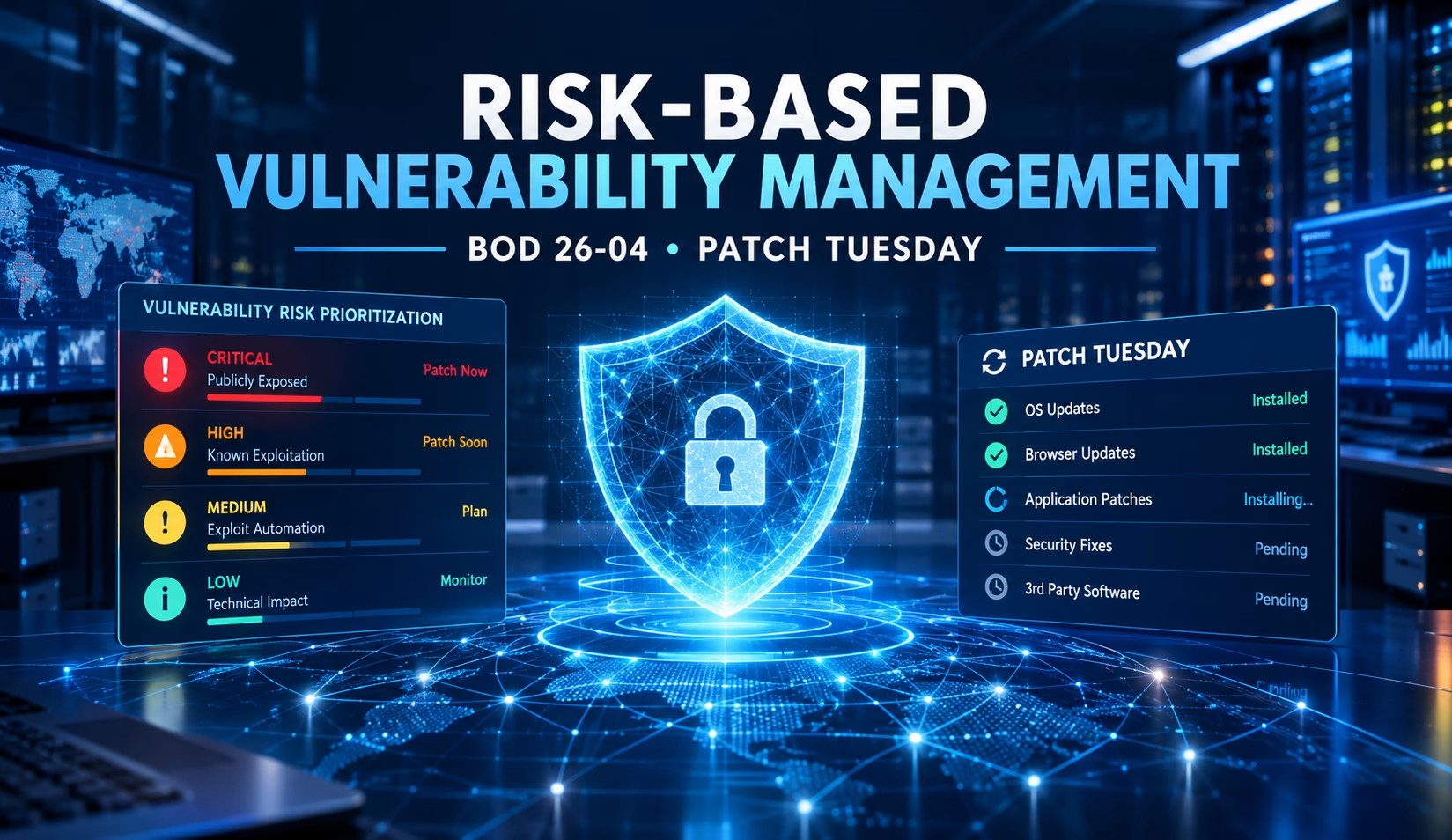
The directive turns those answers into remediation windows of 3, 14, or 60 calendar days, with the lowest-risk findings allowed to wait for the next major upgrade. The highest-risk combinations (exposed, exploited, automatable, and total-control) must be fixed or mitigated within three days. The directive also expects machine-level asset tagging, which is why inventory comes first.
The model is spreading beyond agencies. FedRAMP announced that cloud providers must adopt its new Vulnerability Detection and Response and Vulnerability Evaluation and Reporting rules by December 7, 2026 to align with BOD 26-04.
Two public frameworks complement the model: CISA’s SSVC decision trees and FIRST’s EPSS probability scores. Use EPSS to rank unlisted flaws, never to demote a KEV-listed one.
Ivanti Connect Secure: When “Fully Patched” Still Isn’t Safe
On October 13, Volexity disclosed that an actor it tracks as UTA0576 had been chaining three Ivanti Connect Secure zero-days since at least October 3, executing commands as root without logging in. The target appliance was running 22.8R2.4, the latest release at the time. Ivanti patched the first two flaws (an authentication bypass and a remote code execution bug, tracked together as CVE-2026-104935) the same day. A fix for the third, a privilege escalation, was still weeks away, and neither Volexity nor Ivanti named a workaround for customers who cannot upgrade, according to the same report.
What makes the case instructive is how quietly it worked. iTnews reported that the attacker left no malware or web shell, re-ran the entire chain for every command, patched code in memory only, and wiped traces from logs, which blinded Ivanti’s Integrity Checker Tool. BleepingComputer noted that threat-intelligence firm Defused saw first exploitation attempts as early as October 1, and CyberScoop reported that Ivanti missed a chance to fix the flaw before attackers weaponized it. CISA added the bug to KEV and ordered federal agencies to patch by October 16.
Four lessons follow for any enterprise practicing risk-based vulnerability management on a remote-access gateway:
- Patch status is a point-in-time fact, not a safety guarantee. Zero-days beat even perfect patch hygiene.
- Self-integrity checks can be blinded. Do not rely on a compromised appliance to report its own compromise.
- Fileless activity evades file-centric detection. You need network and identity telemetry, not just endpoint scans.
- A pending fix needs a pending plan. Decide in advance how to restrict, segment, or temporarily retire an exposed service.
The Edge Is Where Your Queue Should Start
Ivanti was not alone this fortnight. CISA’s October additions to the KEV catalog read like an inventory of the perimeter: a Fortinet FortiMail path traversal flaw on October 1, then a Palo Alto Networks PAN-OS code injection bug, a Cisco Secure Email Gateway flaw, and two Ahsay backup-server bugs on October 14. Citrix, meanwhile, disclosed its third actively exploited NetScaler zero-day in less than a week.
The pattern matches what we covered in Network Edge Security in 2026, and it echoes earlier incidents like the Interlock ransomware campaign against Cisco FMC and the five-year-old Fortinet flaw still being exploited. In risk-based vulnerability management, edge devices combine all four BOD 26-04 risk factors: they are exposed by design, frequently listed in KEV, often exploitable without credentials, and they grant privileged access when they fall. They belong at the top of every queue.
A 30-Day Plan to Stand Up Risk-Based Vulnerability Management
NIST SP 800-40 Rev. 4 frames patching as preventive maintenance and recommends an enterprise strategy that simplifies and operationalizes it, which is a good backbone for the steps below.
- Map your external attack surface (days 1–5). List every internet-facing VPN, firewall, gateway, mail appliance, and remote-management tool. Include shadow assets that procurement never saw.
- Tag assets by exposure and criticality (days 3–10). Add owner, business function, and “reachable from the internet” as machine-readable fields, mirroring the BOD 26-04 asset-tagging idea.
- Ingest the KEV catalog and EPSS daily (days 5–10). Automate matching of KEV additions against your inventory so a new listing triggers a ticket, not a meeting.
- Adopt a four-tier policy (days 8–14). Borrow the 3-day, 14-day, 60-day, and defer structure, and write down which factor combinations land in each tier.
- Pre-approve an emergency change lane (days 10–18). Tier-one fixes should not wait for a monthly change board. Define who can approve, test, and roll back within hours.
- Write compensating-control playbooks (days 15–25). For each edge platform, document how to restrict access, segment, or disable the service when a patch is not yet available.
- Report time-to-mitigate to leadership (days 25–30). Put the metrics below on the board’s dashboard and review exceptions monthly.
Compensating Controls When the Patch Isn’t Ready
A patch removes a vulnerability. A compensating control shrinks what an attacker can do while the vulnerability exists. Mature risk-based vulnerability management uses both, and the network is where the second half lives. One caution from our earlier analysis of the FBI data breach: a firewall or WAF rule that blocks one exploit string is not a fix, because the vulnerable code stays live. Controls must limit blast radius, not just known payloads.
- Restrict and segment. Place remote-access gateways in tightly scoped network zones so a root-level foothold cannot walk straight to core systems. ibm/SEIMless SD-WAN and Exodus NxtGen Firewall policies support that segmentation.
- Verify every request. Apply the principles in CISA’s Zero Trust Maturity Model with Zero Trust Content Security, so access depends on identity, device health, and policy rather than network location.
- Detect what files cannot show. Fileless, in-memory attacks call for behavior-based monitoring. Pair endpoint detection and response with Exodus Aria ADR for network-level detection and response.
- Make stolen data useless. If an attacker reaches a server, Exodus Transparent Encryption, Data at Rest protection, and Exodus Key Management keep that access from becoming readable data.
- Protect recovery. Backup servers appeared in this month’s KEV additions. Keep immutable backups that a compromised admin account cannot delete.
Industry Lens: Financial Services, Healthcare, and Insurance
Financial services firms should expect examiners and customers to ask for documented, risk-based prioritization, including how fast exploited, internet-facing flaws are mitigated. Healthcare faces the hardest version, because many clinical devices cannot be patched on a normal schedule, so segmentation carries the load, as we explained in Medical Device Cybersecurity in the Quantum Era. Insurers underwriting cyber policies commonly ask how quickly exploited vulnerabilities are remediated, so the metrics below double as underwriting evidence for risk-based vulnerability management.
Metrics That Prove Risk-Based Vulnerability Management Works
- Time-to-mitigate for tier-one exposures: hours or days from KEV listing to patch or compensating control.
- Percentage of internet-facing KEV vulnerabilities closed within policy: the number to beat is the roughly 26 percent industry baseline cited above.
- Exposure window and exception age: days an exploited, reachable flaw stayed open, and how long accepted risks have gone unreviewed.
- Asset-tag coverage: share of assets with owner, exposure, and criticality recorded.
The Bottom Line
October 13 delivered two messages at once. Defenders will never patch everything, and patching alone will not save an exposed device from a zero-day. Risk-based vulnerability management answers both: fix what is exposed, exploited, and automatable first, and surround everything else with controls that limit damage. For a deeper look at how network design supports that approach, explore our next-gen network security solutions and managed IT services, or see the full ibm/SEIMless services portfolio.
Risk-based vulnerability management FAQ
What is risk-based vulnerability management?
Risk-based vulnerability management ranks weaknesses by real-world exploitation risk (internet exposure, confirmed attacks, automatability, and technical impact) instead of by severity score or raw CVE count, then sets deadlines and compensating controls for each tier.
How many vulnerabilities did Microsoft fix in October 2026?
Reports vary by how they count, but the October 13, 2026 Patch Tuesday addressed roughly 1,400 vulnerabilities, with CyberScoop reporting 1,413, the largest single release on record. Only one flaw, a Windows Shell bypass tracked as CVE-2026-96951, was confirmed as exploited.
Does CISA BOD 26-04 apply to private companies?
BOD 26-04 legally binds Federal Civilian Executive Branch agencies, and FedRAMP is aligning cloud providers to it by December 7, 2026. CISA encourages every organization to adopt risk-based prioritization, and its four-factor model is a practical template for private enterprises.
What is the KEV catalog and why does it matter?
CISA’s Known Exploited Vulnerabilities (KEV) catalog lists flaws with evidence of active exploitation. A KEV listing is the strongest signal that a vulnerability needs urgent action, especially on internet-facing assets.
Is a fully patched VPN or firewall safe from attack?
No. In October 2026 attackers chained three zero-days to gain root on a fully patched Ivanti Connect Secure appliance. Patching must be paired with segmentation, zero trust access, monitoring, and a plan for when a fix is not yet available.
How can ibm/SEIMless help with vulnerability prioritization and compensating controls?
ibm/SEIMless designs and manages the network layer: Exodus NxtGen Firewall, Zero Trust Content Security, EDR, Exodus Aria ADR, SD-WAN segmentation, and encryption with Key Management. Call 646-546-5245 or email in**@**********ss.com for a consultation.
| Ready to Strengthen Your Network? Talk to ibm/SEIMless
Since 2001, ibm/SEIMless Communications Technologies, Inc., home of Exodus QRN, has helped medium and enterprise organizations across the U.S. and Canada design secure, vendor-agnostic networks. Book a free consultation and we will map your exposure, your recovery readiness, and your next best step. Phone: 646-546-5245 Email: in**@**********ss.com Headquarters: One Liberty Plaza, New York, NY 10006 |