The dark fiber vs wavelength decision has moved from a niche carrier conversation to a board-level infrastructure question. AI training, inference, cloud on-ramps and hybrid cloud replication push enormous data volumes between a few locations and punish congestion and outages.
For CIOs, CISOs and network leaders, getting dark fiber vs wavelength right shapes cost, agility and risk for years. This guide defines each option, compares them side by side, and closes with a practical RFP checklist.
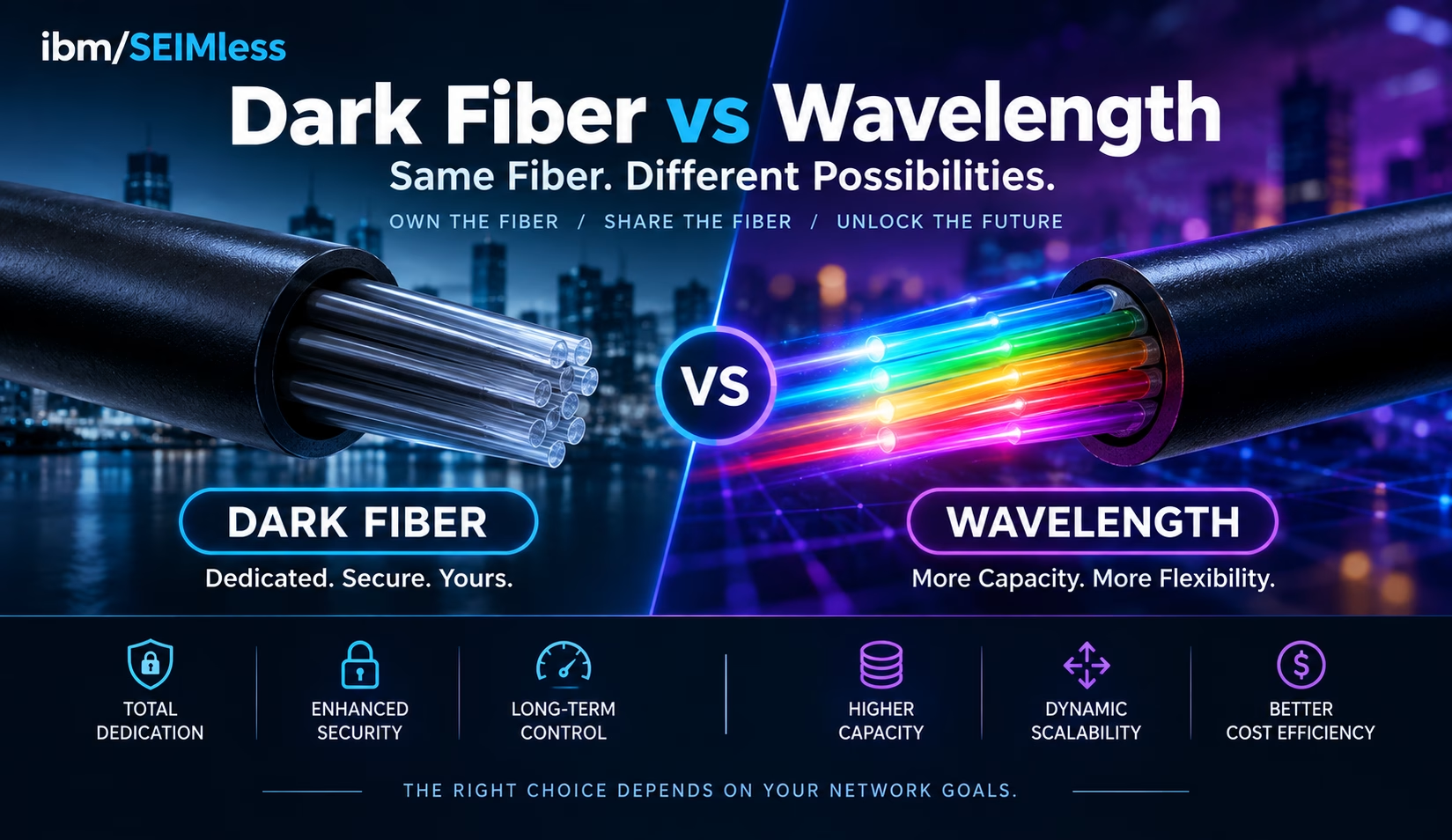
| What is dark fiber vs wavelength? Dark fiber vs wavelength is the choice between leasing unlit optical strands that you light and operate with your own equipment, and buying a lit wavelength service where a carrier provides a dedicated optical channel (such as 100G or 400G) over its DWDM system. Dark fiber maximizes control; wavelengths minimize operational burden. |
| KEY TAKEAWAYS
■ AI and data center growth are driving demand for dedicated 100G, 400G and 800G optical capacity between data centers, clouds and offices. ■ Dark fiber offers near-unlimited capacity and full control but requires optical equipment, skills and CapEx; wavelengths deliver carrier-managed capacity with SLAs on an OpEx model. ■ Physical layer links are not automatically private. Encrypt data in motion and plan now for quantum-safe cryptography. ■ Diverse routing, not just bandwidth, determines whether your private optical network survives a fiber cut. ■ A disciplined RFP that asks about routes, latency, SLAs and encryption prevents expensive surprises. |
Why AI Workloads Are Reshaping the Dark Fiber vs Wavelength Debate
AI is a transport story as much as a compute story. Training datasets, checkpoints and replicated storage move constantly between GPU clusters, colocation halls and public clouds.
The energy data shows how quickly the underlying footprint is growing. According to the U.S. Department of Energy’s release on the Berkeley Lab data center report, data centers consumed about 4.4% of total U.S. electricity in 2023 and could reach roughly 6.7% to 12% by 2028. The full 2024 United States Data Center Energy Usage Report from Lawrence Berkeley National Laboratory traces consumption from 58 TWh in 2014 to 176 TWh in 2023.
The U.S. Energy Information Administration’s Annual Energy Outlook 2026 announcement states that data center load is emerging as the dominant driver of long-term U.S. electricity growth. A May 2026 EIA Today in Energy analysis of data center server energy use estimates that servers accounted for about 7% of commercial-sector electricity in 2025.
Every new megawatt of compute needs a path in and out, so hyperscaler moves such as Alphabet’s $2B data center investment and Meta’s plan to sell AI computing power ripple into enterprise demand for data center interconnect.
The optical speed ladder: 100G, 400G and 800G
The IEEE Standards Association approved IEEE 802.3df-2024, which defines 400 Gb/s and 800 Gb/s Ethernet operation, in February 2024. Cloud providers have followed: AWS Direct Connect documentation lists MACsec support on 10, 100 and 400 Gbps dedicated connections at selected locations.
For most enterprises, 10G and 100G waves remain the workhorses, but GPU clusters and multi-cloud AI pipelines increasingly justify 400G wavelength services. Faster rates also change the dark fiber vs wavelength math, because each new generation of optics lights more capacity on the same strands.
Public investment in middle-mile fiber
Federal programs are also expanding the fiber footprint. NTIA’s Enabling Middle Mile Broadband Infrastructure Program awarded $980 million in 2023. NTIA’s program highlights report more than 12,500 miles of new middle-mile fiber across 40 states and territories. For availability research at specific addresses, the FCC National Broadband Map and the underlying FCC Broadband Data Collection are useful starting points for mass-market service, though not for enterprise optical routes.
Definitions: Dark Fiber, Wavelengths, Ethernet, Private Line and SONET
These terms are often blurred in vendor proposals, so define them before you compare dark fiber vs wavelength pricing.
Dark fiber
Dark fiber is unlit optical fiber leased (often through a long-term indefeasible right of use, or IRU) with no carrier electronics attached. You install your own optics or DWDM platform at each end and decide how many channels to run and at what speeds. ibm/SEIMless dark fiber services range from individual strands to high-count cable designs across more than 20,000 route miles in the Northeast, mid-Atlantic and Chicago regions.
Wavelength (lit) services
A wavelength service is a dedicated optical channel, a specific “color” of light, on a carrier’s DWDM network. You receive a clean handoff such as 10G, 100G or 400G, and the carrier manages the optical layer. ibm/SEIMless wavelength services provide low-latency, point-to-point private connections between data centers and other facilities with dedicated capacity.
Carrier Ethernet
Carrier Ethernet delivers Layer 2 connectivity (E-Line, EVPL, E-LAN) that can be shared or dedicated. ibm/SEIMless Ethernet services offer committed information rates from 10 Mbps to 100 Gbps, making them a flexible middle ground for branch and metro connectivity.
Private line and SONET
Traditional TDM circuits still serve voice and legacy workloads. A private line delivers DS-1, DS-3 and OC-N capacity with optional route diversity. SONET services use ring-based protection for high availability and remain common for disaster recovery and PBX backhaul.
Dark Fiber vs Wavelength: Side-by-Side Comparison
Actual terms vary by route, market and carrier, so treat this table as a framework rather than a quote.
| Factor | Dark Fiber | Wavelength Service | Carrier Ethernet | Private Line / SONET |
| Control | Full control of optics, channels and upgrades | Carrier controls optical layer; you control traffic | Carrier-managed Layer 2 | Carrier-managed TDM |
| Cost model | CapEx heavy (IRU plus equipment), low marginal cost per added channel | OpEx monthly recurring charge per wave | OpEx, priced by committed rate | OpEx, priced by circuit |
| Scalability | Add wavelengths by upgrading your own gear | Order additional waves or higher-rate waves | Increase committed rate up to port speed | Limited; step changes by circuit type |
| Lead times | Often longest if construction or splicing is needed | Shorter where the carrier is already lit on-net | Short to moderate on-net | Depends on legacy availability |
| SLAs | Typically fiber availability only; you own performance | Availability, latency and repair SLAs from carrier | Availability, latency, jitter, loss SLAs | Availability and protection switching |
| Management burden | High; you need optical engineering and 24/7 operations | Low to moderate | Low | Low |
| Security posture | Physically dedicated; you choose and manage encryption | Dedicated channel on shared fiber; encryption strongly advised | Logical separation; encryption advised | Dedicated timeslots; encryption advised |
The core trade-off in any dark fiber vs wavelength evaluation is control versus operational simplicity. Dark fiber rewards organizations with scale and optical expertise; wavelengths reward organizations that want predictable, carrier-supported capacity.
When Each Option Fits
Financial trading and low-latency markets
Trading firms care about microseconds. Dark fiber lets them choose the straightest route and lowest-latency optics, while wavelengths compete when the carrier guarantees route-specific latency.
The SEC’s proposed expansion of Regulation SCI emphasizes capacity, resiliency and business continuity testing for critical market participants. ibm/SEIMless dark fiber links major Chicago metro areas and financial exchanges, which is relevant for these designs.
Healthcare imaging and clinical data
Hospitals move large imaging studies and EHR replicas between campuses and data centers. The HHS HIPAA Security Rule requires technical measures to guard against unauthorized access to ePHI transmitted over electronic networks. An encrypted 10G or 100G wavelength usually balances capacity, compliance and staffing best.
Multi-site enterprises and hybrid cloud
Multi-site organizations often blend services: wavelengths or dark fiber between primary data centers, Carrier Ethernet to large offices, and SD-WAN for smaller branches. Private optical links into AWS, Google Cloud and Microsoft Azure on-ramps also reduce reliance on the public internet for private and hybrid cloud workloads.
Retiring legacy circuits? Weigh our MPLS service against our MPLS replacement solutions. Our guide to choosing hosting and co-location explains how facility choice drives interconnect options.
Security of Optical Links: Why Layer 1 Is Not Automatically Private
Whichever side of the dark fiber vs wavelength choice you land on, a dedicated path is not automatically private. Fiber can be tapped by bending or splicing, and huts, splice points and carrier facilities add exposure.
In December 2024, CISA, NSA, FBI and international partners published enhanced visibility and hardening guidance for communications infrastructure after PRC-affiliated actors compromised major telecommunications providers. The guidance recommends strong encryption wherever possible. CISA’s Communications Sector overview notes that every critical sector depends on communications.
Encryption options for data in motion
- Layer 1 / OTN encryption: Encrypts the entire optical payload at line rate on the transponder, adding minimal latency and protecting all protocols.
- MACsec (IEEE 802.1AE): Encrypts Ethernet frames hop by hop. Microsoft documents MACsec on ExpressRoute Direct, and Google Cloud Interconnect supports MACsec on supported circuits.
- Validated modules: Ask whether encryptors are validated under NIST FIPS 140-3, the federal standard for cryptographic modules.
Quantum-safe encryption and harvest now, decrypt later
High-capacity optical links carry the long-lived data adversaries want to capture now and decrypt later, as explained in our post on why 2026 is the year to move to quantum-resistant networking.
NIST published FIPS 203 (ML-KEM) in August 2024 and later selected HQC as a backup post-quantum algorithm. The draft NIST IR 8547 transition report lays out the migration away from quantum-vulnerable algorithms. NSA’s CNSA 2.0 announcement sets quantum-resistant requirements for national security systems. The joint CISA, NSA and NIST quantum-readiness factsheet urges organizations to inventory cryptography and engage vendors now, and CISA’s Post-Quantum Cryptography Initiative supports critical infrastructure in that transition.
Exodus QRN data-in-motion protection uses quantum-resistant encryption designed to minimize latency while preserving data integrity in transit. Pair it with Exodus key management and review our overview of quantum computing and encryption to build a roadmap.
Diverse Routing and Resilience
Bandwidth without diversity is a single point of failure. A backhoe can take down a 400G wave as easily as a 1G circuit, so resilience belongs in every dark fiber vs wavelength design.
Design for it explicitly:
- Physically diverse paths: Separate conduits, rights-of-way and building entrances, verified with route maps rather than verbal promises.
- Diverse river and corridor crossings: In the New York metro area, ibm/SEIMless dark fiber offers 16 diverse river crossings plus a diverse Transcom route that bypasses the I-95 corridor.
- Protection schemes: Choose between protected wavelengths, SONET ring protection, or two unprotected waves on diverse routes.
- Tested recovery: Include failover drills in your backup and recovery
Financial institutions should align designs with the FFIEC Business Continuity Management booklet, which examiners use to assess enterprise resilience. Oversight bodies have also scrutinized sector coordination, as the GAO noted in its report on CISA’s support for the communications sector.
Dark Fiber vs Wavelength Buying Checklist: RFP Questions to Ask
A structured RFP turns a dark fiber vs wavelength evaluation into an apples-to-apples comparison. Use these questions with every provider:
- Route and diversity: Can you provide KMZ route maps, building entrance details and shared-conduit disclosures for every path?
- Latency: What is the guaranteed round-trip latency per route, and how is it measured and reported?
- Capacity roadmap: Can the route support 100G, 400G and 800G today? What is the upgrade path and cost?
- SLAs: What are the availability, mean-time-to-repair and latency SLAs, and what credits apply?
- Lead times: Is the route on-net and lit, or does it require construction, permits or splicing?
- Encryption: Do you offer Layer 1, OTN or MACsec encryption? Are modules FIPS 140-3 validated? What is your post-quantum roadmap?
- Commercials: For dark fiber, what are IRU length, maintenance fees and relocation terms? For wavelengths, what are term discounts and upgrade rights?
- Cloud and colocation reach: Which data centers, carrier hotels and cloud on-ramps are on-net?
- Exit and portability: What happens at term end, and can you migrate without downtime?
For a deeper framework, see our guide on building a custom network strategy or evaluating ISPs for an RFP.
How ibm/SEIMless Helps You Decide
ibm/SEIMless has been a vendor-agnostic carrier, cloud and communications partner for more than 20 years. That independence matters, because the right dark fiber vs wavelength answer is often a blend.
Our dark fiber footprint includes access to more than 175 data centers and more than 250 carrier hotels and central offices, plus about 1,000 route miles in Virginia connected to the Ashburn data hub. Where lit services fit better, we design around your latency, resilience and budget targets.
We then add transport-layer security with Exodus QRN. Our post on Exodus wide area networking across the USA explains how that fits into a national WAN, and our look at AI-native networks shows where telecom architecture is heading.
Frequently Asked Questions
Is dark fiber cheaper than a wavelength service?
It depends on scale and time horizon. Dark fiber usually requires higher upfront spending on the IRU and optical equipment, but adding more wavelengths later costs relatively little. A wavelength service has predictable monthly charges and no equipment to buy. Organizations needing many high-capacity channels on one route for many years often find dark fiber more economical over the full term.
What speeds do wavelength services support in 2026?
Most enterprise wavelength services are delivered at 10G and 100G, with 400G increasingly common between data centers and cloud on-ramps. IEEE 802.3df-2024 defines 400 Gb/s and 800 Gb/s Ethernet, and 800G is emerging in the largest AI deployments. Availability depends on the carrier’s DWDM platform and the specific route.
Is a dedicated fiber or wavelength secure without encryption?
No. A dedicated optical path is separated from the public internet, but fiber can be tapped and carrier facilities can be compromised. Federal guidance from CISA, NSA and FBI recommends strong encryption wherever possible. Use Layer 1, OTN or MACsec encryption with validated modules, and plan a transition to quantum-resistant cryptography for long-lived sensitive data.
When should an enterprise choose dark fiber over wavelengths?
Choose dark fiber when you need very high or rapidly growing capacity on a fixed route, want full control over optics and latency, and have or can hire optical engineering and 24/7 operations. Financial trading firms, hyperscale-adjacent AI operators and large health systems with several campuses are typical candidates. Otherwise, wavelengths usually deliver faster time to value.
How does harvest now, decrypt later affect optical networks?
Adversaries can record encrypted traffic today and store it until quantum computers can break classical public-key algorithms. High-capacity data center interconnect links carry exactly the long-lived financial, health and intellectual property data they target. Adopting NIST’s post-quantum standards, such as FIPS 203 ML-KEM, and quantum-resistant encryption for data in motion reduces that future exposure.
What should an RFP for dark fiber or wavelengths include?
A strong RFP asks for route maps and shared-conduit disclosures, guaranteed latency per route, availability and repair SLAs with credits, lead times, and upgrade paths to 400G or 800G. It should also request encryption options, FIPS 140-3 validation status, a post-quantum roadmap, on-net data center and cloud locations, and clear terms for renewal, relocation and exit.
Talk to ibm/SEIMless About Your Dark Fiber vs Wavelength Strategy
Your AI and hybrid cloud plans deserve an optical foundation that is fast, resilient and secure. ibm/SEIMless will map your routes, compare every option side by side, and design quantum-resistant protection for data in motion.
Get started with a network assessment or contact our team today.
- Phone: 646-546-5245
- Email: in**@**********ss.com
- Address: One Liberty Plaza, New York, NY 10006