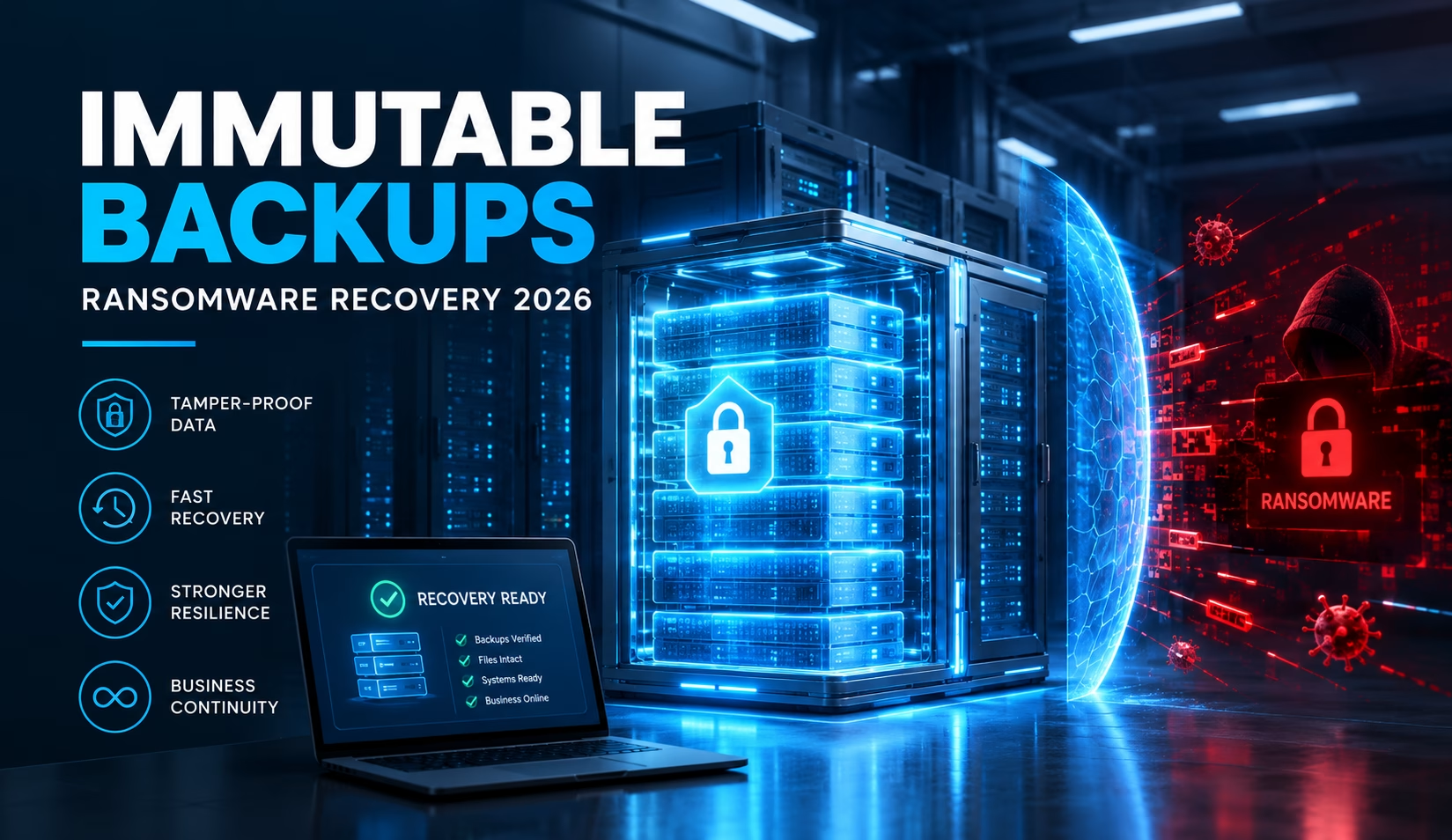
Immutable backups have become the control that separates a bad week from a business-ending ransomware event. Modern attackers no longer stop at encrypting production servers. They hunt for backup consoles, delete snapshots and poison recovery points first, so that when the ransom note appears, the victim has nowhere left to turn.
The Verizon 2026 Data Breach Investigations Report finds ransomware in 48% of all breaches, with 31% of breaches starting from an exploited software vulnerability. A year earlier, Verizon found ransomware in 44% of breaches and 88% of breaches at small and midsize businesses. For leaders in financial services, healthcare and insurance, the question is no longer whether you will be hit, but whether you can restore clean data quickly and prove it to regulators.
This guide covers why attackers target backups, the 3-2-1-1-0 rule, cloud immutability controls, 2026 regulatory expectations and a recovery-readiness checklist you can use this quarter.
| What are immutable backups? Immutable backups are copies of data written in a write-once, read-many (WORM) state that cannot be changed, encrypted or deleted by anyone, including administrators, until a set retention period expires. Paired with isolation and tested restores, they give organizations a trusted, clean recovery point after ransomware or destructive attacks. |
Why Attackers Target Backups First
Ransomware is an extortion business, and backups are the biggest threat to its revenue. If a victim can restore, it does not need to pay. The CISA #StopRansomware Guide warns that “many ransomware variants attempt to find and subsequently delete or encrypt accessible backups.”
Recovery capability is paying off. Verizon’s 2025 report found 64% of ransomware victims did not pay, and the 2026 edition reports that share rose to 69%.
The modern attack chain against recovery
- Initial access through a stolen credential or an unpatched edge device.
- Privilege escalation to domain admin or cloud root.
- Reconnaissance of backup servers, hypervisor snapshots and cloud storage accounts.
- Destruction of recovery points by deleting snapshots or shortening retention.
- Data theft and encryption of production, followed by double extortion.
We documented this pattern in our analysis of how Interlock ransomware exploited a Cisco FMC zero-day for root access. In the joint #StopRansomware advisory on Interlock, CISA and the FBI recommend ensuring “all backup data is encrypted, immutable (i.e., cannot be altered or deleted), and covers the entire organization’s data infrastructure.”
What the 2025 FBI data shows
The FBI IC3 2025 Internet Crime Report logged $20.877 billion in reported losses, 3,611 ransomware complaints and 63 new ransomware variants, led by Akira and Qilin. Critical manufacturing, healthcare and government facilities were most affected. The FBI notes ransomware losses exclude “lost business, time, wages, files, or equipment,” so downtime is usually the largest cost, as our coverage of the Asahi cyberattack and nationwide shortages shows.
The 3-2-1-1-0 Rule for Immutable Backups
CISA’s backup guidance for businesses describes the 3-2-1 rule: three copies of important files, on two types of storage media, with one copy off-site. It was designed for hardware failure and disasters, not adversaries holding admin credentials. The industry has extended it:
- 3 copies of your data, including production.
- 2 different media or platforms, such as on-premises disk and cloud object storage.
- 1 copy off-site, in a separate facility or cloud region.
- 1 copy immutable or offline, meaning WORM-locked, logically air-gapped or disconnected.
- 0 errors after automated restore verification.
Those last two numbers turn ordinary copies into immutable backups you can bet the business on. CISA also advises ensuring you can “roll back data at least seven days if needed,” which demands adequate retention.
How Immutability Works: WORM, Object Lock and Immutable Vaults
Immutability must be enforced by the storage platform, not by backup software’s good intentions.
AWS
Amazon S3 Object Lock uses a WORM model. In compliance mode, no user, including root, can delete a protected object until retention expires; governance mode can be bypassed by privileged users. The AWS Backup logically air-gapped vault stores backups locked by default and shareable to a separate recovery account. Our Amazon Web Services team can help design these controls.
Microsoft Azure
Immutable storage for Azure Blob Storage supports time-based retention and legal holds, and locked policies meet SEC Rule 17a-4(f). The Azure Backup immutable vault blocks deletion of recovery points and retention reductions and can be locked irreversibly. See our Microsoft Azure services and our post on Azure as an enterprise cloud built for security.
Google Cloud
Google’s ransomware best practices for Backup and DR recommend vaults with enforced minimum retention, a hub-and-spoke project model separating backups from production, and separated admin roles. Explore our Google Cloud services.
A caution on “immutable” marketing
CISA cautions that immutable storage “does not meet compliance criteria for certain regulations and misconfiguration can impose significant cost.” Bypassable governance locks and short retention create false confidence. NIST SP 800-209 offers guidance for hardening the storage layer itself.
Isolated Recovery Environments and Air-Gapped Vaults
Immutability protects data from deletion, but it does not give you a clean place to restore. If identity, hypervisors and the network are still compromised, restoring simply re-infects the business.
An isolated recovery environment adds a separate control plane with its own credentials, network isolation from production, and a staging area where restored systems are scanned before release. CISA’s Interlock advisory calls for copies “in a physically separate, segmented, and secure location,” and its guide recommends “golden images” of critical systems for rapid rebuilds.
Traditional backup vs. immutable backups vs. isolated recovery vault
| Capability | Traditional backup | Immutable backups | Isolated recovery vault |
| Protects against hardware failure | Yes | Yes | Yes |
| Resists deletion by a compromised admin | No | Yes, during retention | Yes, plus separate credentials |
| Resists encryption by ransomware | Rarely | Yes | Yes |
| Separate identity and control plane | No | Usually not | Yes |
| Clean staging for malware scanning | No | No | Yes |
| Recovery speed after ransomware | Slow and uncertain | Moderate | Fastest trusted restore |
| Cost and complexity | Low | Moderate | Higher |
| Best fit | Non-critical data | Most enterprise workloads | Tier-0 and regulated systems |
Most organizations need a tiered design: immutable backups for broad coverage and an isolated vault for identity, core banking, EHR and claims platforms. Our private and hybrid cloud services support recovery across environments, and our IBM i high availability service replicates IBM i workloads in real time to a secure off-site data center.
RPO, RTO and Proving Recovery with Restore Testing
Recovery point objective (RPO) is how much data you can afford to lose; recovery time objective (RTO) is how long a service can be down. Business owners, not IT alone, should set both.
The NIST Cybersecurity Framework 2.0 makes testing explicit. Subcategory PR.DS-11 states “Backups of data are created, protected, maintained, and tested,” and the Recover function requires that backup integrity be “verified before using them for restoration” (RC.RP-03), per the CSF 2.0 core document. NIST’s practice guides SP 1800-25 and SP 1800-26 address protecting against and responding to ransomware, while NIST SP 800-34 Rev. 1 remains the contingency planning reference.
A practical restore-testing cadence
- Daily: automated verification that jobs completed and recovery points are readable.
- Monthly: file and database restores for a rotating sample of critical applications.
- Quarterly: full application restores into an isolated environment, timed against RTO.
- Annually: an exercise simulating total loss of identity and production, with executives involved.
Protecting Backup Consoles, Identities and Keys
Most backup compromises are identity compromises. An attacker signed in to your backup console or cloud account can shorten retention or delete vaults before immutability takes effect.
- Phishing-resistant MFA on every backup, hypervisor and cloud admin account; CISA calls phishing-resistant MFA “the gold standard for MFA.”
- Separate identities for backup administration, outside the production domain.
- Multi-person approval for destructive actions such as deleting vaults.
- Continuous monitoring for anomalous logins and mass deletions.
Our endpoint detection and response services and the Exodus ARIA ADR platform, which unifies SIEM, UEBA, NTA, EDR, threat intelligence, IDS and SOAR with 24/7 monitoring, help surface attacker activity before it reaches backups. See also our guide to choosing an endpoint detection system.
Encrypting Backups for Today and the Quantum Era
Backups concentrate your most sensitive data, making them targets for theft as well as destruction. CISA recommends “offline, encrypted backups of critical data,” and HHS states that when ePHI is encrypted by ransomware, a breach has occurred unless a risk assessment shows low probability of compromise.
Long-retention backups carry a future risk too: data stolen today could be decrypted once cryptographically relevant quantum computers arrive. NIST finalized FIPS 203 (ML-KEM) for post-quantum key establishment, and CISA’s Post-Quantum Cryptography Initiative urges organizations to plan migration now. ibm/SEIMless delivers quantum resistant encryption for data at rest through Exodus QRN, detailed in Exodus QRN Data at Rest and our post on harvest now, decrypt later.
Regulations and Cyber Insurance: What Examiners Expect in 2026
NYDFS 23 NYCRR Part 500
Under New York’s Part 500 cybersecurity regulation, Section 500.16 (see the text at Cornell’s Legal Information Institute) requires backups “adequately protected from unauthorized alterations or destruction” and at least annual testing of the ability to restore from them. On November 1, 2025, expanded MFA and asset inventory requirements took effect, including recovery objectives for each asset.
HIPAA contingency plan
45 CFR 164.308(a)(7) requires a data backup plan maintaining “retrievable exact copies” of ePHI, a disaster recovery plan and emergency mode operations, with testing as an addressable specification. In April 2026, HHS OCR settled four ransomware investigations totaling $1,165,000.
FFIEC and SEC
Financial institutions are examined against the FFIEC Business Continuity Management booklet. Public companies must file Form 8-K Item 1.05 within four business days of determining an incident is material, per the SEC compliance guide. Fast, verifiable recovery simplifies that assessment.
Cyber insurance
The NAIC notes insurers “increasingly mandate robust cybersecurity controls and may impose limits on ransom coverage,” and the GAO reports insurers have tightened terms. Documented immutable backups, MFA and restore tests strengthen your underwriting position.
Recovery-Readiness Checklist for Immutable Backups
- Inventory critical applications with owners and approved RPO and RTO.
- Keep at least one copy of each critical dataset in immutable backups using compliance-mode or locked policies.
- Place tier-0 systems, including identity, in an isolated recovery vault with separate credentials.
- Set retention long enough to reach a clean point before attacker dwell time.
- Enforce phishing-resistant MFA and multi-person approval on backup and cloud admin accounts.
- Encrypt backups, manage keys separately and plan quantum-resistant protection for long-retention data.
- Maintain golden images to rebuild systems quickly.
- Automate restore verification and target zero errors.
- Run quarterly full restores into an isolated environment, timed against RTO.
- Map controls to NYDFS 500.16, HIPAA 164.308(a)(7), FFIEC and SEC workflows.
Budget alone does not deliver this, as we discussed in lessons from the UNFI breach, and resilience means avoiding single points of failure, a theme in how CIOs are rethinking cloud strategy after CrowdStrike.
How ibm/SEIMless Helps
For more than 20 years, ibm/SEIMless has been a vendor-agnostic technology partner. Our backup and recovery services, powered by Exodus-Data, include on-site, off-site, cloud and hybrid options, AES 256-bit encryption with key management, continuous data protection, restore validation and near-instant local and remote virtual disaster recovery. We pair them with multi-cloud expertise, managed detection and quantum-resistant encryption. Browse all ibm/SEIMless services.
Frequently Asked Questions
What is the difference between immutable backups and air-gapped backups?
Immutable backups cannot be modified or deleted until their retention period ends, enforced by WORM or object lock controls. Air-gapped backups are isolated from production networks, physically or logically, so attackers cannot reach them. The strongest designs combine both: immutable copies in an isolated vault with separate credentials, protecting against deletion, encryption and misuse of stolen administrator accounts.
Can ransomware encrypt or delete immutable backups?
Properly configured immutable backups in compliance mode or under locked policies cannot be altered or deleted during retention, even by administrators. Risk remains if immutability uses a bypassable governance mode, retention is too short, or attackers change policies before data is written. Protect backup consoles with phishing-resistant MFA and multi-person approval, and monitor for configuration changes.
What is the 3-2-1-1-0 backup rule?
The 3-2-1-1-0 rule means keeping three copies of data on two different media, with one copy off-site, one copy immutable or offline, and zero errors after restore verification. It extends the 3-2-1 rule that CISA recommends with protections built for ransomware, where attackers actively seek out and destroy accessible backups before encrypting production.
How often should we test backup restores?
Automate daily verification that backups completed and are readable, run monthly sample restores, and perform quarterly full-application restores into an isolated environment timed against your RTO. NYDFS Part 500 requires testing restoration from backups at least annually, and NIST CSF 2.0 expects backup integrity to be verified before use. Frequent testing builds real confidence.
Do regulations require immutable backups?
Most regulations do not name immutability, but they require outcomes it supports. NYDFS 500.16 requires backups protected from unauthorized alteration or destruction. HIPAA requires retrievable exact copies of ePHI and disaster recovery procedures. FFIEC examiners review recovery strategies and testing. Immutable backups are among the most practical ways to demonstrate these protections to auditors and examiners.
Why should backups use quantum-resistant encryption?
Backups often hold years of sensitive financial, health and customer data. Adversaries can steal encrypted copies today and attempt to decrypt them once quantum computers mature, a risk known as harvest now, decrypt later. Applying quantum-resistant encryption to long-retention data at rest reduces that exposure and aligns with NIST’s post-quantum standards and CISA’s migration guidance.
Talk to ibm/SEIMless About Ransomware-Ready Immutable Backups
Your backups are a promise to customers, patients and employees that the business will be there tomorrow. If you are not certain your recovery points are immutable, isolated and tested, find out before an attacker does. ibm/SEIMless and Exodus QRN can assess your backup and disaster recovery posture, map it to NYDFS, HIPAA, FFIEC and SEC expectations, and design recovery across on-premises, private cloud, AWS, Azure and Google Cloud.
- Get started: Request a backup and recovery readiness assessment
- Contact us: Reach our team online
- Call: 646-546-5245
- Email: in**@**********ss.com
- Visit: One Liberty Plaza, New York, NY 10006