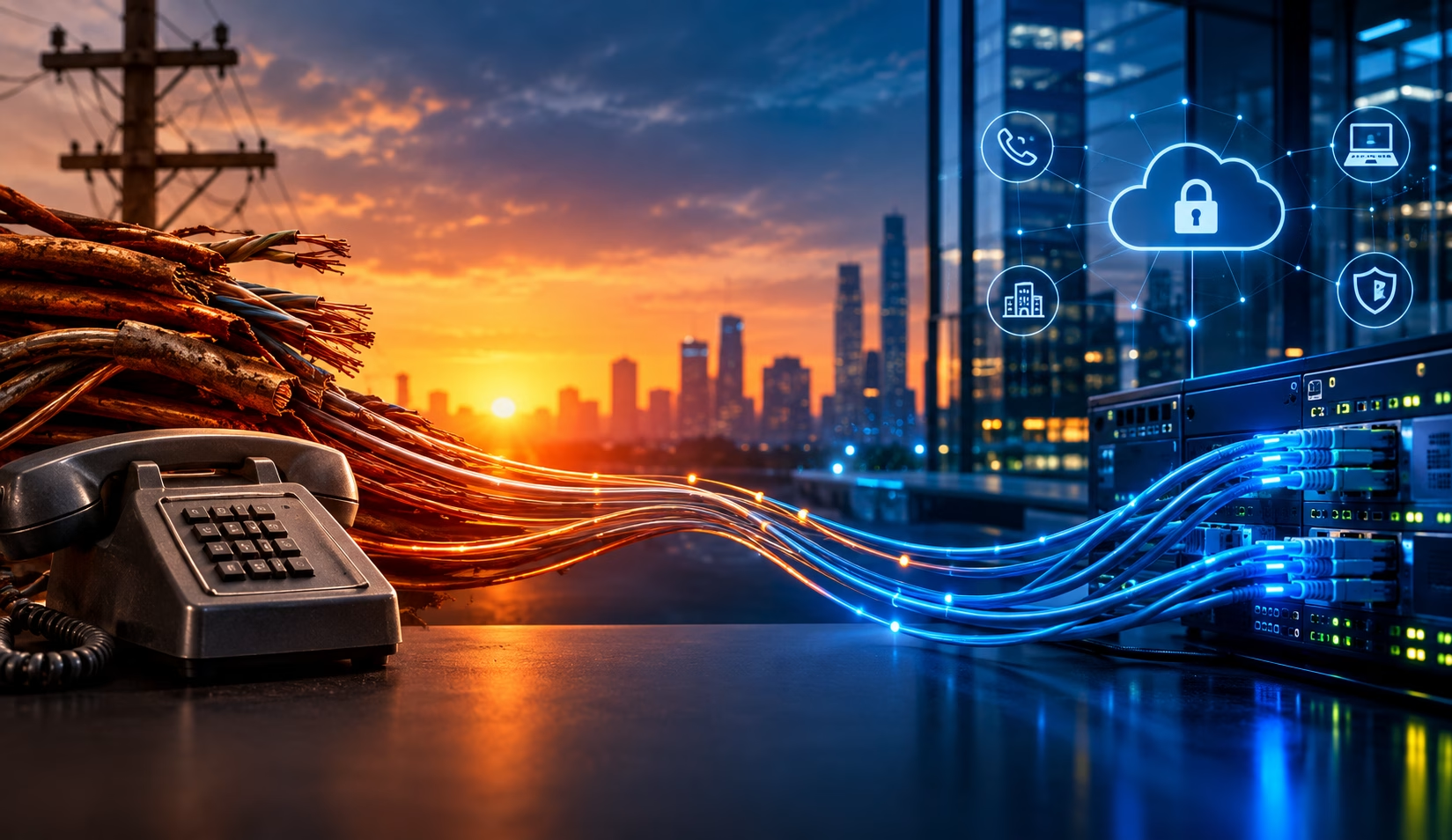
POTS line replacement is no longer a someday project. In 2026 the Federal Communications Commission made it faster and simpler for carriers to stop selling, and then stop providing, copper-based phone service. AT&T and Verizon are already filing to shut down copper in specific wire centers, and many businesses will get the notice before they have a plan.
The desk phone is the easy part. The hard part is the analog lines nobody remembers: the fire alarm dialer, the elevator emergency phone, the garage call box, the burglar panel, the fax line, and the PRI feeding an aging PBX. Those lines protect people. This guide explains what changed and how to plan a POTS line replacement that keeps every life-safety connection working.
| What is POTS line replacement? POTS line replacement is the process of moving analog “plain old telephone service” copper lines to digital alternatives, such as managed POTS-in-a-box devices, dual-path cellular communicators, SIP trunks, or cloud telephony, while keeping fire alarms, elevator phones, fax, and 911 calling working and code compliant. |
| KEY TAKEAWAYS
■ The FCC’s March 2026 order lets carriers grandfather copper voice without a filing and speeds discontinuance approvals. ■ AT&T plans to exit most of its copper footprint outside California by the end of 2029, and Verizon has filed to retire copper in parts of New York. ■ Fire alarm, elevator, and emergency call box lines need a code-reviewed POTS replacement, not a generic VoIP adapter. ■ Kari’s Law and RAY BAUM’S Act 911 rules apply to any new phone system you install. ■ Start with an inventory; audits often find unused copper lines you still pay for. |
Why the Copper Retirement Accelerated in 2026
In July 2025 the FCC’s July 2025 fact sheet on reducing barriers to network improvements proposed eliminating network change filings and consolidating the “adequate replacement” tests for discontinuing legacy voice.
On March 26, 2026, the Commission adopted them. The FCC fact sheet for the Network and Services Modernization Order and the final rule published in the Federal Register (FCC 26-19, WC Docket Nos. 25-208 and 25-209) describe the changes, effective May 20, 2026, with certain sections delayed.
What the new FCC order changes
- Blanket grandfathering. Carriers received blanket Section 214 authority to grandfather legacy voice, data below 25/3 Mbps, and VoIP provisioned over copper. You may be unable to add copper lines long before existing ones shut off.
- Faster discontinuance. Technology-transition discontinuance applications now qualify for a 31-day automatic grant for all carriers, not just smaller ones.
- Five “adequate replacement” categories. Facilities-based VoIP, mobile wireless of at least 5/1 Mbps, voice funded by modernized high-cost programs, the carrier’s own alternative voice service, or a widely available third-party voice service, each with 911 access.
- 911 coordination. Carriers discontinuing services that support 911 traffic must give 911 authorities 90 days’ notice and coordinate before filing.
- No new alarm-compatibility mandate. The order declined to add new codec requirements for legacy alarm devices, noting that compatibility obligations from the 2016 technology transitions rules had already sunset.
See the FCC’s Report and Order, FCC 26-19 and the procedures in 47 CFR 63.71.
That last bullet matters most: keeping your alarm panel talking to its monitoring center is now your responsibility, not the phone company’s.
AT&T and Verizon Landline Sunset Timelines
According to Broadband Breakfast’s report on AT&T’s January 2026 FCC approval, the FCC approved AT&T’s request to discontinue copper services in another 25% of its wire centers, bringing approvals to more than 30% of its copper footprint outside California across 18 states, with discontinuation starting November 15, 2026. AT&T spends roughly $6 billion a year maintaining about 4,600 copper wire centers and targets retiring most copper outside California by the end of 2029.
WWNY-TV reported in September 2026 that Verizon has asked the FCC for approval to phase out copper landlines in parts of northern New York, with a decision expected by the end of November 2026. Verizon told the station it will not discontinue a customer’s copper voice service where a suitable replacement is not yet available.
Why remaining POTS lines keep getting more expensive
In 2019 the FCC’s unbundling and resale forbearance order (FCC 19-72) relieved price-cap incumbents of obligations to unbundle analog voice-grade copper loops and offer avoided-cost resale. That removed a wholesale pricing floor competitive providers relied on, and per-line POTS pricing has tended to climb as the copper base shrinks. For organizations with many analog lines, waiting often costs more than a planned POTS line replacement.
Which Business Lines Are at Risk?
Map every line to the device and the people it protects before choosing technology.
| Line type | Why it matters | Special considerations |
| Fire alarm communicator (DACT) | Sends alarms to a supervising station | NFPA 72 and local fire marshal approval |
| Elevator emergency phone | Trapped passengers call for help | ASME A17.1 and ADA two-way communication rules |
| Emergency call box / area of refuge | Direct help line for people in danger | Must reach a staffed location, often 24/7 |
| Burglar/intrusion alarm | Signals the monitoring center | Panel protocol compatibility with IP or cellular |
| Fax | Regulated document exchange | Analog fax can fail over compressed VoIP |
| PRI / T1 trunks | Main voice capacity | Migration to SIP trunks or cloud voice |
If you are unsure what a line does, trace and test it before disconnecting.
POTS Line Replacement for Life-Safety Systems
A poorly planned POTS line replacement can put people in danger here. Treat each line as its own project, with the authority having jurisdiction (AHJ) involved early.
Fire alarm panels and NFPA 72
The 2025 edition of NFPA 72, the National Fire Alarm and Signaling Code, governs how alarm signals reach a supervising station, though your fire marshal may enforce an earlier edition.
The Minnesota State Fire Marshal’s guidance on fire alarm transmission signals explains that traditional DACT systems relied on two POTS lines, that newer NFPA 72 editions are more performance-based, and that a DACT can pair one phone line with a secondary path that is not a second phone line, such as cellular, radio, or IP. It also cautions that VoIP is not recommended for transmitting fire alarm signals because compression can corrupt the data.
Practical steps:
- Confirm the NFPA 72 edition and local amendments your AHJ enforces.
- Ask your fire alarm contractor whether the panel supports an IP or cellular communicator directly.
- Consider a listed dual-path communicator (for example, cellular plus IP) rather than a generic analog adapter.
- Document supervision, battery standby, and signal testing, and get written AHJ sign-off before cutting copper.
Elevator emergency phones
The U.S. Access Board’s guide to ADA elevator requirements notes that ASME A17.1 requires a two-way means of emergency communication in elevator cars, activated by a push button, with a visual signal acknowledging the call. Replacements must work during power loss and reach a staffed location, so involve your elevator contractor and inspector.
Emergency call boxes and burglar alarms
Confirm your monitoring center supports the replacement path, then test end to end, including a simulated power outage. The FCC’s guidance on modernizing networks is a good checklist for questioning carriers.
Backup power
Copper lines are powered from the central office; digital services are not. The FCC’s technology transitions overview explains that providers of non-copper voice must offer customers backup power options, a requirement rooted in the FCC’s rules on ensuring continuity of 911 communications. For life-safety lines, size batteries to each system’s code-required standby time.
911 Compliance: Kari’s Law and RAY BAUM’S Act
Replacing trunks or a PBX triggers federal 911 obligations, summarized on the FCC’s page on multi-line telephone system 911 requirements with rule text in 47 CFR 9.16.
- Direct dialing. Users must be able to dial 911 without a prefix such as “9.”
- On-site notification. Where technically feasible, the system must alert a central location, such as a front desk or security, when someone calls 911.
- Dispatchable location. Calls must convey a street address plus details such as floor or room. Fixed devices were required to comply by January 6, 2021, and non-fixed and off-premises devices by January 6, 2022.
See the FCC’s dispatchable location page and 911.gov’s Kari’s Law and RAY BAUM’S Act overview. As 911 centers move to IP-based Next Generation 911, accurate location data matters even more.
Comparing POTS Line Replacement Options
Most enterprises mix POTS line replacement options by line purpose.
| Option | Best for | Strengths | Watch-outs |
| Managed POTS-in-a-box | Fire alarms, elevators, call boxes, legacy analog devices | Keeps analog interface; cellular with optional wired failover; remote monitoring; battery backup | Confirm listings and AHJ acceptance; monthly service fee |
| Dual-path alarm communicator | Fire and intrusion panels | Designed for alarm signaling; supervised paths | Panel-specific; requires alarm contractor |
| SIP trunking | Replacing PRI/T1 to an existing IP-capable PBX | Lower cost per call path; scales easily; supports DID | Needs quality broadband, SBC, and 911 location configuration |
| Cloud telephony (UCaaS) | Desk phones, softphones, remote workers | No on-site PBX; built-in mobility and collaboration | Plan for power and internet outages; configure dispatchable location |
| Premises-based IP PBX | Sites needing local control or survivability | Local call processing; integration flexibility | Hardware lifecycle and maintenance |
| Cloud fax (fax-to-email) | Regulated document exchange | Eliminates fax lines and machines | Review retention and security requirements |
For voice, ibm/SEIMless supports every model: POTS, PRI, TDM, and SIP services, cloud-based telephony, and premises-based telephony. If you are weighing platforms, our guide to choosing the right unified communications solution and our overview of Microsoft 365 and Teams voice can help.
Resilience: Don’t Trade One Single Point of Failure for Another
Copper often kept working in power outages. Digital replacements depend on power, broadband, and cellular networks, which fail too. The FCC’s report on the February 22, 2024 AT&T wireless outage found that the event blocked more than 92 million calls, including about 25,000 calls to 911. We covered a related incident in our post on the AT&T 911 outage that disrupted emergency services across three states.
Build resilience into your POTS line replacement:
- Dual paths. Pair cellular with wired broadband, ideally from different carriers. Our fixed and mobile 4G/5G wireless solutions include dual-path protection combining fixed wireless and fiber.
- Diverse WAN. An SD-WAN design can steer voice across multiple circuits and fail over automatically.
- Secure the voice path. Protect voice like data, including encryption of data in motion.
- Priority services. Explore CISA priority telecommunications services.
Your POTS Line Replacement Roadmap
A practical POTS line replacement sequence for CIOs and facilities leaders:
Step 1: Inventory and audit
Match every circuit ID on carrier invoices to a location and device. Our single, accurate view of telecom assets and expenses approach helps you find them.
Step 2: Classify by risk
Group lines as life-safety, regulated, business-critical, or disposable.
Step 3: Watch carrier notices
Assign someone to read every carrier notice, and see the Massachusetts consumer guide to the copper-to-fiber transition for what those notices should include.
Step 4: Select and pilot
Match each class to an option above and pilot at one site, including power-failure tests.
Step 5: Migrate voice and fax
Move PRIs to SIP or cloud voice, update or retire PBX installations, and shift fax to Fax2Mail cloud faxing. Verify 911 settings on every endpoint.
Step 6: Document and decommission
Record AHJ approvals, test results, and new circuit IDs, then cancel old copper so billing stops.
Multi-site organizations can lean on our managed telecom services in New York to run this program end to end.
Frequently Asked Questions
Are POTS lines being discontinued in 2026?
Not everywhere at once, but the pace is accelerating. The FCC’s March 2026 order lets carriers grandfather copper voice without a filing and streamlines discontinuance approvals. AT&T received approval covering more than 30% of its copper footprint outside California, with discontinuations beginning November 15, 2026, and Verizon has filed to retire copper in parts of New York. Expect notices by location rather than a single national shutdown date.
What is the best POTS line replacement for a fire alarm panel?
Usually a listed dual-path communicator or a managed POTS replacement device designed for alarm signaling, using cellular plus a second path such as IP. The right choice depends on the NFPA 72 edition your jurisdiction enforces, your panel model, and your monitoring center. Always involve your fire alarm contractor and get written approval from the local fire marshal before disconnecting the copper line.
Can I just plug my alarm or elevator phone into a VoIP line?
It is risky. Standard VoIP compresses audio, which can corrupt alarm tones and modem signals, and the Minnesota State Fire Marshal specifically advises against VoIP for fire alarm transmission. Elevator phones also need to work during power loss and reach a staffed location. Use equipment built and supported for these life-safety uses, and test it end to end.
What happens if I ignore my carrier’s copper retirement notice?
Once the discontinuance takes effect, the line can stop working. For a fire alarm, that could mean the monitoring center never receives an alarm and your building falls out of compliance. For an elevator, a trapped passenger may not reach help. Ignoring a notice also leaves you with less time to buy equipment, schedule contractors, and secure AHJ approvals.
Do Kari’s Law and RAY BAUM’S Act apply to my new phone system?
Yes, if it is a multi-line telephone system or VoIP service installed or configured under current rules. Users must dial 911 directly without a prefix, a central on-site contact should be notified when 911 is called where feasible, and the call must send a dispatchable location such as street address, floor, and room. Build these settings into every SIP, cloud, or PBX migration.
How much does POTS line replacement cost?
Costs depend on the number of lines, device types, and required approvals. Managed POTS replacement typically carries a monthly per-line fee plus hardware and installation, while SIP trunking and cloud voice are priced per call path or user. Many organizations offset costs by auditing invoices and cancelling unused copper lines, which can fund part of the migration.
Talk to ibm/SEIMless About Your POTS Line Replacement
For more than 20 years, ibm/SEIMless has helped financial, healthcare, and insurance organizations manage communications services without vendor bias. We will inventory your copper, coordinate with your alarm and elevator contractors, and move you to the right mix of managed POTS, SIP, cloud telephony, and resilient wireless.
- Get started: Request your POTS and copper line assessment
- Contact us: Reach the ibm/SEIMless team
- Call: 646-546-5245
- Email: in**@**********ss.com
- Visit: One Liberty Plaza, New York, NY 10006
Your people depend on those lines. Let’s make sure they keep working.