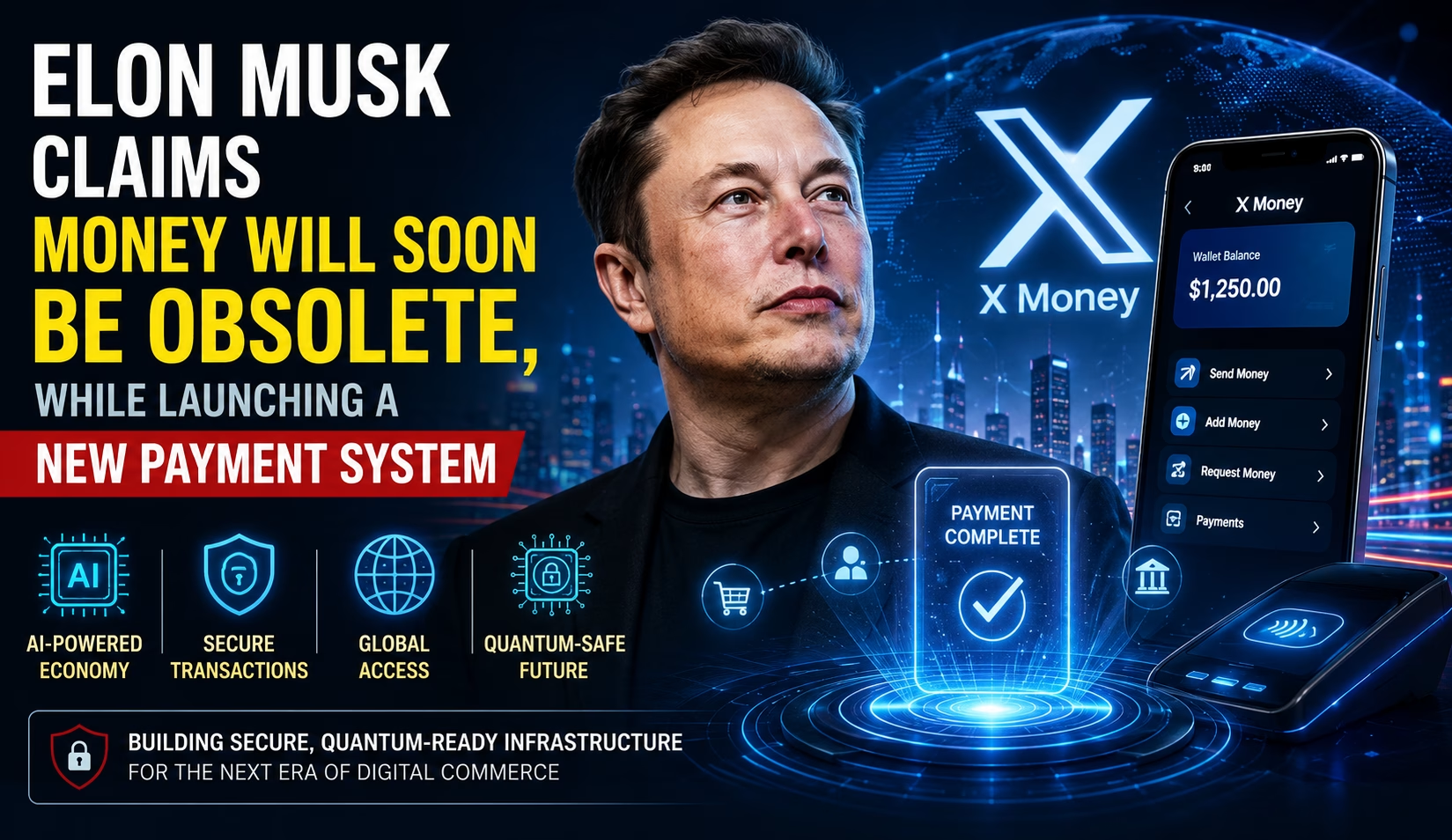
During recent discussions surrounding the future of digital finance and artificial intelligence, Musk suggested that traditional money may eventually become obsolete as AI-driven economies, autonomous agents, and instant digital transactions redefine how value is exchanged.
At nearly the same time, X (formerly Twitter) continues expanding its financial ecosystem through X Money, a digital payment platform designed to transform the social media platform into an “everything app.”
Although these developments are separate, together they reveal a much bigger trend:
The future isn’t simply about replacing cash—it is about rebuilding the entire financial infrastructure.
For enterprises, governments, financial institutions, and technology providers, this raises one important question:
Is today’s payment infrastructure prepared for tomorrow’s digital economy?
The Evolution of Money
Money has continuously evolved throughout human history.
- Barter systems
- Precious metals
- Paper currency
- Credit cards
- Online banking
- Mobile wallets
- Cryptocurrency
- Central Bank Digital Currencies (CBDCs)
Every major innovation has reduced friction between buyers and sellers.
Artificial intelligence is now pushing this evolution even further.
Future transactions may occur without human involvement.
Imagine:
- AI assistants purchasing groceries
- Autonomous vehicles paying tolls automatically
- Industrial robots ordering replacement parts
- Smart factories negotiating supplier contracts
- Digital identities performing cross-border payments
In this world, payment becomes an invisible background process.
What Elon Musk Is Actually Building
Rather than introducing another cryptocurrency, Musk’s current strategy centers around integrating financial services directly into X.
The platform is gradually evolving into a digital ecosystem capable of supporting:
- Peer-to-peer transfers
- Creator payments
- Digital wallets
- Merchant services
- Subscription management
- Financial identity
- Banking partnerships
The objective resembles the highly successful “super apps” already common across Asia.
Instead of switching between multiple applications, users interact within a single ecosystem.
Communication.
Commerce.
Entertainment.
Payments.
All connected together.
Why This Matters Beyond Social Media
Most headlines focus on Musk.
The larger story is infrastructure.
Digital payments are becoming deeply integrated into everyday software.
Examples include:
- SaaS platforms
- ERP systems
- Healthcare portals
- Retail applications
- Logistics software
- Manufacturing systems
- Smart cities
- Government digital services
Payments are no longer standalone banking functions.
They are becoming embedded services.
The AI Economy Is Different
Traditional commerce involves people making purchasing decisions.
AI-driven commerce introduces machine-to-machine transactions.
Examples include:
- Cloud servers purchasing additional computing resources automatically
- AI agents scheduling software subscriptions
- Smart energy grids buying electricity in real time
- Autonomous delivery fleets paying charging stations
- IoT devices ordering maintenance
This creates billions of automated transactions every day.
Existing financial systems were never designed for this scale.
The Cybersecurity Challenge
Every payment system becomes a target.
As digital finance expands, cyber threats grow alongside it.
Organizations now face:
- Identity theft
- API attacks
- Supply-chain compromises
- Account takeover
- AI-generated fraud
- Deepfake authentication
- Credential stuffing
- Ransomware targeting financial systems
Attackers increasingly automate their operations using AI.
Defenders must do the same.
Quantum Computing Changes Everything
Today’s online payments rely heavily on public-key cryptography.
Protocols such as RSA and ECC secure:
- Banking applications
- Payment gateways
- Digital wallets
- E-commerce platforms
- Financial APIs
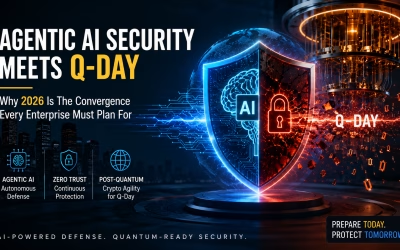
However, sufficiently powerful quantum computers could eventually break many of today’s widely used encryption methods.
Even before that day arrives, adversaries can adopt a “Harvest Now, Decrypt Later” strategy—stealing encrypted financial data today with the intention of decrypting it once quantum capabilities mature.
This is one of the strongest reasons organizations are beginning the transition toward post-quantum cryptography (PQC) and quantum-resistant security architectures.
Why Payment Infrastructure Must Become Quantum-Ready
Modern payment ecosystems require protection that extends beyond current threats.
Organizations should prioritize:
- Quantum-resistant encryption
- Zero Trust architecture
- Identity-first security
- Continuous authentication
- Secure API gateways
- AI-powered fraud detection
- Network segmentation
- Real-time monitoring
Financial security is becoming inseparable from network security.
The Role of Enterprise Networks
Fast payments require resilient networks.
Every transaction travels through:
- Cloud infrastructure
- Internet service providers
- Data centers
- Telecom carriers
- Financial APIs
- Identity providers
If any component is compromised, payment integrity suffers.
Organizations therefore need secure networking strategies that include:
- Encrypted communications
- Continuous threat detection
- Intelligent routing
- High availability
- Secure edge computing
- Quantum-resistant communication paths
AI Will Handle More Than Payments
Future AI systems may autonomously:
- Negotiate vendor contracts
- Execute recurring purchases
- Manage enterprise budgets
- Optimize logistics spending
- Balance cloud computing costs
- Allocate marketing budgets
- Purchase cybersecurity services
This transforms payments into machine-generated decisions rather than human actions.
Security must therefore protect both people and autonomous software agents.
Regulatory Questions Remain
Governments worldwide are still determining how to regulate:
- AI financial agents
- Digital identity
- Stablecoins
- CBDCs
- Cross-border payments
- Consumer protection
- Privacy
- Financial transparency
Compliance will become increasingly important as payment systems evolve.
Organizations operating globally must prepare for varying regulatory frameworks.
What Businesses Should Do Today
Whether or not Musk’s long-term prediction comes true, organizations should begin preparing for the next generation of digital commerce.
Recommended priorities include:
Modernize Payment Infrastructure
Support API-first architectures capable of integrating with emerging payment platforms.
Adopt Zero Trust Security
Verify every user, device, and workload continuously.
Prepare for Post-Quantum Cryptography
Develop migration plans aligned with evolving cryptographic standards.
Strengthen Identity Management
Implement strong authentication and least-privilege access controls.
Invest in AI-Powered Security
Leverage machine learning for anomaly detection and fraud prevention.
Secure Enterprise Networks
Ensure payment traffic is protected across hybrid cloud and edge environments.
The Bigger Picture
Elon Musk’s statement that money could eventually become obsolete should not be interpreted literally as the disappearance of economic value.
Instead, it points toward a future where:
- Payments become invisible.
- AI performs transactions autonomously.
- Digital identity becomes central.
- Financial services integrate directly into everyday applications.
- Secure networking becomes as critical as the payment systems themselves.
For enterprises, the challenge is not simply adopting new payment technologies—it is building secure, resilient, and quantum-ready digital infrastructure capable of supporting the next era of commerce.
Why This Matters for Enterprise Leaders
At ibm/SEIMless, we believe the future of payments depends on more than innovation—it depends on trust.
As digital transactions become increasingly autonomous and interconnected, organizations need infrastructure that is:
- Secure by design
- Resilient against evolving cyber threats
- Ready for the post-quantum era
- Built to support AI-driven business operations
The convergence of AI, advanced networking, and next-generation cybersecurity will define the winners of tomorrow’s digital economy. Businesses that begin preparing today will be best positioned to operate securely in a world where value moves faster than ever before.
(FAQ)
1. Did Elon Musk say money will become obsolete?
Musk has suggested that future AI-driven economies could reduce the traditional role of money, emphasizing automated digital value exchange. His broader vision aligns with integrated digital financial ecosystems rather than the immediate elimination of currency.
2. What is X Money?
X Money is the payment platform being developed for X (formerly Twitter), intended to support peer-to-peer transfers, creator monetization, merchant payments, and other financial services within the platform.
3. Why is quantum computing a concern for payment systems?
Quantum computers could eventually compromise widely used public-key cryptography, making it necessary for organizations to adopt post-quantum cryptographic standards to protect future financial transactions.
4. How will AI change digital payments?
AI agents are expected to automate purchasing, subscriptions, supply-chain transactions, and financial decision-making, creating a machine-to-machine economy that requires highly secure, intelligent payment infrastructure.
5. How can enterprises prepare for the future of digital payments?
Organizations should modernize payment architectures, implement Zero Trust security, strengthen identity management, deploy AI-driven threat detection, and begin transitioning toward quantum-resistant cybersecurity.