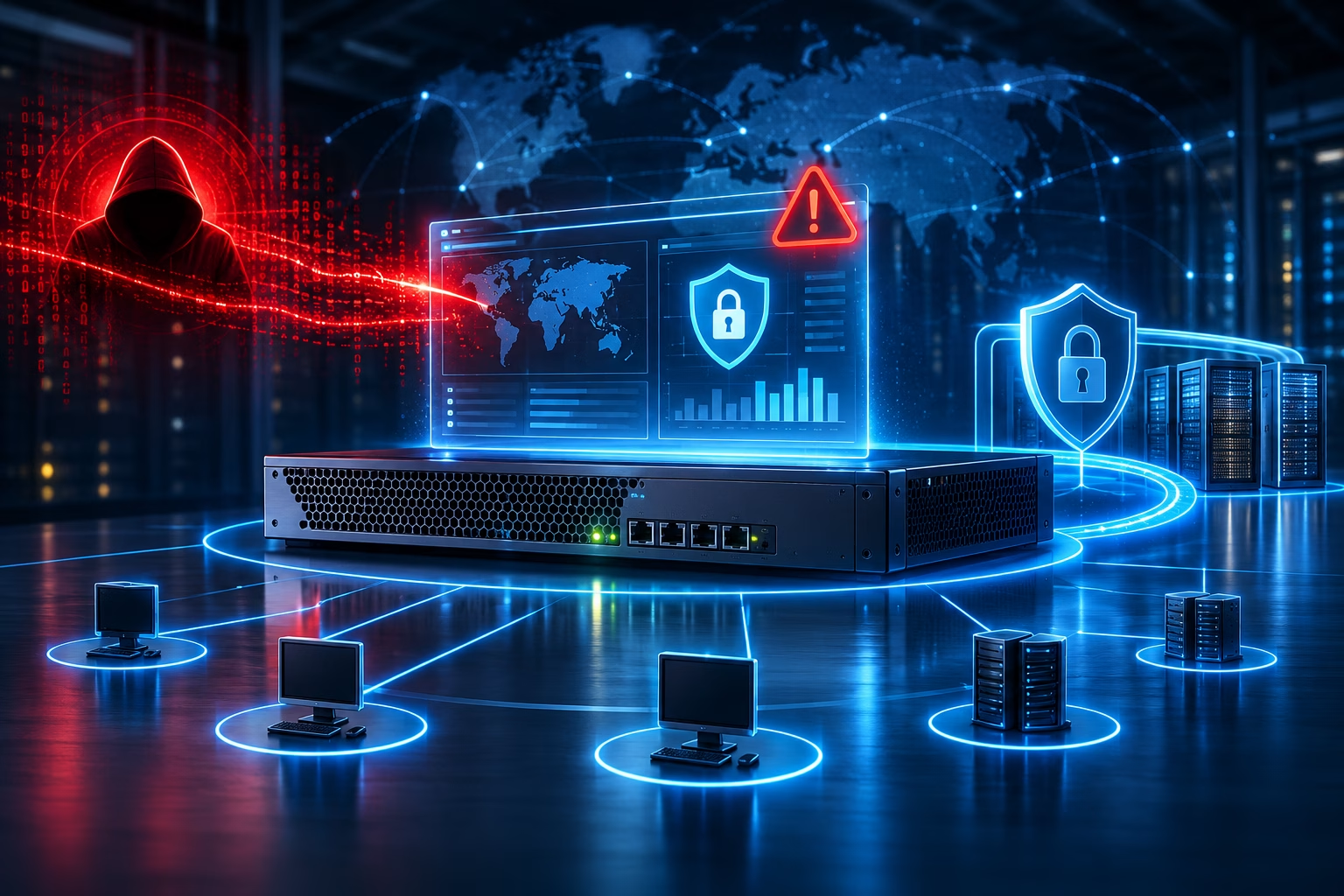
A firewall management interface is supposed to be the quietest door in your network: one administrative page that only a handful of engineers should ever see. In late October 2026 it became the front door for a suspected China-nexus campaign. SecurityWeek reported that attackers chained a pair of PHP flaws called PHP2Shell with a Linux kernel bug to gain root on Palo Alto Networks firewalls, and that the firewalls involved had a management interface reachable from the public internet. This guide explains what happened, why the lesson reaches every vendor and every regulated industry, and how to lock down your own firewall management interface in 30 days.
Definition: A firewall management interface is the administrative web page, API or command line used to configure a firewall. It controls every rule, certificate and stored credential on the device, so it should be reachable only from a small set of trusted internal addresses and never from the public internet.
Key Takeaways on Firewall Management Interface Security
- Exposure was the enabling condition: Palo Alto Networks says no special configuration is needed to be affected, but risk is highest when the management interface is reachable from the internet.
- Speed: researchers at Dream reported that the full chain, from one unauthenticated web request to a persistent root web shell, takes under 15 minutes.
- The firewall was a stepping stone: after rooting devices, the attackers went after an LDAP service account and Active Directory.
- Patching is not the finish line: anyone compromised before a fix was applied can still hold tunnels and stolen credentials.
- The cure is mostly design: remove public access, broker administration, log off-box and hunt for compromise.
What Happened: PHP2Shell Meets the Firewall Management Interface
PHP2Shell is the name for two flaws, CVE-2026-109618 and CVE-2026-109619, that allow unauthenticated remote code execution. The Hacker News reports a CVSS score of 9.2 and says the PHP Foundation fixed them upstream on October 21, 2026, in PHP 8.5.12, 8.4.27, 8.3.36 and 8.2.35. Palo Alto Networks appliances bundle their own PHP runtime, so the vendor shipped separate hotfixes. It affects the management web interface, meaning the HTTPS web UI and the XML API, on PAN-OS 10.2, 11.1, 11.2, 12.1 and 12.2 and on Panorama. Traffic passing through the firewall is not the issue, and GlobalProtect is not affected. Field Effect adds that Siemens published an advisory for its RUGGEDCOM APE1808, which runs PAN-OS.
| Date (2026) | Event |
| Oct 20 | Palo Alto Networks releases Threat ID 543004 for customers with Frontier Virtual Patching |
| Oct 21 | PHP Foundation releases upstream fixes |
| Oct 23 | Dream says exploitation began; Siemens publishes its RUGGEDCOM advisory |
| Oct 28 | Palo Alto Networks confirms active exploitation of internet-exposed management interfaces; CISA adds the Linux kernel flaw Fragnesia (CVE-2026-46300) to its Known Exploited Vulnerabilities catalog |
| Oct 30 | Palo Alto Networks reports patches for all vulnerable PAN-OS branches |
| Oct 31 | Federal deadline for the Fragnesia fix, as reported |
Reporting differs by a day on when Palo Alto Networks sounded the alarm; one outlet says October 29, while the vendor’s advisory update and several others say October 28. We use October 28.
The Console-on-the-Curb Problem: Why an Exposed Firewall Management Interface Is So Dangerous
We call the core issue the console-on-the-curb problem: a device that exists to protect the network has an administrative door facing the street. A firewall sees every packet, holds the VPN and directory credentials, and often stores the keys that let it talk to Active Directory. Anyone who owns the console owns a trusted vantage point inside the perimeter. That is why a firewall management interface that faces the internet is a different class of risk from an exposed web server.
The Register, citing Dream, reports that the attackers used the FOFA search engine to fingerprint about 19,000 internet-facing Palo Alto Networks firewalls and narrowed the list to vulnerable versions. Palo Alto Networks offers a different measurement: its Xpanse data shows under 0.01 percent of its installed base has an internet-facing management interface. Those figures count different things, so we do not try to reconcile them. Both are consistent with the same lesson: attackers search for exposed consoles at scale, and the few that are exposed are found quickly.
The timeline shows a window of about a week between the upstream fix and confirmed exploitation, and Dream says activity began two days after the PHP patch. Our post on the SonicWall MFA bypass shows the same compression on a different vendor.
How the Attack Chain Worked Against the Firewall Management Interface
At a summary level, the reported chain has two parts. First, PHP2Shell gives an unauthenticated attacker command execution as a low-privilege user through the web interface. Second, Fragnesia, a high-severity local privilege-escalation flaw in the Linux kernel’s XFRM ESP-in-TCP subsystem, turns that foothold into root. CISA’s KEV entry notes the two can be chained to plant PHP web shells and run commands as root. Dream says the exploit does not resemble any known public code and appears to have been built for the target platform after the attacker obtained the firmware, decrypted it and profiled nine software versions.
The effort shows intent. Dream counted about 40 custom post-exploitation scripts, and recovered artifacts included AI-assisted tooling and FOFA API keys. Dream stresses the operation was not fully autonomous. Unit 42, Palo Alto Networks’ research group, independently verified the tooling and tracks the cluster as CL-UNK-1280, attributed to a Chinese-speaking actor, according to The Hacker News.
After the Firewall Management Interface: The Identity Pivot
Root on a firewall is rarely the goal; it is the launch pad. According to Dream’s findings as relayed by The Register and Field Effect, the attackers decrypted an LDAP service account password, enumerated domain users and groups, ran password spraying against every account, opened reverse SSH tunnels and tried to create backdoor accounts and extract SAML signing keys. Dream does not know whether those last two attempts succeeded, because the results stayed on a management server it could not recover. Dream also describes the attackers tunneling into the internal network of a government-affiliated organization and compromising a third server within hours, and warns they likely still have access.
This matches a pattern we covered in help desk impersonation and AD CS abuse: once an attacker holds a trusted position, directory credentials become the prize. It also echoes the VMware ESX zero-day, where the device that should record events was itself the target. A service account stored on a firewall is a credential you must treat as exposed if the box is ever compromised.
A Seven-Control Plan for Your Firewall Management Interface
| # | Control | What good looks like |
| 1 | Find every management surface | Inventory of every firewall, Panorama-style manager and appliance with its management address, web UI, API and attached management profiles |
| 2 | Remove public access | No management interface reachable from the internet, confirmed by an external scan, not by reading configuration alone |
| 3 | Broker administration | Admins connect through a jump host or privileged-access gateway with multi-factor authentication and session recording |
| 4 | Patch to a fixed release | Hotfix for your exact maintenance release applied; emergency change path agreed in advance |
| 5 | Limit what the box can read | Least-privilege LDAP bind accounts, no reuse, rotation after any suspected compromise |
| 6 | Log off the device | Firewall logs streamed to a SIEM so evidence survives tampering on the box |
| 7 | Hunt for compromise | Review for unexpected outbound SSH, web shells, unusual admin activity, credential access and directory reconnaissance |
Control two carries the most weight. Palo Alto Networks and Unit 42 name removing public access and restricting the interface to trusted internal IP addresses as the primary recommendation. For branches that could not apply a hotfix right away, the vendor listed compensating controls: route management traffic through a dataplane interface with a management profile, replace the certificate used for inbound management traffic, decrypt inbound management traffic so the firewall can inspect it, and enable threat prevention on it. Treat those as stopgaps, not as a replacement for the fix.
What to do in the first 24 hours
- Scan every public address you own from outside your network and list every responding administrative page.
- Check each dataplane interface for an attached management profile, since that can expose the interface even if the dedicated port is closed.
- Apply the hotfix for your maintenance release; PAN-OS 12.2 requires 12.2.4-h1 or later, per Field Effect.
- If an interface was ever exposed on a vulnerable version, assume compromise until a hunt says otherwise, and start with the credentials the firewall can read.
Hunting Past the Patch: Was Your Firewall Management Interface Breached?
A fix removes the door but does not evict someone already inside. Field Effect’s guidance is a good starting list: look for unexpected outbound SSH, web shells, unusual administrator activity, credential-access attempts and Active Directory reconnaissance; rotate credentials used by exposed firewalls, including LDAP service and admin accounts; review the directory for password spraying, new accounts and unauthorized changes; patch the Linux kernel flaw on other Linux systems; and forward firewall logs off the device. In MITRE ATT&CK terms, the behaviors to look for map to exploiting public-facing applications, web shells, protocol tunneling and password spraying. Our guide to EDR explains how endpoint telemetry helps on the servers the attacker reached next.
Not Just One Vendor: A Firewall Management Interface Is an Industry-Wide Weak Spot
This is not a Palo Alto Networks problem alone. In 2023 CISA issued BOD 23-02, which directs federal agencies to take internet-exposed management interfaces of networked devices off the internet or protect them with a gateway that enforces access control. That logic applies to every firewall, VPN gateway, load balancer and switch. We covered the cost of leaving older gear in place in our end-of-support edge devices guide, and the same reasoning behind BOD 26-04 and the Known Exploited Vulnerabilities catalog is a fair prioritization tool for non-federal teams.
The firewall is also where encryption keys and trust meet. Our analysis of SD-WAN encryption keys and KeyDrift shows how a compromised edge box can expose key material, which is one reason key custody belongs on your firewall review checklist. For the physical-world version of the same lesson, see cold chain cybersecurity, where controllers reachable from the internet were the common thread.
Network Architecture That Keeps the Firewall Management Interface Private
Closing a firewall management interface is mostly a network-design task, which is where ibm/SEIMless works. A dedicated out-of-band management network keeps administrative traffic away from user and internet paths. A modern next-generation firewall enforces who may reach that network, while zero trust content security and per-session access replace the standing admin port. An SD-WAN fabric and MPLS replacement design can keep branch administration on private, segmented paths. Detection such as Exodus Aria ADR helps surface unusual administrative activity, and backup and recovery together with immutable backups keep a clean configuration to rebuild from.
Because attackers who reach a firewall can read stored secrets, strong key management and protection for data in motion limit what any one stolen box can reveal, a point that matters more as adversaries collect encrypted traffic today for decryption later. Our broader guide to securing applications anywhere explains consistent policy across environments. An honest note: the attacks described here exploited a software flaw and an exposed interface, not a weakness in encryption, and no product named in this post is claimed to have stopped them. The point is to remove the conditions the reporting describes.
Regulatory and Sector Lens for the Firewall Management Interface
- Financial services: the FFIEC IT Examination Handbook expects network and access controls on critical infrastructure, and NYDFS 23 NYCRR 500 requires access privilege limits and multi-factor authentication for remote access, which includes administrative paths.
- Healthcare: the HIPAA Security Rule requires technical safeguards and risk analysis that should cover every administrative interface.
- Public companies: the SEC cybersecurity disclosure rules require timely disclosure of material incidents, so an unknown firewall compromise is also a disclosure risk.
- Insurers and other covered entities: the FTC Safeguards Rule and state laws modeled on the NAIC model law require access controls, and underwriters increasingly ask about edge-device exposure.
- Everyone: NIST SP 800-41 Rev. 1 on firewalls, NIST SP 800-92 on log management, NIST SP 800-207 on zero trust, the NIST Cybersecurity Framework 2.0 and CISA’s Cross-Sector Cybersecurity Performance Goals give a common language. Report incidents to the FBI Internet Crime Complaint Center.
For threat context, see the Verizon Data Breach Investigations Report, the CIS Critical Security Controls, the OWASP Top 10, PHP release notes and ongoing coverage from BleepingComputer.
What We Still Don’t Know About This Firewall Management Interface Campaign
Several questions remain open. Dream did not name the firewall vendor in its report, and the link to Palo Alto Networks comes from press coverage and the vendor’s own advisory. The method used to find the first victim, how many organizations beyond the 25 devices Dream counted were affected, and whether the persistent tunnel into a government-affiliated network has been closed are not public. CISA and the FBI declined to comment to The Register. Attribution to a China-nexus actor is a researcher assessment, not an official finding. Plan against the conditions, an exposed console, an unpatched web component and a readable service account, rather than against any single named actor. Confirm exact build numbers in the vendor advisory before you change production.
A 30-Day Firewall Management Interface Lockdown Plan
| Week | Action | Output |
| 1 | Inventory every management surface; scan externally; close public access; apply hotfixes | Device register; external scan report; patch log |
| 2 | Hunt for compromise; rotate LDAP, admin and service credentials the firewalls can read; stream logs off-box | Hunt findings; rotation log; SIEM onboarding record |
| 3 | Build or verify an out-of-band management network; route admin access through a brokered, multi-factor gateway | Segmentation diagram; admin access policy |
| 4 | Extend the review to VPN gateways, load balancers and switches; write an emergency-patch runbook and rehearse it | Edge-device register; tabletop results |
Frequently Asked Questions About the Firewall Management Interface
What is a firewall management interface?
It is the administrative web page, API or command line used to configure a firewall. It controls every rule and stored credential, so it should be reachable only from a small set of trusted internal addresses.
What is PHP2Shell?
It is the name for two PHP flaws, CVE-2026-109618 and CVE-2026-109619, that allow unauthenticated remote code execution. The PHP Foundation fixed them on October 21, 2026, and Palo Alto Networks confirmed on October 28 that attackers were exploiting them against internet-exposed management interfaces.
Which products are affected?
Palo Alto Networks lists PAN-OS 10.2, 11.1, 11.2, 12.1 and 12.2 plus Panorama, and Siemens published an advisory for its RUGGEDCOM APE1808, which runs PAN-OS. The vulnerable component is the management web interface.
Is patching enough?
No. Patching closes the door, but attackers who got in first may still hold web shells, tunnels and stolen credentials. Hunt for compromise, rotate credentials the firewall could read and remove public access.
How do I know if my interface is exposed?
Scan every public address you own from outside your network and check each interface for an attached management profile. Palo Alto Networks’ primary recommendation is to remove public access and restrict the interface to trusted internal addresses.
Does this only affect Palo Alto Networks customers?
This campaign targeted PAN-OS, but the lesson applies to every vendor. CISA’s BOD 23-02 exists because internet-facing management interfaces have been abused across many products.
Is Your Firewall Management Interface Visible From the Internet Today?
ibm/SEIMless Communications Technologies, Inc. and Exodus QRN, Inc. help financial services, healthcare and insurance organizations isolate, monitor and secure the networks behind their critical systems, including the administrative paths that attackers search for first. Let’s map your firewall management interface exposure and close it together.
Call: 646-546-5245
Email: in**@**********ss.com
Address: One Liberty Plaza, New York, NY 10006
Sources and Further Reading
- The Hacker News: Attackers exploit PHP2Shell flaws in Palo Alto Networks management interfaces
- SecurityWeek: PHP2Shell attacks root Palo Alto firewalls but fail against WordPress
- NVD: CVE-2026-109618 NVD: CVE-2026-109619 · NVD: CVE-2026-46300 (Fragnesia)
- Palo Alto Networks security advisory: CVE-2026-109618
- Also consulted: The Register’s report on Dream’s findings and Field Effect’s PHP2Shell summary (non-U.S. outlets, not linked in the body).
- SANS Institute Cybersecurity Dive · Dark Reading