
For two years, the security conversation about AI was about models: what they might say, leak, or get tricked into revealing. That conversation is now incomplete. AI agents plan, call tools, read files, and use real credentials, and they do it inside your network. AI agent security has become a question about who, or what, is acting with your authority.
That shift is the theme of “The Agent State Has Arrived,” a CrowdStrike virtual event set for November 18, 2026 at 2 p.m. ET. Whatever vendor you use, the message deserves a vendor-neutral reading, and that is what this guide offers: what changed, what the evidence does and does not show, and six controls that define AI agent security for enterprises.
What is “the agent state”? It is the condition in which autonomous AI agents operate as software actors inside the enterprise, running commands, accessing data, and using delegated credentials. In that state, an agent can cause a breach without being malicious, simply by following instructions that are wrong, stale, or tampered with. Securing it means discovering every agent, limiting what each can do, watching what it does, and being able to stop it.
Key Takeaways
- Agents are insiders. They hold credentials and act on your behalf, so they belong in your insider-risk model.
- Harm does not require malice. Error, drift, and poisoned inputs can all cause damage.
- The market is converging on four capabilities: discovery, runtime enforcement, observability, and a kill switch.
- Treat vendor statistics as claims. Several headline numbers come from the vendors selling the fix.
- AI agent security includes the network. Egress policy and segmentation limit any agent, from any vendor.
What “The Agent State” Means for AI Agent Security
The event’s pitch is direct: agents do not have to be malicious to cause breaches, because they can follow legitimate instructions and still produce unintended harm. In CrowdStrike’s framing, that makes agents a new kind of insider threat, and the prescription is to find every agent, stop dangerous behavior at runtime, and keep continuous oversight.
The idea is not confined to one company. CrowdStrike’s own insider-threat analysis notes that an agent can drift without tripping an alarm when something upstream changes, such as a tampered tool or an unexpected instruction. At Fal.Con in September, its president told attendees that every agent has an identity, and that in most cases it is an overprivileged one, as BizTech Magazine reported.
We agree with the direction and want to be careful about the framing. Agents are also a genuine productivity tool. The goal of AI agent security is not to stop adoption; it is to make adoption safe enough to continue.
Why AI Agent Security Is Now an Insider Problem
A traditional insider is a person with access and a motive. An agent is a process with access and a task. Four features make it riskier than ordinary software:
- Delegated credentials. Agents often run with a user’s permissions, so their reach equals the user’s reach.
- Autonomy at speed. An agent can chain dozens of actions before a human reads the first log line.
- Soft failure modes. Hallucination, drift, and misread instructions produce harmful actions that look like normal work.
- Trusted input channels. Documents, web pages, and tool outputs can carry instructions the agent obeys. See our earlier posts on agent documentation and memory and the undeclared agent problem.
Security researchers track these patterns in the OWASP GenAI Security Project and the MITRE ATLAS knowledge base of adversarial AI techniques. Both are good starting points for threat modeling.
What the Market Announced in November
Several product announcements arrived within days of each other. They are worth reading as a signal of where AI agent security is heading, not as a buying guide.
| Capability | What was announced | Status as reported |
| Discovery and enforcement | Falcon Guardian finds the AI agents running in a company and shuts down unapproved ones; announced Sept. 1 | Available since September |
| Kill switch | AI Kill Switch directs connected AI gateways to block model access, and can end endpoint agents and prevent restarts | Announced Nov. 3; available to Guardian customers |
| Observability | Planned Fiddler acquisition to deliver Falcon Observe, a “flight recorder” for agents | Deal announced Nov. 3; general availability targeted for Q4 FY27 |
| Behavioral detection | Agent Insider Threat Detection learns normal behavior for an agent and its owner and flags deviations even when no policy is violated | Slated for Q4 |
Two cautions apply. First, planned products are not shipping products, and the acquisition had not closed at announcement. Second, a vendor’s own endpoint-based design has its own scope: one analyst brief noted that coverage for cloud-native and containerized agents was not characterized in public sources. Test any claim against your own environment.
Reading the Numbers Without the Hype
Three statistics are circulating. Each deserves context.
- “Agentic incidents doubled twice.” CrowdStrike’s CEO said agentic incidents roughly doubled from July to August and again from August to September. That is a vendor-reported figure from a keynote, without a published definition of “incident” in the coverage we reviewed.
- Breakout time of 29 minutes. The CrowdStrike 2026 Global Threat Report put average eCrime breakout time at 29 minutes, with a fastest case of 27 seconds. It describes attackers in general, not only agent activity.
- 82% malware-free detections. CrowdStrike says 82% of 2025 detections involved no malware, consistent with identity-driven intrusion. This supports prioritizing identity controls, whatever your product choices.
A balanced CSO Online analysis points out the limits of confidence: what happens when millions of agents act at machine speed on both sides is something nobody can be certain about yet. We think that honesty is the right posture. For broader context on breach costs and patterns, consult the IBM Cost of a Data Breach report and the Verizon Data Breach Investigations Report.
The Delegation Gap
We use the term delegation gap for the distance between what a human intended to authorize and what an agent holding their credentials is technically able to do. A manager who says “summarize this folder” has authorized a task. The agent, running as that manager, can usually read email, move files, and call internal APIs too. Every unit of that unused authority is risk.
The delegation gap explains why agent incidents are hard to spot. No credential was stolen and no exploit ran. The agent used permissions it was legitimately given, which is also why detection must focus on behavior, not signatures. It is the same logic that made the Outlook credential-leak flaw and help desk impersonation so effective: attackers prefer to borrow trust than to break in.
Six Controls That Define AI Agent Security
Six controls anchor any AI agent security program, and none depends on a particular product.
1. Discover every agent
You cannot govern what you cannot see. Build an inventory of sanctioned and shadow agents: who deployed each, where it runs, which tools and data it reaches. Our earlier analysis of third-party risk applies here, because many agents arrive inside vendor products.
2. Give each agent its own identity
Do not let agents borrow a human’s login. Issue a unique, least-privilege, short-lived identity per agent, tied to an accountable owner. The NCCoE project on software and AI agent identity and authorization is tracking standards in this area, and NIST SP 800-63B remains the baseline for authentication strength.
3. Constrain at runtime and at the edge
Allowlist the tools, domains, and data stores each agent may use, and deny the rest. This is zero trust applied to software actors, as described in NIST SP 800-207.
4. Make behavior observable
Log prompts, tool calls, and outcomes in a tamper-resistant record so an investigator can answer “what did it do and why?” The NIST SP 800-53 audit and accountability controls are a practical template.
5. Be able to stop an agent
Define, in advance, how you revoke an agent’s identity, block its model access, cut its network path, and quarantine its host. Then rehearse it. The incident-handling structure in NIST SP 800-61 Rev. 3 fits.
6. Test before you deploy
Red-team agents against prompt injection, tool misuse, and data exfiltration before production. NIST SP 800-218A covers secure development practices for generative AI, and the NIST AI Risk Management Framework supports governance.
Where Network Design Closes the Gap
Agent-specific products are only part of the answer. The network decides what any agent can reach, and that holds regardless of vendor. ibm/SEIMless approaches AI agent security at the network layer in these ways:
- Egress and content policy: the Exodus NxtGen Firewall and Zero Trust Content Security.
- Behavioral detection and response: Exodus Aria ADR and EDR, where agents execute.
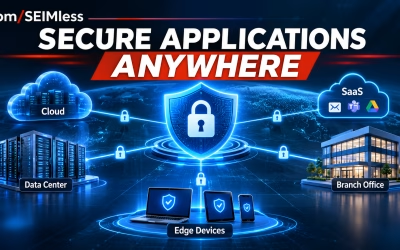
- Uniform policy across sites: SD-WAN or an MPLS replacement built so every branch enforces the same agent rules, the principle behind Secure Applications Anywhere.
- Contained workspaces: Desktop as a Service and a private hybrid cloud limit what a runaway agent can touch.
- Protected data and keys: Exodus Key Management, Data in Motion, Data at Rest, and Transparent Encryption.
- Recovery: backup and recovery for the day an agent corrupts what it was meant to help.
Agents also move sensitive data over long periods, which brings the quantum-era encryption question into the same conversation. For agent-to-agent risk inside financial services, read our post on blind agent transfer, and for the offensive side, the AI agent botnet warning.
Federal and Regulatory Guidance to Anchor Your Program
No single U.S. rule governs AI agents yet, but existing frameworks already apply. Start with the CISA AI resources, NIST’s Center for AI Standards and Innovation, and NSA’s cybersecurity guidance. For program structure, use NIST CSF 2.0, CISA’s Cross-Sector Cybersecurity Performance Goals, and the Secure by Design expectations you can put to vendors.
Financial services. The Federal Reserve’s SR 26-2 on model risk, the NYDFS cybersecurity regulation, the FFIEC IT Handbook, and SEC cyber disclosure rules all expect governance, monitoring, and incident readiness. The FTC Safeguards Rule reaches non-bank lenders.
Healthcare. The HIPAA Security Rule requires access control and audit logging, which an agent touching patient records must satisfy.
Insurance and consumer-facing firms. The FTC’s AI guidance signals scrutiny of deceptive or unsafe AI use, and the FBI Internet Crime Complaint Center is where AI-enabled fraud is reported.
A 90-Day Plan
Here is a practical sequence for starting AI agent security work without a large budget.
| Window | Action | Owner |
| Days 1–30 | Inventory agents and tool access; name an owner for each; freeze new agent credentials that reuse human logins | Security and IT |
| Days 31–60 | Issue per-agent identities; add egress allowlists; turn on agent audit logging; draft the stop procedure | Identity and network teams |
| Days 61–90 | Rehearse the kill path; red-team two high-value agents; add agents to the insider-risk program and board reporting | CISO and risk |
The Bottom Line on AI Agent Security
The agent state is not a product category; it is a change in who acts inside your environment. Products will mature, announcements will be revised, and some claims will not survive scrutiny. What lasts is the discipline: know your agents, bound their authority, record their actions, and keep a hand on the switch. The risk-based approach we recommend for patching applies here too: spend effort where an agent’s reach and your data’s value are highest.
Frequently Asked Questions
What does “the agent state has arrived” mean?
It describes AI agents operating as autonomous software actors inside the enterprise, so security teams must govern them like a new class of insider. It is also the title of a CrowdStrike virtual event on November 18, 2026.
Why are AI agents called an insider threat?
They run inside your network with delegated credentials, and can cause harm by following legitimate but flawed, stale, or tampered instructions, without any malicious intent.
What is an AI kill switch?
A central control that lets a human cut an agent off quickly, for example by blocking its model access through a gateway, terminating its process, or removing its network access.
What controls does AI agent security need?
AI agent security needs six: discovery, per-agent least-privilege identity, runtime and egress constraints, observability and audit logs, a tested way to stop an agent, and pre-deployment testing.
Do I need a specific vendor to secure agents?
No. The control objectives are vendor-neutral. Test any product against your own agent inventory, identity model, and network architecture before you buy.
How can ibm/SEIMless help?
We design egress controls, segmentation, endpoint detection, and quantum-resistant networking for medium and enterprise organizations. Call 646-546-5245 or email in**@**********ss.com.
Put Guardrails Around Your Agents Before They Act
Whether you need an agent inventory, an egress review, or a network design that limits any agent’s reach, our engineers can help. Explore services on the ibm/SEIMless home page, then talk with a specialist.
Phone: 646-546-5245
Email: in**@**********ss.com
Address: One Liberty Plaza, New York, NY 10006
Sources and Further Reading
Event and product details (the November 18 event, Falcon Guardian, AI Kill Switch, Fiddler acquisition, Agent Insider Threat Detection, and the cited statistics) come from CrowdStrike releases and blogs and from trade coverage published September through November 2026. ibm/SEIMless is vendor-agnostic and does not endorse any product named here. Verify product status and availability with each vendor.