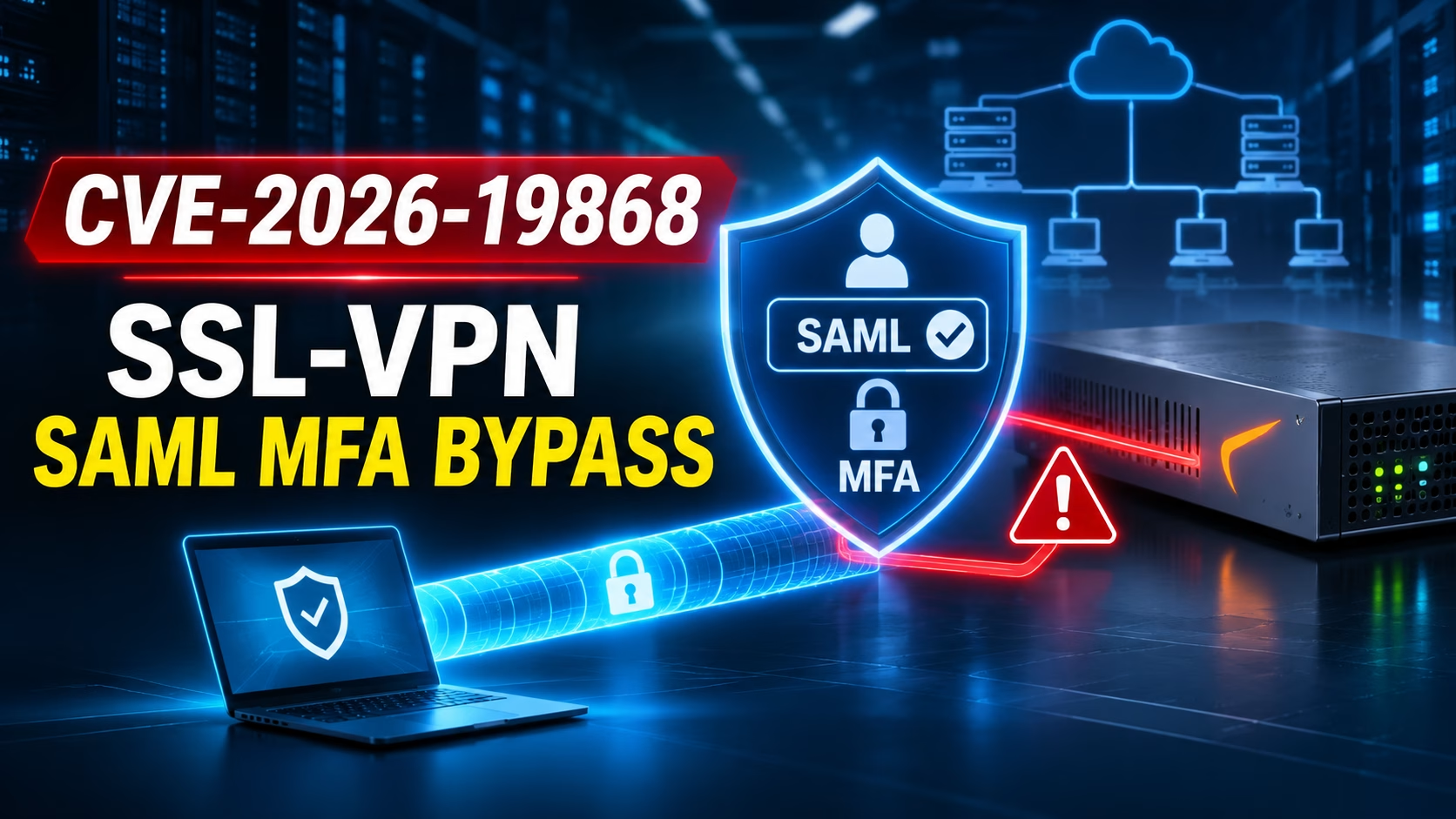
The SonicWall MFA bypass tracked as CVE-2026-19868 is now confirmed as exploited in real attacks, and the federal patch deadline lands this Friday, November 20. eSecurity Planet reports that CISA added the flaw to its Known Exploited Vulnerabilities (KEV) catalog on November 6, confirming that attackers have used a weakness capable of defeating SAML authentication controls, including multi-factor authentication. If your firewall terminates SSL VPN logins with SAML, this is a same-week job. This guide explains how the SonicWall MFA bypass works, who is affected, what to do in the next 48 hours, and why the deeper lesson is about architecture, not just patching.
Definition: The SonicWall MFA bypass (CVE-2026-19868) is an authentication enforcement flaw in the SonicOS SSL VPN service that lets a user holding valid credentials for an alternate login method skip SAML checks and, with them, any SAML-enforced multi-factor authentication.
Key Takeaways on the SonicWall MFA Bypass
- Exploited, not theoretical: CISA listed it in KEV on November 6, 2026, with a November 20 deadline for federal civilian agencies.
- Affected: SonicOS Gen7 7.3.3-7015 and earlier, and Gen8 8.2.2-8015 and earlier, when SAML is enabled for SSL VPN logins.
- Fixed: SonicOS 7.3.4-7013 (Gen7) and 8.2.3-8015 (Gen8). BleepingComputer reports no workarounds are available.
- Not unauthenticated: the attacker needs valid credentials for an alternate authentication method.
- Bigger lesson: strong MFA on one login path means little if a second path still accepts a password.
What Happened: The SonicWall MFA Bypass at a Glance
SonicWall published advisory SNWLID-2026-0014 on November 6, 2026. It bundles seven vulnerabilities, and per ITPro the affected builds are the same Gen7 and Gen8 lines for the group. Only CVE-2026-19868 is marked as exploited. SecurityWeek notes that federal agencies must address it by November 20 under CISA’s Binding Operational Directive 26-04.
| Item | Detail |
| CVE | CVE-2026-19868 · CWE-308 (use of single-factor authentication) |
| Component | SonicOS SSL VPN service |
| Condition | Exploitable only if SAML is enabled for SSL VPN logins |
| Affected | Gen7: 7.3.3-7015 and earlier · Gen8: 8.2.2-8015 and earlier |
| Fixed | Gen7: 7.3.4-7013 · Gen8: 8.2.3-8015 |
| KEV added / due | November 6, 2026 / November 20, 2026 (CISA KEV catalog) |
| Discovered by | Ryan Harris of Electronic Office, per Help Net Security |
How the SonicWall MFA Bypass Works: The Second-Door Problem
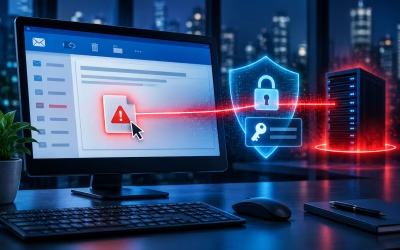
Most coverage describes the flaw the same way: SonicOS fails to enforce SAML when a user authenticates through an alternate method. Picture a building where the front door has a guard, a badge reader and a camera, while a side door accepts a key. We call this the second-door problem, and it is the core of the SonicWall MFA bypass: strong authentication on the path you designed, and a weaker path that still works. An attacker who already holds a valid credential, perhaps from a phishing kit, an infostealer or a reused password, walks through the side door and never meets the SAML prompt or the MFA challenge behind it.
This is why the severity story is more nuanced than a headline suggests. eSecurity Planet stresses that the flaw does not hand an unauthenticated stranger access to the firewall. But MFA exists precisely for the case where a password has leaked, and that is the case the bypass erases. The attack technique maps to valid accounts and external remote services in MITRE ATT&CK, two of the most common routes into enterprise networks.
A repeat pattern for SSL VPN appliances
This is not the first SonicWall MFA bypass. Help Net Security notes that attackers exploited CVE-2024-12802, another SonicWall SSL VPN MFA bypass, in multiple environments. Internet-facing remote access gateways are attractive because one flaw, like this SonicWall MFA bypass, can expose many organizations at once. We covered the same dynamic for SD-WAN in our post on SD-WAN encryption keys and for aging perimeter gear in end-of-support edge devices.
Why a 7.1 Outranks Two 8.8s: Exploitation Beats Score
Scores disagree across sources. SonicWall’s CVE-specific rating is reported as 7.1, while other coverage, such as Security Affairs, lists 7.5. Either way, it sits below two 8.8-rated management interface flaws in the same advisory. A security analyst quoted by CSO Online pointed out that the lower-scored bug is the one CISA put in KEV the same day SonicWall disclosed it.
The SonicWall MFA bypass is a useful teaching moment. NVD scoring measures potential impact; KEV measures evidence. A flaw attackers are using on an internet-facing gateway outranks a higher score with no known use. Treat the two 8.8 flaws seriously, but patch all seven in one maintenance window since the fix train is the same.
Are You Affected by the SonicWall MFA Bypass? A Five-Minute Check
- Inventory SonicWall firewalls, including virtual appliances, branch units and anything a managed provider operates for you.
- Record the SonicOS version. Gen7 at 7.3.3-7015 or earlier and Gen8 at 8.2.2-8015 or earlier are in scope.
- Check whether SAML is enabled for SSL VPN logins. If it is not, this specific flaw does not apply, but you still need the other six fixes.
- List every other authentication method accepted by the same VPN service: local users, directory or RADIUS connections, anything legacy.
- Confirm who owns the patch. Many outages and breaches begin with a device nobody believes they manage.
The 48-Hour SonicWall MFA Bypass Response Plan
SonicWall says no workaround exists for the SonicWall MFA bypass, so patching is step one. The steps below combine vendor guidance with widely accepted hardening practice; the last four are our recommendations rather than vendor-confirmed requirements.
| Window | Action | Why it matters |
| Hour 0–8 | Upgrade to 7.3.4-7013 (Gen7) or 8.2.3-8015 (Gen8); schedule a restart window | Only a fix closes the flaw |
| Hour 8–16 | Disable alternate authentication methods you do not need on the SSL VPN service | Removes the second door |
| Hour 16–24 | Review VPN logs back to at least October for logins that lack a matching identity provider assertion, and for unfamiliar source addresses | Finds past abuse; exploitation timing is unknown |
| Hour 24–36 | Reset passwords and tokens for accounts seen in suspicious sessions; revoke active VPN sessions | Stolen credentials remain valid after a patch |
| Hour 36–48 | Confirm management interfaces are not reachable from the internet; brief leadership | The 8.8-rated flaws target management access |
Our post on the Outlook security flaw shows the same urgency logic: when CISA adds a vulnerability to KEV, the useful question is how fast you can verify and close it, not whether the score looks alarming.
What We Still Don’t Know About the SonicWall MFA Bypass
Several details remain unsettled in public reporting. According to TechBytes, it is unconfirmed whether attackers used the flaw as a zero-day before November 6 or began after disclosure. Public sources have not named the threat actors, the number of victims, or whether ransomware crews are involved. Treat those as open questions and look back through logs accordingly, rather than assuming a clean history because the advisory is only days old.
Questions to Ask Your Managed Provider About the SonicWall MFA Bypass
Many organizations do not run their own firewalls, so the first call is to the provider that does. Ask five things in writing. Which of our units run affected builds, and when will each be fixed? Is SAML enabled on our SSL VPN, and which other authentication methods are still accepted? Has anyone reviewed logs for SAML-bypassed logins since the disclosure and before it? Which credentials were reset? And who is accountable if a device is missed? Vague answers are themselves a finding. The same discipline applies to any vendor you rely on, as our look at third-party risk management shows. Document the replies, since regulators and cyber insurers increasingly ask for evidence of how quickly you acted on a known-exploited flaw.
Beyond Patching: Rethinking the Remote Access Perimeter
Patching a gateway after the SonicWall MFA bypass is necessary and, for many organizations, sufficient for this week. It is not a strategy. A VPN gateway sits on the internet, holds the keys to the internal network, and accepts logins from anywhere, which is why edge appliances keep appearing in KEV and in ransomware intrusion guidance. Four design shifts reduce your exposure to the next bypass.
1. Make MFA phishing-resistant and path-independent
CISA’s guidance on phishing-resistant MFA favors standards such as those promoted by the FIDO Alliance. FBI and CISA advisory AA23-320A makes a similar point. The goal is that no password-only path exists anywhere. NIST SP 800-63B describes authenticator assurance levels you can map to each remote access route, and the OWASP Authentication Cheat Sheet covers common implementation gaps.
2. Move from network access to application access
A traditional VPN drops an authenticated user onto a network. Zero trust grants access to specific applications after evaluating identity and device. NIST SP 800-207 defines the model, the CISA Zero Trust Maturity Model gives a roadmap, and the NCCoE zero trust architecture project publishes example builds. The NSA’s application and workload pillar guidance adds specifics. For a deeper view, read our guide to securing applications anywhere, and look at zero trust content security controls.
3. Segment so a stolen login reaches little
If an attacker does get through a gateway, segmentation decides what happens next. The NSA’s guide on selecting and hardening remote access VPNs and NIST SP 800-113 on SSL VPNs both stress limiting what remote sessions can reach. A modern next-generation firewall, an SD-WAN fabric with enforced segments, and MPLS replacement designs that keep branch traffic off the open internet all help. Our analysis of why SD-WAN is not ready for next-gen attacks explains where to look.
4. Watch identity and endpoints, not just the gateway
The first sign of a bypass is usually a login that looks normal. Detection that correlates VPN sessions with identity provider events and endpoint behavior catches it. EDR and Exodus Aria ADR are the ibm/SEIMless services in this category, and our post on help desk impersonation shows how quickly a single trusted login becomes domain-level access. Protect keys and data too: Exodus Key Management, data in motion and backup and recovery protect what sits behind the gateway, a theme we also covered in third-party risk management after the Sageworks shutdown.
An honest note: ibm/SEIMless is vendor agnostic, and we make no claim about any other vendor’s product being immune to similar flaws. The point is to reduce how much any one gateway’s bad day costs you.
Regulatory Lens: Financial Services, Healthcare and Insurance
- Banks and fintech (New York): 23 NYCRR Part 500 requires multi-factor authentication for access to information systems, fully phased in from November 1, 2025. A SonicWall MFA bypass on remote access is a control-effectiveness question for your next attestation. The FFIEC IT Handbook and the FFIEC authentication guidance set similar expectations.
- Public companies: the SEC’s cybersecurity disclosure rules make a material intrusion through an unpatched gateway a disclosure question.
- Healthcare: the HIPAA Security Rule expects access controls and audit logging for systems holding patient data.
- Insurers: state laws modeled on the NAIC Insurance Data Security Model Law require access controls and incident notification.
- Federal contractors: track FedRAMP expectations and OMB M-22-09, the federal zero trust strategy.
For context on how often stolen credentials drive breaches, see the Verizon Data Breach Investigations Report, the IBM Cost of a Data Breach Report, the CrowdStrike Global Threat Report and Mandiant M-Trends. Report intrusions to the FBI Internet Crime Complaint Center, and follow CIRCIA developments if you operate critical infrastructure.
A 30-Day Plan After the SonicWall MFA Bypass
| Week | Action | Output |
| 1 | Patch all SonicOS units; remove unused authentication methods; reset exposed credentials | Patched inventory; hardening checklist |
| 2 | Inventory every remote access path (VPN, remote desktop, vendor tunnels) and its authentication options | Path-by-path authentication map |
| 3 | Enforce phishing-resistant MFA for administrators and high-risk roles; add VPN and identity log correlation | MFA coverage report; detection rules |
| 4 | Pilot per-application access for one business unit; set a gateway replacement or segmentation roadmap | Pilot results; board summary |
Frameworks like the NIST Cybersecurity Framework 2.0, the CIS Critical Security Controls and CISA’s Cross-Sector Cybersecurity Performance Goals give you language to defend the plan to auditors and boards, and CISA’s Secure by Design principles are a fair yardstick when you question vendors.
Frequently Asked Questions About the SonicWall MFA Bypass
What is the SonicWall MFA bypass?
It is CVE-2026-19868, an authentication enforcement flaw in the SonicOS SSL VPN service that lets a user with valid credentials for an alternate login method bypass SAML checks and SAML-enforced MFA.
Which SonicOS versions are affected and what are the fixed builds?
Gen7 at 7.3.3-7015 and earlier and Gen8 at 8.2.2-8015 and earlier are affected when SAML is enabled for SSL VPN logins. The fixed releases are 7.3.4-7013 and 8.2.3-8015, and no workaround is listed.
Can an attacker use it without any credentials?
No. Reporting indicates the attacker needs valid credentials for an alternate authentication method. The flaw defeats the second factor, which is why stolen or reused passwords make it dangerous.
When is the federal deadline?
CISA added the flaw to KEV on November 6, 2026, and set a November 20, 2026 deadline for federal civilian agencies. Private organizations should treat that date as a benchmark.
Why does a CVSS 7.1 flaw get an urgent deadline?
KEV tracks evidence of real-world exploitation, not severity scores. A flaw attackers already use on an internet-facing gateway deserves faster action than a higher score with no known use.
What should we do beyond patching?
Remove unneeded authentication paths, reset exposed credentials, review VPN logs, keep management interfaces off the internet, adopt phishing-resistant MFA, and plan a move to segmented, per-application zero trust access.
Is Your VPN Gateway Protecting You, or Exposing You?
ibm/SEIMless Communications Technologies, Inc. and Exodus QRN, Inc. help financial services, healthcare and insurance organizations replace single-gateway risk with segmented, zero trust remote access. Let’s map your remote access paths and close your second door together.
Call: 646-546-5245
Email: in**@**********ss.com
Address: One Liberty Plaza, New York, NY 10006
Sources and Further Reading
- eSecurity Planet: CISA adds exploited SonicWall SSLVPN authentication bypass to KEV
- SecurityWeek: SonicWall patches exploited SonicOS bug that weakens VPN logins
- BleepingComputer: SonicWall warns of new SSL-VPN MFA bypass flaw
- CSO Online: SonicWall releases patches for seven flaws
- Cybersecurity Dive Dark Reading · SC Media · Krebs on Security · SANS Institute · OWASP
- NIST SP 800-53 Rev. 5 NIST SP 800-77 Rev. 1 (IPsec VPNs)