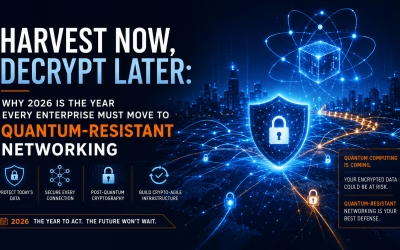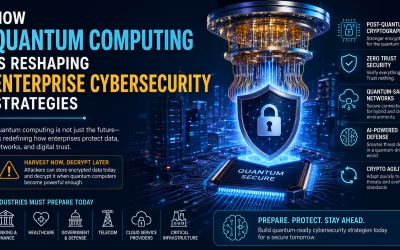

In an era where digital security is paramount, quantum networks are emerging as a groundbreaking solution. These networks promise unprecedented levels of security through the principles of quantum mechanics. This blog explores how quantum networks can revolutionize secure communication, their current state, and their potential impact on the future of cybersecurity.
Understanding Quantum Networks
It leverage the principles of quantum mechanics to enable a new era of secure communication. This section delves into the foundational concepts of quantum networking, such as entanglement and superposition, and how they differ from classical networks.
At the heart of quantum networks is the concept of entanglement, a phenomenon where quantum particles become interlinked. This interconnection means that the state of one particle can instantly influence the state of another, no matter how far apart they are. This unique property lays the groundwork for secure communication, as intercepting information would disturb the quantum state, immediately alerting the parties involved.
In contrast, traditional communication relies heavily on encryption methods that can be potentially vulnerable to sophisticated hacking techniques. The inherent security of quantum entanglement provides a safeguard that classical systems cannot match. Hence, as we explore quantum networks, we unveil a revolutionary step forward in how we perceive digital security.
Moreover, the concept of superposition enables qubits to exist in multiple states simultaneously. This characteristic significantly enhances the capacity for information processing and transmission in quantum networks. By integrating these groundbreaking principles, quantum networks promise to redefine the very landscape of secure communication today.
The Importance of Security in Communication
With the surge in data breaches and hacking incidents, securing communication channels has never been more critical. This section discusses the vulnerabilities of current communication systems and why quantum networks offer a compelling alternative.
Data breaches have become alarmingly common, leaving companies and individuals vulnerable. As hackers continuously evolve their tactics, traditional security measures often come up short. The public’s increasing reliance on digital communications amplifies these vulnerabilities, making the need for a robust security framework essential. Quantum networks rise to meet this challenge, offering a level of security that traditional methods simply cannot provide.
The flaw in classical systems often lies in the predictability of encryption keys. As computational power grows, it becomes easier for malicious actors to crack these codes. It is utilizing quantum key distribution (QKD), make it substantially harder for intruders to intercept or decipher sensitive information without being detected. This proactive approach not only secures data but also boosts users’ confidence in digital communications.
Key Technologies Behind
This section will explore the technologies driving quantum networks today, including quantum key distribution (QKD), quantum repeaters, and the role of photonic qubits in data transmission. Understanding these technologies helps to appreciate the underlying mechanisms of quantum security.
At the forefront of quantum networking is quantum key distribution (QKD), a revolutionary technique that ensures secure communication by allowing two parties to generate a shared, random secret key. QKD takes advantage of the principles of quantum mechanics, specifically the behavior of particles. If a third party tries to eavesdrop, the quantum state will change, alerting the communicators to the breach immediately. This property not only safeguards the transmission but also instills trust in the system.
Next, we delve into the technology of quantum repeaters, essential for extending the range of quantum communication. As with traditional communication networks, distance leads to signal degradation. Quantum repeaters help combat this limitation by entangling quantum states and facilitating reliable information transfer over long distances, thus paving the way for a global quantum network.
Finally, the role of photonic qubits cannot be overstated. These light-based quantum bits serve as the fundamental units of information within a quantum network. Their speed and efficiency make them ideal for transmitting information securely and at unprecedented rates. Collectively, these technologies not only showcase the ingenuity of quantum mechanics but also align seamlessly with the increasing demands for secure digital communication.
Current Research and Developments
Numerous research initiatives are underway to develop practical quantum networks. This section reviews some of the leading projects and collaborations in the field, highlighting their goals and milestones achieved so far.
Across the globe, researchers are making significant strides in quantum networking. In the United States, initiatives like Google’s Quantum AI and IBM’s Quantum Network are pioneering efforts to create quantum systems that scale. These projects aim to not only develop quantum computers but also create the infrastructure necessary for widespread quantum networking.
Moreover, in Europe, the Quantum Internet Alliance is working towards building a quantum internet framework, bridging the gap between existing networks and emerging quantum technologies. By focusing on hardware advancements and integration techniques, these collective efforts are not mere theoretical exercises; they represent tangible steps towards actualizing quantum communication on a grand scale.
Challenges Facing Quantum Networking
Despite its potential, the deployment of quantum networks faces several challenges, including technological limitations, high costs, and integration with existing infrastructure. This section discusses these hurdles and the ongoing efforts to overcome them.
The road to quantum networking is fraught with challenges. One significant hurdle is the sensitivity of quantum states to environmental disturbances. Maintaining the coherence of quantum bits over long distances requires sophisticated technology, which is still in its infancy. This need for advanced facilities adds to the overall cost of quantum networking, presenting a substantial barrier to entry for many organizations.
Furthermore, integrating quantum networks with legacy systems poses another obstacle. Many existing communications infrastructures are built upon classical principles. Transitioning to a quantum infrastructure necessitates careful planning and investment, which can deter organizations from embracing this innovative technology. Combating these challenges will require collaboration among researchers, technologists, and policymakers to foster a conducive environment for quantum networking.
The Future of Secure Communication
What lies ahead for quantum networks and secure communication? This section speculates on future advancements, potential real-world applications, and how quantum networks could reshape aspects of communication in sectors such as finance, healthcare, and national security.
As we look to the future, the integration of quantum networks in various sectors appears promising. In finance, for instance, real-time transaction security will take precedence. Quantum networks could enable banks to safeguard sensitive transactions from threats, forging a new standard of trust in digital banking. Similarly, healthcare systems could leverage quantum technology to protect patient information and ensure secure communication between medical providers.
On a broader scale, national security will undeniably benefit from these advancements. Governments may deploy quantum networks for secure communications, allowing classified information to flow without the risk of interception. This could be pivotal in ensuring confidentiality and integrity during critical operations. The potential applications seem limitless, making the exploration of quantum networks not just an academic pursuit but a pressing necessity.
Looking Ahead: The Future in Cybersecurity
It hold remarkable potential for creating a robust framework for secure communication. As research and technology continue to evolve, we can anticipate transformers in privacy and data integrity, paving the way for a safer digital world. Embracing these advancements could be the key to addressing the pressing security challenges of our time.